Recognition: no theorem link
Non-intrusive Body Composition Assessment from Full-body mmWave Scans
Pith reviewed 2026-05-12 01:12 UTC · model grok-4.3
The pith
mmWave radar scans can estimate visceral adipose tissue volume and body fat percentage from clothed individuals with mean absolute errors of 1.0 L and 3.2%.
A machine-rendered reading of the paper's core claim, the machinery that carries it, and where it could break.
Core claim
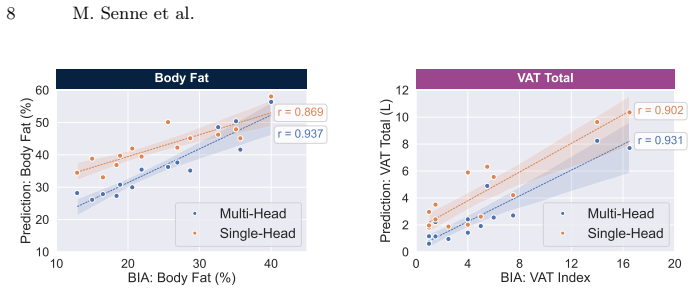
The paper demonstrates the feasibility of body composition assessment from millimeter wave radar scans by regressing visceral adipose tissue (VAT) volume and body fat percentage (BFP) using a multi-task learning model. Synthetic mmWave-like point clouds are created from CT/MRI data and parametric human models to train the system. When tested on real mmWave scans acquired in a standing posture through clothing and compared to bioimpedance measurements, the model achieves a mean absolute error of 1.0 L for VAT and 3.2% for BFP.
What carries the argument
A multi-task neural network regressor trained on synthetic mmWave point clouds to predict VAT and BFP from full-body scans.
Load-bearing premise
The synthetic mmWave-like point clouds derived from clinical imaging and parametric human models accurately represent the characteristics of real mmWave scans taken through clothing while standing.
What would settle it
A study with a larger cohort of participants providing both real mmWave scans and independent gold-standard measurements such as DEXA or MRI, where errors significantly exceed the reported 1.0 L and 3.2% would disprove the feasibility claim.
Figures

read the original abstract
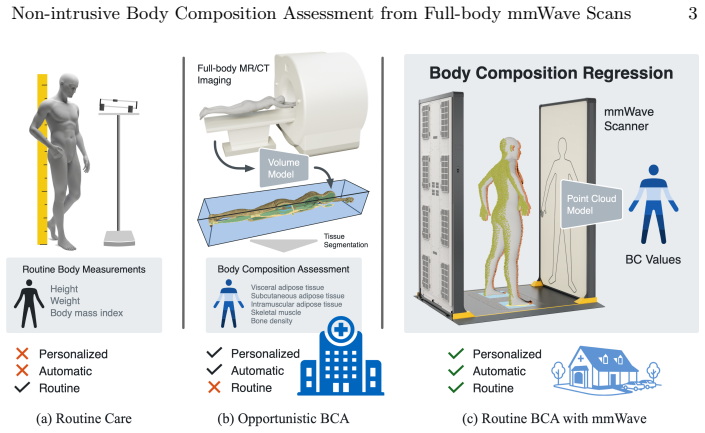
Body composition assessment (BCA) provides detailed information about the distribution of different tissue types in the body, enabling more precise characterization of individuals than BMI or weight alone. Consistent and frequent BCA would be valuable for personalized medicine, but the gold standard methods for BCA, such as CT and MRI, are only practical for opportunistic monitoring of patients with clinical indications for imaging and are not suitable for routine use in the general population. Here, we consider an imaging modality which is not currently used in medical applications: millimeter wave (mmWave) radar. Commonly used in security settings, mmWave scans enable fast, non-intrusive, and privacy-preserving reconstruction of full body shape without the need to remove clothing. To demonstrate the feasibility of fast and convenient BCA from mmWave scans, we present a method for BCA value regression using a multi-task learning strategy that leverages synthetic mmWave-like point clouds derived from clinical imaging and parametric human models. We evaluate the model on a pilot cohort of real mmWave scans with bioimpedance-derived body fat measurements, supporting the feasibility of estimating VAT and body fat percentage (BFP) from mmWave data acquired through clothing in a standing posture. We find that the model can predict VAT and BFP with a mean absolute error of 1.0 L and 3.2\%, respectively, demonstrating the potential of mmWave scanning for routine BCA in a wide range of settings.
Editorial analysis
A structured set of objections, weighed in public.
Referee Report
Summary. The paper claims that a multi-task regressor trained exclusively on synthetic mmWave-like point clouds (derived from CT/MRI scans and parametric human models) can predict visceral adipose tissue (VAT) volume and body fat percentage (BFP) from real full-body mmWave radar scans acquired through clothing, achieving mean absolute errors of 1.0 L and 3.2% respectively on a pilot cohort with bioimpedance ground truth, thereby demonstrating feasibility for routine non-intrusive body composition assessment.
Significance. If the synthetic-to-real transfer holds, the work could enable convenient, privacy-preserving BCA using existing security scanners, offering an alternative to CT/MRI for personalized medicine and population-level monitoring. The use of independent clinical sources for synthetic data generation is a strength that avoids circularity with the evaluation ground truth.
major comments (2)
- [Abstract] Abstract: The reported MAEs of 1.0 L for VAT and 3.2% for BFP are given without cohort size, error bars, statistical significance tests, or data exclusion criteria, which are required to evaluate whether the pilot results support the feasibility conclusion.
- [Evaluation] Evaluation section: No quantitative evidence (e.g., distribution distances, clothing attenuation modeling, point density statistics, or noise injection) is provided to validate that synthetic mmWave-like point clouds match the geometric and intensity characteristics of real scans through clothing in standing posture; this domain gap is load-bearing for the central claim of generalizable performance.
minor comments (1)
- [Abstract] Abstract: Consider specifying the pilot cohort size and any key limitations to better contextualize the reported errors.
Simulated Author's Rebuttal
We thank the referee for the constructive feedback, which helps clarify key aspects of our pilot study. We respond to each major comment below and indicate planned revisions.
read point-by-point responses
-
Referee: [Abstract] Abstract: The reported MAEs of 1.0 L for VAT and 3.2% for BFP are given without cohort size, error bars, statistical significance tests, or data exclusion criteria, which are required to evaluate whether the pilot results support the feasibility conclusion.
Authors: We agree that the abstract would benefit from additional context. The Evaluation section contains the cohort size, error bars, statistical details, and exclusion criteria. In the revised manuscript, we will update the abstract to include the pilot cohort size and a brief reference to these metrics and criteria from the main text. revision: yes
-
Referee: [Evaluation] Evaluation section: No quantitative evidence (e.g., distribution distances, clothing attenuation modeling, point density statistics, or noise injection) is provided to validate that synthetic mmWave-like point clouds match the geometric and intensity characteristics of real scans through clothing in standing posture; this domain gap is load-bearing for the central claim of generalizable performance.
Authors: This observation is fair. The synthetic data are generated using established physical models from clinical sources to approximate real mmWave characteristics, and generalization to real data provides supporting evidence. In revision, we will expand the Evaluation section with more details on the generation process (including point density and noise models) and add qualitative visualizations comparing synthetic and real scans. However, quantitative metrics such as distribution distances or explicit clothing attenuation modeling cannot be provided without paired data, which is unavailable in this pilot; we will note this limitation. revision: partial
- Quantitative validation of synthetic-to-real similarity (e.g., distribution distances, clothing attenuation modeling)
Circularity Check
No circularity detected; training on independent synthetic data and evaluation on separate real bioimpedance ground truth
full rationale
The derivation consists of training a multi-task regressor on synthetic mmWave-like point clouds generated from external clinical CT/MRI scans and parametric human models, then reporting MAE against independent bioimpedance measurements collected on a pilot set of real clothed standing mmWave scans. No equations, parameters, or predictions are defined in terms of the target outputs; no self-citations are used to justify uniqueness or load-bearing assumptions; the synthetic-to-real transfer is an empirical modeling choice whose validity is external to the reported numbers. The central claim therefore remains an independent empirical result rather than a self-referential reduction.
Axiom & Free-Parameter Ledger
axioms (1)
- domain assumption Synthetic mmWave-like point clouds derived from clinical imaging and parametric human models sufficiently approximate real mmWave scans through clothing
Reference graph
Works this paper leans on
-
[1]
IEEE microwave magazine13(6), 26–43 (2012)
Ahmed, S.S., Schiessl, A., Gumbmann, F., Tiebout, M., Methfessel, S., Schmidt, L.P.: Advanced microwave imaging. IEEE microwave magazine13(6), 26–43 (2012)
work page 2012
-
[2]
Anony- mous Journal (2026), https://www.example.com
Anonymous: Millimeter-wave Imaging for Anthropometric Measurement. Anony- mous Journal (2026), https://www.example.com
work page 2026
-
[3]
Bates, D.D.B., Pickhardt, P.J., Bates, D.D.B., Pickhardt, P.J.: CT-Derived Body Composition Assessment as a Prognostic Tool in Oncologic Patients: From Oppor- tunistic Research to Artificial Intelligence–Based Clinical Implementation. Am. J. Roentgenol. (Jun 2022). https://doi.org/10.2214/AJR.22.27749
-
[4]
Office of the Medical Investigator (2020)
Edgar, H., Daneshvari Berry, S., Moes, E., Adolphi, N.L., Bridges, P., Nolte, K.B.: New mexico decedent image database. Office of the Medical Investigator (2020)
work page 2020
-
[5]
In: Proceedings of the IEEE/CVF Conference on Computer Vision and Pattern Recognition
He, Y., Tiwari, G., Birdal, T., Lenssen, J.E., Pons-Moll, G.: Nrdf: Neural rieman- nian distance fields for learning articulated pose priors. In: Proceedings of the IEEE/CVF Conference on Computer Vision and Pattern Recognition. pp. 1661– 1671 (2024)
work page 2024
-
[6]
Standard, International Organization for Standardization, Geneva, CH (Mar 2017)
Part 1: Anthropometric definitions for body measurement. Standard, International Organization for Standardization, Geneva, CH (Mar 2017)
work page 2017
-
[7]
In: Proceedings of the IEEE/CVF Conference on Computer Vision and Pattern Recognition
Keller, M., Arora, V., Dakri, A., Chandhok, S., Machann, J., Fritsche, A., Black, M.J., Pujades, S.: Hit: Estimating internal human implicit tissues from the body surface. In: Proceedings of the IEEE/CVF Conference on Computer Vision and Pattern Recognition. pp. 3480–3490 (2024)
work page 2024
-
[8]
Killeen, B.D., Wan, B., Kulkarni, A.V., Drenkow, N., Oberst, M., Yi, P.H., Un- berath, M.: Towards Virtual Clinical Trials of Radiology AI with Conditional Gen- erative Modeling. arXiv (Feb 2025). https://doi.org/10.48550/arXiv.2502.09688
-
[9]
NPJ digital medicine5(1), 105 (2022)
Klarqvist, M.D., Agrawal, S., Diamant, N., Ellinor, P.T., Philippakis, A., Ng, K., Batra,P.,Khera,A.V.:Silhouetteimagesenableestimationofbodyfatdistribution and associated cardiometabolic risk. NPJ digital medicine5(1), 105 (2022)
work page 2022
-
[10]
In: Proceedings of the IEEE/CVF conference on computer vision and pattern recog- nition
Liu, S., Johns, E., Davison, A.J.: End-to-end multi-task learning with attention. In: Proceedings of the IEEE/CVF conference on computer vision and pattern recog- nition. pp. 1871–1880 (2019)
work page 2019
-
[11]
Loper,M.,Mahmood,N.,Romero,J.,Pons-Moll,G.,Black,M.J.:SMPL:askinned multi-person linear model. ACM Trans. Graph.34(6), 1–16 (Aug 2023). https: //doi.org/10.1145/2816795.2818013
-
[12]
In: Proceedings of the IEEE/CVF International Conference on Computer Vision
Mihajlovic, M., Zhang, S., Li, G., Zhao, K., Muller, L., Tang, S.: Volumetricsmpl: A neural volumetric body model for efficient interactions, contacts, and collisions. In: Proceedings of the IEEE/CVF International Conference on Computer Vision. pp. 5060–5070 (2025) 10 M. Senne et al
work page 2025
-
[13]
In: International workshop on shape in medical imag- ing
Mueller, T.T., Zhou, S., Starck, S., Jungmann, F., Ziller, A., Aksoy, O., Movchan, D., Braren, R., Kaissis, G., Rueckert, D.: Body fat estimation from surface meshes using graph neural networks. In: International workshop on shape in medical imag- ing. pp. 105–117. Springer (2023)
work page 2023
-
[14]
Pavlakos, G., Choutas, V., Ghorbani, N., Bolkart, T., Osman, A.A.A., Tzionas, D., Black, M.J.: Expressive body capture: 3d hands, face, and body from a single image. In: Proceedings IEEE Conf. on Computer Vision and Pattern Recognition (CVPR) (2019)
work page 2019
-
[15]
Radiographics (Mar 2021), https://pubs.rsna.org/doi/abs/10.1148/rg.2021200056
Pickhardt, P.J., Graffy, P.M., Perez, A.A., Lubner, M.G., Elton, D.C., Summers, R.M.: Opportunistic Screening at Abdominal CT: Use of Automated Body Com- position Biomarkers for Added Cardiometabolic Value. Radiographics (Mar 2021), https://pubs.rsna.org/doi/abs/10.1148/rg.2021200056
-
[16]
Quirino-Vela, L., Mayoral-Chavez, M., Pérez-Cervera, Y., Ildefonso-García, O., Cruz-Altamirano, E., Ruiz-García, M., Alpuche, J.: Cardiometabolic risk assess- ment by anthropometric and biochemical indices in mexican population. Front. Endocrinol.16, 1588469 (Jul 2025). https://doi.org/10.3389/fendo.2025.1588469
-
[17]
Tanita Europe B.V.: Tanita RD-545HR. Tanita Europe B.V., Amsterdam, Nether- lands (2021), https://tanita.de/rd-545hr, dual-frequency segmental bioelectrical impedance analyzer with heart rate monitoring
work page 2021
-
[18]
Tewari, N., Awad, S., Macdonald, I.A., Lobo, D.N.: A comparison of three methods to assess body composition. Nutrition47, 1–5 (Mar 2018). https://doi.org/10. 1016/j.nut.2017.09.005
work page 2018
-
[19]
TotalSegmentator: Robust Segmentation of 104 Anatomic Structures in CT Images
Wasserthal, J., Breit, H.C., Meyer, M.T., Pradella, M., Hinck, D., Sauter, A.W., Heye, T., Boll, D.T., Cyriac, J., Yang, S., Bach, M., Segeroth, M.: TotalSegmenta- tor: Robust Segmentation of 104 Anatomic Structures in CT Images. Radiology: Artificial Intelligence (Jul 2023), https://pubs.rsna.org/doi/10.1148/ryai.230024
-
[20]
In: Proceedings of the IEEE/CVF conference on computer vision and pattern recognition
Wu, X., Jiang, L., Wang, P.S., Liu, Z., Liu, X., Qiao, Y., Ouyang, W., He, T., Zhao, H.: Point transformer v3: Simpler faster stronger. In: Proceedings of the IEEE/CVF conference on computer vision and pattern recognition. pp. 4840–4851 (2024)
work page 2024
-
[21]
IEEE Journal of Biomedical and Health Informatics29(2), 848–856 (2024)
Zheng, Y., Long, Z., Feng, B., Cheng, R., Vaziri, K., Hahn, J.K.: D3bt: Dynamic 3d body transformer for body fat percentage assessment. IEEE Journal of Biomedical and Health Informatics29(2), 848–856 (2024)
work page 2024
discussion (0)
Sign in with ORCID, Apple, or X to comment. Anyone can read and Pith papers without signing in.