Recognition: 2 theorem links
· Lean TheoremOptimal FALQON for Quantum Approximate Optimization via Layer-wise Parameter Tuning
Pith reviewed 2026-05-12 01:03 UTC · model grok-4.3
The pith
Optimizing per-layer time steps and scaling factors in FALQON improves success probability and efficiency for combinatorial optimization on quantum devices.
A machine-rendered reading of the paper's core claim, the machinery that carries it, and where it could break.
Core claim
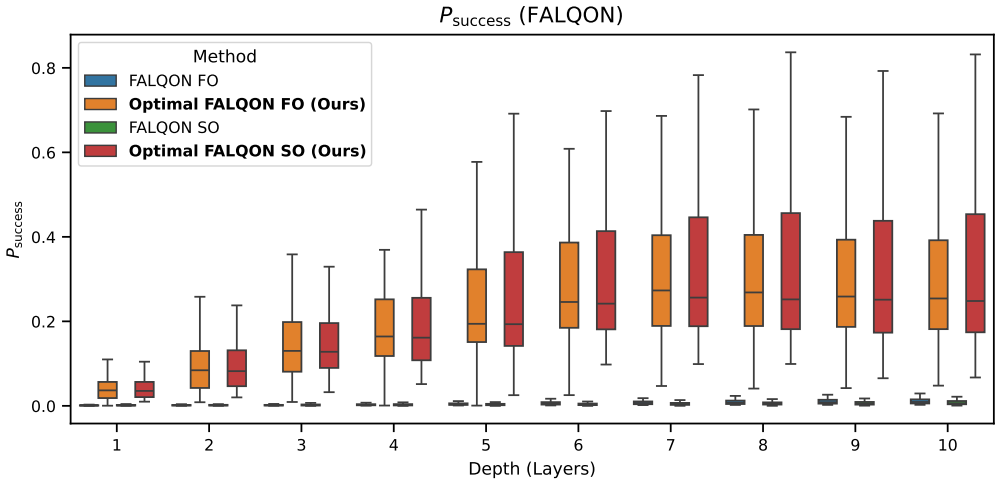
Optimal FALQON formulates the per-layer parameters δ_k and M_k as decision variables that are optimized classically at each step, leading to faster convergence and higher success probabilities than fixed-parameter FALQON on small 3-regular graphs.
What carries the argument
The layer-wise classical optimization of the time step δ_k and scaling factor M_k, which replaces the fixed hyperparameters of standard FALQON.
Load-bearing premise
That the classical optimization of per-layer parameters remains computationally feasible and that performance gains observed on 12-vertex graphs will hold for larger or different problem instances.
What would settle it
Observing whether the success probability improvements persist when applied to graphs with 20 or more vertices, or whether the classical optimization time exceeds the quantum evaluation savings.
Figures




read the original abstract
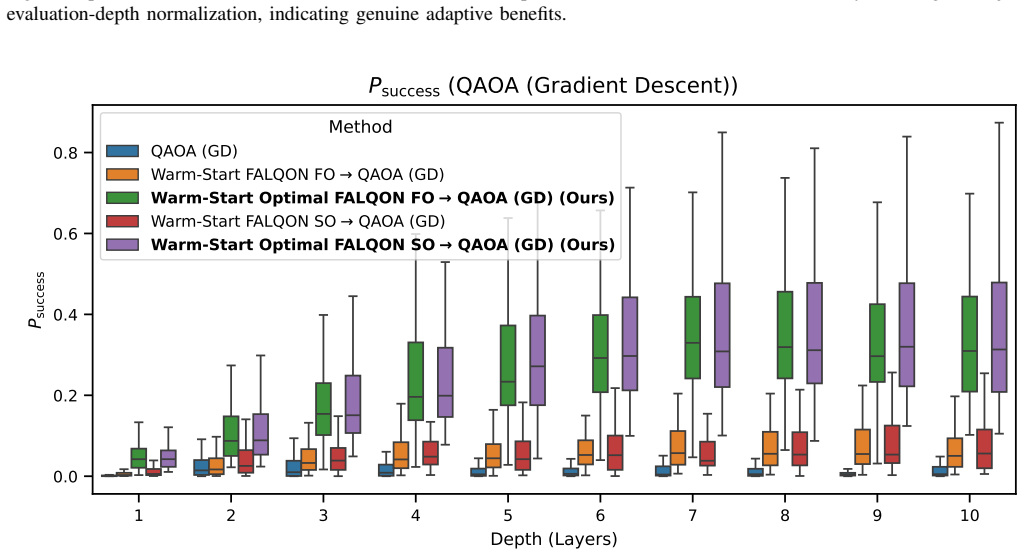
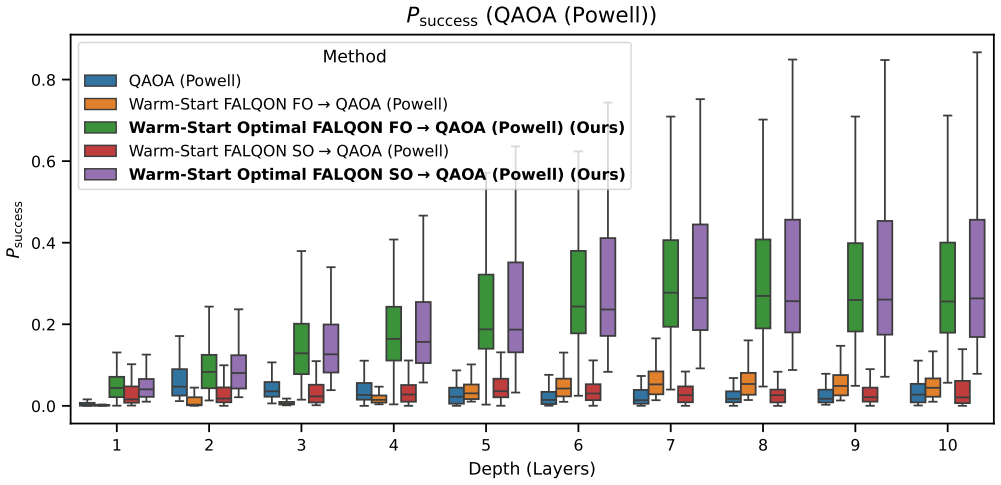
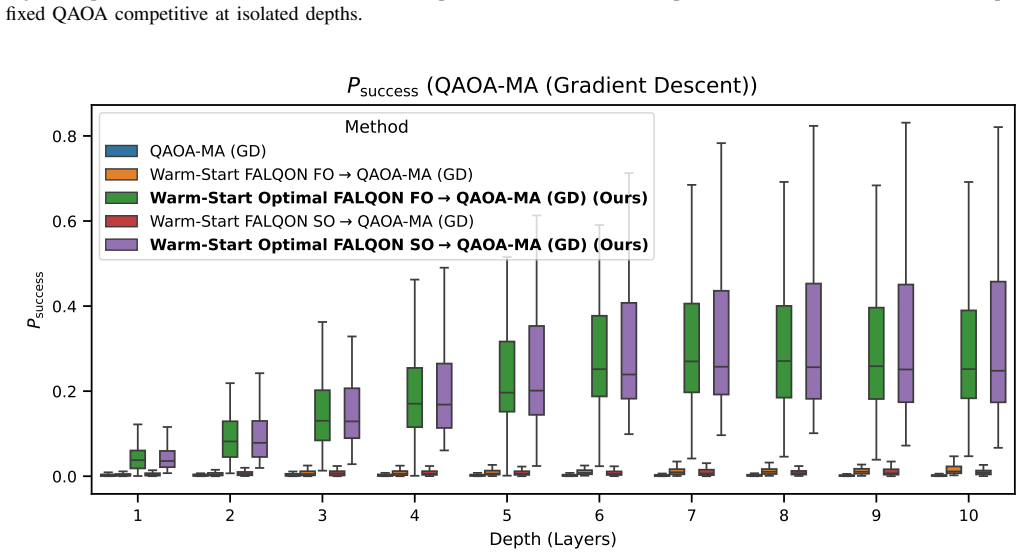
Feedback-based adaptive quantum optimization (FALQON) is a promising approach for solving combinatorial problems on noisy intermediate-scale quantum (NISQ) devices, requiring only single circuit evaluations per layer. However, standard FALQON relies on fixed hyperparameters that severely limit convergence speed, requiring hundreds to thousands of layers for acceptable solutions. This paper proposes Optimal FALQON, an optimization-based formulation that treats the per-layer time step ($\delta_k$) and scaling factor ($M_k$) as decision variables optimized via classical methods. We present a comprehensive empirical study on all 94 non-isomorphic 3-regular graphs with 12 vertices, comparing Optimal FALQON with standard FALQON and multiple QAOA variants. Results demonstrate statistically significant improvements in success probability, evaluation efficiency, and depth-normalized cost across the evaluated benchmarks. Furthermore, initializing QAOA with parameters from Optimal FALQON yields superior warm-start performance compared to fixed initialization.
Editorial analysis
A structured set of objections, weighed in public.
Referee Report
Summary. The manuscript introduces Optimal FALQON, which treats the per-layer time step δ_k and scaling factor M_k as decision variables optimized by classical methods rather than using the fixed hyperparameters of standard FALQON. It reports a comprehensive empirical comparison on all 94 non-isomorphic 3-regular graphs with 12 vertices, claiming statistically significant gains in success probability, evaluation efficiency, and depth-normalized cost versus standard FALQON and several QAOA variants. It further shows that parameters obtained from Optimal FALQON provide superior warm-start initialization for QAOA relative to fixed initialization.
Significance. If the empirical gains survive a full accounting of classical optimization overhead, the work could improve the layer efficiency of feedback-based quantum optimization on NISQ hardware. The exhaustive benchmark over the complete set of 12-vertex 3-regular graphs is a clear strength, enabling definitive within-class comparisons. The QAOA warm-start result is a useful byproduct. Broader significance is constrained by the small instance size and the absence of scaling data or net-cost analysis.
major comments (3)
- [§3] §3 (Optimal FALQON formulation): the classical optimizer used to tune δ_k and M_k per layer necessarily incurs multiple cost-function evaluations; the manuscript provides no count of total quantum circuit calls (including optimizer iterations) and therefore cannot substantiate the abstract claim of improved evaluation efficiency relative to standard FALQON's single evaluation per layer.
- [§4] §4 (empirical study): all reported results are confined to 12-vertex graphs; because the central efficiency and generalization claims rest on the assumption that classical tuning overhead remains modest at larger sizes, the manuscript must either demonstrate scaling behavior or explicitly bound the regime in which the reported gains are expected to hold.
- [§4.3] §4.3 (statistical claims): the abstract asserts 'statistically significant' improvements, yet the text does not specify the exact hypothesis test, correction for multiple comparisons, or effect-size reporting used to support this statement; without these details the strength of the empirical evidence cannot be evaluated.
minor comments (2)
- [§2] The definition and normalization procedure for 'depth-normalized cost' should be stated explicitly in §2 or §3 rather than introduced only in the results tables.
- [Figures 2-4] Figure captions and axis labels for the success-probability and efficiency plots should include the exact number of independent runs and random seeds used.
Simulated Author's Rebuttal
We thank the referee for the thorough and constructive review of our manuscript. We address each major comment in detail below and indicate the revisions we plan to make.
read point-by-point responses
-
Referee: §3 (Optimal FALQON formulation): the classical optimizer used to tune δ_k and M_k per layer necessarily incurs multiple cost-function evaluations; the manuscript provides no count of total quantum circuit calls (including optimizer iterations) and therefore cannot substantiate the abstract claim of improved evaluation efficiency relative to standard FALQON's single evaluation per layer.
Authors: We agree with the referee that the total quantum circuit calls, including those from the classical optimizer's iterations, were not quantified in the original manuscript. This is an important point for a fair efficiency comparison. In the revised manuscript, we will add a section or subsection detailing the number of quantum circuit evaluations required by the classical optimization procedure for tuning δ_k and M_k. We will report the average and maximum number of cost function evaluations across the benchmarks and use this to substantiate or qualify the claims of improved evaluation efficiency. Additionally, we will clarify that 'evaluation efficiency' refers to the quantum resources needed to reach a target success probability. revision: yes
-
Referee: §4 (empirical study): all reported results are confined to 12-vertex graphs; because the central efficiency and generalization claims rest on the assumption that classical tuning overhead remains modest at larger sizes, the manuscript must either demonstrate scaling behavior or explicitly bound the regime in which the reported gains are expected to hold.
Authors: We acknowledge the limitation of our study to 12-vertex graphs, which was chosen to enable an exhaustive comparison over all non-isomorphic instances. While we cannot provide new scaling experiments in this revision, we will explicitly bound the regime by discussing the expected growth of the classical optimization overhead. Specifically, we will note that for graphs where the optimal number of layers remains small (as observed in our results), the overhead is modest, and provide a rough estimate based on the dimensionality of the parameter space. We will also emphasize that the primary contribution is the within-class comparison for this size and flag scaling as future work. revision: partial
-
Referee: §4.3 (statistical claims): the abstract asserts 'statistically significant' improvements, yet the text does not specify the exact hypothesis test, correction for multiple comparisons, or effect-size reporting used to support this statement; without these details the strength of the empirical evidence cannot be evaluated.
Authors: We thank the referee for highlighting this omission. In the revised manuscript, we will provide the missing statistical details. We will specify the exact hypothesis test(s) used, any corrections applied for multiple comparisons, and include effect-size reporting to support the statistical significance claims. revision: yes
Circularity Check
No significant circularity in derivation chain
full rationale
The paper proposes Optimal FALQON by treating per-layer δ_k and M_k as classically optimizable decision variables, then reports empirical performance gains versus standard FALQON and QAOA on a fixed set of 94 graphs. No derivation step equates a claimed result to its own inputs by construction, no fitted parameter is relabeled as a prediction, and no load-bearing premise reduces to a self-citation chain. The central claims are measured outcomes of an algorithmic variant, not tautological reductions from the quantum circuit equations themselves.
Axiom & Free-Parameter Ledger
axioms (1)
- domain assumption Standard quantum circuit model and NISQ noise assumptions hold for the tested circuit depths
Lean theorems connected to this paper
-
IndisputableMonolith/Foundation/RealityFromDistinction.leanreality_from_one_distinction unclear?
unclearRelation between the paper passage and the cited Recognition theorem.
Optimal FALQON: An optimization-based formulation treating the per-layer time step δ_k and scaling term M_k as decision variables, optimized via the Powell method... on all 94 non-isomorphic 3-regular graphs with N=12 vertices.
-
IndisputableMonolith/Cost/FunctionalEquation.leanwashburn_uniqueness_aczel unclear?
unclearRelation between the paper passage and the cited Recognition theorem.
Costk(δk, Mk) = ⟨ψ_k(δk, Mk)|Hp|ψk(δk, Mk)⟩
What do these tags mean?
- matches
- The paper's claim is directly supported by a theorem in the formal canon.
- supports
- The theorem supports part of the paper's argument, but the paper may add assumptions or extra steps.
- extends
- The paper goes beyond the formal theorem; the theorem is a base layer rather than the whole result.
- uses
- The paper appears to rely on the theorem as machinery.
- contradicts
- The paper's claim conflicts with a theorem or certificate in the canon.
- unclear
- Pith found a possible connection, but the passage is too broad, indirect, or ambiguous to say the theorem truly supports the claim.
Reference graph
Works this paper leans on
-
[1]
A variational eigenvalue solver on a photonic quantum processor,
A. Peruzzo, J. McClean, P. Shadbolt, M.-H. Yung, X.-Q. Zhou, P. J. Love, A. Aspuru-Guzik, and J. L. O’Brien, “A variational eigenvalue solver on a photonic quantum processor,”Nature Communications, vol. 5, p. 4213, 2014. [Online]. Available: https://doi.org/10.1038/ ncomms5213
work page 2014
-
[2]
The theory of variational hybrid quantum-classical algorithms,
J. R. McClean, J. Romero, R. Babbush, and A. Aspuru-Guzik, “The theory of variational hybrid quantum-classical algorithms,”New Journal of Physics, vol. 18, p. 023023, 2016. [Online]. Available: https://doi.org/10.1088/1367-2630/18/2/023023
-
[3]
A Quantum Approximate Optimization Algorithm
E. Farhi, J. Goldstone, and S. Gutmann, “A quantum approximate optimization algorithm,”arXiv preprint arXiv:1411.4028, 2014. [Online]. Available: https://arxiv.org/abs/1411.4028
work page internal anchor Pith review Pith/arXiv arXiv 2014
-
[4]
Feedback-based quantum optimization,
A. B. Magann, K. M. Rudinger, M. D. Grace, and M. Sarovar, “Feedback-based quantum optimization,”Physical Review Letters, vol. 129, p. 250502, 2022. [Online]. Available: https://doi.org/10.1103/ PhysRevLett.129.250502
work page 2022
-
[5]
Stochastic properties of the frequency dynamics in real and synthetic power grids,
D. Arai, K. N. Okada, Y . Nakano, K. Mitarai, and K. Fujii, “Scalable circuit depth reduction in feedback-based quantum optimization with a quadratic approximation,”Physical Review Research, vol. 7, p. 013035, Jan 2025. [Online]. Available: https://doi.org/10.1103/PhysRevResearch. 7.013035
-
[6]
F. Arute, K. Arya, R. Babbushet al., “Quantum supremacy using a programmable superconducting processor,”Nature, vol. 574, no. 7779, pp. 505–510, 2019. [Online]. Available: https: //doi.org/10.1038/s41586-019-1666-5
-
[7]
Superconducting qubits: Current state of play,
M. Kjaergaard, M. E. Schwartz, J. Braum ¨uller, P. Krantz, J. I.- J. Wang, S. Gustavsson, and W. D. Oliver, “Superconducting qubits: Current state of play,”Annual Review of Condensed Matter Physics, vol. 11, no. 1, pp. 369–395, 2020. [Online]. Available: https://doi.org/10.1146/annurev-conmatphys-031119-050605
-
[8]
IBM Research, “Ibm quantum services,” https://www.ibm.com/quantum, 2025, accessed: January 24, 2026
work page 2025
-
[9]
Amazon Web Services, “Amazon braket pricing,” https://aws.amazon. com/braket/pricing/, 2026, accessed: January 24, 2026
work page 2026
-
[10]
Accelerating feedback-based quantum algorithms through time rescaling,
L. A. M. Rattighieri, G. E. L. Pexe, B. L. Bernardo, and F. F. Fanchini, “Accelerating feedback-based quantum algorithms through time rescaling,”Physical Review A, vol. 112, p. 042607, 2025. [Online]. Available: https://doi.org/10.1103/qc91-5mj2
-
[11]
Robust feedback-based quantum optimization: analysis of coherent control errors,
M. Legnini and J. Berberich, “Robust feedback-based quantum optimization: analysis of coherent control errors,” in2025 IEEE International Conference on Quantum Control, Computing and Learning (qCCL), 2025, pp. 17–22. [Online]. Available: https: //doi.org/10.1109/qCCL65142.2025.11158422
-
[12]
PennyLane: Automatic differentiation of hybrid quantum-classical computations
V . Bergholm, J. Izaac, M. Schuld, C. Gogolin, C. Blank, K. McK- iernan, and N. Killoran, “Pennylane: Automatic differentiation of hy- brid quantum-classical computations,”arXiv preprint arXiv:1811.04968, 2018
work page internal anchor Pith review Pith/arXiv arXiv 2018
-
[13]
D. J. Griffiths and D. F. Schroeter,Introduction to Quantum Mechanics, 3rd ed. Cambridge University Press, 2018
work page 2018
-
[14]
Low-depth clifford circuits approximately solve maxcut,
M. H. M. noz Arias, S. Kourtis, and A. Blais, “Low-depth clifford circuits approximately solve maxcut,”Physical Review Research, vol. 6, p. 023294, 2024. [Online]. Available: https: //doi.org/10.1103/PhysRevResearch.6.023294
-
[15]
Multi-angle quantum approximate optimization algorithm,
R. Herrman, P. C. Lotshaw, J. Ostrowski, T. S. Humble, and G. Siopsis, “Multi-angle quantum approximate optimization algorithm,” Scientific Reports, vol. 12, p. 6781, 2022. [Online]. Available: https://doi.org/10.1038/s41598-022-10555-8
-
[16]
The Sage Developers,SageMath, the Sage Mathematics Software System (Version 9.5), 2022,https://www.sagemath.org
work page 2022
-
[17]
B. D. McKay, “Practical graph isomorphism,”Congressus Numerantium, vol. 30, pp. 45–87, 1981, version 2.7: https://pallini.di.uniroma1.it/
work page 1981
-
[18]
M. J. D. Powell, “An efficient method for finding the minimum of a function of several variables without calculating derivatives,”The Computer Journal, vol. 7, no. 2, pp. 155–162, 1964
work page 1964
-
[19]
A comparison of various classical optimizers for a variational quantum linear solver,
M. A. Alam, S. Ghosh, T. S. Humble, and N. Imam, “A comparison of various classical optimizers for a variational quantum linear solver,” arXiv preprint arXiv:2106.08682, 2021
-
[20]
Warm-starting quantum optimization,
D. J. Egger, J. Mare ˇcek, and S. Woerner, “Warm-starting quantum optimization,”Quantum, vol. 5, p. 479, jun 2021. [Online]. Available: https://doi.org/10.22331/q-2021-06-17-479
-
[21]
Quantum annealing initialization of the quantum approximate optimization algorithm,
S. H. Sack and M. Serbyn, “Quantum annealing initialization of the quantum approximate optimization algorithm,”Quantum, vol. 5, p. 491, jul 2021. [Online]. Available: https://doi.org/10.22331/ q-2021-07-01-491
work page 2021
-
[22]
Lyapunov control-inspired strategies for quantum combinatorial optimization,
A. B. Magann, K. M. Rudinger, M. D. Grace, and M. Sarovar, “Lyapunov control-inspired strategies for quantum combinatorial optimization,”Physical Review A, vol. 106, p. 062414, 2022. [Online]. Available: https://doi.org/10.1103/PhysRevA.106.062414
-
[23]
Lyapunov-based control of quantum systems,
S. Grivopoulos and B. Bamieh, “Lyapunov-based control of quantum systems,” inProceedings of the 42nd IEEE Conference on Decision and Control, vol. 1. Maui, HI, USA: IEEE, dec 2003, pp. 434–438
work page 2003
-
[24]
Individual comparisons by ranking methods,
F. Wilcoxon, “Individual comparisons by ranking methods,”Biometrics Bulletin, vol. 1, no. 6, pp. 80–83, 1945
work page 1945
-
[25]
M. Hollander, D. A. Wolfe, and E. Chicken,Nonparametric Statistical Methods, 3rd ed. Wiley, 2013
work page 2013
-
[26]
A simple sequentially rejective multiple test procedure,
S. Holm, “A simple sequentially rejective multiple test procedure,” Scandinavian Journal of Statistics, vol. 6, pp. 65–70, 1979
work page 1979
-
[27]
A simplex method for function minimiza- tion,
J. A. Nelder and R. Mead, “A simplex method for function minimiza- tion,”The Computer Journal, vol. 7, no. 4, pp. 308–313, 1965
work page 1965
-
[28]
M. J. D. Powell, “A direct search optimization method that models the objective and constraint functions by linear interpolation,” inAdvances in Optimization and Numerical Analysis. Springer, 1994, pp. 51–67
work page 1994
-
[29]
The Scipy community,Scipy Lecture Notes, https: //scipy-lectures.org/advanced/mathematical optimization/, 2023, https://scipy-lectures.org/
work page 2023
discussion (0)
Sign in with ORCID, Apple, or X to comment. Anyone can read and Pith papers without signing in.