Recognition: no theorem link
You Shall Not Pass (Without Modeling): High-Resolution Analysis of KMT-2019-BLG-0253 using MORIA
Pith reviewed 2026-05-12 01:05 UTC · model grok-4.3
The pith
The MORIA pipeline automates HST image reduction and fitting to measure host and planet masses in microlensing events.
A machine-rendered reading of the paper's core claim, the machinery that carries it, and where it could break.
Core claim
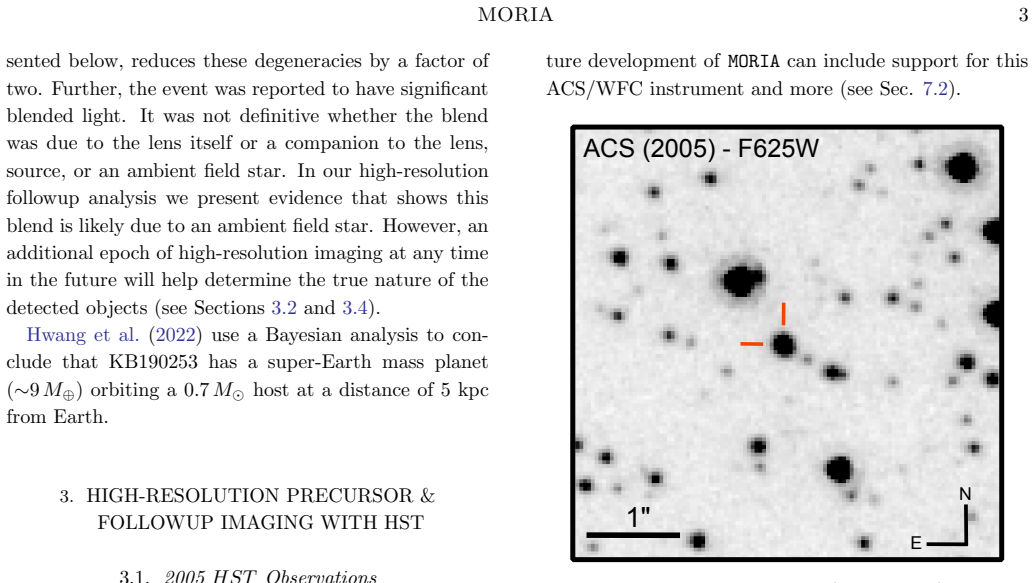
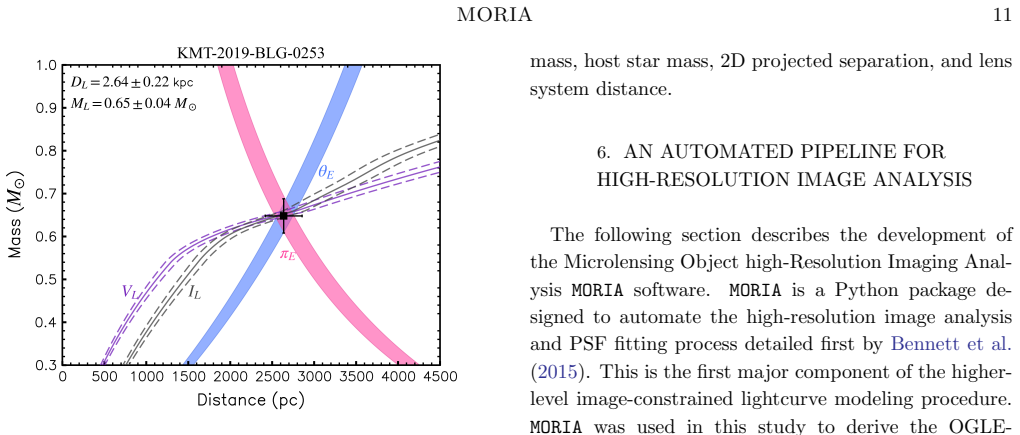
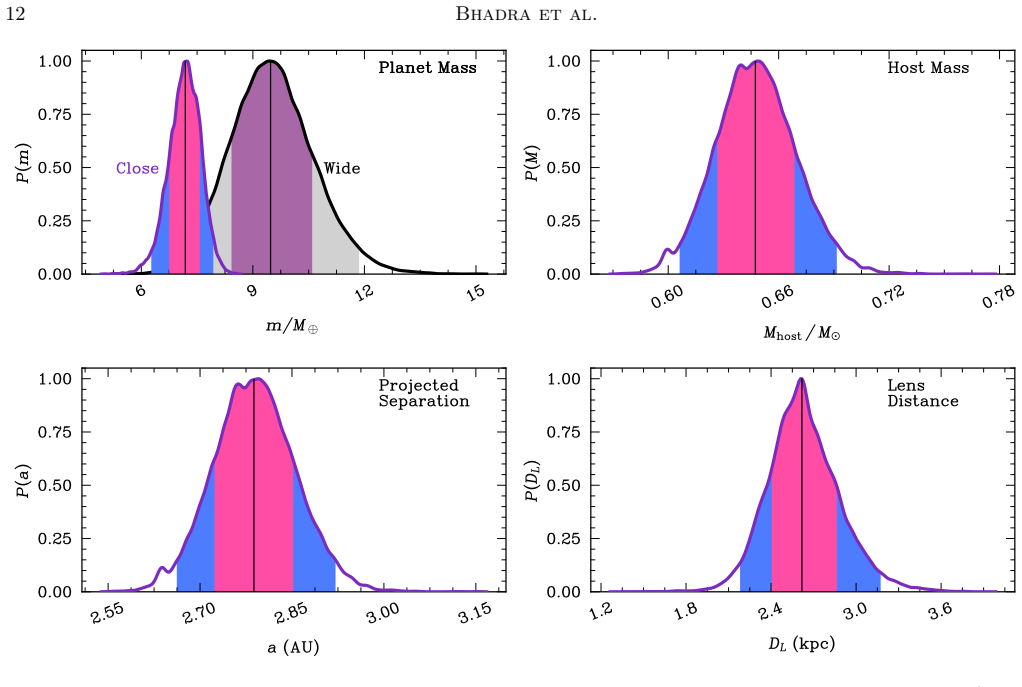
The authors present the Microlensing Object high-Resolution Imaging Analysis pipeline, or MORIA. This is an automated procedure to reduce high-resolution HST images of microlensing targets, build empirical point-spread function models from the data, and perform simultaneous multi-star PSF fitting to blended sources, lenses, and neighbor stars. Tested on KMT-2019-BLG-0253, MORIA determines a host mass of 0.65 plus or minus 0.04 solar masses, reduces the number of possible solutions by a factor of two with the remaining solution subject to the close-wide degeneracy, a planet mass of 7.18 plus or minus 0.40 Earth masses in the close case or 9.48 plus or minus 1.13 Earth masses in the wide case,
What carries the argument
The MORIA pipeline, an automated procedure that reduces HST images, constructs empirical point-spread function models from the observations themselves, and performs simultaneous multi-star PSF fitting to separate the blended lens, source, and neighbor stars.
Where Pith is reading between the lines
- MORIA could be applied to archival HST observations of other microlensing events to resolve degeneracies in their light-curve solutions.
- The data-driven approach to PSF modeling may be adapted to high-resolution data from other telescopes or future instruments.
- Systematic application of the pipeline across many events could reveal statistical patterns in planet-host mass ratios that are currently hidden by degeneracies.
Load-bearing premise
The empirical PSF models constructed from the HST data accurately capture the true point-spread function and allow unbiased simultaneous fitting of the blended lens, source, and neighbor stars without significant systematic residuals.
What would settle it
An independent mass or distance measurement for the same lens system, obtained through long-baseline astrometry or spectroscopy, that differs from 0.65 solar masses or 2.64 kiloparsecs would falsify the reliability of the MORIA-derived parameters.
Figures



read the original abstract
We present the Microlensing Object high-Resolution Imaging Analysis pipeline, or MORIA. This is an automated procedure to reduce high-resolution HST images of microlensing targets, build empirical point-spread function models from the data, and perform simultaneous multi-star PSF fitting to blended sources, lenses, and neighbor stars. We have developed and tested this pipeline using HST observations of the microlensing event KMT-2019-BLG-0253, where we determine a host mass of $M_{host} = 0.65 \pm 0.04M_{\odot}$. We have reduced the number of possible solutions for this target by a factor of two, with the remaining solution subject to the well-known close-wide degeneracy. We determine a planet mass of $m_{p} = 7.18 \pm 0.40 M_{\oplus}$ (close) or $m_{p} = 9.48 \pm 1.13 M_{\oplus}$ (wide), and distance to the lens system of $D_L= 2.64 \pm 0.22$ kpc. This work demonstrates the importance of using an automated high resolution imaging tool to inform light curve modeling for microlensing planets found during the upcoming Nancy Grace Roman Galactic Bulge Time Domain Survey (GBTDS).
Editorial analysis
A structured set of objections, weighed in public.
Referee Report
Summary. The manuscript introduces the MORIA pipeline, an automated procedure for reducing HST images of microlensing events, constructing empirical PSF models from the data, and performing simultaneous multi-star PSF fitting to deblend the lens, source, and neighbors. Applied to KMT-2019-BLG-0253, the pipeline yields a host mass of 0.65 ± 0.04 M_⊙, reduces the number of viable solutions by a factor of two (leaving the close-wide degeneracy), planet masses of 7.18 ± 0.40 M_⊕ (close) or 9.48 ± 1.13 M_⊕ (wide), and a lens distance of 2.64 ± 0.22 kpc. The work positions the pipeline as a tool to inform light-curve modeling for the upcoming Roman GBTDS.
Significance. If the PSF modeling and deblending steps are shown to be unbiased, the pipeline would provide a reproducible, automated route to physical parameters (masses and distances) for microlensing planets by directly measuring lens flux and relative proper motion from high-resolution imaging. This addresses a key limitation in ground-based microlensing surveys and would be particularly valuable for the expected volume of Roman events. The concrete application to KMT-2019-BLG-0253 supplies a worked example with reported uncertainties.
major comments (3)
- [§3] §3 (empirical PSF construction and simultaneous multi-star fit): The central results (host mass, planet masses, D_L, and factor-of-two reduction in solutions) are obtained by converting the measured lens flux and proper motion from the blended fit. No quantitative validation is presented (e.g., residual maps after subtraction, χ² per degree of freedom for the multi-star model, or injection-recovery tests with simulated lenses at the reported separation and flux ratio). Without these, it is impossible to confirm that systematic residuals from focus breathing, CTE, or color terms are smaller than the quoted ±0.04 M_⊙ uncertainty on M_host.
- [Abstract and §4] Abstract and §4 (combination with light-curve modeling): The factor-of-two reduction in solutions and the final planet-mass values are stated to result from joint use of the HST-derived lens flux/proper motion with the light curve. The manuscript provides no explicit description or table showing how the imaging constraints are folded into the light-curve parameter space (e.g., prior on θ_E or π_E, or updated posterior after adding the HST data). This step is load-bearing for the claimed reduction in degeneracies.
- [Results section] Error budget (throughout results section): The reported uncertainties on M_host, m_p, and D_L are given without a breakdown separating statistical errors from potential systematic contributions arising from the empirical PSF model or from the conversion of lens flux to mass. This omission prevents assessment of whether the quoted precisions are realistic given the weakest assumption identified in the analysis.
minor comments (3)
- [Figures] Figure 2 (or equivalent showing the multi-star fit): The residual image after PSF subtraction should be displayed with the same stretch as the data to allow visual inspection of any correlated residuals near the lens position.
- [Abstract] Notation: The symbols M_host and m_p are used without an initial definition in the abstract; a brief parenthetical clarification on first use would improve readability.
- [Introduction] References: The manuscript would benefit from citing at least one prior microlensing paper that performed similar HST deblending (e.g., on the close-wide degeneracy or lens-flux measurements) to place the MORIA results in context.
Simulated Author's Rebuttal
We thank the referee for the constructive and detailed comments, which have helped us identify areas where the manuscript can be strengthened. We address each major comment below and will incorporate the suggested improvements in the revised version.
read point-by-point responses
-
Referee: §3 (empirical PSF construction and simultaneous multi-star fit): The central results (host mass, planet masses, D_L, and factor-of-two reduction in solutions) are obtained by converting the measured lens flux and proper motion from the blended fit. No quantitative validation is presented (e.g., residual maps after subtraction, χ² per degree of freedom for the multi-star model, or injection-recovery tests with simulated lenses at the reported separation and flux ratio). Without these, it is impossible to confirm that systematic residuals from focus breathing, CTE, or color terms are smaller than the quoted ±0.04 M_⊙ uncertainty on M_host.
Authors: We agree that quantitative validation of the PSF modeling and deblending is important to support the claimed precision. In the revised manuscript, we will add residual maps after multi-star subtraction, report the χ² per degree of freedom for the fits, and include injection-recovery tests with simulated lenses at the observed separation and flux ratio. These will quantify potential systematics from focus breathing, CTE, and color terms, confirming they are subdominant to the reported uncertainties on M_host. revision: yes
-
Referee: Abstract and §4 (combination with light-curve modeling): The factor-of-two reduction in solutions and the final planet-mass values are stated to result from joint use of the HST-derived lens flux/proper motion with the light curve. The manuscript provides no explicit description or table showing how the imaging constraints are folded into the light-curve parameter space (e.g., prior on θ_E or π_E, or updated posterior after adding the HST data). This step is load-bearing for the claimed reduction in degeneracies.
Authors: We acknowledge that the manuscript does not explicitly detail how the HST constraints are combined with the light-curve modeling. In the revision, we will add a clear description of this process, specifying the priors on θ_E and π_E derived from the HST lens flux and proper motion, along with a table or figure comparing the light-curve posteriors before and after incorporating the imaging data. This will demonstrate the origin of the factor-of-two reduction in viable solutions. revision: yes
-
Referee: Error budget (throughout results section): The reported uncertainties on M_host, m_p, and D_L are given without a breakdown separating statistical errors from potential systematic contributions arising from the empirical PSF model or from the conversion of lens flux to mass. This omission prevents assessment of whether the quoted precisions are realistic given the weakest assumption identified in the analysis.
Authors: We agree that a transparent error budget is needed to evaluate the realism of the quoted precisions. We will revise the results section to provide a detailed breakdown separating statistical uncertainties from systematic contributions due to the empirical PSF model and the lens flux-to-mass conversion. This will identify the dominant error sources and support the reported values. revision: yes
Circularity Check
No circularity: direct empirical fitting of HST data yields masses and distance
full rationale
The paper describes an automated pipeline (MORIA) that constructs empirical PSF models from HST frames and performs simultaneous multi-star fitting to extract lens flux and relative proper motion for KMT-2019-BLG-0253. These fitted quantities are then converted to physical parameters (M_host, m_p, D_L) via standard microlensing mass-distance relations that are external to the fit. No equation in the provided text defines a derived quantity in terms of itself or renames a fitted parameter as a 'prediction.' No self-citation chain or uniqueness theorem is invoked to justify the central results. The analysis is self-contained against the image data and light-curve constraints.
Axiom & Free-Parameter Ledger
free parameters (4)
- Host star mass =
0.65 M_sun
- Planet mass (close solution) =
7.18 M_earth
- Planet mass (wide solution) =
9.48 M_earth
- Lens distance =
2.64 kpc
axioms (2)
- domain assumption Standard microlensing light-curve modeling assumptions, including the existence of the close-wide degeneracy, remain valid when combined with high-resolution imaging.
- domain assumption Empirical PSF models built from the HST data can be used for unbiased simultaneous multi-star fitting of blended lens, source, and neighbor stars.
Reference graph
Works this paper leans on
-
[1]
Exoplanet Occurrence Rates from Microlensing Surveys. arXiv e-prints , keywords =. doi:10.48550/arXiv.2310.07502 , archivePrefix =. 2310.07502 , primaryClass =
-
[2]
Estimating Microlensing Parameters from Observables and Stellar Isochrones with pyLIMASS. , keywords =. doi:10.3847/1538-3881/ad4862 , archivePrefix =. 2405.02230 , primaryClass =
-
[3]
Final Reductions of the OGLE-III Data , author=
The Optical Gravitational Lensing Experiment. Final Reductions of the OGLE-III Data , author=. Acta Astronomica, vol. 58, pp. 69-87 , volume=
-
[4]
Gravitational microlensing by the galactic halo , journal=
-
[5]
doi:10.1051/0004-6361/201322068 , Eid =. arXiv , Author =:1307.6212 , Journal =
-
[6]
The Astropy Project: Building an Open-science Project and Status of the v2.0 Core Package. , keywords =. doi:10.3847/1538-3881/aabc4f , archivePrefix =. 1801.02634 , primaryClass =
-
[7]
Toward High-Precision Astrometry with WFPC2. I. Deriving an Accurate Point-Spread Function. , keywords =. doi:10.1086/316632 , archivePrefix =. astro-ph/0006325 , primaryClass =
-
[8]
PSFs, Photometry, and Astronomy for the ACS/WFC
-
[9]
The Astropy Project: Sustaining and Growing a Community-oriented Open-source Project and the Latest Major Release (v5.0) of the Core Package. , keywords =. doi:10.3847/1538-4357/ac7c74 , archivePrefix =. 2206.14220 , primaryClass =
work page internal anchor Pith review Pith/arXiv arXiv doi:10.3847/1538-4357/ac7c74
-
[10]
Charles R. Harris and K. Jarrod Millman and St. Array programming with. 2020 , month = sep, journal =. doi:10.1038/s41586-020-2649-2 , publisher =
-
[11]
Predictions of the Nancy Grace Roman Space Telescope Galactic Exoplanet Survey. IV. Lens Mass and Distance Measurements , author=. The Astronomical Journal , volume=. 2026 , publisher=
work page 2026
-
[12]
Bulletin of the American Astronomical Society , year = 2022, volume =
The Roman Galactic Bulge Time Domain Survey. Bulletin of the American Astronomical Society , year = 2022, volume =
work page 2022
-
[13]
The Astronomical Journal , volume=
Detecting isolated stellar-mass black holes with the Roman telescope , author=. The Astronomical Journal , volume=. 2023 , publisher=
work page 2023
-
[14]
PopSyCLE: A New Population Synthesis Code for Compact Object Microlensing Events. , keywords =. doi:10.3847/1538-4357/ab5fd3 , archivePrefix =. 1912.04510 , primaryClass =
-
[15]
Free-floating Planet Mass Function from MOA-II 9 yr Survey toward the Galactic Bulge. , keywords =. doi:10.3847/1538-3881/ace688 , archivePrefix =. 2303.08280 , primaryClass =
-
[16]
The Astrophysical Journal , volume=
The first direct detection of a gravitational -lens toward the Galactic bulge , author=. The Astrophysical Journal , volume=
-
[17]
pandas development team, pandas-dev/pandas: Pandas (Feb
Pandas , title =. doi:10.5281/zenodo.3509134 , url =
-
[18]
Unveiling MOA-2007-BLG-192: An M Dwarf Hosting a Likely Super-Earth. , keywords =. doi:10.3847/1538-3881/ad5444 , archivePrefix =. 2403.12118 , primaryClass =
-
[19]
Confirming Serendipitous Microlens Host Detections with New and Archival HST Imaging , author=. HST Proposal , pages=
-
[20]
Journal of The Korean Astronomical Society, vol
KMTNET: a network of 1.6 m wide-field optical telescopes installed at three southern observatories , author=. Journal of The Korean Astronomical Society, vol. 49, issue 1, pp. 37-44 , volume=
-
[21]
HST Proposal GO-10353 , author=
-
[22]
Astronomy & Astrophysics , volume=
Astropy: A community Python package for astronomy , author=. Astronomy & Astrophysics , volume=. 2013 , publisher=
work page 2013
-
[23]
Keck and Hubble Observations Show that MOA-2008-BLG-379Lb is a Super-Jupiter Orbiting an M Dwarf. , keywords =. doi:10.3847/1538-3881/ad4880 , archivePrefix =. 2311.00627 , primaryClass =
-
[24]
Systematic KMTNet Planetary Anomaly Search. II. Six New q < 2 10 ^ -4 Mass-ratio Planets. , keywords =. doi:10.3847/1538-3881/ac38ad , archivePrefix =. 2106.06686 , primaryClass =
-
[25]
The Astronomical Journal , volume=
An Optical Distortion Solution for the Keck I OSIRIS Imager , author=. The Astronomical Journal , volume=. 2023 , publisher=
work page 2023
-
[26]
Binary Lenses in OGLE-III EWS Database. Seasons 2006-2008. , keywords =. doi:10.48550/arXiv.1009.5563 , archivePrefix =. 1009.5563 , primaryClass =
-
[27]
Astronomy & Astrophysics , volume=
A frozen super-Earth orbiting a star at the bottom of the main sequence , author=. Astronomy & Astrophysics , volume=. 2012 , publisher=
work page 2012
-
[28]
arXiv preprint arXiv:2209.12501 , year=
MASADA: From Microlensing Planet Mass-Ratio Function to Planet Mass Function , author=. arXiv preprint arXiv:2209.12501 , year=
-
[29]
arXiv preprint arXiv:2401.17549 , year=
Precise mass measurement of OGLE-2013-BLG-0132/MOA-2013-BLG-148: a Saturn mass planet orbiting an M-dwarf , author=. arXiv preprint arXiv:2401.17549 , year=
-
[30]
OGLE-III Photometric Maps of the Galactic Bulge Fields
The Optical Gravitational Lensing Experiment. OGLE-III Photometric Maps of the Galactic Bulge Fields. , keywords =. doi:10.48550/arXiv.1107.4008 , archivePrefix =. 1107.4008 , primaryClass =
-
[31]
HST Proposal GO-16716 , author=
-
[32]
HST Proposal GO-13417 , author=
-
[33]
HST Proposal GO-12541 , author=
-
[34]
arXiv preprint arXiv:2311.00627 , year=
Keck and Hubble Observations Show That MOA-2008-BLG-379Lb Is a Super-Jupiter Orbiting an M Dwarf , author=. arXiv preprint arXiv:2311.00627 , year=
-
[35]
Journal of Astronomical Telescopes, Instruments, and Systems , volume=
AIROPA IV: Validating point spread function reconstruction on various science cases , author=. Journal of Astronomical Telescopes, Instruments, and Systems , volume=. 2023 , publisher=
work page 2023
-
[36]
Instrument Science Report WFC3 , volume=
One-Pass HST Photometry with hst1pass , author=. Instrument Science Report WFC3 , volume=
-
[37]
The Astrophysical Journal , volume=
A low-mass planet with a possible sub-stellar-mass host in microlensing event MOA-2007-BLG-192 , author=. The Astrophysical Journal , volume=. 2008 , publisher=
work page 2007
-
[38]
The Astrophysical Journal , volume=
Planetary and other short binary microlensing events from the MOA short-event analysis , author=. The Astrophysical Journal , volume=. 2012 , publisher=
work page 2012
-
[39]
The Astrophysical Journal , volume=
OGLE-2012-BLG-0563Lb: a Saturn-mass planet around an M dwarf with the mass constrained by Subaru AO imaging , author=. The Astrophysical Journal , volume=. 2015 , publisher=
work page 2012
-
[40]
The Astrophysical Journal , volume=
Microlensing event MOA-2007-BLG-400: exhuming the buried signature of a cool, Jovian-mass planet , author=. The Astrophysical Journal , volume=. 2009 , publisher=
work page 2007
-
[41]
The Astronomical Journal , volume=
MOA-2012-BLG-505Lb: A Super-Earth-mass Planet That Probably Resides in the Galactic Bulge , author=. The Astronomical Journal , volume=. 2017 , publisher=
work page 2012
-
[42]
The Astrophysical Journal , volume=
MOA-2008-BLG-379Lb: A massive planet from a high magnification event with a faint source , author=. The Astrophysical Journal , volume=. 2013 , publisher=
work page 2008
-
[43]
The Astrophysical Journal , volume=
MOA 2010-BLG-477Lb: constraining the mass of a microlensing planet from microlensing parallax, orbital motion, and detection of blended light , author=. The Astrophysical Journal , volume=. 2012 , publisher=
work page 2010
-
[44]
The Astrophysical Journal , volume=
Sub-Saturn planet MOA-2008-BLG-310Lb: likely to be in the Galactic bulge , author=. The Astrophysical Journal , volume=. 2010 , publisher=
work page 2008
-
[45]
The Astronomical Journal , volume=
A Planetary Microlensing Event with an Unusually Red Source Star: MOA-2011-BLG-291 , author=. The Astronomical Journal , volume=. 2018 , publisher=
work page 2011
-
[46]
The Astrophysical Journal , volume=
Microlens OGLE-2005-BLG-169 implies that cool Neptune-like planets are common , author=. The Astrophysical Journal , volume=. 2006 , publisher=
work page 2005
-
[47]
doi:10.5281/zenodo.4898012 , url =
Naoki Koshimoto and Clément Ranc , title =. doi:10.5281/zenodo.4898012 , url =
- [48]
-
[49]
Keck-DataReductionPipelines/KAI: v1.0.0 Release of KAI , DOI=
Jessica Lu , year=. Keck-DataReductionPipelines/KAI: v1.0.0 Release of KAI , DOI=
-
[50]
The Astrophysical Journal , volume=
A Parametric Galactic Model toward the Galactic Bulge Based on Gaia and Microlensing Data , author=. The Astrophysical Journal , volume=. 2021 , publisher=
work page 2021
-
[51]
Arxiv preprint astro-ph/9804173 , year=
RXTE broad band observations of X-ray Nova XTE J1755-324 , author=. Arxiv preprint astro-ph/9804173 , year=
work page internal anchor Pith review arXiv
-
[52]
The Astrophysical Journal , volume=
Growing white dwarfs to the Chandrasekhar limit: the parameter space of the single degenerate SN Ia channel , author=. The Astrophysical Journal , volume=. 2016 , publisher=
work page 2016
-
[53]
The Astrophysical Journal , volume=
Convection and the mechanism of type II supernovae , author=. The Astrophysical Journal , volume=
-
[54]
arXiv preprint arXiv:2201.13296 , year=
An Isolated Stellar-Mass Black Hole Detected Through Astrometric Microlensing , author=. arXiv preprint arXiv:2201.13296 , year=
-
[55]
arXiv preprint arXiv:2202.01903 , year=
An isolated mass gap black hole or neutron star detected with astrometric microlensing , author=. arXiv preprint arXiv:2202.01903 , year=
-
[56]
A Jovian analogue orbiting a white dwarf star , author=. Nature , volume=. 2021 , publisher=
work page 2021
-
[57]
OGLE-IV: Fourth Phase of the Optical Gravitational Lensing Experiment
OGLE-IV: fourth phase of the Optical Gravitational Lensing Experiment , author=. arXiv preprint arXiv:1504.05966 , year=
-
[58]
Discovery of the first candidate microlensing event in the direction of the Galactic Bulge , author=
The optical gravitational lensing experiment. Discovery of the first candidate microlensing event in the direction of the Galactic Bulge , author=. Acta astronomica , volume=
-
[59]
arXiv preprint arXiv:2111.13696 , year=
A Ubiquitous Unifying Degeneracy in 2-body Microlensing Systems , author=. arXiv preprint arXiv:2111.13696 , year=
-
[60]
The Astronomical Journal , volume=
Adaptive optics imaging can break the central caustic cusp approach degeneracy in high-magnification microlensing events , author=. The Astronomical Journal , volume=. 2022 , publisher=
work page 2022
-
[61]
A disk of young stars at the galactic center as determined by individual stellar orbits , author=. ApJ , volume=. 2008 , publisher=
work page 2008
-
[62]
Measuring distance and properties of the Milky Way’s central supermassive black hole with stellar orbits , author=. ApJ , volume=. 2008 , publisher=
work page 2008
-
[63]
MOA-2009-BLG-319Lb: A sub-saturn planet inside the predicted mass desert , author=. AJ , volume=. 2021 , publisher=
work page 2009
-
[64]
PLANET observations of microlensing event OGLE-1999-BUL-23: limb-darkening measurement of the source star , author=. ApJ , volume=. 2001 , publisher=
work page 1999
-
[65]
KMT-2017-BLG-0165Lb: A Super-Neptune-mass Planet Orbiting a Sun-like Host Star , author=. AJ , volume=. 2019 , publisher=
work page 2017
-
[66]
No Large Dependence of Planet Frequency on Galactocentric Distance , author=. ApJL , volume=. 2021 , publisher=
work page 2021
-
[67]
OGLE-2019-BLG-0960 Lb: the Smallest Microlensing Planet , author=. AJ , volume=. 2021 , publisher=
work page 2019
-
[68]
A new type of ambiguity in the planet and binary interpretations of central perturbations of high-magnification gravitational microlensing events , author=. ApJ , volume=. 2012 , publisher=
work page 2012
-
[69]
Bayesian Approach for Determining Microlens System Properties with High-angular-resolution Follow-up Imaging. , keywords =. doi:10.3847/1538-3881/ab8adf , archivePrefix =. 1910.11448 , primaryClass =
-
[70]
MOA-2007-BLG-400 A super-Jupiter-mass planet orbiting a galactic bulge K-dwarf revealed by Keck adaptive optics imaging , author=. AJ , volume=. 2021 , publisher=
work page 2007
- [71]
-
[72]
Matplotlib: A 2D graphics environment , author=. CSE , volume=. 2007 , publisher=
work page 2007
-
[73]
Predictions of the Nancy Grace Roman Space Telescope Galactic Exoplanet Survey. II. Free-floating Planet Detection Rates , author=. , volume=. 2020 , publisher=
work page 2020
-
[74]
Cambridge University Press, 1986, 839 , year=
Numerical recipes: The art of scientific computing((Book)) , author=. Cambridge University Press, 1986, 839 , year=
work page 1986
-
[75]
Optical, Infrared, and Millimeter Space Telescopes , volume=
The Microlensing Planet Finder: completing the census of extrasolar planets in the Milky Way , author=. Optical, Infrared, and Millimeter Space Telescopes , volume=. 2004 , organization=
work page 2004
-
[76]
Some adaptive Monte Carlo methods for Bayesian inference , author=. Stat Med , volume=. 1999 , publisher=
work page 1999
-
[77]
Probabilistic Engineering Mechanics , volume=
Estimation of small failure probabilities in high dimensions by subset simulation , author=. Probabilistic Engineering Mechanics , volume=. 2001 , publisher=
work page 2001
-
[78]
Astrophysics Source Code Library , year=
SWarp: Resampling and Co-adding FITS Images Together , author=. Astrophysics Source Code Library , year=
-
[79]
An Efficient Method for Modeling High-magnification Planetary Microlensing Events , author=. ApJ , volume=. 2010 , publisher=
work page 2010
-
[80]
Detection of extrasolar planets by gravitational microlensing , author=. Exoplanets , pages=. 2008 , publisher=
work page 2008
discussion (0)
Sign in with ORCID, Apple, or X to comment. Anyone can read and Pith papers without signing in.