Recognition: 2 theorem links
· Lean TheoremWhat Time Is It? How Data Geometry Makes Time Conditioning Optional for Flow Matching
Pith reviewed 2026-05-12 00:54 UTC · model grok-4.3
The pith
High-dimensional data geometry allows recovering interpolation time from a single noisy observation, rendering explicit time conditioning optional in flow matching.
A machine-rendered reading of the paper's core claim, the machinery that carries it, and where it could break.
Core claim
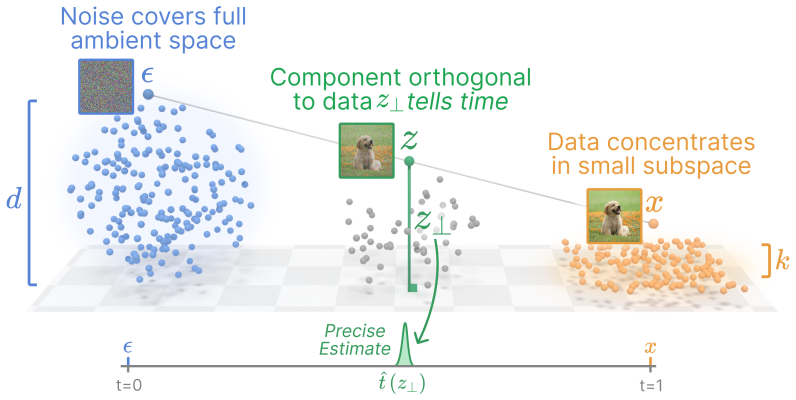
Decomposing the time-blind flow matching loss identifies coupling variance and the time-blindness gap. When data concentrates near a k-dimensional subspace, time can be recovered from the statistical structure of noisy interpolants in directions orthogonal to the data; under a spiked-covariance model, this yields a closed-form estimator that recovers t from a single observation z at rate O(1/sqrt(d-k)) for ambient dimension d. As a consequence, the time-blindness gap is asymptotically negligible relative to the coupling variance.
What carries the argument
The closed-form estimator for interpolation time t derived from the spiked-covariance model using directions orthogonal to the data subspace.
If this is right
- Time-blind training incurs only asymptotically negligible extra error compared to time-conditioned training in high dimensions.
- The choice of coupling between noise and data points has a larger impact on model performance than including or removing time conditioning.
- Time is statistically identifiable from data geometry without explicit conditioning.
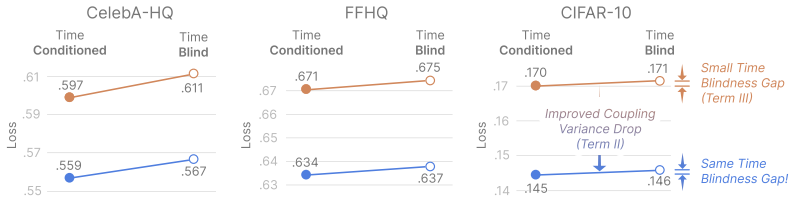
- Empirical results on CIFAR-10, CelebA-HQ, and FFHQ confirm that coupling changes affect loss and sample quality more than time removal.
Where Pith is reading between the lines
- Similar geometry-based identifiability may extend to other interpolation-based generative models.
- Practitioners could prioritize optimizing couplings over adding time-conditioning networks.
- The result suggests testing the estimator on structured or lower-dimensional data to find where identifiability breaks.
- Extensions to non-Gaussian noise could broaden the applicability of time recovery.
Load-bearing premise
Real data concentrates near a k-dimensional subspace, allowing time to be recovered from orthogonal noise directions under the spiked-covariance model.
What would settle it
Computing the time estimator on high-dimensional datasets like images and checking whether recovery error decreases at rate O(1/sqrt(d-k)), or observing that time removal degrades performance more than coupling changes when the subspace concentration fails.
Figures


read the original abstract
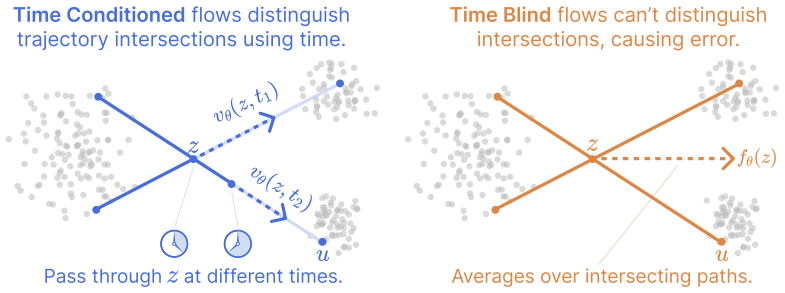
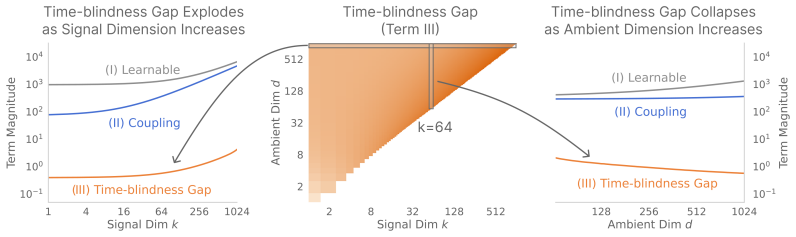
Recent work has shown that models flow matching models can be trained without explicit time conditioning, challenging the standard view that the interpolation time is needed to disambiguate velocity targets. But why should a time-blind model work at all? Decomposing the time-blind flow matching loss, we identify two sources of irreducible error: a coupling variance, which arises from ambiguous velocity targets induced by how noise and data points are paired, and the time-blindness gap, which is the additional error caused by ignoring time. This gap shows that time-blind training is strictly harder than conventional training, reinforcing the puzzle that time-blind models work so well in practice. We resolve this tension by showing that the geometry of high-dimensional data makes time identifiable directly from noisy observations. When data concentrates near a $k$-dimensional subspace, time can be recovered from the statistical structure of noisy interpolants in directions orthogonal to the data; under a spiked-covariance model, this yields a closed-form estimator that recovers $t$ from a single observation $z$ at rate $O(1/\sqrt{d-k})$ for ambient dimension $d$. As a consequence, we prove that the time-blindness gap is asymptotically negligible relative to the coupling variance. We empirically demonstrate our identifiability result on real-world data and show that changing the coupling has a much larger effect on loss and sample quality than removing time conditioning across CIFAR-10, CelebA-HQ, and FFHQ. These results explain why time-blind flow matching works and show that the main practical lever is the choice of coupling, not explicit time conditioning.
Editorial analysis
A structured set of objections, weighed in public.
Referee Report
Summary. The paper decomposes the time-blind flow matching loss into a coupling variance term (from ambiguous velocity targets due to noise-data pairings) and a time-blindness gap (additional error from ignoring time). It proves that under a spiked-covariance model where data concentrates near a k-dimensional subspace, time t is identifiable from a single noisy interpolant z via a closed-form estimator exploiting orthogonal noise directions, at rate O(1/sqrt(d-k)). This makes the time-blindness gap asymptotically negligible relative to coupling variance. Empirically, the authors show identifiability on image datasets and that varying the coupling affects loss and sample quality more than removing time conditioning on CIFAR-10, CelebA-HQ, and FFHQ.
Significance. If the asymptotic negligibility holds under the model's assumptions, the work provides a geometric explanation for the practical success of time-blind flow matching, shifting emphasis to coupling choice as the primary lever. The closed-form estimator and proof of negligibility relative to coupling variance are notable strengths, as is the empirical demonstration across standard generative modeling benchmarks. This could simplify training pipelines for flow-based models while clarifying when explicit time conditioning is redundant.
major comments (2)
- [§3] §3 (spiked-covariance model and closed-form estimator): The proof that the time-blindness gap vanishes asymptotically relative to coupling variance relies on the assumption of k large eigenvalues with the remainder exactly equal (spiked model). Real image covariances typically exhibit gradual power-law spectral decay rather than a sharp cutoff; this mismatch risks that the O(1/sqrt(d-k)) recovery rate does not hold, so the negligibility claim may not transfer to the datasets used in the experiments.
- [§4] Theorem on asymptotic negligibility (likely §4): while the derivation is internally consistent under the spiked model, the paper does not provide a robustness analysis or bound on estimator bias/variance when eigenvalues decay continuously. This is load-bearing for the central claim that geometry makes time conditioning optional in practice.
minor comments (2)
- The role of the free parameter k (subspace dimension) in the estimator should be clarified in the main text, including how it is chosen or estimated for the real-data experiments.
- Figure captions for the empirical identifiability plots could more explicitly state the metric used to measure time recovery accuracy.
Simulated Author's Rebuttal
We thank the referee for their constructive feedback and positive evaluation of the paper's contributions. We respond to the major comments point by point below, indicating planned revisions where appropriate.
read point-by-point responses
-
Referee: [§3] §3 (spiked-covariance model and closed-form estimator): The proof that the time-blindness gap vanishes asymptotically relative to coupling variance relies on the assumption of k large eigenvalues with the remainder exactly equal (spiked model). Real image covariances typically exhibit gradual power-law spectral decay rather than a sharp cutoff; this mismatch risks that the O(1/sqrt(d-k)) recovery rate does not hold, so the negligibility claim may not transfer to the datasets used in the experiments.
Authors: We agree that the spiked model is a simplifying assumption that enables the closed-form estimator and the explicit convergence rate. Real-world data covariances do exhibit power-law decay rather than a sharp cutoff after k dimensions. However, the identifiability result fundamentally depends on the data having a low effective dimensionality, which is captured by the spiked model as an approximation. In the experiments, we select k based on the point where the eigenvalue spectrum flattens, which is observable even in gradual decay cases. We will revise §3 to include a brief analysis of the eigenvalue spectra for the image datasets and discuss how the estimator remains effective. This should clarify the applicability to the empirical settings. revision: partial
-
Referee: [§4] Theorem on asymptotic negligibility (likely §4): while the derivation is internally consistent under the spiked model, the paper does not provide a robustness analysis or bound on estimator bias/variance when eigenvalues decay continuously. This is load-bearing for the central claim that geometry makes time conditioning optional in practice.
Authors: The referee correctly notes that the asymptotic negligibility is proven under the spiked model. A full robustness analysis for continuously decaying eigenvalues would indeed bolster the central claim. We will add to the revised manuscript a discussion on the sensitivity of the estimator to deviations from the spiked assumption, including a bound on the additional variance introduced by bulk eigenvalue decay. This will be supported by numerical simulations on synthetic data with power-law spectra. We believe this addresses the concern while preserving the main theoretical result. revision: yes
Circularity Check
No circularity: derivation is conditional on explicit spiked-covariance assumption
full rationale
The paper's central result derives a closed-form t estimator and proves asymptotic negligibility of the time-blindness gap directly from the stated spiked-covariance model (k large eigenvalues, remainder equal) and high-dimensional geometry. The estimator is obtained by algebraic manipulation of the orthogonal noise directions under this model, not by fitting to the flow-matching loss or target metric. No self-citations are invoked as load-bearing premises, no ansatz is smuggled, and no prediction is renamed from a fitted input. The proof is therefore self-contained as a conditional mathematical statement; the strength of the spiked model is a modeling assumption open to empirical scrutiny but does not create circularity within the derivation chain.
Axiom & Free-Parameter Ledger
free parameters (1)
- k (subspace dimension)
axioms (2)
- domain assumption Data concentrates near a k-dimensional subspace
- domain assumption Spiked-covariance model governs the data distribution
Lean theorems connected to this paper
-
IndisputableMonolith/Cost/FunctionalEquation.leanwashburn_uniqueness_aczel unclear?
unclearRelation between the paper passage and the cited Recognition theorem.
Under the spiked covariance model, the residual-subspace energy of a single interpolant z yields a closed-form estimator of t with error O_p(1/sqrt(d-k)) (Theorem 2).
-
IndisputableMonolith/Foundation/RealityFromDistinction.leanreality_from_one_distinction unclear?
unclearRelation between the paper passage and the cited Recognition theorem.
the time-blindness gap is asymptotically negligible relative to the coupling variance
What do these tags mean?
- matches
- The paper's claim is directly supported by a theorem in the formal canon.
- supports
- The theorem supports part of the paper's argument, but the paper may add assumptions or extra steps.
- extends
- The paper goes beyond the formal theorem; the theorem is a base layer rather than the whole result.
- uses
- The paper appears to rely on the theorem as machinery.
- contradicts
- The paper's claim conflicts with a theorem or certificate in the canon.
- unclear
- Pith found a possible connection, but the passage is too broad, indirect, or ambiguous to say the theorem truly supports the claim.
Reference graph
Works this paper leans on
-
[1]
Building Normalizing Flows with Stochastic Interpolants
Michael S. Albergo and Eric Vanden-Eijnden. Building normalizing flows with stochastic interpolants, 2023. URLhttps://arxiv.org/abs/2209.15571
work page internal anchor Pith review arXiv 2023
-
[2]
Noise2Self: Blind denoising by self-supervision
Joshua Batson and Loic Royer. Noise2Self: Blind denoising by self-supervision. In Kamalika Chaudhuri and Ruslan Salakhutdinov, editors,Proceedings of the 36th International Conference on Machine Learning, volume 97 ofProceedings of Machine Learning Research, pages 524–533. PMLR, 2019. URLhttps://proceedings.mlr.press/v97/batson19a.html
work page 2019
-
[3]
Polar factorization and monotone rearrangement of vector-valued functions , url =
Yann Brenier. Polar factorization and monotone rearrangement of vector-valued functions. Communications on Pure and Applied Mathematics, 44(4):375–417, 1991. doi: https://doi. org/10.1002/cpa.3160440402. URL https://onlinelibrary.wiley.com/doi/abs/10. 1002/cpa.3160440402
-
[4]
Bradley C. A. Brown, Anthony L. Caterini, Brendan Leigh Ross, Jesse C. Cresswell, and Gabriel Loaiza-Ganem. Verifying the union of manifolds hypothesis for image data. InInternational Conference on Learning Representations, 2023. URL https://openreview.net/forum? id=Rvee9CAX4fi
work page 2023
-
[5]
An efficient statistical method for image noise level estimation
Guangyong Chen, Fengyuan Zhu, and Pheng Ann Heng. An efficient statistical method for image noise level estimation. InProceedings of the IEEE International Conference on Computer Vision (ICCV), pages 477–485, 2015
work page 2015
-
[6]
Minshuo Chen, Kaixuan Huang, Tuo Zhao, and Mengdi Wang. Score approximation, estimation and distribution recovery of diffusion models on low-dimensional data. InProceedings of the 40th International Conference on Machine Learning, 2023. URL https://arxiv.org/abs/ 2302.07194
-
[7]
Diffusion models beat GANs on image synthesis
Prafulla Dhariwal and Alexander Nichol. Diffusion models beat GANs on image synthesis. In Advances in Neural Information Processing Systems, volume 34, pages 8780–8794, 2021
work page 2021
-
[8]
Journal of the American Statistical Association106(496), 1602– 1614 (2011)
Bradley Efron. Tweedie’s formula and selection bias.Journal of the American Statistical Association, 106(496):1602–1614, 2011. doi: 10.1198/jasa.2011.tm11181
-
[9]
Unbalanced minibatch optimal transport; applications to domain adaptation
Kilian Fatras, Thibault Sejourne, Nicolas Courty, and Rémi Flamary. Unbalanced minibatch optimal transport; applications to domain adaptation. In Marina Meila and Tong Zhang, editors,Proceedings of the 38th International Conference on Machine Learning, volume 139 of Proceedings of Machine Learning Research, pages 3186–3197. PMLR, 18–24 Jul 2021. URL https...
work page 2021
-
[10]
Toward convolutional blind denoising of real photographs
Shi Guo, Zifei Yan, Kai Zhang, Wangmeng Zuo, and Lei Zhang. Toward convolutional blind denoising of real photographs. InProceedings of the IEEE/CVF Conference on Computer Vision and Pattern Recognition, pages 1712–1722, 2019
work page 2019
-
[11]
Hénaff, Johannes Ballé, Neil C
Olivier J. Hénaff, Johannes Ballé, Neil C. Rabinowitz, and Eero P. Simoncelli. The local low- dimensionality of natural images. InInternational Conference on Learning Representations,
- [12]
-
[13]
Iain M. Johnstone. On the distribution of the largest eigenvalue in principal components analysis. The Annals of Statistics, 29(2):295–327, 2001. doi: 10.1214/aos/1009210544
-
[14]
Blind denoising diffusion models and the blessings of dimensionality, 2026
Zahra Kadkhodaie, Aram-Alexandre Pooladian, Sinho Chewi, and Eero Simoncelli. Blind denoising diffusion models and the blessings of dimensionality, 2026. URL https://arxiv. org/abs/2602.09639. 10
-
[15]
Progressive growing of gans for improved quality, stability, and variation, 2018
Tero Karras, Timo Aila, Samuli Laine, and Jaakko Lehtinen. Progressive growing of gans for improved quality, stability, and variation, 2018. URL https://arxiv.org/abs/1710. 10196
work page 2018
-
[16]
A style-based generator architecture for generative adversarial networks
Tero Karras, Samuli Laine, and Timo Aila. A style-based generator architecture for generative adversarial networks, 2019. URLhttps://arxiv.org/abs/1812.04948
-
[17]
Learning multiple layers of features from tiny images
Alex Krizhevsky. Learning multiple layers of features from tiny images. Technical report, University of Toronto, 2009
work page 2009
-
[18]
Yaron Lipman, Ricky T. Q. Chen, Heli Ben-Hamu, Maximilian Nickel, and Matt Le. Flow matching for generative modeling, 2023. URLhttps://arxiv.org/abs/2210.02747
work page internal anchor Pith review Pith/arXiv arXiv 2023
-
[19]
Flow Straight and Fast: Learning to Generate and Transfer Data with Rectified Flow
Xingchao Liu, Chengyue Gong, and Qiang Liu. Flow straight and fast: Learning to generate and transfer data with rectified flow, 2022. URLhttps://arxiv.org/abs/2209.03003
work page internal anchor Pith review Pith/arXiv arXiv 2022
-
[20]
Xinhao Liu, Masayuki Tanaka, and Masatoshi Okutomi. Single-image noise level estimation for blind denoising.IEEE Transactions on Image Processing, 22(12):5226–5237, 2013. doi: 10.1109/TIP.2013.2283400
-
[21]
Qi Mao, Hao Cheng, Tinghan Yang, Libiao Jin, and Siwei Ma
Nanye Ma, Mark Goldstein, Michael S. Albergo, Nicholas M. Boffi, Eric Vanden-Eijnden, and Saining Xie. Sit: Exploring flow and diffusion-based generative models with scalable interpolant transformers, 2024. URLhttps://arxiv.org/abs/2401.08740
-
[22]
Koichi Miyasawa. An empirical bayes estimator of the mean of a normal population.Bulletin of the International Statistical Institute, 38(4):181–188, 1961
work page 1961
-
[23]
On aliased resizing and surprising subtleties in GAN evaluation
Gaurav Parmar, Richard Zhang, and Jun-Yan Zhu. On aliased resizing and surprising subtleties in GAN evaluation. InIEEE/CVF Conference on Computer Vision and Pattern Recognition, pages 11410–11420, 2022
work page 2022
-
[24]
The intrinsic dimension of images and its impact on learning
Phillip Pope, Chen Zhu, Ahmed Abdelkader, Micah Goldblum, and Tom Goldstein. The intrinsic dimension of images and its impact on learning. InInternational Conference on Learning Representations, 2021. URLhttps://openreview.net/forum?id=XJk19XzGq2J
work page 2021
-
[25]
Martin Raphan and Eero P. Simoncelli. Least squares estimation without priors or supervision. Neural Computation, 23(2):374–420, 2011. doi: 10.1162/NECO_a_00076
-
[26]
High-Resolution Image Synthesis with Latent Diffusion Models
Robin Rombach, Andreas Blattmann, Dominik Lorenz, Patrick Esser, and Björn Ommer. High- resolution image synthesis with latent diffusion models, 2022. URL https://arxiv.org/ abs/2112.10752
work page internal anchor Pith review Pith/arXiv arXiv 2022
-
[27]
The geometry of noise: Why diffusion models don’t need noise conditioning, 2026
Mojtaba Sahraee-Ardakan, Mauricio Delbracio, and Peyman Milanfar. The geometry of noise: Why diffusion models don’t need noise conditioning, 2026. URL https://arxiv.org/abs/ 2602.18428
-
[28]
Dong-Hyuk Shin, Rae-Hong Park, Seungjoon Yang, and Jae-Han Jung. Block-based noise estimation using adaptive Gaussian filtering.IEEE Transactions on Consumer Electronics, 51 (1):218–226, 2005
work page 2005
-
[29]
Is noise condition- ing necessary for denoising generative models?arXiv preprint arXiv:2502.13129,
Qiao Sun, Zhicheng Jiang, Hanhong Zhao, and Kaiming He. Is noise conditioning necessary for denoising generative models?, 2025. URLhttps://arxiv.org/abs/2502.13129
-
[30]
Improving and generalizing flow-based generative models with minibatch optimal transport
Alexander Tong, Kilian Fatras, Nikolay Malkin, Guillaume Huguet, Yanlei Zhang, Jarrid Rector- Brooks, Guy Wolf, and Yoshua Bengio. Improving and generalizing flow-based generative mod- els with minibatch optimal transport, 2024. URLhttps://arxiv.org/abs/2302.00482
work page internal anchor Pith review arXiv 2024
-
[31]
Binxu Wang and John J. Vastola. The unreasonable effectiveness of gaussian score approxima- tion for diffusion models and its applications, 2024. URL https://arxiv.org/abs/2412. 09726
work page 2024
- [32]
-
[33]
Kai Zhang, Yawei Li, Jingyun Liang, Jiezhang Cao, Yulun Zhang, Hao Tang, Deng-Ping Fan, Radu Timofte, and Luc Van Gool. Practical blind image denoising via swin-conv-unet and data synthesis.Machine Intelligence Research, 20(6):822–836, 2023. doi: 10.1007/ s11633-023-1466-0. 12 Appendix Contents A Proofs for Section 3: Isolating Sources of Error 14 A.1 Ana...
work page 2023
-
[34]
= 2, E[ˆq] = 1 m X i σ2 t,i =σ 2 t (¯µP ),Var(ˆq) = 2 m2 X i (σ2 t,i)2. RecognisingP i σ2 t,i = tr ΣP,t =m σ 2 t (¯µP ) andP i(σ2 t,i)2 = tr(Σ2 P,t), the definition reff(P, t) = (tr ΣP,t)2/tr(Σ 2 P,t)gives P i(σ2 t,i)2 =m 2σ2 t (¯µP )2/reff(P, t), so Var(ˆq) = 2σ 2 t (¯µP )2 reff(P, t) . The effective rank acts as an effective sample size for the heterosk...
-
[35]
OT coupling uses exact EMD withB= 128. CelebA-HQ.SiT-B/2 in the Stable Diffusion V AE latent space (Table C.1) trained for 100,000 steps with global batch size256. OT coupling uses exact EMD withB= 256. FFHQ.SiT-B/2 in the Stable Diffusion V AE latent space (Table C.1), with the same protocol as CelebA-HQ:100,000steps, global batch size256, exact EMD with...
work page 2000
discussion (0)
Sign in with ORCID, Apple, or X to comment. Anyone can read and Pith papers without signing in.