Recognition: 1 theorem link
· Lean TheoremStochastic Dynamics of Domain Wall on a Racetrack: Impact of Line-Edge Roughness
Pith reviewed 2026-05-12 01:38 UTC · model grok-4.3
The pith
Even minimal line-edge roughness causes pronounced stochastic pinning of domain walls purely from spatial disorder.
A machine-rendered reading of the paper's core claim, the machinery that carries it, and where it could break.
Core claim
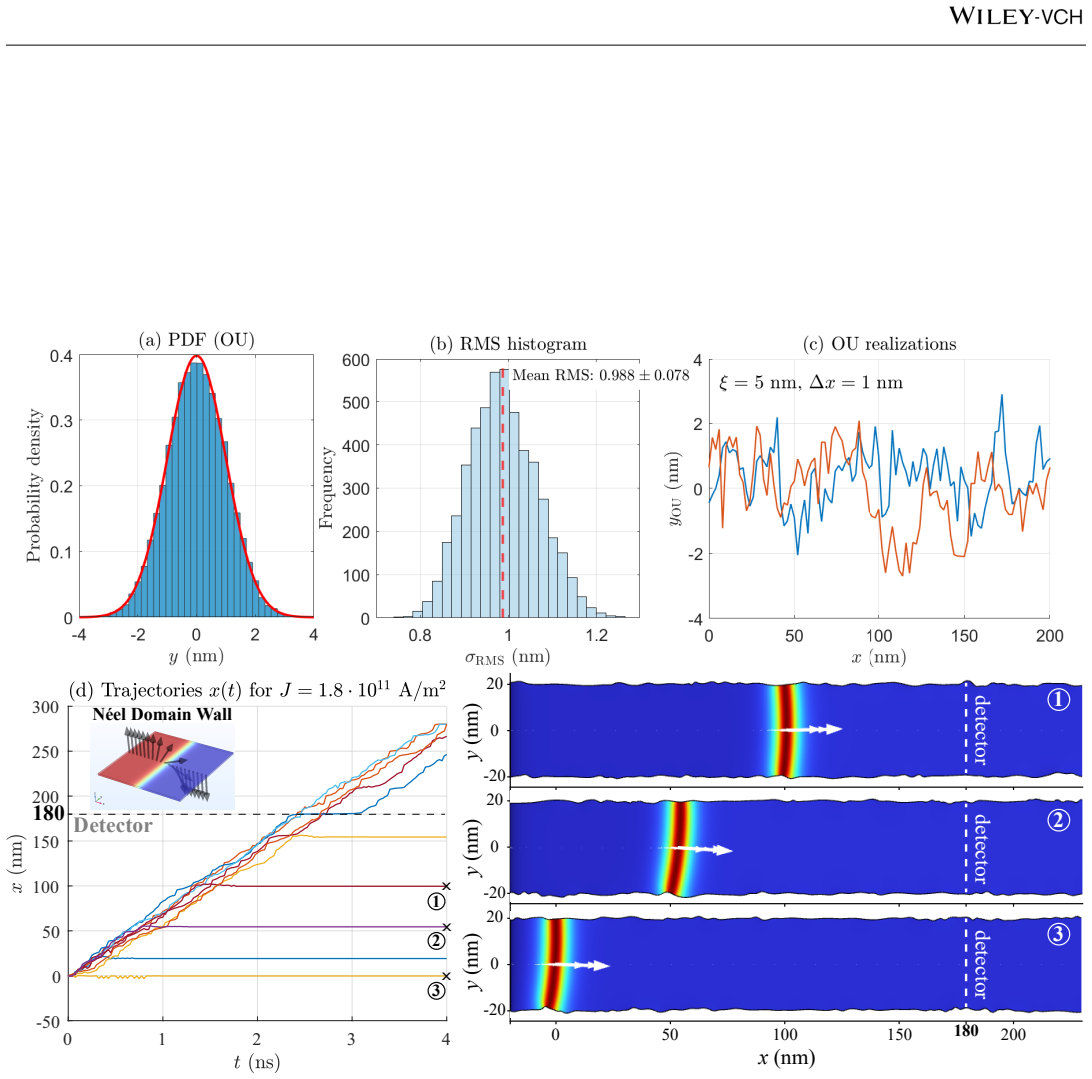
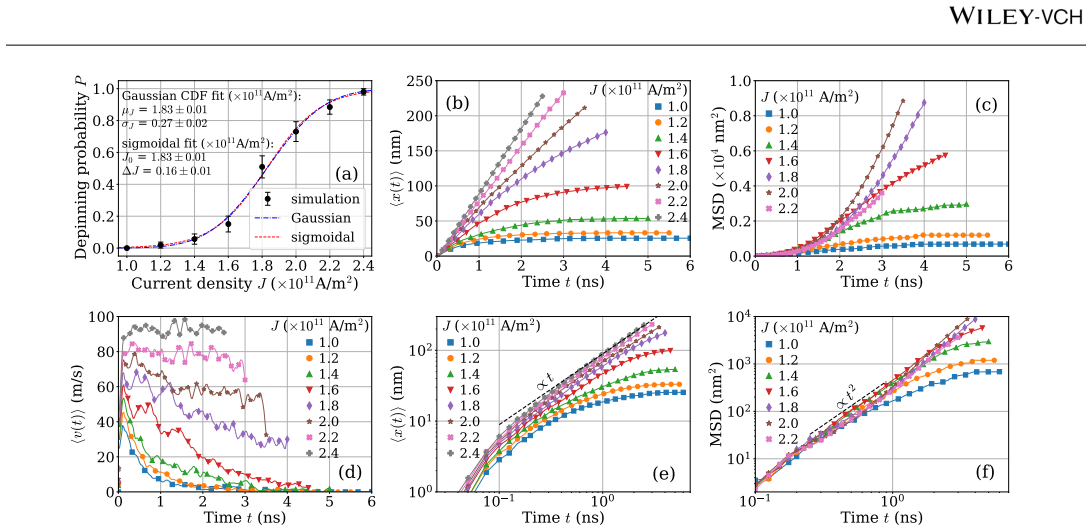
Modeling the edge disorder as a spatially correlated Ornstein-Uhlenbeck process, we demonstrate that even minimal experimentally relevant roughness induces pronounced stochastic pinning of domain walls. This stochasticity of the current-driven motion arises purely from spatial disorder, even in the absence of thermal fluctuations. The probability of a domain wall to reach a given position exhibits a robust sigmoidal dependence on the applied current, reflecting an effective distribution of depinning thresholds. At the same time, the underlying dynamics is highly nontrivial: the mean velocity exhibits a nonlinear dependence on both time and current, while the mean-square displacement exhibits
What carries the argument
Spatially correlated Ornstein-Uhlenbeck process representing line-edge roughness that creates a distribution of local pinning sites and effective depinning thresholds.
If this is right
- Domain walls show current-dependent stochastic positioning with a sigmoidal probability curve.
- Mean velocity depends nonlinearly on both elapsed time and applied current.
- Mean-square displacement follows a short-time ballistic regime that saturates due to trapping at pinning sites.
- Line-edge roughness supplies a controllable source of stochasticity suitable for p-bit functionality in racetrack hardware.
Where Pith is reading between the lines
- Tuning the correlation length or amplitude of the roughness model could adjust the width of the sigmoidal transition for specific probabilistic computing needs.
- The same spatial-disorder mechanism may produce analogous stochasticity in other current-driven magnetic textures such as skyrmions or vortices.
- Experimental tests could vary fabrication parameters to produce a range of roughness strengths and directly compare displacement statistics to the simulated sigmoidal and saturation behaviors.
Load-bearing premise
Real fabricated line-edge roughness is accurately captured by a spatially correlated Ornstein-Uhlenbeck process and no other effects such as thermal activation dominate the simulated behavior.
What would settle it
Measure the probability that a domain wall reaches successive positions in fabricated racetracks with controlled roughness levels at different currents and check whether the curve is sigmoidal and whether perfectly smooth edges eliminate the stochasticity.
Figures
read the original abstract
We investigate the impact of line-edge roughness on current-driven domain wall dynamics in ferromagnetic racetracks. Modeling the edge disorder as a spatially correlated Ornstein-Uhlenbeck process, we demonstrate that even minimal experimentally relevant roughness induces pronounced stochastic pinning of domain walls. Notably, this stochasticity of the current-driven motion arises purely from spatial disorder, even in the absence of thermal fluctuations. The probability of a domain wall to reach a given position exhibits a robust sigmoidal dependence on the applied current, reflecting an effective distribution of depinning thresholds. At the same time, the underlying dynamics is highly nontrivial: the mean velocity exhibits a nonlinear dependence on both time and current, while the mean-square displacement exhibits a ballistic regime at short times followed by saturation due to trapping at pinning sites. These results demonstrate that line-edge roughness provides a controllable source of stochasticity and enables p-bit-like functionality in racetrack systems, offering a pathway toward hardware implementations of probabilistic and neuromorphic computing.
Editorial analysis
A structured set of objections, weighed in public.
Referee Report
Summary. The manuscript investigates current-driven domain wall dynamics in ferromagnetic racetracks with line-edge roughness modeled as a spatially correlated Ornstein-Uhlenbeck process. Using micromagnetic simulations at zero temperature, it claims that even minimal experimentally relevant roughness produces pronounced stochastic pinning and depinning purely from spatial disorder, with the probability of a domain wall reaching a given position showing a robust sigmoidal dependence on applied current; mean velocity is nonlinear in time and current, while mean-square displacement exhibits a short-time ballistic regime followed by saturation due to trapping.
Significance. If the roughness model accurately represents fabricated devices, the results identify a controllable source of stochasticity arising solely from spatial disorder, which could enable p-bit-like probabilistic functionality in racetrack systems for neuromorphic or probabilistic computing. The separation of disorder-induced effects from thermal fluctuations is a potentially useful distinction for device design.
major comments (3)
- [§2 (Modeling)] §2 (Modeling): The Ornstein-Uhlenbeck parameters (roughness amplitude and correlation length) are described as 'minimal experimentally relevant' but no validation against measured roughness spectra (AFM/SEM) from actual fabricated racetracks is provided, nor is a sensitivity analysis shown down to the lowest reported experimental RMS values. This directly affects the load-bearing claim that the observed stochastic pinning occurs under realistic conditions.
- [§3 (Numerical methods)] §3 (Numerical methods): The manuscript provides no parameter tables, convergence checks, or full specification of the micromagnetic integration scheme and stochastic term implementation. Without these, the quantitative support for the sigmoidal depinning probability and the ballistic-to-saturation MSD transition remains moderate.
- [Results] Results (zero-temperature assumption): All reported dynamics are obtained at T=0. The paper does not examine whether thermal activation over the roughness-induced pinning barriers at 300 K would dominate or wash out the claimed purely spatial stochasticity, which is central to the distinction from thermal-fluctuation-driven behavior.
minor comments (2)
- [Abstract] Abstract and introduction: The link to 'p-bit-like functionality' would benefit from a short citation to existing p-bit literature to clarify the intended hardware mapping.
- [Figures] Figures: Include statistical measures (e.g., standard deviation over multiple roughness realizations) on the probability curves and velocity plots to demonstrate robustness of the sigmoidal shape.
Simulated Author's Rebuttal
We thank the referee for their constructive and detailed comments, which have helped us identify areas where the manuscript can be strengthened for clarity and rigor. We address each major comment point by point below, indicating the revisions we plan to implement.
read point-by-point responses
-
Referee: [§2 (Modeling)] The Ornstein-Uhlenbeck parameters (roughness amplitude and correlation length) are described as 'minimal experimentally relevant' but no validation against measured roughness spectra (AFM/SEM) from actual fabricated racetracks is provided, nor is a sensitivity analysis shown down to the lowest reported experimental RMS values. This directly affects the load-bearing claim that the observed stochastic pinning occurs under realistic conditions.
Authors: We chose the Ornstein-Uhlenbeck parameters to represent minimal values drawn from the range of roughness amplitudes and correlation lengths reported in the experimental literature on fabricated ferromagnetic racetracks and nanowires. In the revised manuscript we will add a sensitivity analysis that systematically varies the roughness amplitude down to the lowest experimentally reported RMS values, together with additional citations to specific AFM/SEM studies that justify our parameter selection. These changes will provide stronger support for the claim that the observed stochastic pinning is relevant under realistic fabrication conditions. revision: yes
-
Referee: [§3 (Numerical methods)] The manuscript provides no parameter tables, convergence checks, or full specification of the micromagnetic integration scheme and stochastic term implementation. Without these, the quantitative support for the sigmoidal depinning probability and the ballistic-to-saturation MSD transition remains moderate.
Authors: We agree that the numerical methods section requires more complete documentation to ensure reproducibility. In the revised manuscript we will insert a comprehensive table listing all material parameters, simulation cell sizes, time steps, and boundary conditions; we will explicitly describe the micromagnetic integration scheme (including the treatment of the spatially correlated Ornstein-Uhlenbeck edge roughness) and provide convergence tests with respect to spatial discretization and temporal step size. These additions will strengthen the quantitative foundation of the reported sigmoidal probabilities and MSD regimes. revision: yes
-
Referee: [Results] All reported dynamics are obtained at T=0. The paper does not examine whether thermal activation over the roughness-induced pinning barriers at 300 K would dominate or wash out the claimed purely spatial stochasticity, which is central to the distinction from thermal-fluctuation-driven behavior.
Authors: The zero-temperature framework is intentional, as stated in the abstract and introduction, to isolate the stochastic pinning that arises exclusively from spatial disorder. This separation is central to the paper’s contribution. We will nevertheless revise the manuscript to include an extended discussion that estimates the roughness-induced pinning energy barriers and compares them with thermal energy kT at 300 K, thereby indicating the temperature regimes in which spatial stochasticity is expected to remain dominant. While performing exhaustive finite-temperature micromagnetic simulations lies beyond the present computational scope, the added analysis will clarify the distinction and the limitations of the T = 0 results. revision: partial
Circularity Check
No circularity: results from explicit numerical integration of micromagnetic equations with OU roughness
full rationale
The paper demonstrates its claims via direct numerical solution of the micromagnetic equations (or collective-coordinate model) with an added spatially correlated Ornstein-Uhlenbeck term for edge roughness. The sigmoidal depinning probability, nonlinear velocity, and ballistic-to-saturated MSD are simulation outputs, not quantities fitted to data and then relabeled as predictions. No self-citations, uniqueness theorems, or ansatzes imported from prior author work are invoked to close the derivation. The modeling assumptions are stated explicitly and the results follow from integration without reduction to inputs by construction.
Axiom & Free-Parameter Ledger
free parameters (2)
- roughness amplitude
- correlation length
axioms (2)
- domain assumption Magnetization dynamics obey the Landau-Lifshitz-Gilbert equation with spin-transfer torque.
- ad hoc to paper Line-edge roughness is adequately represented by a spatially correlated Ornstein-Uhlenbeck process.
Lean theorems connected to this paper
-
IndisputableMonolith/Cost/FunctionalEquation.leanwashburn_uniqueness_aczel unclear?
unclearRelation between the paper passage and the cited Recognition theorem.
Modeling the edge disorder as a spatially correlated Ornstein-Uhlenbeck process... even minimal experimentally relevant roughness induces pronounced stochastic pinning... purely from spatial disorder, even in the absence of thermal fluctuations.
What do these tags mean?
- matches
- The paper's claim is directly supported by a theorem in the formal canon.
- supports
- The theorem supports part of the paper's argument, but the paper may add assumptions or extra steps.
- extends
- The paper goes beyond the formal theorem; the theorem is a base layer rather than the whole result.
- uses
- The paper appears to rely on the theorem as machinery.
- contradicts
- The paper's claim conflicts with a theorem or certificate in the canon.
- unclear
- Pith found a possible connection, but the passage is too broad, indirect, or ambiguous to say the theorem truly supports the claim.
Reference graph
Works this paper leans on
- [1]
-
[2]
Harry J. Levinson , title =. J. Micro/Nanopatterning Mater. Metrol. , volume =. 2025 , doi =
work page 2025
-
[3]
Naulleau, Patrick P. and Gallatin, Gregg M. , title =. J. Vac. Sci. Technol., B , volume =. 2010 , month =. doi:10.1116/1.3509437 , url =
-
[4]
Constantoudis, V. and Patsis, G. P. and Leunissen, L. H. A. and Gogolides, E. , title =. J. Vac. Sci. Technol. B , volume =. 2004 , month =. doi:10.1116/1.1776561 , url =
-
[5]
Precision Engineering , volume =
Kizu, Ryosuke and Misumi, Ichiko and Hirai, Akiko and Gonda, Satoshi and Takahashi, Satoru , title =. Precision Engineering , volume =. 2023 , doi =
work page 2023
-
[6]
Analysis of Line-Edge Roughness Using EUV Scatterometry , journal =
Fern. Analysis of Line-Edge Roughness Using EUV Scatterometry , journal =. 2022 , doi =
work page 2022
-
[7]
Parkin, Stuart S. P. and Hayashi, Masamitsu and Thomas, Luc , title =. Science , volume =. 2008 , doi =
work page 2008
-
[8]
Ryu, K.-S. and Thomas, L. and Yang, S.-H. and Parkin, S. S. P. , title =. Nature Nanotechnology , volume =. 2013 , doi =
work page 2013
-
[9]
Fedorov, Pavel and Soldatov, Ivan and Neu, Volker and Sch. Self-assembly of Co/Pt stripes with current-induced domain wall motion towards 3D racetrack devices , journal =. 2024 , doi =
work page 2024
-
[10]
Toyama, Ryo and Kawachi, Shiro and Yamaura, Jun-ichi and Fujita, Takeshi and Murakami, Youichi and Hosono, Hideo and Majima, Yutaka , title =. Nanoscale Advances , volume =. 2022 , doi =
work page 2022
-
[11]
Journal of Physics: Condensed Matter , volume =
Albert, Maximilian and Franchin, Matteo and Fischbacher, Thomas and Meier, Guido and Fangohr, Hans , title =. Journal of Physics: Condensed Matter , volume =. 2012 , doi =
work page 2012
-
[12]
and Currivan-Incorvia, Jean Anne and Ross, Caroline A
Dutta, Sumit and Siddiqui, Saima A. and Currivan-Incorvia, Jean Anne and Ross, Caroline A. and Baldo, Marc A. , title =. Nano Letters , volume =. 2017 , doi =
work page 2017
-
[13]
Hoang, Duc-Quang and Tran, Minh-Tung and Cao, Xuan-Huu and Ngo, Duc-The , title =. RSC Advances , volume =. 2017 , doi =
work page 2017
-
[14]
Camsari, Kerem Yunus and Faria, Rafatul and Sutton, Brian M. and Datta, Supriyo , title =. Physical Review X , volume =. 2017 , doi =
work page 2017
-
[15]
Camsari, Kerem Y. and Sutton, Brian M. and Datta, Supriyo , title =. Applied Physics Reviews , volume =. 2019 , doi =
work page 2019
-
[16]
Nature Communications , volume =
Daniel, John and Sun, Zheng and Zhang, Xuejian and Tan, Yuanqiu and Dilley, Neil and Chen, Zhihong and Appenzeller, Joerg , title =. Nature Communications , volume =. 2024 , doi =
work page 2024
-
[17]
Godinho, J. and Rout, P. K. and Salikhov, R. and Hellwig, O. and. Antiferromagnetic domain wall memory with neuromorphic functionality , journal =. 2024 , doi =
work page 2024
-
[18]
National Science Review , volume =
Wang, Yadi and Chen, Bin and Gao, Wenping and Ye, Biying and Niu, Chang and Wang, Wenbin and Zhu, Yinyan and Yu, Weichao and Guo, Hangwen and Shen, Jian , title =. National Science Review , volume =. 2025 , doi =
work page 2025
-
[19]
O'Shea, K. J. and Tracey, J. and Bramsiepe, S. and Stamps, R. L. , title =. Applied Physics Letters , volume =. 2013 , doi =
work page 2013
-
[20]
Statistically meaningful measure of domain-wall roughness in magnetic thin films , author =. Phys. Rev. B , volume =. 2020 , month =. doi:10.1103/PhysRevB.101.184431 , url =
-
[21]
Communications Materials , volume =
Kaappa, Sami and Santa-aho, Suvi and Honkanen, Mari and Vippola, Minnamari and Laurson, Lasse , title =. Communications Materials , volume =. 2024 , doi =
work page 2024
-
[22]
Hlushchenko, Anton V. and Bratchenko, Mykhailo I. and Chechkin, Aleksei V. , title =. arXiv preprint arXiv:2511.20287 , year =
-
[23]
Jiang, Xin and Thomas, Luc and Moriya, Rai and Hayashi, Masamitsu and Bergman, Bastiaan and Rettner, Charles and Parkin, Stuart S.P. , title=. Nat. Commun. , year=. doi:10.1038/ncomms1024 , url=
-
[24]
Stuart S. P. Parkin and Masamitsu Hayashi and Luc Thomas , title =. Science , volume =. 2008 , doi =
work page 2008
-
[25]
Parkin, Stuart and Yang, See-Hun , title=. Nat. Nanotechnol. , year=. doi:10.1038/nnano.2015.41 , url=
-
[26]
Bl. Proc. IEEE , title=. 2020 , volume=
work page 2020
-
[27]
Jeon, Jae-Chun and Migliorini, Andrea and Fischer, Lukas and Yoon, Jiho and Parkin, Stuart S. P. , title =. ACS Nano , volume =. 2024 , doi =
work page 2024
-
[28]
Jae-Chun Jeon and Andrea Migliorini and Jiho Yoon and Jaewoo Jeong and Stuart S. P. Parkin , title =. Science , volume =. 2024 , doi =
work page 2024
-
[29]
Chudnovskiy, A. and H. Spin switching: From quantum to quasiclassical approach , journal =. doi:https://doi.org/10.1002/pssb.201350225 , url =
-
[30]
Magnetization Noise in Magnetoelectronic Nanostructures , author =. Phys. Rev. Lett. , volume =. 2005 , month =. doi:10.1103/PhysRevLett.95.016601 , url =
-
[31]
Gorchon, J. and Bustingorry, S. and Ferr\'e, J. and Jeudy, V. and Kolton, A. B. and Giamarchi, T. , journal =. Pinning-Dependent Field-Driven Domain Wall Dynamics and Thermal Scaling in an Ultrathin. 2014 , month =. doi:10.1103/PhysRevLett.113.027205 , url =
-
[32]
Pinning of domain walls in thin ferromagnetic films , author =. Phys. Rev. B , volume =. 2018 , month =. doi:10.1103/PhysRevB.98.054406 , url =
-
[33]
Statics and dynamics of skyrmions interacting with disorder and nanostructures , author =. Rev. Mod. Phys. , volume =. 2022 , month =. doi:10.1103/RevModPhys.94.035005 , url =
-
[34]
Mio Ishibashi and Masashi Kawaguchi and Yuki Hibino and Kay Yakushiji and Arata Tsukamoto and Satoru Nakatsuji and Masamitsu Hayashi , title =. Sci. Adv. , volume =. 2024 , doi =
work page 2024
- [35]
-
[36]
IEEE Transactions on Neural Networks and Learning Systems , volume =
Liu, Yidong and Liu, Siting and Wang, Yanzhi and Lombardi, Fabrizio and Han, Jie , title =. IEEE Transactions on Neural Networks and Learning Systems , volume =. 2021 , doi =
work page 2021
-
[37]
Cao, Weipeng and Wang, Xizhao and Ming, Zhong and Gao, Jinzhu , title =. Neurocomputing , volume =. 2018 , doi =
work page 2018
-
[38]
Advanced Quantum Technologies , volume =
Lei, Kun and Wang, Xinrui and Zhou, Yiqi and Liu, Bohan and Wang, Kaiyou , title =. Advanced Quantum Technologies , volume =. 2026 , doi =
work page 2026
-
[39]
Grollier, J. and Querlioz, D. and Camsari, K. Y. and Everschor-Sitte, K. and Fukami, S. and Stiles, M. D. , title =. Nature Electronics , volume =. 2020 , doi =
work page 2020
-
[40]
Finocchio, Giovanni and Incorvia, Jean Anne C. and Friedman, Joseph S. and Yang, Qu and Giordano, Anna and Grollier, Julie and Yang, Hyunsoo and Ciubotaru, Florin and Chumak, Andrii V. and Naeemi, Azad J. and Cotofana, Sorin D. and Tomasello, Riccardo and Panagopoulos, Christos and Carpentieri, Mario and Lin, Peng and Pan, Gang and Yang, J. Joshua and Tod...
work page 2024
-
[41]
Mohseni, Naeimeh and McMahon, Peter L. and Byrnes, Tim , title =. Nature Reviews Physics , volume =. 2022 , doi =
work page 2022
-
[42]
Guan, Yicheng and Zhou, Xilin and Ma, Tianping and Bl\"asing, Robin and Deniz, Hakan and Yang, See-Hun and Parkin, Stuart S. P. , title =. Advanced Materials , volume =. 2021 , doi =
work page 2021
-
[43]
Weichao Yu , title =
- [44]
-
[45]
Effects of spatially engineered Dzyaloshinskii-Moriya interaction in ferromagnetic films , author =. Phys. Rev. B , volume =. 2017 , month =. doi:10.1103/PhysRevB.95.144401 , url =
-
[46]
Mutual Interaction between Superconductors and Ferromagnetic Skyrmionic Structures in Confined Geometries , author =. Phys. Rev. Appl. , volume =. 2022 , month =. doi:10.1103/PhysRevApplied.17.034069 , url =
-
[47]
Deterministic approach to skyrmionic dynamics at nonzero temperatures: Pinning sites and racetracks , author =. Phys. Rev. B , volume =. 2020 , month =. doi:10.1103/PhysRevB.101.140404 , url =
-
[48]
Castell-Queralt, Josep and Abad-López, Guillermo and González-Gómez, Leonardo and Del-Valle, Nuria and Navau, Carles , title =. Nanoscale Adv. , year =. doi:10.1039/D3NA00464C , url =
-
[49]
Coey, J. M. D. , year=. Magnetism and Magnetic Materials , publisher=. doi:10.1017/CBO9780511845000 , url =
-
[50]
Dependence of Domain-Wall Depinning Threshold Current on Pinning Profile , author =. Phys. Rev. Lett. , volume =. 2009 , doi =
work page 2009
discussion (0)
Sign in with ORCID, Apple, or X to comment. Anyone can read and Pith papers without signing in.