Recognition: no theorem link
Online Matrix Factorization, Online Private Query Release, and Online Discrepancy Minimization
Pith reviewed 2026-05-12 01:33 UTC · model grok-4.3
The pith
Online matrix factorization can match offline error bounds up to logarithmic factors for non-adaptive queries.
A machine-rendered reading of the paper's core claim, the machinery that carries it, and where it could break.
Core claim
An online algorithm maintains a factorization L_t R_t = Q_t by appending rows to R_t and outputting a new row ell_t satisfying ell_t R_t = q_t for each arriving row q_t; this factorization is competitive with the best offline factorization up to logarithmic factors even when the total number of rows is unknown in advance.
What carries the argument
The incremental online matrix factorization that builds L_t R_t by extending the right factor and producing a matching left row for each new query row, preserving competitiveness with the optimal offline factorization.
If this is right
- Private release of statistical queries can be performed online with error nearly matching the offline gamma-two bound.
- Online discrepancy minimization achieves discrepancy competitive with both the gamma-two norm and hereditary discrepancy up to log factors.
- The algorithm requires no advance knowledge of the total number of queries or rows.
Where Pith is reading between the lines
- Similar incremental factorization ideas could apply to other online linear-algebra tasks that currently rely on offline matrix decompositions.
- Removing the non-adaptive restriction would likely require either larger logarithmic factors or entirely different techniques.
- The competitiveness guarantee suggests that online versions of other gamma-two-based algorithms may also be possible with only logarithmic overhead.
Load-bearing premise
The queries arrive in a fixed sequence chosen ahead of time and cannot change based on the answers already produced.
What would settle it
Compute the ratio of the online factorization cost to the optimal offline gamma-two norm on a fixed sequence of query rows; if the ratio grows faster than logarithmic in the number of rows for some matrix family, the competitiveness claim fails.
Figures





read the original abstract
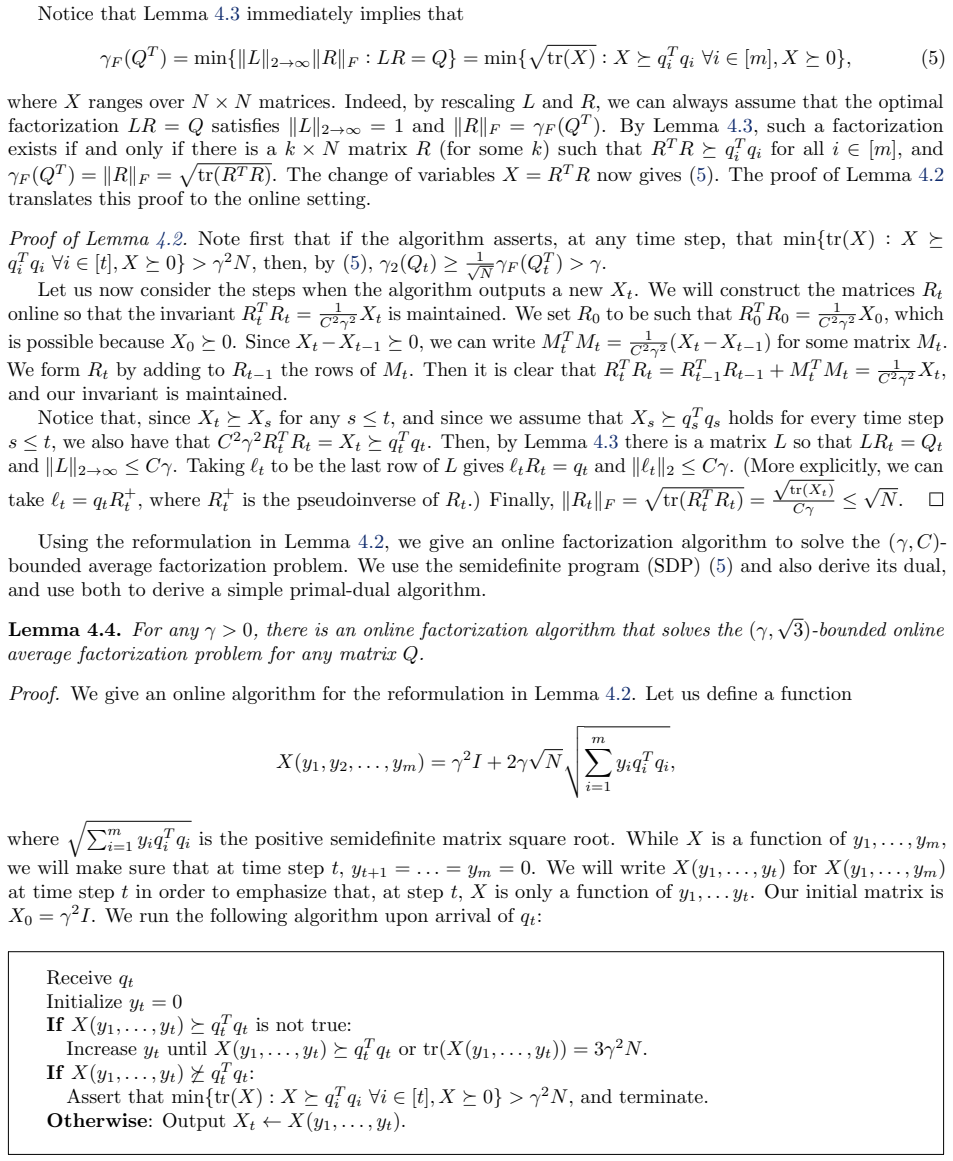
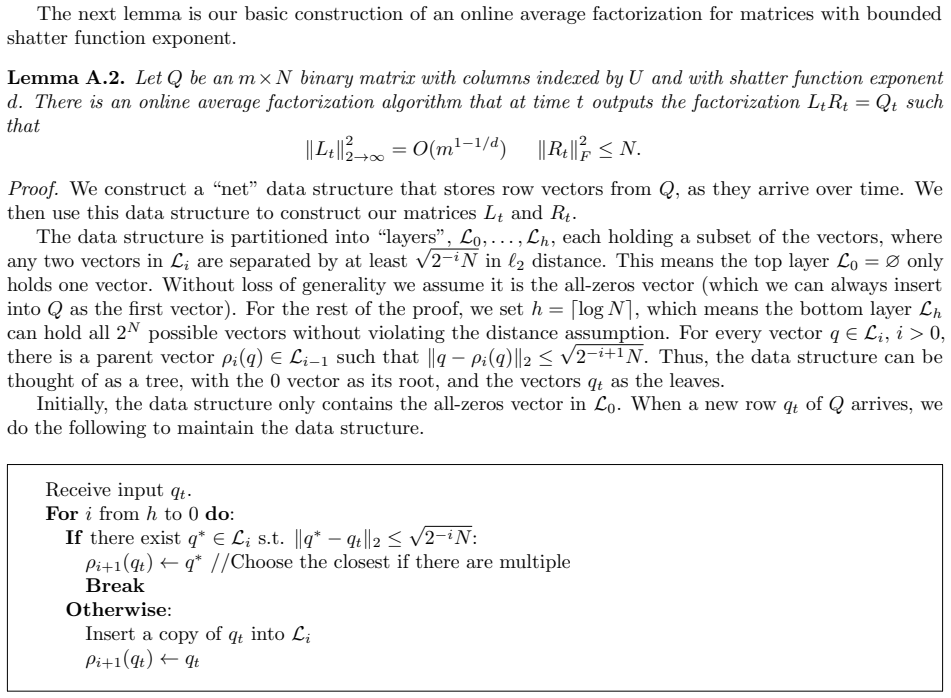
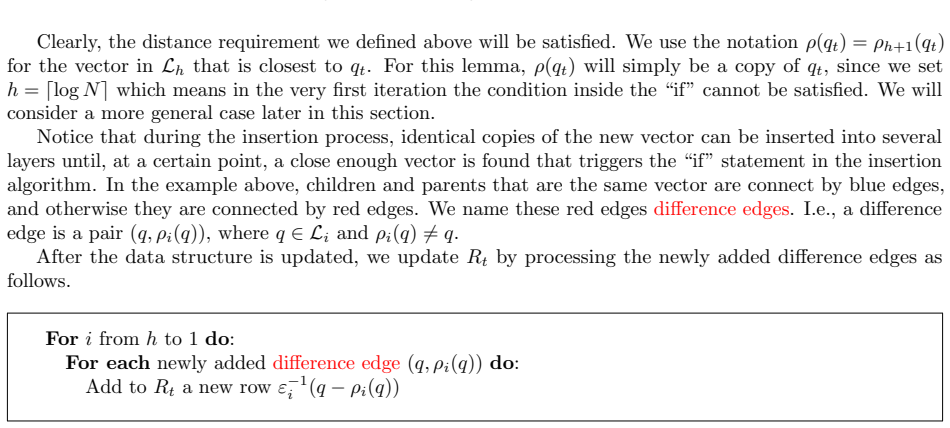
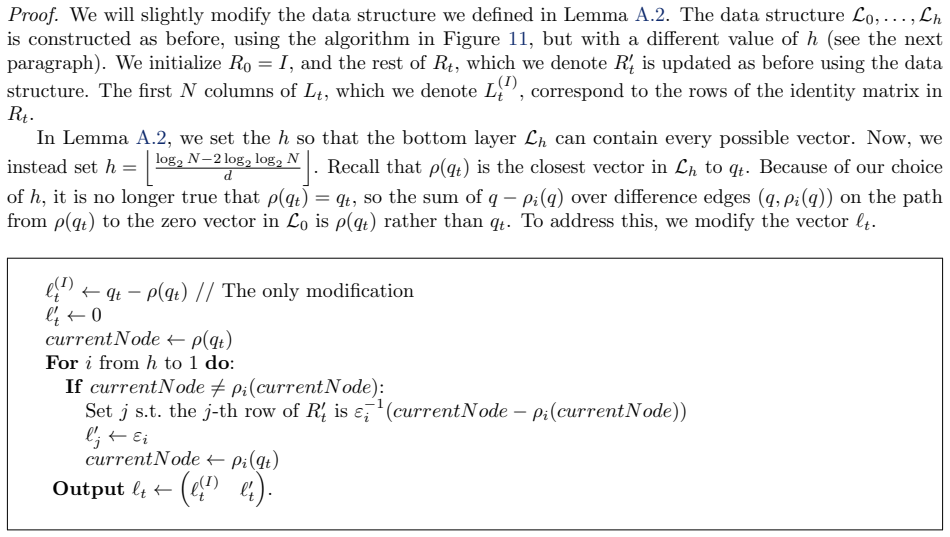
In this paper we consider several related online computation problems. First, we study answering sequences of statistical queries arriving online, and being answered immediately when they arrive with differential privacy. Known matrix factorization mechanisms can answer a set of statistical queries with error bounded by the $\gamma_2$ norm of their query matrix, but require that all queries are known in advance. We show that nearly the same error bounds can be achieved in the online setting for non-adaptively chosen queries. To do so, we give an online factorization algorithm that competitively matches the best offline factorization up to logarithmic factors. In the online matrix factorization problem, a new row $q_t$ of a matrix arrives at each time step $t$, and the algorithm needs to maintain a factorization $L_tR_t=Q_t$ such that at each time it appends some rows to $R_t$, and outputs a new row $\ell_t$ s.t. $\ell_tR_t=q_t$. Our algorithm maintains the competitiveness over this online process, even if the number of rows to arrive is unknown. As another application, we give an online discrepancy minimization algorithm that achieves discrepancy competitive against the $\gamma_2$ norm (and also against hereditary discrepancy) up to logarithmic factors.
Editorial analysis
A structured set of objections, weighed in public.
Referee Report
Summary. The paper presents an online matrix factorization algorithm for a matrix whose rows q_t arrive sequentially in a non-adaptive fashion. At each step the algorithm appends (possibly multiple) rows to the right factor R_t and emits a new row ell_t of the left factor L_t so that L_t R_t equals the prefix matrix Q_t seen so far. The central claim is that the resulting factorization norm remains competitive with the best offline gamma_2-norm factorization of the entire matrix, up to logarithmic factors, even when the horizon T is unknown in advance. The same technique yields an online differentially private query-release mechanism whose error is competitive with the offline gamma_2 bound and an online discrepancy-minimization algorithm whose discrepancy is competitive with both the gamma_2 norm and the hereditary discrepancy, again up to logarithmic factors.
Significance. If the claimed competitiveness holds, the result is significant because it removes the offline requirement that all queries be known in advance while incurring only logarithmic overhead, a standard price for online algorithms that use doubling epochs or potential-based resizing. The unified treatment of matrix factorization, private query release, and discrepancy minimization under a single online framework is a strength, and the explicit handling of unknown horizon distinguishes the work from many prior online results that assume a known T.
minor comments (3)
- [Abstract] The abstract states that the online factorization is competitive 'up to logarithmic factors' but does not exhibit the precise dependence on the dimension or on the gamma_2 norm; a short statement of the main theorem (including the exact log factors) should appear in the introduction.
- The description of the algorithm in the abstract mentions appending 'some rows' to R_t; the precise rule for deciding how many rows to append and the potential function used to control the growth should be stated explicitly in the algorithmic section.
- For the discrepancy application, it is not immediately clear whether the hereditary-discrepancy competitiveness follows directly from the gamma_2 bound or requires an additional argument; a short paragraph clarifying the relationship would improve readability.
Simulated Author's Rebuttal
We thank the referee for the careful summary of our paper and the positive assessment of its significance. We are pleased that the referee recognizes the value of the online matrix factorization result and its unified applications to private query release and discrepancy minimization, as well as the handling of unknown horizon. We appreciate the recommendation for minor revision.
Circularity Check
No significant circularity identified
full rationale
The paper constructs an online matrix factorization algorithm that maintains a factorization L_t R_t = Q_t by appending rows to R_t and emitting ell_t such that the norm remains competitive with the offline gamma_2 norm of the full matrix up to logarithmic factors, even for unknown horizon T. This competitiveness is measured against an externally defined offline benchmark (gamma_2 norm and hereditary discrepancy), not redefined in terms of the online outputs or fitted parameters. The non-adaptive query assumption and online process are handled via standard techniques without self-referential definitions or load-bearing self-citations that reduce the central claim to its inputs. The applications to private query release and discrepancy minimization inherit the same independent comparison, rendering the derivation self-contained.
Axiom & Free-Parameter Ledger
axioms (1)
- domain assumption Non-adaptive query arrival and standard differential privacy definitions
Reference graph
Works this paper leans on
-
[1]
Ryan Alweiss, Yang P. Liu, and Mehtaab Sawhney. Discrepancy minimization via a self-balancing walk. In S ymposium on T heory of C omputing, STOC , pages 14--20, 2021
work page 2021
-
[2]
Balancing vectors and G aussian measures of n -dimensional convex bodies
Wojciech Banaszczyk. Balancing vectors and G aussian measures of n -dimensional convex bodies. Random Structures and Algorithms , 12(4):351--360, 1998
work page 1998
-
[3]
Imre B \' a r \' a ny. On a class of balancing games. J. Comb. Theory, Ser. A , 26(2):115--126, 1979
work page 1979
-
[4]
The G ram- S chmidt walk: a cure for the B anaszczyk blues
Nikhil Bansal, Daniel Dadush, Shashwat Garg, and Shachar Lovett. The G ram- S chmidt walk: a cure for the B anaszczyk blues. Theory Comput. , 15:Paper No. 21, 27, 2019
work page 2019
-
[5]
Practical privacy: the SuLQ framework
Avrim Blum, Cynthia Dwork, Frank McSherry, and Kobbi Nissim. Practical privacy: the SuLQ framework. In Proceedings of the 24th ACM Symposium on Principles of Database Systems , PODS '05, pages 128--138. ACM, 2005
work page 2005
-
[6]
Matrix analysis , volume 169 of Graduate Texts in Mathematics
Rajendra Bhatia. Matrix analysis , volume 169 of Graduate Texts in Mathematics . Springer-Verlag, New York, 1997
work page 1997
-
[7]
Decoupling via affine spectral-independence: Beck-fiala and koml\'os bounds beyond banaszczyk, 2025
Nikhil Bansal and Haotian Jiang. Decoupling via affine spectral-independence: Beck-fiala and koml\'os bounds beyond banaszczyk, 2025
work page 2025
-
[8]
The design of competitive online algorithms via a primal-dual approach
Niv Buchbinder and Joseph Naor. The design of competitive online algorithms via a primal-dual approach. Found. Trends Theor. Comput. Sci. , 3(2-3):front matter, 93--263, 2007
work page 2007
-
[9]
Decomposable searching problems i
Jon Louis Bentley and James B Saxe. Decomposable searching problems i. static-to-dynamic transformation. Journal of Algorithms , 1(4):301--358, 1980
work page 1980
-
[10]
Nikhil Bansal and Joel H. Spencer. On-line balancing of random inputs. Random Structures Algorithms , 57(4):879--891, 2020
work page 2020
-
[11]
Make up your mind: The price of online queries in differential privacy
Mark Bun, Thomas Steinke, and Jonathan Ullman. Make up your mind: The price of online queries in differential privacy. In Proceedings of the 28th Annual ACM-SIAM Symposium on Discrete Algorithms , SODA '17, pages 1306--1325, Philadelphia, PA, 2017. SIAM
work page 2017
-
[12]
Fingerprinting codes and the price of approximate differential privacy
Mark Bun, Jonathan Ullman, and Salil Vadhan. Fingerprinting codes and the price of approximate differential privacy. In 46th Annual ACM Symposium on the Theory of Computing , STOC '14, pages 1--10, New York, NY, USA, 2014
work page 2014
-
[13]
Tight hardness results for minimizing discrepancy
Moses Charikar, Alantha Newman, and Aleksandar Nikolov. Tight hardness results for minimizing discrepancy. In ACM-SIAM Symposium on Discrete Algorithms, SODA , pages 1607--1614, 2011
work page 2011
-
[14]
Private and continual release of statistics
T-H Hubert Chan, Elaine Shi, and Dawn Song. Private and continual release of statistics. ACM Transactions on Information and System Security (TISSEC) , 14(3):26, 2011
work page 2011
-
[15]
Towards a constructive version of B anaszczyk's vector balancing theorem
Daniel Dadush, Shashwat Garg, Shachar Lovett, and Aleksandar Nikolov. Towards a constructive version of B anaszczyk's vector balancing theorem. Theory Comput. , 15:Paper No. 15, 58, 2019
work page 2019
-
[16]
Our data, ourselves: Privacy via distributed noise generation
Cynthia Dwork, Krishnaram Kenthapadi, Frank McSherry, Ilya Mironov, and Moni Naor. Our data, ourselves: Privacy via distributed noise generation. In Advances in Cryptology - EUROCRYPT 2006, 25th Annual International Conference on the Theory and Applications of Cryptographic Techniques, St. Petersburg, Russia, May 28 - June 1, 2006, Proceedings , volume 40...
work page 2006
-
[17]
Aref N. Dajani, Amy D. Lauger, Phyllis E. Singer, Daniel Kifer, Jerome P. Reiter, Ashwin Machanavajjhala, Simson L. Garfinkel, Scot A. Dahl, Matthew Graham, Vishesh Karwa, Hang Kim, Philip Lelerc, Ian M. Schmutte, William N. Sexton, Lars Vilhuber, and John M. Abowd. The modernization of statistical disclosure limitation at the U.S. census bureau, 2017. Pr...
work page 2017
-
[18]
Calibrating noise to sensitivity in private data analysis
Cynthia Dwork, Frank McSherry, Kobbi Nissim, and Adam Smith. Calibrating noise to sensitivity in private data analysis. In Proceedings of the 3rd Conference on Theory of Cryptography , TCC '06, pages 265--284, Berlin, Heidelberg, 2006. Springer
work page 2006
-
[19]
Revealing information while preserving privacy
Irit Dinur and Kobbi Nissim. Revealing information while preserving privacy. In PODS , pages 202--210. ACM , 2003
work page 2003
-
[20]
Privacy-preserving datamining on vertically partitioned databases
Cynthia Dwork and Kobbi Nissim. Privacy-preserving datamining on vertically partitioned databases. In Annual International Cryptology Conference , pages 528--544. Springer, 2004
work page 2004
- [21]
-
[22]
Cynthia Dwork, Moni Naor, Omer Reingold, Guy N. Rothblum, and Salil P. Vadhan. On the complexity of differentially private data release: efficient algorithms and hardness results. In STOC , pages 381--390. ACM , 2009
work page 2009
-
[23]
The algorithmic foundations of differential privacy
Cynthia Dwork and Aaron Roth. The algorithmic foundations of differential privacy. Found. Trends Theor. Comput. Sci. , 9(3-4):211--407, 2014
work page 2014
-
[24]
Cynthia Dwork, Guy N. Rothblum, and Salil P. Vadhan. Boosting and differential privacy. In FOCS , pages 51--60. IEEE , 2010
work page 2010
-
[25]
New efficient attacks on statistical disclosure control mechanisms
Cynthia Dwork and Sergey Yekhanin. New efficient attacks on statistical disclosure control mechanisms. In Annual International Cryptology Conference , pages 469--480. Springer, 2008
work page 2008
-
[26]
Online semidefinite programming
Noa Elad, Satyen Kale, and Joseph Naor. Online semidefinite programming. In 43rd I nternational C olloquium on A utomata, L anguages, and P rogramming , volume 55 of LIPIcs. Leibniz Int. Proc. Inform. , pages Art. No. 40, 13. Schloss Dagstuhl. Leibniz-Zent. Inform., Wadern, 2016
work page 2016
-
[27]
Alexander Edmonds, Aleksandar Nikolov, and Jonathan R. Ullman. The power of factorization mechanisms in local and central differential privacy. In Proceedings of the 52nd Annual ACM SIGACT Symposium on Theory of Computing, STOC 2020, Chicago, IL, USA, June 22-26, 2020 , pages 425--438. ACM , 2020
work page 2020
-
[28]
Competitive online algorithms for resource allocation over the positive semidefinite cone
Reza Eghbali, James Saunderson, and Maryam Fazel. Competitive online algorithms for resource allocation over the positive semidefinite cone. Math. Program. , 170(1):267--292, 2018
work page 2018
-
[29]
Iterative constructions and private data release
Anupam Gupta, Aaron Roth, and Jonathan Ullman. Iterative constructions and private data release. In 9th IACR Theory of Cryptography Conference , TCC '12, pages 339--356, Taormina, Italy, 2012. Springer
work page 2012
-
[30]
David Haussler. Sphere packing numbers for subsets of the B oolean n -cube with bounded V apnik- C hervonenkis dimension. J. Combin. Theory Ser. A , 69(2):217--232, 1995
work page 1995
-
[31]
A simple and practical algorithm for differentially private data release
Moritz Hardt, Katrina Ligett, and Frank McSherry. A simple and practical algorithm for differentially private data release. In Advances in Neural Information Processing Systems 25: 26th Annual Conference on Neural Information Processing Systems 2012. Proceedings of a meeting held December 3-6, 2012, Lake Tahoe, Nevada, United States. , pages 2348--2356, 2012
work page 2012
-
[32]
A multiplicative weights mechanism for privacy-preserving data analysis
Moritz Hardt and Guy Rothblum. A multiplicative weights mechanism for privacy-preserving data analysis. In FOCS , pages 61--70, 2014
work page 2014
-
[33]
Optimal online discrepancy minimization
Janardhan Kulkarni, Victor Reis, and Thomas Rothvoss. Optimal online discrepancy minimization. In Bojan Mohar, Igor Shinkar, and Ryan O'Donnell, editors, Proceedings of the 56th Annual ACM Symposium on Theory of Computing, STOC 2024, Vancouver, BC, Canada, June 24-28, 2024 , pages 1832--1840. ACM , 2024
work page 2024
-
[34]
Better gaussian mechanism using correlated noise
Christian Janos Lebeda. Better gaussian mechanism using correlated noise. In Ioana Oriana Bercea and Rasmus Pagh, editors, 2025 Symposium on Simplicity in Algorithms, SOSA 2025, New Orleans, LA, USA, January 13-15, 2025 , pages 119--133. SIAM , 2025
work page 2025
-
[35]
Optimizing linear counting queries under differential privacy
Chao Li, Michael Hay, Vibhor Rastogi, Gerome Miklau, and Andrew McGregor. Optimizing linear counting queries under differential privacy. In Proceedings of the 29th ACM Symposium on Principles of Database Systems , PODS'10, pages 123--134. ACM, 2010
work page 2010
-
[36]
Complexity measures of sign matrices
Nati Linial, Shahar Mendelson, Gideon Schechtman, and Adi Shraibman. Complexity measures of sign matrices. Combinatorica , 27(4):439--463, 2007
work page 2007
-
[37]
Discrepancy of set-systems and matrices
L \'a szl \'o Lov \'a sz, Joel Spencer, and Katalin Vesztergombi. Discrepancy of set-systems and matrices. European Journal of Combinatorics , 7(2):151--160, 1986
work page 1986
-
[38]
Better differentially private approximate histograms and heavy hitters using the misra-gries sketch
Christian Janos Lebeda and Jakub Tetek. Better differentially private approximate histograms and heavy hitters using the misra-gries sketch. SIGMOD Rec. , 53(1):7--14, 2024
work page 2024
-
[39]
Optimizing error of high-dimensional statistical queries under differential privacy
Ryan McKenna, Gerome Miklau, Michael Hay, and Ashwin Machanavajjhala. Optimizing error of high-dimensional statistical queries under differential privacy. Journal of Privacy and Confidentiality , 13(1), Aug. 2023
work page 2023
-
[40]
Optimal private halfspace counting via discrepancy
S Muthukrishnan and Aleksandar Nikolov. Optimal private halfspace counting via discrepancy. In Proceedings of the forty-fourth annual ACM symposium on Theory of computing , pages 1285--1292. ACM, 2012
work page 2012
-
[41]
Factorization norms and hereditary discrepancy
Ji r \'i Matou s ek, Aleksandar Nikolov, and Kunal Talwar. Factorization norms and hereditary discrepancy. Int. Math. Res. Not. IMRN , (3):751--780, 2020
work page 2020
- [42]
-
[43]
General gaussian noise mechanisms and their optimality for unbiased mean estimation
Aleksandar Nikolov and Haohua Tang. General gaussian noise mechanisms and their optimality for unbiased mean estimation. In ITCS , volume 287 of LIPIcs , pages 85:1--85:23. Schloss Dagstuhl - Leibniz-Zentrum f \" u r Informatik, 2024
work page 2024
-
[44]
The geometry of differential privacy: The small database and approximate cases
Aleksandar Nikolov, Kunal Talwar, and Li Zhang. The geometry of differential privacy: The small database and approximate cases. SIAM J. Comput. , 45(2):575--616, 2016
work page 2016
-
[45]
Interactive privacy via the median mechanism
Aaron Roth and Tim Roughgarden. Interactive privacy via the median mechanism. In STOC , pages 765--774. ACM , June 5--8 2010
work page 2010
-
[46]
Joel Spencer. Balancing games. J. Comb. Theory, Ser. B , 23(1):68--74, 1977
work page 1977
-
[47]
Roman Vershynin. High-dimensional probability , volume 47 of Cambridge Series in Statistical and Probabilistic Mathematics . Cambridge University Press, Cambridge, 2018. An introduction with applications in data science, With a foreword by Sara van de Geer
work page 2018
-
[48]
Differential privacy via wavelet transforms
Xiaokui Xiao, Guozhang Wang, and Johannes Gehrke. Differential privacy via wavelet transforms. IEEE Trans. Knowl. Data Eng. , 23(8):1200--1214, 2011
work page 2011
discussion (0)
Sign in with ORCID, Apple, or X to comment. Anyone can read and Pith papers without signing in.