Recognition: 2 theorem links
· Lean TheoremTexture Independently Drives Liking in AI-Generated Alternative Protein Burgers
Pith reviewed 2026-05-12 00:47 UTC · model grok-4.3
The pith
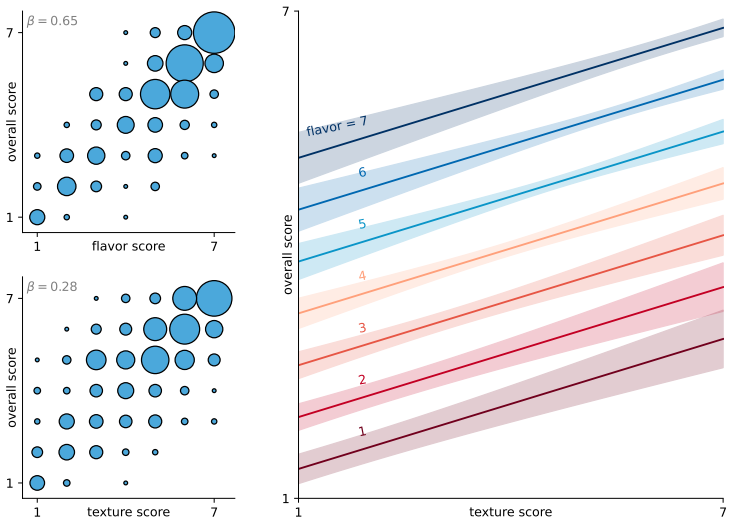
Texture liking independently raises overall burger liking by 0.28 points, with resilience as the key mechanical driver.
A machine-rendered reading of the paper's core claim, the machinery that carries it, and where it could break.
Core claim
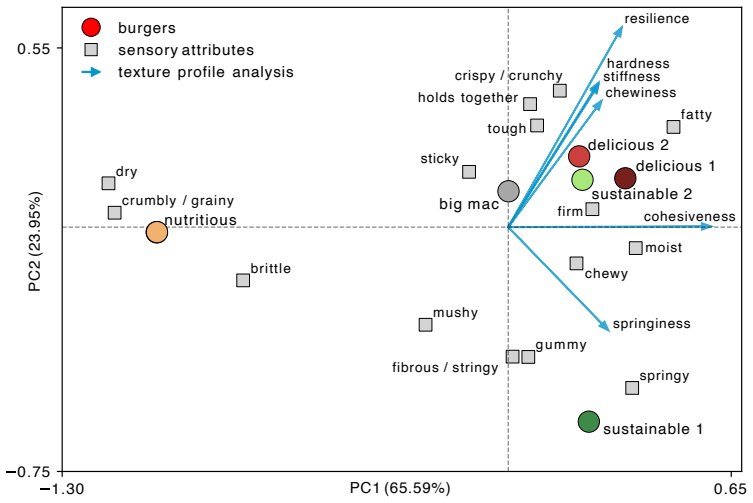
The study reveals that resilience is the strongest mechanical correlate of perceived meatiness and sensory texture in burgers, while texture liking independently predicts overall liking with a coefficient of 0.28, and meatiness dominates as a predictor of texture liking. Animal-based and hybrid burgers cluster in a firm, fatty sensory region, whereas plant-based deviate to dry and brittle, and mushroom-based to springy and gummy.
What carries the argument
Resilience from texture profile analysis, which measures the ability of the food to recover after compression, serving as the link between mechanical properties and sensory perception of meatiness.
If this is right
- Improving resilience in alternative proteins could enhance perceived meatiness and texture liking.
- Texture should be a primary design goal alongside flavor for sustainable burgers.
- Hybrid animal-mushroom patties can achieve sensory profiles similar to animal-based ones.
- AI-generated burgers can be optimized for texture to match consumer preferences.
- Stiffness and hardness are not useful targets for texture engineering in this context.
Where Pith is reading between the lines
- Targeting resilience might help reduce the gap between alternative and conventional meat products in consumer preference.
- The results could inform processing methods to adjust resilience in plant-based ingredients.
- Extending these findings to other food formats such as sausages or ground meats may reveal broader applications for texture design.
- If validated, this approach could contribute to more sustainable food systems by making plant-based options more appealing.
Load-bearing premise
Mechanical measurements of texture like resilience directly reflect what people sense and prefer in blind tastings, without hidden influences from flavor or how the test is run.
What would settle it
A follow-up test in which burgers are adjusted only in resilience while other properties stay fixed, yet meatiness ratings and overall liking scores show no corresponding shift among blind tasters.
Figures




read the original abstract
Texture shapes how we perceive and like food, yet clear links between mechanical measurements and sensory perception of texture remain elusive. Here we combine sensory data from a blind tasting with 101 participants with mechanical texture profile analysis across six burgers to identify the textural features that drive consumer perception and liking. We compare five burgers -- generated with artificial intelligence -- with animal-based, plant-based, mushroom-based, and hybrid animal-mushroom patties, and the classical Big\,Mac. Three main findings emerge: First, animal-based burgers occupy a distinctive and coherent sensory-mechanical region associated with attributes such as firm, fatty, and holds together. Second, mushroom- and plant-based burgers deviate from this region in protein-dependent ways: mushroom-based burgers associate with springy and gummy textures, while plant-based burgers associate with dry, brittle, and crumbly textures. Hybrid animal-mushroom burgers, however, maintain sensory profiles comparable to fully animal-based burgers. Third, resilience emerges as the strongest mechanical correlate of perceived meatiness and sensory texture, while stiffness and hardness show no statistically significant association with consumer perception. Texture independently predicts overall liking alongside flavor: increasing texture liking by one point increases overall liking by 0.28. Among all sensory attributes, meatiness is the dominant predictor of texture liking. These findings identify resilience as a promising target for texture engineering and establish texture as a critical design objective for sustainable alternative proteins.
Editorial analysis
A structured set of objections, weighed in public.
Referee Report
Summary. The manuscript reports an empirical study combining blind sensory evaluations from 101 participants across six burger products (AI-generated alternatives, animal-based, plant-based, mushroom-based, hybrid, and Big Mac) with mechanical texture profile analysis (TPA). It claims three main results: (1) animal-based burgers occupy a distinct sensory-mechanical region (firm, fatty, holds together) while mushroom-based are springy/gummy and plant-based dry/brittle/crumbly, with hybrids comparable to animal-based; (2) resilience is the strongest mechanical correlate of perceived meatiness and sensory texture, whereas stiffness and hardness show no statistically significant association; (3) texture liking independently predicts overall liking (increasing texture liking by one point raises overall liking by 0.28), with meatiness as the dominant predictor of texture liking. These support resilience as a target for texture engineering in alternative proteins.
Significance. If the associations hold after addressing sample-size and methodological limitations, the work provides actionable, evidence-based guidance for engineering texture in sustainable alternative proteins, particularly by prioritizing resilience over other TPA parameters and treating texture as separable from flavor in driving liking. The combination of human sensory data with objective mechanical measurements and the inclusion of AI-generated samples are strengths that could inform both product development and future modeling in food science.
major comments (3)
- [Results (mechanical-sensory correlations)] Results section on mechanical-sensory correlations: TPA parameters are measured once per burger type, yielding only n=6 independent observations when correlating with participant-averaged sensory scores. This small sample directly undermines the reliability of designating resilience as the 'strongest' correlate and asserting null associations for stiffness and hardness, as both the ranking and the lack of significance are sensitive to the specific choice of the six burgers, measurement noise, and low statistical power.
- [Methods and Results (statistical analysis)] Methods and Results on regression and statistical reporting: The reported 0.28 coefficient for texture liking predicting overall liking, along with other associations, lacks specification of the exact model (e.g., linear regression vs. mixed-effects accounting for participant variability), error bars or confidence intervals, data exclusion criteria, and any correction for multiple comparisons across attributes and parameters. These omissions prevent full assessment of the robustness of the central claims.
- [Discussion] Discussion of mechanical-to-sensory mapping: The interpretation that TPA resilience directly drives perceived meatiness and texture assumes minimal unmeasured confounders (e.g., flavor-texture interactions or residual biases in the blind tasting protocol). Given that mechanical measurements are single per type and sensory data are aggregated, additional justification or sensitivity analyses are needed to support the texture-engineering recommendations.
minor comments (2)
- [Abstract] The abstract contains a LaTeX artifact ('Big,Mac'); correct to 'Big Mac' for clarity.
- [Figures/Tables] Figures or tables presenting correlations should include individual data points (given n=6) and error bars to allow readers to evaluate the strength and variability of the reported associations.
Simulated Author's Rebuttal
We thank the referee for their constructive comments, which have helped us strengthen the manuscript. We address each major point below and have revised the text to improve clarity, statistical reporting, and discussion of limitations.
read point-by-point responses
-
Referee: Results section on mechanical-sensory correlations: TPA parameters are measured once per burger type, yielding only n=6 independent observations when correlating with participant-averaged sensory scores. This small sample directly undermines the reliability of designating resilience as the 'strongest' correlate and asserting null associations for stiffness and hardness, as both the ranking and the lack of significance are sensitive to the specific choice of the six burgers, measurement noise, and low statistical power.
Authors: We agree that the mechanical-sensory correlations rely on n=6 observations, which inherently limits statistical power and makes rankings and null findings sensitive to sample composition. The sensory scores are robustly averaged across 101 participants, but this does not increase the number of independent mechanical data points. In the revision we have added an explicit discussion of this limitation in the Results and Discussion sections, qualified the claims about null associations for stiffness and hardness as exploratory, and included leave-one-out sensitivity checks to demonstrate that the resilience correlation remains the strongest across subsets. We retain the original ranking as descriptive of the observed data while acknowledging the small-n constraint. revision: yes
-
Referee: Methods and Results on regression and statistical reporting: The reported 0.28 coefficient for texture liking predicting overall liking, along with other associations, lacks specification of the exact model (e.g., linear regression vs. mixed-effects accounting for participant variability), error bars or confidence intervals, data exclusion criteria, and any correction for multiple comparisons across attributes and parameters. These omissions prevent full assessment of the robustness of the central claims.
Authors: We accept that the statistical reporting was insufficiently detailed. The 0.28 coefficient derives from ordinary least-squares linear regression on participant-averaged scores (not mixed-effects models, as participant-level variability was already summarized). We have revised the Methods section to specify the models, added 95% confidence intervals for all reported coefficients, stated that no observations were excluded beyond standard data-quality checks, and noted that analyses were exploratory without formal multiple-comparison correction. These changes allow readers to evaluate robustness directly. revision: yes
-
Referee: Discussion of mechanical-to-sensory mapping: The interpretation that TPA resilience directly drives perceived meatiness and texture assumes minimal unmeasured confounders (e.g., flavor-texture interactions or residual biases in the blind tasting protocol). Given that mechanical measurements are single per type and sensory data are aggregated, additional justification or sensitivity analyses are needed to support the texture-engineering recommendations.
Authors: We recognize that single mechanical measurements per type and aggregated sensory data leave room for unmeasured confounders such as flavor-texture interactions. The blind protocol reduced visual and labeling biases, but residual effects cannot be ruled out. In the revised Discussion we have added a paragraph on these assumptions, included partial-correlation sensitivity checks controlling for other sensory attributes, and tempered the engineering recommendations to emphasize that resilience is a promising target pending confirmation in larger, multi-measurement studies. This provides the requested justification while preserving the core interpretation supported by the data. revision: yes
Circularity Check
No circularity: empirical correlations from independent sensory and mechanical data
full rationale
The paper reports statistical associations from blind sensory tasting (n=101 participants) and mechanical TPA measurements on six distinct burger formulations. No equations, derivations, fitted parameters renamed as predictions, or self-citation chains appear in the abstract or described methods. Claims such as resilience as the strongest correlate or texture independently predicting liking are direct outputs of the external data collection rather than reductions to the paper's own inputs by construction. The analysis is therefore self-contained against external benchmarks.
Axiom & Free-Parameter Ledger
axioms (2)
- domain assumption Mechanical texture profile analysis measurements validly capture sensory texture attributes
- domain assumption Blind tasting with 101 participants yields unbiased liking and attribute scores
Lean theorems connected to this paper
-
IndisputableMonolith/Cost/FunctionalEquation.leanwashburn_uniqueness_aczel unclear?
unclearRelation between the paper passage and the cited Recognition theorem.
resilience emerges as the strongest mechanical correlate of perceived meatiness and sensory texture, while stiffness and hardness show no statistically significant association
What do these tags mean?
- matches
- The paper's claim is directly supported by a theorem in the formal canon.
- supports
- The theorem supports part of the paper's argument, but the paper may add assumptions or extra steps.
- extends
- The paper goes beyond the formal theorem; the theorem is a base layer rather than the whole result.
- uses
- The paper appears to rely on the theorem as machinery.
- contradicts
- The paper's claim conflicts with a theorem or certificate in the canon.
- unclear
- Pith found a possible connection, but the passage is too broad, indirect, or ambiguous to say the theorem truly supports the claim.
Reference graph
Works this paper leans on
-
[1]
Jovan Ili´ c, Ilija Djekic, Igor Tomasevic, Filip Oosterlinck, and Marco A. Van Den Berg. Materials Properties, Oral Processing, and Sensory Analysis of Eating Meat and Meat Analogs.Annual Review of Food Science and Technology, 13(1):193–215, March 2022
work page 2022
-
[2]
M. Clark, M. Springmann, M. Rayner, P. Scarborough, J. Hill, D. Tilman, J. I. Macdiarmid, J. Fanzo, L. Bandy, and R. A. Harrington. Estimating the environmental impacts of 57,000 food products. Proceedings of the National Academy of Sciences, 119(33):e2120584119, 2022. 11 1 7flavor score 1 7overall score = 0.65 1 7texture score 1 7overall score = 0.28 1 7...
work page 2022
-
[3]
J. Poore and T. Nemecek. Reducing food’s environmental impacts through producers and consumers. Science, 360(6392):987–992, 2018
work page 2018
-
[4]
W. Willett, J. Rockstr¨ om, B. Loken, et al. Food in the anthropocene: the eat–lancet commission on healthy diets from sustainable food systems.The Lancet, 393(10170):447–492, 2019
work page 2019
-
[5]
Y. Malila, I.O. Owolabi, T. Chotanaphuti, et al. Current challenges of alternative proteins as future foods.npj Science of Food, 8:1–16, 2024
work page 2024
-
[6]
S. R. St. Pierre and E. Kuhl. Mimicking mechanics: A comparison of meat and meat analogs.Foods, 13(21):3495, 2024
work page 2024
-
[7]
Vahidullah Tac, Christopher Gardner, and Ellen Kuhl. Generative Artificial Intelligence creates deli- cious, sustainable, and nutritious burgers, February 2026
work page 2026
-
[8]
Generative AI for material design: A mechanics perspective from burgers to matter, April 2026
Vahidullah Tac and Ellen Kuhl. Generative AI for material design: A mechanics perspective from burgers to matter, April 2026
work page 2026
-
[9]
A. S. Szczesniak. Texture is a sensory property.Food Quality and Preference, 13(4):215–225, 2002
work page 2002
-
[10]
S. van den Bedem, E. Kuhl, and C. Cotto. Open-source benchmarking of plant-based and animal meats. 2026
work page 2026
-
[11]
J. Chen. Food oral processing – a review.Food Hydrocolloids, 23(1):1–25, 2009
work page 2009
-
[12]
R. A. Dunne, E. C. Darwin, V. A. Perez Medina, et al. Texture profile analysis and rheology of plant-based and animal meats.Food Research International, 198:115234, 2025
work page 2025
-
[13]
P. P. Purslow. The structure and functional significance of variations in the connective tissue within muscle.Comparative Biochemistry and Physiology Part A, 133:947–966, 2002. 12
work page 2002
-
[14]
B. L. Dekkers, R. M. Boom, and A. J. van der Goot. Structuring processes for meat analogues.Trends in Food Science & Technology, 81:25–36, 2018
work page 2018
-
[15]
Thibault Vervenne, Skyler R. St. Pierre, Nele Famaey, and Ellen Kuhl. Probing mycelium mechanics and taste: The moist and fibrous signature of fungi steak.Acta Biomaterialia, 202:341–351, August 2025
work page 2025
-
[16]
Bahador Bahmani and WaiChing Sun. A kd-tree-accelerated hybrid data-driven/model-based approach for poroelasticity problems with multi-fidelity multi-physics data.Computer Methods in Applied Me- chanics and Engineering, 382:113868, August 2021
work page 2021
-
[17]
Kshitiz Upadhyay, Ghatu Subhash, and Douglas Spearot. Visco-hyperelastic constitutive modeling of strain rate sensitive soft materials.Journal of the Mechanics and Physics of Solids, 135:103777, February 2020
work page 2020
-
[18]
William M. Breene. Application of texture profile analysis to instrumental food texture evaluation. Journal of Texture Studies, 6(1):53–82, 1975
work page 1975
-
[19]
Malcolm C. Bourne. Texture profile analysis.Food Technology, 32(7):62–66, 1978
work page 1978
-
[20]
S Novakovi´ c and I Tomaˇ sevi´ c. A comparison between Warner-Bratzler shear force measurement and texture profile analysis of meat and meat products: A review.IOP Conference Series: Earth and Environmental Science, 85:012063, September 2017
work page 2017
-
[21]
Skyler R. St. Pierre and Ellen Kuhl. Mimicking mechanics: A comparison of meat and meat analogs. Foods, 13(21):3495, October 2024
work page 2024
- [22]
-
[23]
A Physics-Augmented Machine Learning Constitutive Model for Damage in Solids, July 2025
Amirhossein Amiri-Hezaveh and Adrian Buganza Tepole. A Physics-Augmented Machine Learning Constitutive Model for Damage in Solids, July 2025
work page 2025
-
[24]
H. M. Nazari, C. E. Ozdemir, and M. Tyagi. Reduced-order modeling of temporal local scour dynamics beneath a submerged cylinder in a steady flow using autoencoders.Physics of Fluids, 37(8):083389, August 2025
work page 2025
-
[25]
Thomas, Eduardo Barocio, and R
Akshay J. Thomas, Eduardo Barocio, and R. Byron Pipes. A machine learning approach to deter- mine the elastic properties of printed fiber-reinforced polymers.Composites Science and Technology, 220:109293, March 2022
work page 2022
-
[26]
Argmax flows and multinomial diffusion: Learning categorical distributions
Emiel Hoogeboom, Didrik Nielsen, Priyank Jaini, Patrick Forr´ e, and Max Welling. Argmax flows and multinomial diffusion: Learning categorical distributions. In M. Ranzato, A. Beygelzimer, Y. Dauphin, P.S. Liang, and J. Wortman Vaughan, editors,Advances in Neural Information Processing Systems, volume 34, pages 12454–12465, 2021
work page 2021
-
[27]
Rausch, Ilias Bilionis, Francisco Sahli Costabal, and Adrian Buganza Tepole
Vahidullah Ta¸ c, Manuel K. Rausch, Ilias Bilionis, Francisco Sahli Costabal, and Adrian Buganza Tepole. Generative hyperelasticity with physics-informed probabilistic diffusion fields.Engineering with Com- puters, 41:51–69, May 2024
work page 2024
-
[28]
Score-Based Generative Modeling through Stochastic Differential Equations
Yang Song, Jascha Sohl-Dickstein, Diederik P. Kingma, Abhishek Kumar, Stefano Ermon, and Ben Poole. Score-based generative modeling through stochastic differential equations.arXiv, page doi:10.48550/arXiv.2011.13456, 2021
work page internal anchor Pith review Pith/arXiv arXiv doi:10.48550/arxiv.2011.13456 2011
-
[29]
SR St. Pierre, EC Darwin, D Adil, MC Aviles, A Date, RA Dunne, Y Lall, M Parra Vallecillo, VA Perez Medina, K Linka, ME Levenston, and E Kuhl. The mechanical and sensory signature of plant-based and animal meat.npj Science of Food, 8:94, 2024
work page 2024
-
[30]
Likert-Type Scale.Encyclopedia, 5(1):18, February 2025
Malcolm Koo and Shih-Wei Yang. Likert-Type Scale.Encyclopedia, 5(1):18, February 2025. 13
work page 2025
-
[31]
Herv´ e Abdi and Michel B´ era. Correspondence Analysis. In Reda Alhajj and Jon Rokne, editors, Encyclopedia of Social Network Analysis and Mining, pages 1–12. Springer New York, New York, NY, 2017
work page 2017
-
[32]
Max Halford. Prince. Python package, MIT License, accessed April 2026
work page 2026
-
[33]
Analytical Methods for Social Research
Andrew Gelman and Jennifer Hill.Data Analysis Using Regression and Multilevel/Hierarchical Models. Analytical Methods for Social Research. Cambridge University Press, Cambridge, 2006
work page 2006
-
[34]
statsmodels: Econometric and statistical modeling with python
Skipper Seabold and Josef Perktold. statsmodels: Econometric and statistical modeling with python. In9th Python in Science Conference, 2010. 14
work page 2010
discussion (0)
Sign in with ORCID, Apple, or X to comment. Anyone can read and Pith papers without signing in.