Recognition: 2 theorem links
· Lean TheoremAccelerator Upgrades Required for Beam Operation at Fermilab in the PIP-II/DUNE Era
Pith reviewed 2026-05-12 00:54 UTC · model grok-4.3
The pith
Upgrades to Fermilab's Booster, Recycler Ring and Main Injector are required to accept and accelerate the higher-energy, higher-intensity beam from the PIP-II linac.
A machine-rendered reading of the paper's core claim, the machinery that carries it, and where it could break.
Core claim
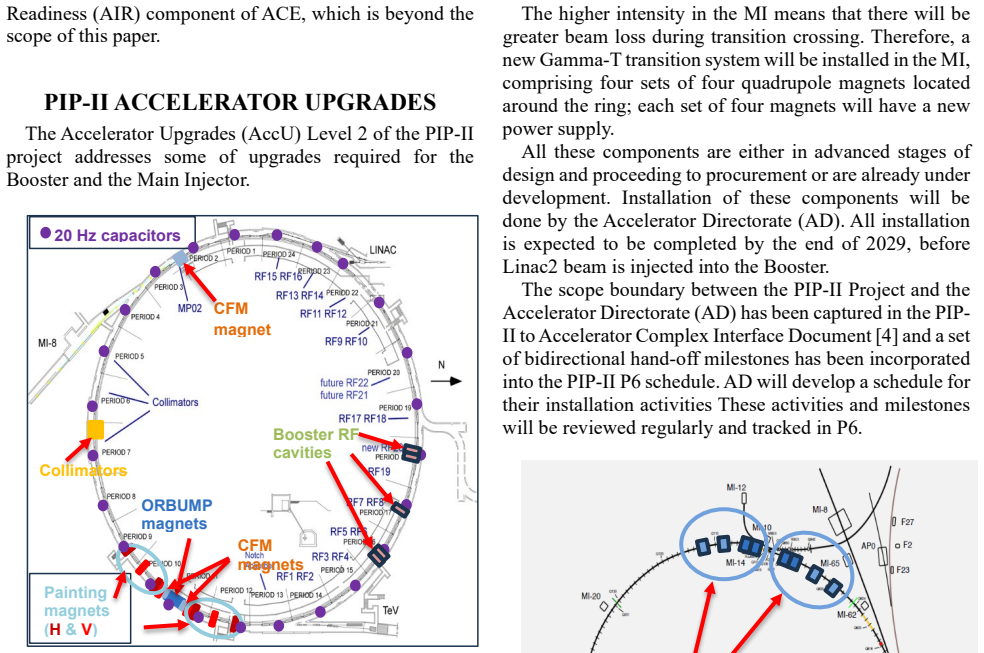
The higher energy, intensity and repetition rate from PIP-II require various upgrades to the Booster, the Recycler Ring and the Main Injector so that the existing accelerator complex can accept and accelerate the new beam.
What carries the argument
The existing accelerator complex of Booster, Recycler Ring and Main Injector, which must be modified to accept and accelerate the PIP-II beam parameters.
Load-bearing premise
That the listed upgrades will prove sufficient and can be implemented on schedule without major unforeseen beam dynamics problems or hardware limitations.
What would settle it
Measurement after upgrades showing that PIP-II beam cannot be injected, captured or accelerated at the required intensity or repetition rate without unacceptable losses or instability.
Figures
read the original abstract
The Proton Improvement Plan - II (PIP-II) injector linac is an 800 MeV superconducting H$^-$ linac, christened Linac2, that will replace the existing 400 MeV injector to the accelerator complex at Fermilab. The higher energy, intensity and repetition rate require various upgrades to the existing accelerator complex consisting of the Booster, the Recycler Ring and the Main Injector, in order to be able to accept and accelerate beam from PIP-II. In this paper we discuss various upgrades that are required and steps being taken to implement them.
Editorial analysis
A structured set of objections, weighed in public.
Referee Report
Summary. The manuscript presents the upgrades required for the Fermilab Booster, Recycler Ring, and Main Injector to handle the beam from the PIP-II 800 MeV H- linac, which has higher energy, intensity, and repetition rate compared to the current injector. It details the necessary modifications and the ongoing implementation steps to enable beam operation in the PIP-II/DUNE era.
Significance. This work is significant for the accelerator physics community as it provides a detailed planning document for upgrading an existing accelerator complex to meet the demands of a major neutrino experiment. By outlining specific upgrades and implementation steps, it helps ensure the feasibility of high-intensity beam delivery for DUNE. The paper's strength is in its focus on practical engineering and operational considerations rather than new physics results or derivations.
major comments (2)
- [Booster section] Booster section: The listed upgrades for handling increased intensity and repetition rate are presented without reference to specific beam dynamics simulations or quantitative limits (e.g., space charge or instability thresholds) that would demonstrate why these changes are required at the PIP-II parameters.
- [Recycler Ring and Main Injector sections] Recycler Ring and Main Injector sections: The discussion of required upgrades does not address potential beam loss mechanisms or emittance growth that the upgrades are intended to mitigate, leaving the necessity claim without supporting estimates.
minor comments (2)
- [Abstract] The abstract would benefit from briefly enumerating the main categories of upgrades to provide a clearer high-level overview before the detailed sections.
- Consider adding a summary table that lists all proposed upgrades, their locations, and primary purposes for improved readability and reference.
Simulated Author's Rebuttal
We thank the referee for the constructive review and recommendation of minor revision. The comments correctly identify opportunities to strengthen the justification for the listed upgrades by adding supporting references and estimates. We address each major comment below and will incorporate the suggested additions in the revised manuscript.
read point-by-point responses
-
Referee: [Booster section] Booster section: The listed upgrades for handling increased intensity and repetition rate are presented without reference to specific beam dynamics simulations or quantitative limits (e.g., space charge or instability thresholds) that would demonstrate why these changes are required at the PIP-II parameters.
Authors: We agree that explicit references to beam dynamics studies would improve the Booster section. The upgrades are driven by the fact that PIP-II parameters exceed the intensity and repetition-rate limits established by prior Fermilab simulations and operational experience. In the revision we will add citations to existing space-charge and instability threshold studies (including those performed for the original PIP-II design) that quantify the required changes at 800 MeV and the higher repetition rate. revision: yes
-
Referee: [Recycler Ring and Main Injector sections] Recycler Ring and Main Injector sections: The discussion of required upgrades does not address potential beam loss mechanisms or emittance growth that the upgrades are intended to mitigate, leaving the necessity claim without supporting estimates.
Authors: We acknowledge the value of briefly describing the beam-loss and emittance-growth mechanisms that the upgrades address. The Recycler and Main Injector upgrades target space-charge-driven losses, head-tail instabilities, and emittance dilution at the higher PIP-II intensities. We will add a short paragraph with order-of-magnitude estimates drawn from existing tracking studies and operational data to show how the proposed hardware and operational changes mitigate these effects. revision: yes
Circularity Check
No significant circularity
full rationale
The paper is a descriptive requirements document that lists upgrades needed for the Booster, Recycler, and Main Injector to accept PIP-II beam parameters. It contains no equations, derivations, fitted parameters, predictions, or self-citations that reduce any claim to its own inputs by construction. The central statement is a planning list grounded in external beam specifications, making the document self-contained with no internal circularity.
Axiom & Free-Parameter Ledger
Lean theorems connected to this paper
-
IndisputableMonolith/Foundation/AbsoluteFloorClosure.leanreality_from_one_distinction unclearThe higher energy, intensity and repetition rate require various upgrades to the existing accelerator complex consisting of the Booster, the Recycler Ring and the Main Injector
-
IndisputableMonolith/Foundation/AlexanderDuality.leanalexander_duality_circle_linking unclearNew Gamma-T jump system for the MI... New Gamma-T jump system for the Booster
Reference graph
Works this paper leans on
-
[1]
The PIP-II Conceptual Design Report,
M. Ball et al. , “The PIP-II Conceptual Design Report,” Fer- milab, Batavia, IL, USA, Tech. Rep. FERMILAB-DESIGN- 2017-01, Mar. 2017. https://doi.org/10.2172/1346823
-
[2]
B. Abi et al. (DUNE Collaboration), “Deep Underground Neutrino Experiment (DUNE), Far Detector Technical De- sign Report, V olume I: Introduction to DUNE,” J. Instrum., vol. 15, no. 8, p. T08008, Aug. 2020. https://doi.org/10.1088/1748-0221/15/08/T08008
-
[3]
AD Preparation for the DUNE -PIP-II Era: Workshop Summary,
M. Convery et al. , “AD Preparation for the DUNE -PIP-II Era: Workshop Summary,” Fermilab Accelerator Directorate, Batavia, IL, USA, Mar. 2024
work page 2024
-
[4]
PIP-II to Accelerator Complex Interface Document,
“PIP-II to Accelerator Complex Interface Document,” Fer- milab, Batavia, IL, USA, PIP-II docDB-4298, 2024
work page 2024
-
[5]
Rapid -cycling synchrotron options for a multi-MW proton facility at Fermilab,
J. Eldred et al. , “Rapid -cycling synchrotron options for a multi-MW proton facility at Fermilab,” Phys. Rev. Accel. Beams, vol. 22, no. 4, p. 044002, Apr. 2019. https://doi.org/10.1103/PhysRevAccelBeams.22.044002
-
[6]
Accelerator Complex Evolution at Fermilab
M. Convery, “Accelerator Complex Evolution at Fermilab ”, talk at the 17th International Particle Accelerator Conf. (IPAC’26), Deauville, France, May 2026 , paper TUI4M02, this conference. FY26 FY27 FY28 FY29 FY30 FY31 FY32 FY33 PIP-II related infrastructure 20 Hz instrumentation Booster RF cavities & tuners BTL buncher Power supplies HWR spare Booster Gamma-T
work page 2026
discussion (0)
Sign in with ORCID, Apple, or X to comment. Anyone can read and Pith papers without signing in.