Recognition: 2 theorem links
· Lean TheoremDispersive decay bounds for the SSH model on the half-line
Pith reviewed 2026-05-12 00:47 UTC · model grok-4.3
The pith
Dispersive decay estimates hold for the SSH model on the half-line with precise parameter dependence in the constants.
A machine-rendered reading of the paper's core claim, the machinery that carries it, and where it could break.
Core claim
Using oscillatory integral techniques, dispersive time-decay estimates are proved for the Schrödinger flow of the SSH model on the half-line. The estimates quantify the spreading of energy for localized initial data and determine the precise dependence of the decay constants on the parameters of the Hamiltonian, despite the presence of nonintegrable singularities in the oscillatory integrals arising from the boundary condition.
What carries the argument
Oscillatory integral estimates applied to the propagator of the half-line SSH Hamiltonian, which controls nonintegrable singularities induced by the boundary condition.
If this is right
- Energy from a localized initial condition spreads throughout the half-line lattice at a rate controlled by the decay estimates.
- The decay rates and their constants depend explicitly on the dimerization and coupling parameters of the SSH Hamiltonian.
- The bounds apply directly to self-adjoint discrete dimer lattice Hamiltonians on the half-line.
- Standard oscillatory integral methods remain effective even when the propagator expression contains boundary-induced singularities.
Where Pith is reading between the lines
- The precise parameter dependence could allow tuning of dispersion in engineered lattice systems with boundaries.
- Similar oscillatory-integral control might apply to other one-dimensional discrete models with defects or edges.
- The decay bounds provide a quantitative starting point for studying long-time behavior in related quantum walk or tight-binding models.
Load-bearing premise
Oscillatory integrals with nonintegrable singularities from the boundary condition can still be controlled by standard oscillatory-integral estimates to produce the claimed decay bounds and parameter dependence.
What would settle it
A numerical computation of the time-evolved wave packet for specific parameter values showing decay slower than the proved rate or constants that violate the predicted parameter dependence.
Figures


read the original abstract
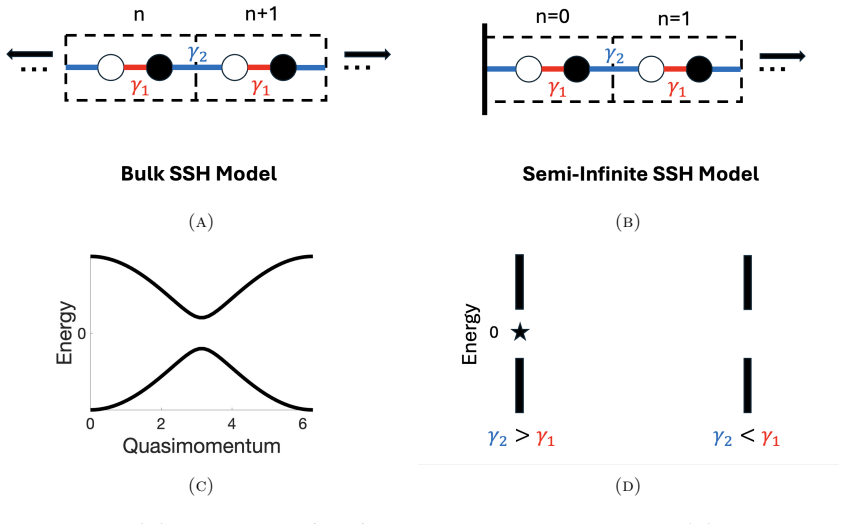
We study the Schr\"odinger flow for the SSH model, a class of self-adjoint discrete dimer lattice Hamiltonians on the half-line. Using oscillatory integral techniques, we prove dispersive time-decay estimates, which quantify the spreading of energy throughout the lattice for a localized initial condition. Furthermore, we determine precise dependence of the constants in the decay rates on the parameters of the Hamiltonian. The analysis is complicated by the fact that as a consequence of the boundary condition, the expression for the propagator contains oscillatory integrals with nonintegrable singularities.
Editorial analysis
A structured set of objections, weighed in public.
Referee Report
Summary. The manuscript proves dispersive time-decay estimates for the Schrödinger evolution generated by the Su-Schrieffer-Heeger (SSH) Hamiltonian on the half-line. The authors represent the propagator via oscillatory integrals that incorporate the boundary condition, then apply oscillatory-integral techniques to obtain decay bounds quantifying the spreading of localized initial data; the constants in these bounds are tracked explicitly in terms of the dimerization and hopping parameters of the model. The central technical step is the control of non-integrable singularities induced by the half-line boundary.
Significance. If the estimates hold with the stated parameter dependence, the result supplies quantitative dispersive bounds for a discrete lattice model with an edge, extending known infinite-line results to the half-line setting. Such bounds are useful for analyzing transport and localization phenomena in one-dimensional topological chains. The explicit parameter tracking is a positive feature that permits regime-specific conclusions without additional assumptions.
major comments (2)
- [§3] §3 (Oscillatory integral representation): The argument that the non-integrable singularities arising from the boundary condition can be controlled by standard oscillatory-integral estimates (integration by parts or van der Corput) without loss of the decay exponent or extra parameter restrictions is not fully detailed. A concrete verification that the phase and amplitude satisfy the required non-stationary or curvature conditions uniformly in the model parameters is needed to support the claimed t^{-1/2} (or better) decay.
- [Theorem 1.1] Theorem 1.1 (main decay statement): The dependence of the implicit constant on the SSH parameters (dimerization strength and boundary hopping) is asserted to be continuous and explicit, yet the proof sketch does not isolate where this dependence enters after the singularity is removed. If the constant blows up at certain parameter values (e.g., when the bulk gap closes), the statement should be qualified accordingly.
minor comments (2)
- [§2] Notation for the half-line lattice sites and the dimerization parameter should be introduced once and used consistently; occasional switches between a_n and the dimerized hopping confuse the reader.
- The abstract and introduction both mention 'precise dependence,' but no explicit formula or table summarizing the constant's scaling with the parameters is provided; adding such a summary would improve readability.
Simulated Author's Rebuttal
We thank the referee for the careful reading of our manuscript and the constructive comments. We address each major comment below and will revise the manuscript accordingly to improve clarity and completeness.
read point-by-point responses
-
Referee: [§3] §3 (Oscillatory integral representation): The argument that the non-integrable singularities arising from the boundary condition can be controlled by standard oscillatory-integral estimates (integration by parts or van der Corput) without loss of the decay exponent or extra parameter restrictions is not fully detailed. A concrete verification that the phase and amplitude satisfy the required non-stationary or curvature conditions uniformly in the model parameters is needed to support the claimed t^{-1/2} (or better) decay.
Authors: We agree that the presentation in Section 3 would benefit from additional explicit verification. In the revised manuscript we will expand the argument to include a direct check that the phase function φ(k) = kx − tE(k) (with E(k) the SSH dispersion) satisfies |φ''(k)| ≥ c(δ,t) > 0 uniformly away from the gap-closing point, where c depends continuously on the dimerization δ and hopping t. The amplitude, which incorporates the boundary reflection coefficient, remains C^1 and bounded uniformly in the same parameter regime. This permits a direct application of van der Corput’s lemma (or integration by parts) that recovers the t^{-1/2} decay rate without further restrictions. revision: yes
-
Referee: [Theorem 1.1] Theorem 1.1 (main decay statement): The dependence of the implicit constant on the SSH parameters (dimerization strength and boundary hopping) is asserted to be continuous and explicit, yet the proof sketch does not isolate where this dependence enters after the singularity is removed. If the constant blows up at certain parameter values (e.g., when the bulk gap closes), the statement should be qualified accordingly.
Authors: The constant in Theorem 1.1 is assembled from the lower bound on the curvature of the phase and the size of the spectral gap after the boundary singularity has been subtracted. Both quantities depend continuously on δ and t and remain positive precisely when the bulk gap is open. We will revise the statement of Theorem 1.1 to record this dependence explicitly and add a short remark immediately following the theorem that states the constant remains bounded for |δ| > 0 and may diverge as δ → 0 (gap closure). This isolates the parameter dependence without altering the main result. revision: yes
Circularity Check
Direct proof of estimates; no circular reductions
full rationale
The paper is a self-contained mathematical derivation of dispersive decay bounds via oscillatory integral techniques applied to the SSH Hamiltonian on the half-line. The central result is obtained by direct analysis of the propagator, with explicit handling of boundary-induced singularities; no parameters are fitted to data, no predictions are renamed fits, and no load-bearing steps reduce to self-citations or prior ansatzes by the same authors. The derivation relies on standard oscillatory-integral estimates (van der Corput, integration by parts) applied to the explicit integral representation, which is independent of the target bounds. This is the normal case of a direct proof paper whose claims are externally falsifiable via the stated assumptions on the Hamiltonian parameters.
Axiom & Free-Parameter Ledger
axioms (1)
- standard math Standard estimates for oscillatory integrals with singularities
Reference graph
Works this paper leans on
-
[1]
M. J. Ablowitz and A. S. Fokas.Complex Variables: Introduction and Applications. 2nd ed. Cambridge University Press, 2003
work page 2003
-
[2]
L. V. Ahlfors.Complex Analysis. 3rd ed. McGraw-Hill, 1979
work page 1979
-
[3]
J. K. Asb´ oth, L. Oroszl´ any, and A. P´ alyi.A Short Course on Topological Insulators. Springer, 2016
work page 2016
-
[4]
T. B¨ uhler and D. A. Salamon.Functional Analysis. Vol. 191. American Mathematical Society, 2018
work page 2018
-
[5]
Dispersion for Schr¨ odinger Operators with One-gap Periodic Potentials on R1
K. Cai. “Dispersion for Schr¨ odinger Operators with One-gap Periodic Potentials on R1”. In: Dynamics of PDE3 (Jan. 2006), pp. 71–92
work page 2006
-
[6]
Topological bands for ultracold atoms
N. R. Cooper, J. Dalibard, and I. B. Spielman. “Topological bands for ultracold atoms”. In: Rev. Mod. Phys.91 (1 2019), p. 015005
work page 2019
-
[7]
A. Coutant et al. “Acoustic Su-Schrieffer-Heeger lattice: Direct mapping of acoustic waveg- uides to the Su-Schrieffer-Heeger model”. In:Phys. Rev. B103 (22 2021), p. 224309
work page 2021
-
[8]
Dispersion for Schr¨ odinger Equation with Periodic Potential in 1D
S. Cuccagna. “Dispersion for Schr¨ odinger Equation with Periodic Potential in 1D”. In:Com- munications in Partial Differential Equations33.11 (2008), pp. 2064–2095
work page 2008
-
[9]
On Asymptotic Stability of Standing Waves of Discrete Schr¨ odinger Equation inZ
S. Cuccagna and M. Tarulli. “On Asymptotic Stability of Standing Waves of Discrete Schr¨ odinger Equation inZ”. In:SIAM Journal on Mathematical Analysis41.3 (2009), pp. 861–885
work page 2009
-
[10]
Floquet topological transitions in a driven one-dimensional topological insulator
V. Dal Lago, M. Atala, and L. E. F. Foa Torres. “Floquet topological transitions in a driven one-dimensional topological insulator”. In:Phys. Rev. A92 (2 2015), p. 023624
work page 2015
-
[11]
D. Damanik, J. Fillman, and G. Young.Optimal dispersion for discrete periodic Schr¨ odinger operators. 2025
work page 2025
-
[12]
A generalization of the Sherman-Morrison-Woodbury formula
C. Y. Deng. “A generalization of the Sherman-Morrison-Woodbury formula”. In:Applied Mathematics Letters24 (2011), pp. 1561–1564
work page 2011
-
[13]
F. Dewez. “Estimates of oscillatory integrals with stationary phase and singular amplitude: Applications to propagation features for dispersive equations”. In:Mathematische Nachrichten 291.5-6 (2018), pp. 793–826
work page 2018
-
[14]
J. Diestel and J. J. U. Jr.Vector Measures. Vol. 15. Mathematical Surveys and Monographs, 1997
work page 1997
-
[15]
S. Dyatlov and M. Zworski.Mathematical Theory of Scattering Resonances. Vol. 200. Amer- ican Mathematical Society, 2019
work page 2019
-
[16]
Dispersion estimates for one-dimensional Schr¨ odinger and Klein–Gordon equations revisited
I. E. Egorova et al. “Dispersion estimates for one-dimensional Schr¨ odinger and Klein–Gordon equations revisited”. In:Russian Mathematical Surveys71.3 (2016), p. 391
work page 2016
-
[17]
Dispersion estimates for one-dimensional discrete Schr¨ odinger and wave equations
I. Egorova, E. Kopylova, and G. Teschl. “Dispersion estimates for one-dimensional discrete Schr¨ odinger and wave equations”. In:Journal of Spectral Theory5.4 (2015), pp. 663–696
work page 2015
-
[18]
The massless Dirac equation in two dimen- sions: zero-energy obstructions and dispersive estimates
M. B. Erdo˘ gan, M. Goldberg, and W. R. Green. “The massless Dirac equation in two dimen- sions: zero-energy obstructions and dispersive estimates”. In:Journal of Spectral Theory11.3 (2021), pp. 935–979
work page 2021
-
[19]
Dispersive estimates for massive Dirac oper- ators in dimension two
M. B. Erdo˘ gan, W. R. Green, and E. Toprak. “Dispersive estimates for massive Dirac oper- ators in dimension two”. In:Journal of Differential Equations264.9 (2018), pp. 5802–5837
work page 2018
-
[20]
M. B. Erdo˘ gan, W. R. Green, and E. Toprak. “Dispersive estimates for Dirac operators in di- mension three with obstructions at threshold energies”. In:American Journal of Mathematics 141.5 (2019), pp. 1217–1258
work page 2019
-
[21]
Continuum Schroedinger Operators for Sharply Termi- nated Graphene-Like Structures
C. L. Fefferman and M. I. Weinstein. “Continuum Schroedinger Operators for Sharply Termi- nated Graphene-Like Structures”. In:Communications in Mathematical Physics380 (2020), pp. 853–945
work page 2020
-
[22]
An introduction to topological insulators
M. Fruchart and D. Carpentier. “An introduction to topological insulators”. In:Comptes Rendus Physique14.9 (2013), pp. 779–815. 94
work page 2013
-
[23]
Gakhov.Boundary Value Problems
F. Gakhov.Boundary Value Problems. Pergamon Press, 1966
work page 1966
-
[24]
Grafakos.Classical Fourier Analysis
L. Grafakos.Classical Fourier Analysis. 3rd ed. Springer New York, NY, 2014
work page 2014
-
[25]
Radiative Decay of Edge States in Floquet Media
S. N. Hameedi, A. Sagiv, and M. I. Weinstein. “Radiative Decay of Edge States in Floquet Media”. In:Multiscale Modeling and Simulation21.3 (2023), pp. 925–963
work page 2023
-
[26]
Enhanced Superconductivity in Quasi Two-Dimensional Systems
J. E. Hirsch and D. J. Scalapino. “Enhanced Superconductivity in Quasi Two-Dimensional Systems”. In:Phys. Rev. Lett.56 (25 1986), pp. 2732–2735
work page 1986
-
[27]
On the determination of a Hill’s equation from its spectrum
H. Hochstadt. “On the determination of a Hill’s equation from its spectrum”. In:Archive for Rational Mechanics and Analysis19 (1965), pp. 353–362
work page 1965
-
[28]
Y. Hong, Y. Tadano, and C. Yang.On the dispersive estimates for the discrete Schr¨ odinger equation on a honeycomb lattice. 2025
work page 2025
-
[29]
Resolvent expansions for the Schr¨ odinger operator on the discrete half-line
K. Ito and A. Jensen. “Resolvent expansions for the Schr¨ odinger operator on the discrete half-line”. In:Journal of Mathematical Physics58 (2017)
work page 2017
-
[30]
Decay estimates for Schr¨ odinger operators
J.-L. Journ´ e, A. Soffer, and C. D. Sogge. “Decay estimates for Schr¨ odinger operators”. In: Communications on Pure and Applied Mathematics44.5 (1991), pp. 573–604
work page 1991
-
[31]
Dispersive Estimates for 1D Discrete Schr¨ odinger and Klein-Gordon Equations
A. I. Komech, E. A. Kopylova, and M. Kunze. “Dispersive Estimates for 1D Discrete Schr¨ odinger and Klein-Gordon Equations”. In:Applicable Analysis85.12 (2006), pp. 1487–1508
work page 2006
-
[32]
Dispersive decay estimates for Dirac equations with a domain wall
J. Kraisler, A. Sagiv, and M. I. Weinstein. “Dispersive decay estimates for Dirac equations with a domain wall”. In:SIAM Journal on Mathematical Analysis56.6 (2024), pp. 7194–7227
work page 2024
-
[33]
Two-dimensional Hubbard model with nearest- and next-nearest- neighbor hopping
H. Q. Lin and J. E. Hirsch. “Two-dimensional Hubbard model with nearest- and next-nearest- neighbor hopping”. In:Phys. Rev. B35 (7 1987), pp. 3359–3368
work page 1987
-
[34]
Luki´ c.A First Course in Spectral Theory
M. Luki´ c.A First Course in Spectral Theory. Vol. 226. American Mathematical Society, 2022
work page 2022
-
[35]
Floquet Engineering of Quantum Materials
T. Oka and S. Kitamura. “Floquet Engineering of Quantum Materials”. In:Annual Review of Condensed Matter Physics10 (2019), pp. 387–408
work page 2019
-
[36]
Edge-Mode Lasing in 1D Topological Active Arrays
M. Parto et al. “Edge-Mode Lasing in 1D Topological Active Arrays”. In:Phys. Rev. Lett. 120 (11 2018), p. 113901
work page 2018
-
[37]
D. E. Pelinovsky and A. Stefanov. “On the spectral theory and dispersive estimates for a discrete Schr¨ odinger equation in one dimension”. In:Journal of Mathematical Physics49.11 (2008), p. 113501
work page 2008
-
[38]
M. Reed and B. Simon.Methods of Modern Mathematical Physics: Functional Analysis. Vol. 1. Academic Press, 1972
work page 1972
-
[39]
M. Reed and B. Simon.Methods of Modern Mathematical Physics: Analysis of Operators. Vol. 4. Academic Press, 1978
work page 1978
-
[40]
Decay versus survival of a localized state subjected to harmonic forcing: exact results
A. Rokhlenko, O. Costin, and J. Lebowitz. “Decay versus survival of a localized state subjected to harmonic forcing: exact results”. In:Journal of Physics A: Mathematical and General35.42 (2002), pp. 8943–8951
work page 2002
- [41]
-
[42]
Dispersive decay estimates for periodic Jacobi operators on the half-line
A. Sagiv, R. Kassem, and M. I. Weinstein. “Dispersive decay estimates for periodic Jacobi operators on the half-line”. In:Journal of Mathematical Analysis and Applications553.1 (2026), p. 129945
work page 2026
-
[43]
Second-neighbor hopping in the attractive Hubbard model
R. R. dos Santos. “Second-neighbor hopping in the attractive Hubbard model”. In:Phys. Rev. B46 (9 1992), pp. 5496–5498
work page 1992
-
[44]
Schlag.Dispersive estimates for Schroedinger operators: A survey
W. Schlag.Dispersive estimates for Schroedinger operators: A survey. 2005
work page 2005
-
[45]
The wave equation on the lattice in two and three dimensions
P. Schultz. “The wave equation on the lattice in two and three dimensions”. In:Communica- tions on Pure and Applied Mathematics51.6 (1998), pp. 663–695
work page 1998
-
[46]
Is the continuum SSH model topological?
J. Shapiro and M. I. Weinstein. “Is the continuum SSH model topological?” In:Journal of Mathematical Physics63.11 (2022), p. 111901
work page 2022
-
[47]
Tight binding reduction and topological equivalence in strong magnetic fields
J. Shapiro and M. I. Weinstein. “Tight binding reduction and topological equivalence in strong magnetic fields”. In:Advances in Mathematics403 (2022), p. 108343. 95
work page 2022
-
[48]
On the genericity of nonvanishing instability intervals in Hills equation
B. Simon. “On the genericity of nonvanishing instability intervals in Hills equation”. In: Annales de l’institut Henri Poincar´ e. Section A, Physique Th´ eorique24.1 (1976), pp. 91–93
work page 1976
-
[49]
Simon.Spectral Theory for L2 Perturbations of Orthogonal Polynomials
B. Simon.Spectral Theory for L2 Perturbations of Orthogonal Polynomials. Princeton: Prince- ton University Press, 2010
work page 2010
-
[50]
A. Soffer and M. I. Weinstein. “Nonautonomous Hamiltonians”. In:Journal of Statistical Physics93 (1998), pp. 359–391
work page 1998
-
[51]
A. Stefanov and P. G. Kevrekidis. “Asymptotic behaviour of small solutions for the discrete nonlinear Schr¨ odinger and Klein–Gordon equations”. In:Nonlinearity18.4 (2005), p. 1841
work page 2005
-
[52]
Interpolation of Linear Operators
E. M. Stein. “Interpolation of Linear Operators”. In:Transactions of the American Mathe- matical Society83.2 (1956), pp. 482–492
work page 1956
-
[53]
E. M. Stein.Singular Integrals and Differentiability Properties of Functions. Princeton Uni- versity Press, 1970
work page 1970
-
[54]
E. M. Stein.Harmonic Analysis: Real-Variable Methods, Orthogonality, and Oscillatory In- tegrals. Princeton University Press, 1993
work page 1993
-
[55]
E. M. Stein and R. Shakarchi.Complex Analysis. Princeton University Press, 2003
work page 2003
-
[56]
W. Su, J. Schrieffer, and A. Heeger. “Solitons in Polyacetylene”. In:Physical Review Letters 42.25 (1979)
work page 1979
-
[57]
Teschl.Jacobi operators and completely integrable nonlinear lattices
G. Teschl.Jacobi operators and completely integrable nonlinear lattices. 72. American Math- ematical Soc., 2000
work page 2000
-
[58]
The Lp-Lp’ estimate for the Schr¨ odinger equation on the half-line
R. Weder. “The Lp-Lp’ estimate for the Schr¨ odinger equation on the half-line”. In:Journal of Mathematical Analysis and Applications281.1 (2003), pp. 233–243
work page 2003
-
[59]
S. Yin, E. Galiffi, and A. Al` u. “Floquet metamaterials”. In:Annual Review of Condensed Matter Physics2.8 (2022)
work page 2022
-
[60]
Berry’s phase for energy bands in solids
J. Zak. “Berry’s phase for energy bands in solids”. In:Phys. Rev. Lett.62 (23 1989), pp. 2747– 2750. 96
work page 1989
discussion (0)
Sign in with ORCID, Apple, or X to comment. Anyone can read and Pith papers without signing in.