Recognition: 2 theorem links
· Lean TheoremThe Peculiar Velocity of Messier~87 from Microarcsecond Geodetic VLBI Astrometry
Pith reviewed 2026-05-12 01:01 UTC · model grok-4.3
The pith
28 years of geodetic VLBI data yield a 1037 km/s peculiar velocity for M87 at 65° to the line of sight.
A machine-rendered reading of the paper's core claim, the machinery that carries it, and where it could break.
Core claim
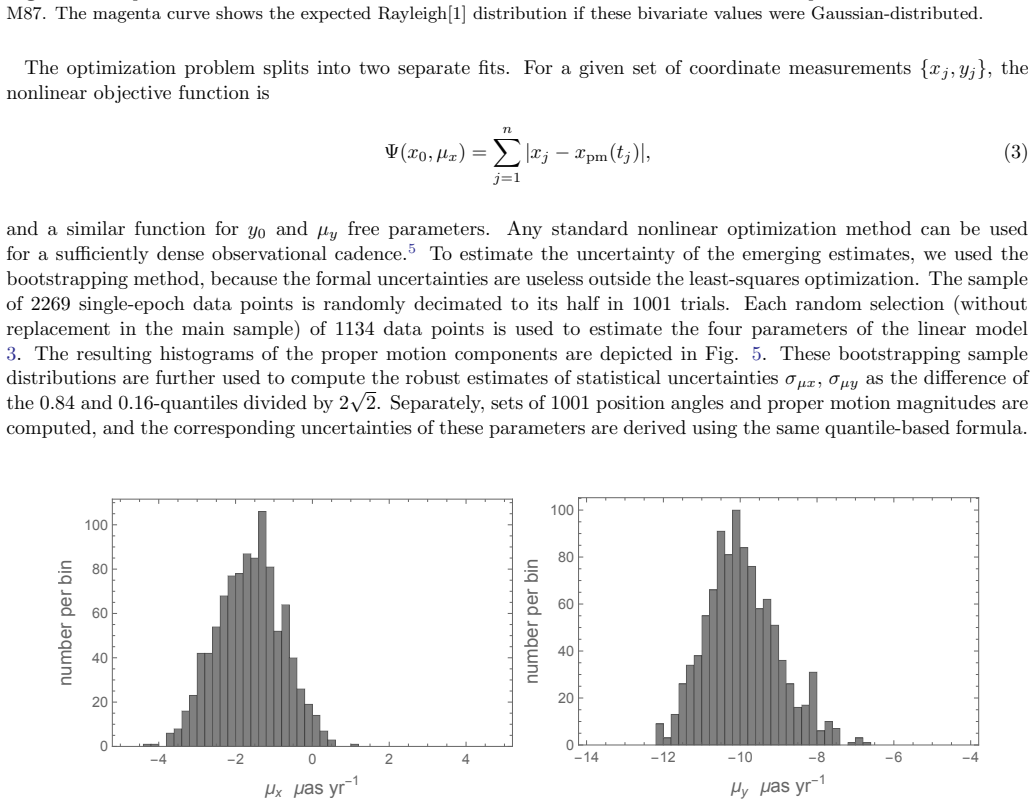
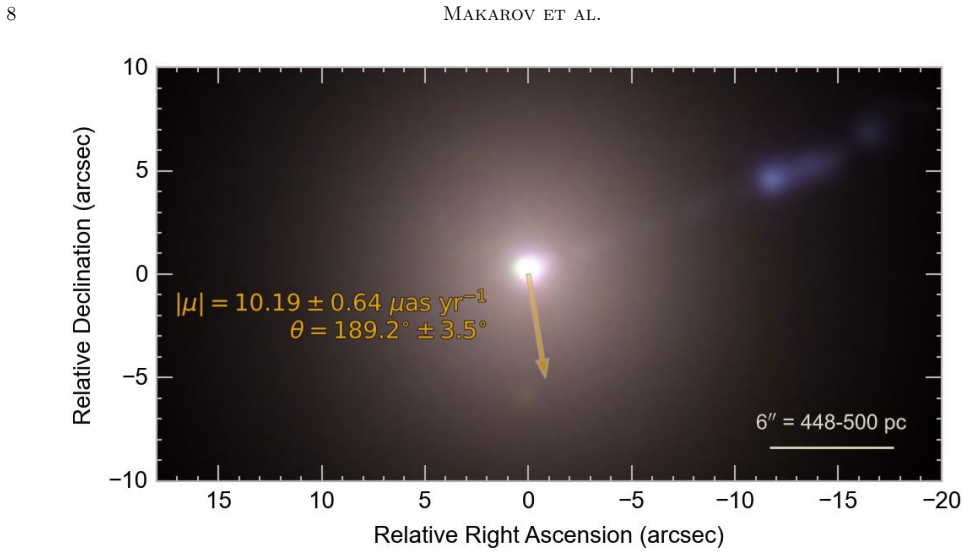
The radio-emitting core of M87 exhibits a proper motion of 10.19 ± 0.64 μas yr⁻¹ at equatorial position angle 189.2° ± 3.5° in the ICRF. At a distance of 16.1 Mpc this corresponds to a tangential velocity of 787 ± 50 km s⁻¹. Combined with the known radial velocity, the total peculiar velocity vector relative to the CMB rest frame has a magnitude of approximately 1037 km s⁻¹ and lies at an angle of 65° to the present line of sight, implying a substantial tangential relative motion between M87 and the Milky Way.
What carries the argument
Robust 1-norm optimization plus bootstrapping applied to 28 years of repeated VLBI position measurements of the radio core to extract the proper-motion vector.
If this is right
- M87 and the Milky Way possess a large relative tangential velocity component.
- The direction of M87's peculiar velocity aligns with the reconstructed motion of the Virgo filament toward the Great Attractor.
- The Milky Way's velocity in the same large-scale direction is slower than M87's by roughly 470 km/s.
- Full three-dimensional velocities of dominant cluster galaxies can now be obtained from long-term geodetic VLBI campaigns.
Where Pith is reading between the lines
- If the core truly represents the galaxy, similar VLBI campaigns on other nearby radio-loud ellipticals could map the local velocity field at higher precision than redshift surveys alone.
- The measured offset from the Milky Way's motion may constrain the dynamical mass of the Virgo cluster or the gravitational influence of the Great Attractor.
- Repeating the measurement with future higher-sensitivity arrays would test whether the current uncertainty of 50 km/s can be reduced enough to distinguish between different Lambda-CDM flow models.
Load-bearing premise
The measured motion of the compact radio core is assumed to trace the bulk peculiar motion of the entire galaxy rather than an internal jet feature.
What would settle it
A future optical or infrared astrometric campaign that measures the proper motion of M87's stellar population directly and finds a tangential velocity differing by more than 200 km/s from 787 km/s.
Figures


read the original abstract
Our knowledge of the space velocity of Messier 87, which is the dominant galaxy in the Virgo cluster, has been limited to the radial velocity component. Using a cadence of precision position measurements with the global geodetic very long baseline interferometry (VLBI) system over 28 years, we determined the proper motion vector of the radio-emitting core by a robust statistical method involving 1-norm optimization and bootstrapping. The proper motion vector is directed at a position angle $189.2\degr \pm 3.5\degr$ in the equatorial International Celestial Reference Frame, and its magnitude is $10.19$ $\mu$as yr$^{-1}$ with an uncertainty of $0.64$ $\mu$as yr$^{-1}$. The projected velocity of the AGN in the tangential sky plane is ($787\pm50$)~km~s$^{-1}$. The peculiar velocity of Messier 87 with respect to the preferred rest frame of the cosmic microwave background field is approximately 1037 km s$^{-1}$ (assuming a distance of 16.1 Mpc) with an angle of 65$^\circ$ to the current line of sight, which implies a tangential relative motion of M87 and the Galaxy. The peculiar velocity of M87 is directionally concordant with the reconstructed and $\Lambda$CDM-simulated motion of the Virgo filament towards the Great Attractor, but the Milky Way moves slower by 470 ~km~s$^{-1}$ in that direction.
Editorial analysis
A structured set of objections, weighed in public.
Referee Report
Summary. The manuscript reports a 28-year geodetic VLBI astrometric time series for the radio core of M87. Using 1-norm minimization and bootstrapping, the authors derive a proper motion of 10.19 ± 0.64 μas yr^{-1} at position angle 189.2° ± 3.5° in the ICRF. Converting the transverse component at an adopted distance of 16.1 Mpc yields 787 ± 50 km s^{-1}; combining with the known radial velocity produces a peculiar velocity vector of ~1037 km s^{-1} at 65° to the line of sight relative to the CMB frame. The result is interpreted as evidence for tangential motion between M87 and the Milky Way and directional agreement with the Virgo filament's motion toward the Great Attractor.
Significance. If the radio core motion accurately traces M87's center-of-mass velocity, the measurement supplies the first direct transverse-velocity constraint for the dominant Virgo galaxy. This would be valuable for calibrating local peculiar-velocity fields, testing ΛCDM predictions for the Virgo filament, and refining the relative motion between the Local Group and the Great Attractor. The robust 1-norm plus bootstrap fitting procedure is a clear methodological strength that reduces sensitivity to outliers in the long astrometric series.
major comments (2)
- [Results section (velocity conversion)] Results section (velocity conversion paragraph): the reported peculiar velocity of 1037 km s^{-1} and angle of 65° are computed at a fixed distance of 16.1 Mpc, yet the uncertainty on this distance is not propagated. Because both the tangential speed (v_t = 4.74 μ d) and the radial peculiar component (v_pec,r = v_rad − H_0 d) scale with d, the vector magnitude, direction, and the claimed 470 km s^{-1} differential with the Milky Way inherit this unquantified error; the abstract and main claims should reflect the propagated uncertainty.
- [Discussion section] Discussion section: the central claim that the measured core proper motion equals the bulk peculiar motion of M87 rests on the assumption that jet-induced core shifts and evolving components contribute negligibly. While the 1-norm + bootstrap method is robust, the manuscript does not quantify possible systematic offsets between the optically thick jet base and the stellar center of mass; this assumption is load-bearing for the interpretation of tangential motion and concordance with large-scale flows.
minor comments (1)
- [Abstract] Abstract: the proper-motion magnitude is written as '10.19 μas yr^{-1} with an uncertainty of 0.64 μas yr^{-1}' rather than the conventional '10.19 ± 0.64 μas yr^{-1}'; adopting standard notation would improve readability.
Simulated Author's Rebuttal
We thank the referee for the thoughtful and constructive report. We address the two major comments point by point below. Where the comments identify clear omissions, we have revised the manuscript accordingly.
read point-by-point responses
-
Referee: Results section (velocity conversion paragraph): the reported peculiar velocity of 1037 km s^{-1} and angle of 65° are computed at a fixed distance of 16.1 Mpc, yet the uncertainty on this distance is not propagated. Because both the tangential speed (v_t = 4.74 μ d) and the radial peculiar component (v_pec,r = v_rad − H_0 d) scale with d, the vector magnitude, direction, and the claimed 470 km s^{-1} differential with the Milky Way inherit this unquantified error; the abstract and main claims should reflect the propagated uncertainty.
Authors: We agree that the distance uncertainty must be propagated. The adopted distance of 16.1 Mpc carries a typical uncertainty of order 0.5 Mpc (~3%). In the revised manuscript we recompute the tangential velocity, peculiar-velocity vector magnitude, direction, and the differential with the Milky Way, folding in this error via standard propagation. The updated values and enlarged uncertainties will appear in the abstract, results, and discussion. revision: yes
-
Referee: Discussion section: the central claim that the measured core proper motion equals the bulk peculiar motion of M87 rests on the assumption that jet-induced core shifts and evolving components contribute negligibly. While the 1-norm + bootstrap method is robust, the manuscript does not quantify possible systematic offsets between the optically thick jet base and the stellar center of mass; this assumption is load-bearing for the interpretation of tangential motion and concordance with large-scale flows.
Authors: We acknowledge that the interpretation assumes the geodetic VLBI core position traces the stellar center of mass. The 28-year time series and 1-norm/bootstrap procedure already suppress the influence of transient jet components. Published multi-frequency VLBI studies of M87 indicate core shifts at 8 GHz are ≲ 0.1 mas and stable over decades, well below the measured proper-motion signal. We will add a concise paragraph in the discussion citing these constraints and noting the residual systematic as a caveat, but we cannot derive a new quantitative bound from the existing data alone. revision: partial
Circularity Check
No circularity: direct observational measurement converted via standard formulas and adopted distance
full rationale
The paper reports a direct astrometric measurement of the radio core proper motion from 28 years of VLBI data using 1-norm optimization and bootstrapping. The tangential velocity is computed from this proper motion and an externally adopted distance of 16.1 Mpc via the standard conversion v_t = 4.74 × μ(mas yr⁻¹) × d(kpc). The peculiar velocity vector is formed by combining the transverse component with the radial peculiar velocity (observed radial velocity minus H₀d). These steps rely on external reference frames (ICRF, CMB) and standard astronomical formulas without any self-referential definitions, fitted inputs renamed as predictions, or results that reduce to the inputs by construction. The derivation is self-contained against external benchmarks.
Axiom & Free-Parameter Ledger
free parameters (1)
- distance to M87
axioms (2)
- domain assumption The position of the radio core represents the bulk motion of the galaxy
- standard math The ICRF and CMB define the inertial and rest frames respectively
Reference graph
Works this paper leans on
-
[1]
Batcheldor, D., Robinson, A., Axon, D. J., Perlman, E. S., & Merritt, D. 2010, ApJL, 717, L6, doi: 10.1088/2041-8205/717/1/L6 B¨ ohringer, H., Briel, U. G., Schwarz, R. A., et al. 1994, Nature, 368, 828, doi: 10.1038/368828a0
-
[2]
2010, MNRAS, 407, 1403, doi: 10.1111/j.1365-2966.2010.16985.x
Cappellari, M., Emsellem, E., Krajnovi´ c, D., et al. 2011, MNRAS, 413, 813, doi: 10.1111/j.1365-2966.2010.18174.x
-
[3]
Cigan, P., Makarov, V. V., Secrest, N. J., et al. 2024, ApJS, 274, 28, doi: 10.3847/1538-4365/ad6772 de Grijs, R., & Bono, G. 2020, ApJS, 246, 3, doi: 10.3847/1538-4365/ab5711 de Vaucouleurs, G., de Vaucouleurs, A., & Corwin, J. R. 1976, Second reference catalogue of bright galaxies, 1976, 0 Space Velocity of Messier 8711 Event Horizon Telescope Collabora...
-
[4]
2024, A&A, 681, A79, doi: 10.1051/0004-6361/202347932
Alberdi, A., et al. 2024, A&A, 681, A79, doi: 10.1051/0004-6361/202347932
-
[5]
Feng, B. T., Bouman, K. L., & Freeman, W. T. 2024, ApJ, 975, 201, doi: 10.3847/1538-4357/ad737f Gaia Collaboration, Prusti, T., de Bruijne, J. H. J., et al. 2016, A&A, 595, A1, doi: 10.1051/0004-6361/201629272 Gaia Collaboration, Brown, A. G. A., Vallenari, A., et al. 2021a, A&A, 649, A1, doi: 10.1051/0004-6361/202039657 Gaia Collaboration, Klioner, S. A....
-
[6]
Gordon, D., de Witt, A., & Jacobs, C. S. 2023, AJ, 165, 49, doi: 10.3847/1538-3881/aca65b GRAVITY Collaboration, Abuter, R., Amorim, A., et al. 2019, A&A, 625, L10, doi: 10.1051/0004-6361/201935656
-
[7]
2008, ApJ, 678, 780, doi: 10.1086/586877
Gualandris, A., & Merritt, D. 2008, ApJ, 678, 780, doi: 10.1086/586877
-
[8]
Klypin, A., Hoffman, Y., Kravtsov, A. V., & Gottl¨ ober, S. 2003, ApJ, 596, 19, doi: 10.1086/377574
-
[9]
Kopeikin, S. M., & Makarov, V. V. 2006, AJ, 131, 1471, doi: 10.1086/500170
-
[10]
2003, A&A, 404, 743, doi: 10.1051/0004-6361:20030560
Kovalevsky, J. 2003, A&A, 404, 743, doi: 10.1051/0004-6361:20030560
-
[11]
Lahav, O., Santiago, B. X., Webster, A. M., et al. 1998, arXiv e-prints, astro, doi: 10.48550/arXiv.astro-ph/9809343 L´ opez-Navas, E., & Prieto, M. A. 2018, MNRAS, 480, 4099, doi: 10.1093/mnras/sty2148
work page internal anchor Pith review doi:10.48550/arxiv.astro-ph/9809343 1998
-
[12]
V., Cigan, P., Gordon, D., et al
Makarov, V. V., Cigan, P., Gordon, D., et al. 2024a, ApJL, 977, L14, doi: 10.3847/2041-8213/ad94f1
-
[13]
2024b, PASP, 136, 054503, doi: 10.1088/1538-3873/ad4b9f
Gordon, D. 2024b, PASP, 136, 054503, doi: 10.1088/1538-3873/ad4b9f
-
[14]
McConnachie, A. W., & Venn, K. A. 2020, Research Notes of the American Astronomical Society, 4, 229, doi: 10.3847/2515-5172/abd18b
-
[15]
Mei, S., Blakeslee, J. P., Cˆ ot´ e, P., et al. 2007, ApJ, 655, 144, doi: 10.1086/509598 Mo´ or, A., Frey, S., Lambert, S. B., Titov, O. A., & Bakos, J. 2011, AJ, 141, 178, doi: 10.1088/0004-6256/141/6/178
-
[16]
Mould, J. 2013, in IAU Symposium, Vol. 289, Advancing the Physics of Cosmic Distances, ed. R. de Grijs, 262–268, doi: 10.1017/S1743921312021527
-
[17]
2020, A&A, 634, A38, doi: 10.1051/0004-6361/201936586
Nalewajko, K., Sikora, M., & R´ o˙ za´ nska, A. 2020, A&A, 634, A38, doi: 10.1051/0004-6361/201936586
-
[18]
W., Jord´ an, A., Blakeslee, J
Peng, E. W., Jord´ an, A., Blakeslee, J. P., et al. 2009, ApJ, 703, 42, doi: 10.1088/0004-637X/703/1/42
-
[19]
Pierce, M. J., Welch, D. L., McClure, R. D., et al. 1994, Nature, 371, 385, doi: 10.1038/371385a0 Planck Collaboration, Aghanim, N., Akrami, Y., et al. 2020, A&A, 641, A6, doi: 10.1051/0004-6361/201833910
-
[20]
2007, arXiv e-prints, arXiv:0710.1338, doi: 10.48550/arXiv.0710.1338
Pretorius, F. 2007, arXiv e-prints, arXiv:0710.1338, doi: 10.48550/arXiv.0710.1338
-
[21]
Quercellini, C., Quartin, M., & Amendola, L. 2009, Phys. Rev. Lett., 102, 151302, doi: 10.1103/PhysRevLett.102.151302
-
[22]
B., Ibata, R., Reyl´ e, C., et al
Salomon, J. B., Ibata, R., Reyl´ e, C., et al. 2021, MNRAS, 507, 2592, doi: 10.1093/mnras/stab2253 Sch¨ onrich, R., Binney, J., & Dehnen, W. 2010, MNRAS, 403, 1829, doi: 10.1111/j.1365-2966.2010.16253.x
-
[23]
Shaya, E. J., Tully, R. B., Hoffman, Y., & Pomar` ede, D. 2017, ApJ, 850, 207, doi: 10.3847/1538-4357/aa9525
-
[24]
Tikhonov, N. A., Galazutdinova, O. A., & Karataeva, G. M. 2019, Astrophysical Bulletin, 74, 257, doi: 10.1134/S1990341319030027
-
[25]
Titov, O., & Lambert, S. 2013a, VizieR Online Data Catalog: Fitted proper motions for the DR solution (Titov+, 2013),, VizieR On-line Data Catalog: J/A+A/559/A95. Originally published in: 2013A&A...559A..95T doi: 10.26093/cds/vizier.35590095
-
[26]
2013b, A&A, 559, A95, doi: 10.1051/0004-6361/201321806
Titov, O., & Lambert, S. 2013b, A&A, 559, A95, doi: 10.1051/0004-6361/201321806
-
[27]
Titov, O., Lambert, S. B., & Gontier, A. M. 2011, VizieR Online Data Catalog: Proper motions of 555 quasars from VLBI (Titov+, 2011),, VizieR On-line Data Catalog: J/A+A/529/A91. Originally published in: 2011A&A...529A..91T doi: 10.26093/cds/vizier.35290091
-
[28]
Truebenbach, A. E., & Darling, J. 2017, ApJS, 233, 3, doi: 10.3847/1538-4365/aa9026
-
[29]
Tully, R. B., Courtois, H. M., & Sorce, J. G. 2016, AJ, 152, 50, doi: 10.3847/0004-6256/152/2/50
-
[30]
Tully, R. B., & Shaya, E. J. 1984, ApJ, 281, 31, doi: 10.1086/162073
-
[31]
, archivePrefix = "arXiv", eprint =
Junor, W. 2018, ApJ, 855, 128, doi: 10.3847/1538-4357/aaafcc
discussion (0)
Sign in with ORCID, Apple, or X to comment. Anyone can read and Pith papers without signing in.