Recognition: no theorem link
Electroweak Restoration: SMEFT and HEFT
Pith reviewed 2026-05-12 00:57 UTC · model grok-4.3
The pith
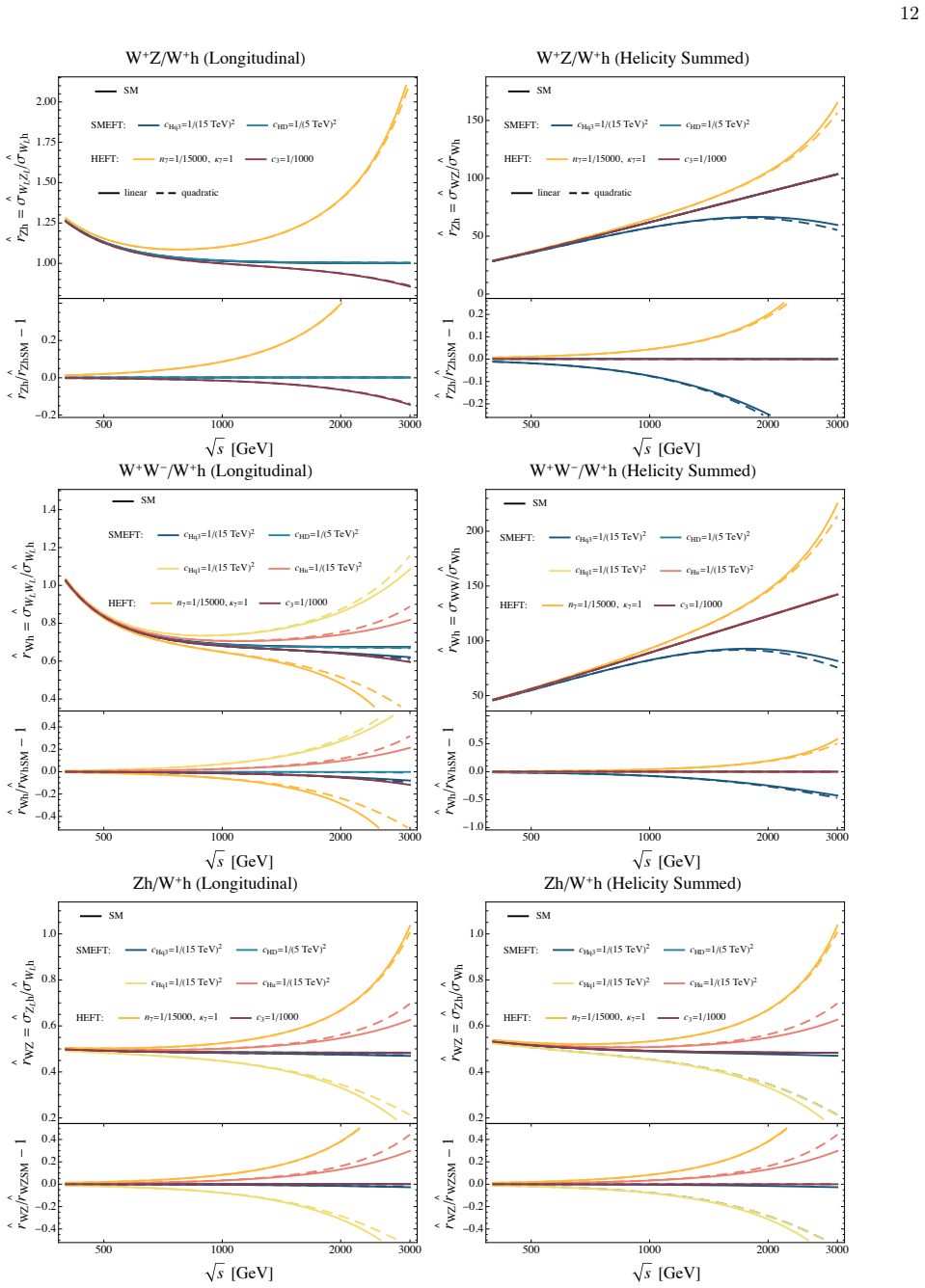
High-energy amplitude ratios for longitudinal gauge boson and Higgs production approach one in the SM and SMEFT but not in HEFT.
A machine-rendered reading of the paper's core claim, the machinery that carries it, and where it could break.
Core claim
Using the Goldstone boson equivalence theorem, the authors derive a set of ratios among high-energy amplitudes for f fbar' to V_L V'_L and V_L h that are expected to approach one in the SM and SMEFT. Explicit calculations confirm these ratios approach one in the SM and dimension-6 SMEFT. In HEFT, however, the ratios do not necessarily approach one. The cross section ratio of W±_L Z_L and W±_L h is highlighted as a promising observable to probe electroweak restoration and distinguish linear from non-linear realizations, with projections for sensitivities at the HL-LHC using current and future measurements.
What carries the argument
The set of high-energy amplitude ratios for longitudinal vector-boson pair production and associated Higgs production, obtained from the Goldstone boson equivalence theorem; these ratios enforce unity in linear effective theories but permit deviations in non-linear ones.
Load-bearing premise
The Goldstone boson equivalence theorem holds with sufficient accuracy at the energies considered, and higher-order operators in HEFT do not spoil the expected ratios before the effective theory breaks down.
What would settle it
A high-energy measurement at the HL-LHC or a future collider in which the cross-section ratio of W±_L Z_L to W±_L h production deviates significantly from the value predicted to approach one in the SM and SMEFT.
Figures


read the original abstract
Colliders continue to push our understanding of electroweak (EW) interactions to ever higher energies. At high energies, many observables in the broken EW theory are expected to approach the unbroken theory. This is the electroweak restoration regime, where longitudinal gauge boson production corresponds to Goldstone boson production. As such, in this paper we investigate electroweak restoration in the context of linear and non-linear realizations of the EW symmetry in longitudinal di-boson production: $f\bar{f}'\rightarrow V_LV'_L$ and $f\bar{f}'\rightarrow V_Lh$, where $V_L,V'_L$ are longitudinal gauge bosons, $h$ is the Higgs boson, and $f,f'$ are SM fermions. For the linear beyond the SM (BSM) theory, we use the Standard Model Effective Theory (SMEFT), and for the non-linear BSM theory, we use Higgs Effective Field Theory (HEFT). We give a general discussion of these amplitudes and cross sections in the SM, SMEFT, and HEFT. Using the Goldstone boson equivalence theorem, we derive a set of ratios among high energy $V_LV'_L$ and $V_Lh$ amplitudes that are expected to approach one in the SM and SMEFT. Through our explicit calculations, we show that these ratios do indeed approach one in the SM and dimension-6 SMEFT, but not necessarily HEFT. Beyond the amplitudes, both theoretically and experimentally, we identify the cross section ratio of $W^\pm_LZ_L$ and $W^\pm_L h$ as a particularly promising observable to probe EW restoration and distinguish HEFT and SMEFT. Using current LHC measurements as well as projections for $W^\pm_L h$ measurements, we project HL-LHC sensitivities to probing the linear vs. non-linear realizations of the EW symmetry.
Editorial analysis
A structured set of objections, weighed in public.
Referee Report
Summary. The paper investigates electroweak restoration in high-energy longitudinal di-boson production processes f f-bar' → V_L V'_L and f f-bar' → V_L h. Using the Goldstone boson equivalence theorem, it derives amplitude ratios expected to approach unity in the SM and dimension-6 SMEFT, verifies this via explicit calculations, and shows that the ratios do not necessarily approach unity in HEFT. It identifies the cross-section ratio of W±_L Z_L to W±_L h as a promising observable to distinguish linear (SMEFT) from non-linear (HEFT) realizations of electroweak symmetry and provides HL-LHC sensitivity projections based on current LHC data.
Significance. If the central calculations hold, the work supplies a concrete, falsifiable handle on the linear versus non-linear structure of electroweak symmetry breaking through a specific high-energy observable. The explicit verification of the amplitude ratios in the SM and SMEFT, together with the identification of the W_L Z_L / W_L h cross-section ratio, adds practical value. The inclusion of LHC measurements and HL-LHC projections strengthens the experimental relevance.
major comments (2)
- [HEFT amplitudes section (near Eq. (15))] HEFT amplitudes section (near Eq. (15)): the statement that the ratios 'do not necessarily' approach one in HEFT is formally correct, but the manuscript provides no quantitative comparison of the energy at which the asymptotic ratios stabilize against the cutoff scale or partial-wave unitarity bounds for representative HEFT benchmark points. This comparison is load-bearing for the claim that the W±_L Z_L / W±_L h ratio can observably distinguish HEFT from SMEFT before the effective theory breaks down.
- [§5 (HL-LHC projections)] §5 (HL-LHC projections): the sensitivity estimates assume the high-energy regime where restoration holds is experimentally accessible within the EFT validity range; however, the text does not supply error estimates on the amplitude computations or unitarity checks in HEFT, leaving the robustness of the projected distinction unclear.
minor comments (3)
- [general discussion of amplitudes] The definition of the amplitude ratios in the general discussion could be stated more explicitly with the precise high-energy limit taken (e.g., s → ∞ at fixed angles).
- [figures] Figure captions for the cross-section plots should specify the center-of-mass energy range shown and whether the curves include interference terms.
- [introduction] A reference to prior literature on electroweak restoration in the unbroken limit would help contextualize the ratio derivations.
Simulated Author's Rebuttal
We thank the referee for the positive overall assessment and for the constructive major comments, which help clarify the robustness of our results. We respond point by point below.
read point-by-point responses
-
Referee: HEFT amplitudes section (near Eq. (15)): the statement that the ratios 'do not necessarily' approach one in HEFT is formally correct, but the manuscript provides no quantitative comparison of the energy at which the asymptotic ratios stabilize against the cutoff scale or partial-wave unitarity bounds for representative HEFT benchmark points. This comparison is load-bearing for the claim that the W±_L Z_L / W±_L h ratio can observably distinguish HEFT from SMEFT before the effective theory breaks down.
Authors: We agree that an explicit comparison for benchmark points would make the observability claim more concrete. The manuscript's central point is the structural difference: unlike SMEFT, HEFT does not enforce the ratios to approach unity. To address the referee's concern, the revised manuscript adds a short discussion with a representative HEFT benchmark (coefficients chosen to satisfy current LHC bounds). For this point the W_L Z_L / W_L h ratio deviates from unity already at ~1 TeV, while the partial-wave unitarity cutoff lies at ~2.5 TeV. This illustrates that the distinction can be probed inside the EFT validity range. A brief remark on the dependence on the HEFT coefficients is also included. revision: yes
-
Referee: §5 (HL-LHC projections): the sensitivity estimates assume the high-energy regime where restoration holds is experimentally accessible within the EFT validity range; however, the text does not supply error estimates on the amplitude computations or unitarity checks in HEFT, leaving the robustness of the projected distinction unclear.
Authors: We accept that the absence of explicit error estimates and unitarity checks weakens the robustness statement. The revised Section 5 now includes (i) a short discussion of theoretical uncertainties from EFT truncation in the amplitudes and (ii) unitarity bounds evaluated for the HEFT scenarios used in the projections. The high-energy bins retained for the sensitivity study lie below these bounds. Error bands reflecting these considerations have been added to the projected exclusion contours. revision: yes
Circularity Check
No circularity: ratios derived via standard GBET and verified by explicit amplitude calculations
full rationale
The paper's central chain begins with the standard Goldstone boson equivalence theorem applied to high-energy amplitudes for f f-bar' to V_L V'_L and V_L h, yielding expected ratios that approach unity in the unbroken limit. These ratios are then computed explicitly in the SM, dimension-6 SMEFT, and HEFT Lagrangians. The explicit results confirm approach to unity in SM/SMEFT but not necessarily in HEFT, with the W_L Z_L / W_L h cross-section ratio identified as observable. No equation reduces a claimed prediction to a parameter fitted inside the paper, no self-citation supplies a uniqueness theorem or ansatz, and the GBET input is an external theorem independent of the present calculations. The derivation is therefore self-contained.
Axiom & Free-Parameter Ledger
axioms (1)
- standard math Goldstone boson equivalence theorem holds for longitudinal gauge boson amplitudes at high energies
Reference graph
Works this paper leans on
-
[1]
J. M. Cornwall, D. N. Levin, and G. Tiktopoulos, Phys. Rev. D10, 1145 (1974), [Erratum: Phys.Rev.D 11, 972 (1975)]
work page 1974
-
[2]
B. W. Lee, C. Quigg, and H. B. Thacker, Phys. Rev. D 16, 1519 (1977)
work page 1977
-
[3]
M. S. Chanowitz and M. K. Gaillard, Nucl. Phys. B261, 379 (1985)
work page 1985
-
[4]
G. J. Gounaris, R. Kogerler, and H. Neufeld, Phys. Rev. D34, 3257 (1986)
work page 1986
- [5]
- [6]
- [7]
- [8]
- [9]
-
[10]
M. Forslund, Z. Liu, I. Mahbub, and P. Meade, Elec- troweak restoration at muon collider, work in progress
-
[11]
S. J. Brodsky and R. W. Brown, Phys. Rev. Lett.49, 966 (1982)
work page 1982
- [12]
-
[13]
R. Capdevilla and T. Han, Phys. Rev. Lett.135, 101801 (2025), arXiv:2412.12336 [hep-ph]
- [14]
-
[15]
Dimension-Six Terms in the Standard Model Lagrangian
B. Grzadkowski, M. Iskrzynski, M. Misiak, and J. Rosiek, JHEP10, 085, arXiv:1008.4884 [hep-ph]
work page internal anchor Pith review arXiv
- [16]
- [17]
-
[18]
L. Berthier, M. Bjørn, and M. Trott, JHEP09, 157, arXiv:1606.06693 [hep-ph]
-
[19]
I. Brivio and M. Trott, Phys. Rept.793, 1 (2019), arXiv:1706.08945 [hep-ph]
-
[20]
I. Brivio and M. Trott, JHEP07, 148, [Addendum: JHEP 05, 136 (2018)], arXiv:1701.06424 [hep-ph]
-
[21]
F. Feruglio, Int. J. Mod. Phys. A8, 4937 (1993), arXiv:hep-ph/9301281
- [22]
-
[23]
B. Grinstein and M. Trott, Phys. Rev. D76, 073002 (2007), arXiv:0704.1505 [hep-ph]
- [24]
- [25]
-
[26]
G. Buchalla, O. Cat` a, and C. Krause, Nucl. Phys. B880, 552 (2014), [Erratum: Nucl.Phys.B 913, 475–478 (2016)], arXiv:1307.5017 [hep-ph]
- [27]
- [28]
- [29]
- [30]
- [31]
- [32]
- [33]
- [34]
-
[35]
F. Abu-Ajamieh, S. Chang, M. Chen, and M. A. Luty, JHEP07, 056, arXiv:2009.11293 [hep-ph]
-
[36]
R. G´ omez-Ambrosio, F. J. Llanes-Estrada, A. Salas- Bern´ ardez, and J. J. Sanz-Cillero, Phys. Rev. D106, 053004 (2022), arXiv:2204.01763 [hep-ph]
-
[37]
D. Domenech, M. J. Herrero, R. A. Morales, and M. Ramos, Phys. Rev. D106, 115027 (2022), arXiv:2208.05452 [hep-ph]
-
[38]
C. Englert, W. Naskar, and D. Sutherland, JHEP11, 158, arXiv:2307.14809 [hep-ph]
- [39]
- [40]
- [41]
-
[42]
D. Domenech, M. Herrero, R. A. Morales, and A. Salas-Bern´ ardez, Phys. Rev. D112, 115022 (2025), arXiv:2506.21716 [hep-ph]
-
[43]
G. Aadet al.(ATLAS), Phys. Lett. B843, 137895 (2023), arXiv:2211.09435 [hep-ex]
-
[44]
G. Aadet al.(ATLAS), Phys. Rev. Lett.133, 101802 (2024), [Erratum: Phys.Rev.Lett. 133, 169901 (2024)], arXiv:2402.16365 [hep-ex]
- [45]
-
[46]
K. J. F. Gaemers and G. J. Gounaris, Z. Phys. C1, 259 (1979)
work page 1979
-
[47]
M. J. Duncan, G. L. Kane, and W. W. Repko, Nucl. Phys. B272, 517 (1986)
work page 1986
-
[48]
K. Hagiwara, R. D. Peccei, D. Zeppenfeld, and K. Hikasa, Nucl. Phys. B282, 253 (1987)
work page 1987
- [49]
- [50]
-
[51]
Z. Zhang, Phys. Rev. Lett.118, 011803 (2017), arXiv:1610.01618 [hep-ph]
- [52]
-
[53]
R. Franceschini, G. Panico, A. Pomarol, F. Riva, and A. Wulzer, JHEP02, 111, arXiv:1712.01310 [hep-ph]
- [54]
- [55]
- [56]
- [57]
-
[58]
T. Corbett and A. Martin, SciPost Phys.16, 019 (2024), arXiv:2306.00053 [hep-ph]
-
[59]
J. de Blas, A. Goncalves, V. Miralles, L. Reina, L. Sil- vestrini, and M. Valli, JHEP03, 013, arXiv:2507.06191 [hep-ph]
- [60]
-
[61]
R. S. Chivukula and H. Georgi, Phys. Lett. B188, 99 (1987)
work page 1987
-
[62]
G. D’Ambrosio, G. F. Giudice, G. Isidori, and A. Stru- mia, Nucl. Phys. B645, 155 (2002), arXiv:hep- ph/0207036
-
[63]
J. Pumplin, D. R. Stump, J. Huston, H. L. Lai, P. M. Nadolsky, and W. K. Tung, JHEP07, 012, arXiv:hep- ph/0201195
-
[64]
LHAPDF6: parton density access in the LHC precision era
A. Buckley, J. Ferrando, S. Lloyd, K. Nordstr¨ om, B. Page, M. R¨ ufenacht, M. Sch¨ onherr, and G. Watt, Eur. Phys. J. C75, 132 (2015), arXiv:1412.7420 [hep-ph]
work page Pith review arXiv 2015
- [65]
-
[66]
J. Alwall, R. Frederix, S. Frixione, V. Hirschi, F. Maltoni, O. Mattelaer, H. S. Shao, T. Stelzer, P. Torrielli, and M. Zaro, JHEP07, 079, arXiv:1405.0301 [hep-ph]
work page internal anchor Pith review Pith/arXiv arXiv
-
[67]
Aadet al.(ATLAS, CMS), (2025), arXiv:2504.00672 [hep-ex]
G. Aadet al.(ATLAS, CMS), (2025), arXiv:2504.00672 [hep-ex]
-
[68]
Aadet al.(ATLAS), JHEP11, 006, arXiv:2507.03500 [hep-ex]
G. Aadet al.(ATLAS), JHEP11, 006, arXiv:2507.03500 [hep-ex]
-
[69]
Aadet al.(ATLAS), JHEP04, 075, arXiv:2410.19611 [hep-ex]
G. Aadet al.(ATLAS), JHEP04, 075, arXiv:2410.19611 [hep-ex]
-
[70]
Hayrapetyanet al.(CMS), (2026), arXiv:2601.05362 [hep-ex]
A. Hayrapetyanet al.(CMS), (2026), arXiv:2601.05362 [hep-ex]
-
[71]
A. Tumasyanet al.(CMS), Phys. Rev. D109, 092011 (2024), arXiv:2312.07562 [hep-ex]
discussion (0)
Sign in with ORCID, Apple, or X to comment. Anyone can read and Pith papers without signing in.