Recognition: 2 theorem links
· Lean TheoremRecovering Physical Dynamics from Discrete Observations via Intrinsic Differential Consistency
Pith reviewed 2026-05-12 03:48 UTC · model grok-4.3
The pith
Enforcing the semi-group property via symmetry rupture recovers continuous dynamics from discrete observations.
A machine-rendered reading of the paper's core claim, the machinery that carries it, and where it could break.
Core claim
Any flow representing autonomous dynamics must satisfy the semi-group property under time translation. By training a time-conditioned secant velocity field to minimize its deviation from this property, called Symmetry Rupture, the method confines the model to internally consistent flows. During inference, the rupture measure replaces local truncation error as the criterion for choosing the largest valid step size, allowing the solver to allocate compute according to local geometric complexity.
What carries the argument
Symmetry Rupture, the deviation of a time-conditioned secant velocity field from the semi-group property under time translation, which acts as both a training regularizer and an adaptive step-size selector.
If this is right
- The learned models produce stable long-horizon rollouts in direct auto-regressive mode without intermediate time cues.
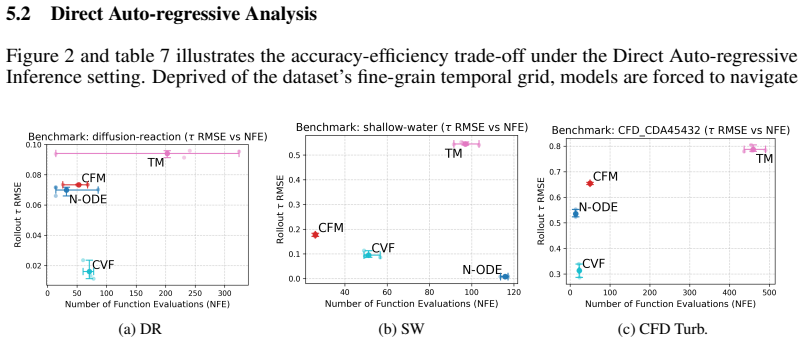
- Rollout RMSE drops substantially while requiring up to 5x fewer function evaluations than standard Neural ODE baselines.
- Adaptive step selection based on local consistency keeps error lowest on multiple PDE benchmarks where baselines diverge or need far more evaluations.
- The approach works in both time-informed inference and more demanding direct prediction settings.
Where Pith is reading between the lines
- The same consistency penalty could be combined with known physical invariants to further narrow the space of possible flows.
- Monitoring growth in rupture over long predictions might serve as an early indicator of when a model loses accuracy.
- The idea of using algebraic flow properties as oracles could extend to learning from irregularly sampled data in non-physical domains.
Load-bearing premise
That penalizing deviation from the semi-group property will recover the true underlying continuous dynamics rather than some other consistent flow.
What would settle it
A system with multiple distinct flows that all satisfy the semi-group property and match the same discrete observations but produce different long-term trajectories; if the method recovers a flow other than the true one, the recovery claim fails.
Figures




read the original abstract
Recovering continuous-time dynamics from discrete observations is difficult because local supervision (e.g., pointwise regression targets, derivative approximations, or equation residuals) loses fidelity as the observation interval grows. We replace local supervision with a global structural constraint: any flow representing autonomous dynamics must satisfy the semi-group property under time translation. We train a time-conditioned secant velocity field whose deviation from this property, which we call Symmetry Rupture, serves two purposes. As a training regularizer, it confines the hypothesis space to flows that compose consistently across temporal scales. As an inference oracle, it lets the solver select the largest step size that preserves internal consistency, replacing the local truncation error that conventional adaptive solvers depend on. On the diffusion-reaction benchmark under time-informed inference, our method reduces rollout RMSE by 87\% while using 5x fewer function evaluations than a Neural ODE baseline. In the more demanding direct auto-regressive setting, where the model must predict distant future frames without intermediate temporal cues, our adaptive solver allocates compute based on local geometric complexity -- maintaining the lowest rollout RMSE on two of three PDE benchmarks while baselines either diverge or require up to an order of magnitude more function evaluations to remain stable.
Editorial analysis
A structured set of objections, weighed in public.
Referee Report
Summary. The paper proposes recovering continuous-time physical dynamics from discrete observations by training a time-conditioned secant velocity field that enforces the semi-group property of autonomous flows. Deviation from this property is quantified as 'Symmetry Rupture,' which serves as both a training regularizer (to ensure consistent composition across time scales) and an inference-time oracle for selecting adaptive step sizes. On PDE benchmarks, the method reports an 87% reduction in rollout RMSE with 5x fewer function evaluations than Neural ODE baselines under time-informed inference, and maintains lowest RMSE in direct auto-regressive settings on two of three tasks while baselines diverge or require more evaluations.
Significance. If validated, the approach provides a structural alternative to local supervision (derivative matching or residual penalties) by leveraging the global semi-group property, which could improve long-term stability and efficiency in learning dynamical systems. The dual use of Symmetry Rupture for regularization and adaptive solving is a concrete strength, as is the focus on reducing function evaluations in rollout scenarios.
major comments (2)
- [Abstract] Abstract: the central claim of 'recovering physical dynamics' (i.e., the true underlying continuous vector field) is not load-bearing supported by the semi-group property alone, since any autonomous flow satisfies φ_{t+s}(x) = φ_t(φ_s(x)) by definition; the reported RMSE gains demonstrate consistency with discrete observations but do not rule out convergence to an alternative internally consistent flow that differs from ground truth on unobserved intervals.
- [Abstract (methods description)] The training procedure (as described in the abstract) computes Symmetry Rupture from the model's own forward predictions, making the optimization signal partly self-referential; this risks rewarding flows that are consistent across scales yet physically incorrect, and no ablation isolating this effect or direct comparison to the true vector field is referenced.
minor comments (2)
- [Abstract] The abstract refers to 'three PDE benchmarks' without naming them; the main text should explicitly list the tasks and provide per-benchmark tables with error bars and hyperparameter sensitivity.
- [Methods] Notation for the secant velocity field and the exact definition of Symmetry Rupture (e.g., how the deviation is measured and normalized) should be introduced with equations in the methods section for reproducibility.
Simulated Author's Rebuttal
We thank the referee for the constructive review and for recognizing the potential of the semi-group property as a structural alternative to local supervision. We respond to each major comment below.
read point-by-point responses
-
Referee: [Abstract] Abstract: the central claim of 'recovering physical dynamics' (i.e., the true underlying continuous vector field) is not load-bearing supported by the semi-group property alone, since any autonomous flow satisfies φ_{t+s}(x) = φ_t(φ_s(x)) by definition; the reported RMSE gains demonstrate consistency with discrete observations but do not rule out convergence to an alternative internally consistent flow that differs from ground truth on unobserved intervals.
Authors: We agree that the semi-group property holds for any autonomous flow and therefore does not by itself guarantee recovery of the exact ground-truth vector field on intervals without observations. The method instead uses this property as a global regularizer that, when combined with fitting to the given discrete observations, produces flows with substantially better long-horizon consistency and lower rollout error than baselines. We will revise the abstract to state that the approach learns a continuous-time model consistent with observations via the semi-group property, rather than claiming unqualified recovery of the true underlying vector field. revision: yes
-
Referee: [Abstract (methods description)] The training procedure (as described in the abstract) computes Symmetry Rupture from the model's own forward predictions, making the optimization signal partly self-referential; this risks rewarding flows that are consistent across scales yet physically incorrect, and no ablation isolating this effect or direct comparison to the true vector field is referenced.
Authors: The self-referential computation of Symmetry Rupture is intentional: it supplies a consistency signal that does not require access to derivatives or the true vector field, which are unavailable under the discrete-observation setting. This regularizer penalizes flows that become inconsistent under time composition. We will add an ablation that removes the Symmetry Rupture term to isolate its contribution. Direct comparison to the true vector field during training is outside the problem scope, as the method is designed precisely for cases where only state observations are given; on the PDE benchmarks we can nevertheless report additional evaluation of the learned model against the known ground-truth dynamics where the underlying equations are available. revision: partial
Circularity Check
No significant circularity; derivation relies on external semi-group property
full rationale
The paper's central mechanism defines Symmetry Rupture as deviation from the semi-group property φ_{t+s}(x) = φ_t(φ_s(x)), a standard requirement for autonomous flows that is invoked as an independent mathematical fact rather than derived from the model's parameters or data. This property is used to construct a regularizer and adaptive oracle, but the optimization does not reduce the recovered vector field to the discrete observations by construction; it only constrains the hypothesis space to time-consistent flows. No self-citations, fitted inputs renamed as predictions, or author-specific uniqueness theorems appear as load-bearing steps. Empirical rollout RMSE improvements are reported as experimental outcomes, not definitional equivalences. The approach is self-contained against external benchmarks for autonomous dynamics.
Axiom & Free-Parameter Ledger
axioms (1)
- domain assumption Any flow representing autonomous dynamics must satisfy the semi-group property under time translation.
invented entities (1)
-
Symmetry Rupture
no independent evidence
Lean theorems connected to this paper
-
IndisputableMonolith/Foundation/ArithmeticFromLogic.leanLogicNat recovery and orbit embedding echoesany flow representing autonomous dynamics must satisfy the semi-group property under time translation... Symmetry Rupture... RΦ_k := ΦΔt_{k-1} ∘ ⋯ ∘ ΦΔt_1 − ΦΔt
Reference graph
Works this paper leans on
-
[1]
Bensoussan, A. , editor =. Ordinary Differential Equations , booktitle =. doi:10.1016/B978-0-08-036201-4.50120-X , bibsource =
-
[2]
and Welling, Max , year = 2022, publisher =
Brandstetter, Johannes and Worrall, Daniel E. and Welling, Max , year = 2022, publisher =. Message Passing Neural. The Tenth International Conference on Learning Representations,
work page 2022
-
[3]
Neural Ordinary Differential Equations , booktitle =
Chen, Tian Qi and Rubanova, Yulia and Bettencourt, Jesse and Duvenaud, David , editor =. Neural Ordinary Differential Equations , booktitle =
-
[4]
Implicit Neural Spatial Representations for Time-Dependent Pdes , booktitle =
Chen, Honglin and Wu, Rundi and Grinspun, Eitan and Zheng, Changxi and Chen, Peter Yichen , editor =. Implicit Neural Spatial Representations for Time-Dependent Pdes , booktitle =
-
[5]
doi:10.1007/978-1-4612-6333-3 , bibsource =
A Practical Guide to Splines , author =. doi:10.1007/978-1-4612-6333-3 , bibsource =
-
[6]
, year = 2018, month = may, edition =
Dormand, John R. , year = 2018, month = may, edition =. Numerical. doi:10.1201/9781351075107 , urldate =
-
[7]
Ghanem, Paul and Demirkaya, Ahmet and Imbiriba, Tales and Ramezani, Alireza and Danziger, Zachary and Erdogmus, Deniz , editor =. Learning. doi:10.1609/AAAI.V39I16.33846 , bibsource =
-
[8]
Hairer, Ernst and Wanner, Gerhard and Lubich, Christian , year = 2006, series =. Geometric. doi:10.1007/3-540-30666-8 , urldate =
-
[9]
Journal of Approximation Theory , volume =
Optimal Error Bounds for Cubic Spline Interpolation , author =. Journal of Approximation Theory , volume =. doi:10.1016/0021-9045(76)90040-X , abstract =
-
[10]
International Conference on Machine Learning,
Hao, Zhongkai and Wang, Zhengyi and Su, Hang and Ying, Chengyang and Dong, Yinpeng and Liu, Songming and Cheng, Ze and Song, Jian and Zhu, Jun , editor =. International Conference on Machine Learning,
-
[11]
Differential Equations and Dynamical Systems (Lawrence Perko) , author =. Siam Review , volume =. doi:10.1137/1034019 , bibsource =
-
[12]
Group Equivariant Fourier Neural Operators for Partial Differential Equations , booktitle =
Helwig, Jacob and Zhang, Xuan and Fu, Cong and Kurtin, Jerry and Wojtowytsch, Stephan and Ji, Shuiwang , editor =. Group Equivariant Fourier Neural Operators for Partial Differential Equations , booktitle =
-
[13]
arXiv , bibsource =:2512.05297 , doi =
Hou, Xianglong and Huang, Xinquan and Perdikaris, Paris , year = 2025, journal =. arXiv , bibsource =:2512.05297 , doi =
-
[14]
Learning Continuous System Dynamics from Irregularly-Sampled Partial Observations , booktitle =
Huang, Zijie and Sun, Yizhou and Wang, Wei , editor =. Learning Continuous System Dynamics from Irregularly-Sampled Partial Observations , booktitle =
-
[15]
Hierarchical-Embedding Autoencoder with a Predictor (
Khrabry, Alexander and Startsev, Edward and Powis, Andrew and Kaganovich, Igor , year = 2025, journal =. Hierarchical-Embedding Autoencoder with a Predictor (. arXiv , bibsource =:2505.18857 , doi =
-
[16]
Kidger, Patrick and Morrill, James and Foster, James and Lyons, Terry J. , editor =. Neural Controlled Differential Equations for Irregular Time Series , booktitle =
-
[17]
Learning Infinitesimal Generators of Continuous Symmetries from Data , booktitle =
Ko, Gyeonghoon and Kim, Hyunsu and Lee, Juho , editor =. Learning Infinitesimal Generators of Continuous Symmetries from Data , booktitle =
-
[18]
The Twelfth International Conference on Learning Representations,
Lau, Gregory Kang Ruey and Hemachandra, Apivich and Ng, See-Kiong and Low, Bryan Kian Hsiang , year = 2024, publisher =. The Twelfth International Conference on Learning Representations,
work page 2024
-
[19]
Li, Zongyi and Kovachki, Nikola B. and Azizzadenesheli, Kamyar and Liu, Burigede and Bhattacharya, Kaushik and Stuart, Andrew M. and Anandkumar, Anima , year = 2020, journal =. Neural Operator:. 2003.03485 , archiveprefix =
-
[20]
and Anandkumar, Anima , year = 2021, publisher =
Li, Zongyi and Kovachki, Nikola Borislavov and Azizzadenesheli, Kamyar and Liu, Burigede and Bhattacharya, Kaushik and Stuart, Andrew M. and Anandkumar, Anima , year = 2021, publisher =. Fourier Neural Operator for Parametric Partial Differential Equations , booktitle =
work page 2021
-
[21]
Geometry-informed neural operator for large-scale 3d pdes, 2023
Li, Zong-Yi and Kovachki, Nikola B. and Choy, Chris and Li, Boyi and Kossaifi, Jean and Otta, S. and Nabian, M. A. and Stadler, Maximilian and Hundt, Christian and Azizzadenesheli, K. and Anandkumar, Anima , year = 2023, month = sep, number =. Geometry-. doi:10.48550/ARXIV.2309.00583 , abstract =. arXiv , file =:2309.00583 , publisher =
-
[22]
Scal- able Transformer for PDE surrogate modeling
Li, Zijie and Zhou, Anthony Y. and Farimani, Amir Barati , year = 2025, journal =. Generative Latent Neural. arXiv , bibsource =:2503.22600 , doi =
-
[23]
Lipman, Yaron and Chen, Ricky T. Q. and. Flow. The Eleventh International Conference on Learning Representations,
-
[24]
Learning to Integrate Diffusion Odes by Averaging the Derivatives , author =. CoRR , volume =. arXiv , bibsource =:2505.14502 , doi =
-
[25]
Liu, Shida and Sinha, Sumit and Krishnan, Vishaal , year = 2026, publisher =
work page 2026
-
[26]
Lu, Lu and Jin, Pengzhan and Pang, Guofei and Zhang, Zhongqiang and Karniadakis, George Em , year = 2021, month = mar, journal =. Learning Nonlinear Operators via. doi:10.1038/s42256-021-00302-5 , abstract =
-
[27]
Learning Diffeomorphism for Image Registration with Time-Continuous Networks Using Semigroup Regularization , author =. CoRR , volume =. arXiv , bibsource =:2405.18684 , doi =
-
[28]
Advances in Neural Information Processing Systems 38:
Mei, Wenjie and Zheng, Dongzhe and Li, Shihua , editor =. Advances in Neural Information Processing Systems 38:
-
[29]
Infinite-Dimensional Dynamical Systems in Mechanics and Physics (Roger Temam) , author =. Siam Review , volume =. doi:10.1137/1033041 , bibsource =
-
[30]
Mukhopadhyay, Payel and McCabe, Michael and Ohana, Ruben and Cranmer, Miles , year = 2025, publisher =. Controllable. doi:10.48550/ARXIV.2507.09264 , urldate =
-
[31]
Noether, Emmy and Tavel, M. A. , year = 1918, journal =. Invariant. doi:10.1080/00411457108231446 , urldate =. arXiv , keywords =:physics/0503066 , pages =
-
[32]
On Second Order Behaviour in Augmented Neural Odes , booktitle =
Norcliffe, Alexander and Bodnar, Cristian and Day, Ben and Simidjievski, Nikola and Li. On Second Order Behaviour in Augmented Neural Odes , booktitle =
-
[33]
Olver, Peter J. , year = 1993, series =. Applications of. doi:10.1007/978-1-4612-4350-2 , urldate =
-
[34]
Learning Mesh-Based Simulation with Graph Networks , booktitle =
Pfaff, Tobias and Fortunato, Meire and. Learning Mesh-Based Simulation with Graph Networks , booktitle =
- [35]
-
[36]
Raissi, Maziar and Perdikaris, Paris and Karniadakis, George E. , year = 2019, month = feb, journal =. Physics-Informed Neural Networks:. doi:10.1016/J.JCP.2018.10.045 , file =
-
[37]
Learning to Simulate Complex Physics with Graph Networks , booktitle =
-
[38]
Consistency Models , booktitle =
Song, Yang and Dhariwal, Prafulla and Chen, Mark and Sutskever, Ilya , editor =. Consistency Models , booktitle =
-
[39]
Hamiltonian Normalizing Flows as Kinetic
Souveton, Vincent and Terrana, S. Hamiltonian Normalizing Flows as Kinetic. Proceedings of the 2nd
-
[40]
Advances in Neural Information Processing Systems 35:
Takamoto, Makoto and Praditia, Timothy and Leiteritz, Raphael and MacKinlay, Daniel and Alesiani, Francesco and Pfl. Advances in Neural Information Processing Systems 35:
-
[41]
Learning and Transferring Physical Models through Derivatives , author =
-
[42]
Wang, Haixin and Pan, Jiashu and Wu, Hao and Zhang, Fan and Wu, Tailin , year = 2025, journal =. arXiv , bibsource =:2506.00862 , doi =
-
[43]
bioRxiv : the preprint server for biology , file =
Time-Series Modeling with Neural Flow Maps , author =. bioRxiv : the preprint server for biology , file =
-
[44]
The Twelfth International Conference on Learning Representations,
Zhang, Xuan and Helwig, Jacob and Lin, Yuchao and Xie, Yaochen and Fu, Cong and Wojtowytsch, Stephan and Ji, Shuiwang , year = 2024, publisher =. The Twelfth International Conference on Learning Representations,
work page 2024
-
[45]
Zhang, Zeyu and Li, Danning and Reid, Ian D. and Hartley, Richard I. , year = 2026, journal =. arXiv , bibsource =:2602.23058 , doi =
discussion (0)
Sign in with ORCID, Apple, or X to comment. Anyone can read and Pith papers without signing in.