Recognition: 2 theorem links
· Lean TheoremBasepoints in Khovanov homology and nonorientable surfaces
Pith reviewed 2026-05-12 00:48 UTC · model grok-4.3
The pith
Enhancing Khovanov homology with basepoint actions produces a TQFT that is invariant under connected sum with the standard RP² of Euler number -2 and vanishes for Euler number 2.
A machine-rendered reading of the paper's core claim, the machinery that carries it, and where it could break.
Core claim
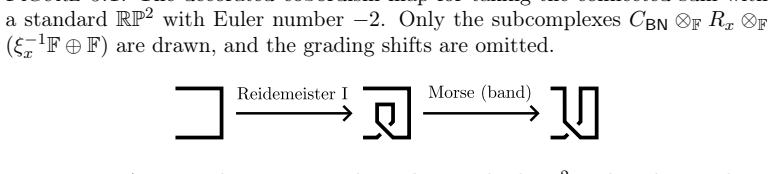
We enhance the Khovanov TQFT using basepoint actions over the field with two elements. Our enhanced Khovanov TQFT behaves similarly to gauge/Floer theoretic invariants of the double branched cover with opposite orientation: they both are invariant, in a certain sense, under taking the connected sum with the standard RP² with Euler number -2, and they both vanish after taking the connected sum with the standard RP² with Euler number 2. This invariance property answers a version of a question posed by Lipshitz and Sarkar. Furthermore, our construction establishes, as a special case, functoriality for the pointed Khovanov homology defined by Baldwin, Levine, and Sarkar.
What carries the argument
Basepoint actions on the Khovanov chain complex over F₂ that commute with the differential and with all cobordism maps, thereby defining an enhanced TQFT functor.
If this is right
- The enhanced TQFT supplies a combinatorial counterpart that reproduces the same invariance and vanishing properties as gauge/Floer invariants of the opposite-orientation double branched cover.
- The construction answers a version of the question posed by Lipshitz and Sarkar concerning such invariance under nonorientable connected sums.
- As a direct corollary the pointed Khovanov homology defined by Baldwin, Levine and Sarkar becomes functorial with respect to link cobordisms.
- The vanishing property implies that the enhanced homology of any link becomes trivial after connected sum with the RP² of Euler number 2.
Where Pith is reading between the lines
- The same basepoint mechanism may be used to define Khovanov-type invariants for links inside nonorientable three-manifolds.
- Direct computation of the enhanced homology for the unknot or trefoil after each type of RP² sum would give an immediate numerical test of the claimed matching with Floer theories.
- The construction suggests a route for comparing combinatorial and analytic link invariants by tracking basepoint actions through nonorientable cobordisms.
Load-bearing premise
The basepoint actions can be defined so that they commute appropriately with the differential and cobordism maps in the Khovanov TQFT, making the enhancement well-defined and functorial.
What would settle it
An explicit calculation of the enhanced Khovanov homology of any link after connected sum with the standard RP² of Euler number 2 that yields a nonzero group would falsify the vanishing claim.
Figures





read the original abstract
We enhance the Khovanov TQFT using basepoint actions, over the field with two elements. Our enhanced Khovanov TQFT behaves similarly to gauge/Floer theoretic invariants of the double branched cover with opposite orientation: they both are invariant, in a certain sense, under taking the connected sum with the standard $\mathbb{RP}^{2}$ with Euler number -2, and they both vanish after taking the connected sum with the standard $\mathbb{RP}^{2}$ with Euler number 2. This invariance property answers a version of a question posed by Lipshitz and Sarkar. Furthermore, our construction establishes, as a special case, functoriality for the pointed Khovanov homology defined by Baldwin, Levine, and Sarkar.
Editorial analysis
A structured set of objections, weighed in public.
Referee Report
Summary. The manuscript constructs an enhancement of the standard Khovanov TQFT by adjoining basepoint actions defined over the field F_2. The resulting enhanced invariant is claimed to be functorial and to satisfy the following properties, mirroring those of gauge/Floer invariants of the double branched cover with reversed orientation: it is invariant (in a suitable sense) under connected sum with the standard RP^2 of Euler number -2, and it vanishes after connected sum with the standard RP^2 of Euler number +2. As a corollary the construction yields functoriality for the pointed Khovanov homology of Baldwin-Levine-Sarkar.
Significance. If the basepoint actions are shown to commute with the differential and all cobordism maps, the work supplies a combinatorial model that reproduces key invariance and vanishing phenomena previously observed only in geometric invariants of nonorientable surfaces. This directly addresses a version of the question posed by Lipshitz and Sarkar and simultaneously resolves the functoriality issue for pointed Khovanov homology, thereby strengthening the dictionary between Khovanov theory and Floer-type invariants.
major comments (3)
- [Definition of basepoint actions and §3] The entire construction rests on the claim that the newly defined basepoint actions commute with the Khovanov differential and with all cobordism-induced maps in the TQFT. This commutation is asserted to hold over F_2 for diagrams and surfaces that may be nonorientable, yet the verification is not carried out explicitly for generators involving nonorientable cobordisms; without this check the enhanced TQFT is not known to be well-defined or functorial (see the section defining the basepoint maps and the subsequent proof of functoriality).
- [Main invariance theorem] Theorem on invariance under connected sum with RP^2(-2) (and the companion vanishing statement for RP^2(+2)) is load-bearing for the comparison with gauge/Floer invariants. The argument appears to reduce the statement to the functoriality of the enhanced TQFT, but the reduction step is not spelled out in sufficient detail to confirm that the Euler-number sign controls the vanishing exactly as claimed.
- [Corollary on pointed Khovanov homology] The special-case recovery of Baldwin-Levine-Sarkar functoriality is presented as immediate once the enhanced TQFT is defined. However, the precise manner in which the basepoint actions restrict to the pointed setting, and why no additional signs or relations arise, requires an explicit diagram chase or reference to a prior lemma.
minor comments (2)
- The introduction would benefit from a short table or diagram contrasting the new basepoint maps with the ordinary Khovanov generators.
- A few instances of overloaded notation (e.g., the same symbol used for a surface and its Euler number) could be disambiguated.
Simulated Author's Rebuttal
We thank the referee for the detailed and constructive report. The comments highlight areas where additional explicit verification and expanded explanations will strengthen the manuscript. We address each major comment below and indicate the revisions we will make.
read point-by-point responses
-
Referee: [Definition of basepoint actions and §3] The entire construction rests on the claim that the newly defined basepoint actions commute with the Khovanov differential and with all cobordism-induced maps in the TQFT. This commutation is asserted to hold over F_2 for diagrams and surfaces that may be nonorientable, yet the verification is not carried out explicitly for generators involving nonorientable cobordisms; without this check the enhanced TQFT is not known to be well-defined or functorial (see the section defining the basepoint maps and the subsequent proof of functoriality).
Authors: We agree that an explicit verification for nonorientable cobordisms is necessary to confirm well-definedness. In the original manuscript the commutation is verified for orientable cases and asserted to extend over F_2 (where all signs vanish) to the nonorientable setting via the same local relations. In the revised version we will add a dedicated subsection in §3 that performs the check generator-by-generator for the nonorientable generators, confirming that the basepoint maps commute with both the differential and the cobordism maps. This will make the functoriality proof fully rigorous. revision: yes
-
Referee: [Main invariance theorem] Theorem on invariance under connected sum with RP^2(-2) (and the companion vanishing statement for RP^2(+2)) is load-bearing for the comparison with gauge/Floer invariants. The argument appears to reduce the statement to the functoriality of the enhanced TQFT, but the reduction step is not spelled out in sufficient detail to confirm that the Euler-number sign controls the vanishing exactly as claimed.
Authors: The proof of the main invariance theorem proceeds by reducing the connected-sum operation to a specific cobordism map in the enhanced TQFT and then invoking the already-established functoriality. The Euler-number sign enters through the explicit computation of the basepoint action on the RP^2 cobordism: for Euler number -2 the map is the identity (up to units in F_2), while for +2 it is zero. We will expand the reduction paragraph in the revised manuscript to include a short commutative diagram that isolates the Euler-number contribution and shows why the sign controls vanishing precisely as stated. revision: yes
-
Referee: [Corollary on pointed Khovanov homology] The special-case recovery of Baldwin-Levine-Sarkar functoriality is presented as immediate once the enhanced TQFT is defined. However, the precise manner in which the basepoint actions restrict to the pointed setting, and why no additional signs or relations arise, requires an explicit diagram chase or reference to a prior lemma.
Authors: The restriction to the pointed setting follows directly from the definition of the enhanced TQFT: the basepoint actions are defined on the same chain complexes used by Baldwin-Levine-Sarkar, and over F_2 they induce no extra signs. To make this transparent we will insert a short diagram chase in the corollary (or reference the relevant lemma from §3) that shows how the pointed maps are recovered as the special case in which all but one basepoint act trivially. This will eliminate any ambiguity. revision: yes
Circularity Check
No circularity: construction of basepoint actions and verification of commutation are independent of the claimed invariance
full rationale
The paper defines basepoint actions on the Khovanov complex over F2 and directly verifies that these actions commute with the differential and with the cobordism maps of the TQFT. This verification is performed by explicit computation on diagrams and is not presupposed by the target invariance statements. The invariance under connected sum with RP2(-2) and vanishing for RP2(+2) are then derived as consequences of the enhanced functorial structure. The special-case recovery of Baldwin-Levine-Sarkar pointed functoriality is likewise a derived property rather than an input. No equations reduce the main claims to fitted parameters, self-definitions, or load-bearing self-citations; the derivation chain remains self-contained against external benchmarks.
Axiom & Free-Parameter Ledger
axioms (2)
- standard math Khovanov homology admits a TQFT structure with well-defined cobordism maps
- domain assumption Basepoint actions can be defined over F2 so that they commute with the differential
Lean theorems connected to this paper
-
IndisputableMonolith/Foundation/AbsoluteFloorClosurereality_from_one_distinction unclearWe enhance the Khovanov TQFT using basepoint actions, over the field with two elements. Our enhanced Khovanov TQFT behaves similarly to gauge/Floer theoretic invariants of the double branched cover with opposite orientation: they both are invariant, in a certain sense, under taking the connected sum with the standard RP2 with Euler number -2, and they both vanish after taking the connected sum with the standard RP2 with Euler number 2.
-
IndisputableMonolith/Cost/FunctionalEquationwashburn_uniqueness_aczel unclearThe basepoint actions can be defined so that they commute appropriately with the differential and cobordism maps in the Khovanov TQFT, making the enhancement well-defined and functorial.
Reference graph
Works this paper leans on
- [1]
-
[2]
Bloom, A link surgery spectral sequence in monopole F loer homology , Adv
Jonathan M. Bloom, A link surgery spectral sequence in monopole F loer homology , Adv. Math. 226 (2011), no. 4, 3216--3281. 2764887
work page 2011
-
[3]
John A. Baldwin, Adam Simon Levine, and Sucharit Sarkar, K hovanov homology and knot F loer homology for pointed links , J. Knot Theory Ramifications 26 (2017), no. 2, 1740004, 49. 3604486
work page 2017
-
[4]
Dror Bar-Natan, K hovanov's homology for tangles and cobordisms
-
[5]
J. Scott Carter and Masahico Saito, Knotted surfaces and their diagrams, Mathematical Surveys and Monographs, vol. 55, American Mathematical Society, Providence, RI, 1998. 1487374
work page 1998
-
[6]
Aliakbar Daemi, Abelian G auge T heory, K nots and O dd K hovanov H omology , 2015
work page 2015
-
[7]
S. K. Donaldson, Irrationality and the h -cobordism conjecture , J. Differential Geom. 26 (1987), no. 1, 141--168. 892034
work page 1987
-
[8]
Donaldson, Polynomial invariants for smooth four-manifolds, Topology 29 (1990), no
S.K. Donaldson, Polynomial invariants for smooth four-manifolds, Topology 29 (1990), no. 3, 257--315
work page 1990
-
[9]
Nathan Dowlin, A spectral sequence from K hovanov homology to knot F loer homology , J. Amer. Math. Soc. 37 (2024), no. 4, 951--1010. 4777638
work page 2024
-
[10]
S. M. Finashin, M. Kreck, and O. Ya. Viro, Exotic knottings of surfaces in the 4 -sphere , Bull. Amer. Math. Soc. (N.S.) 17 (1987), no. 2, 287--290. 903734
work page 1987
-
[11]
1346, Springer, Berlin, 1988, pp
, Nondiffeomorphic but homeomorphic knottings of surfaces in the 4 -sphere , Topology and geometry--- R ohlin S eminar, Lecture Notes in Math., vol. 1346, Springer, Berlin, 1988, pp. 157--198. 970078
work page 1988
-
[12]
Gary Guth, Kyle Hayden, Sungkyung Kang, and JungHwan Park, Doubled disks and satellite surfaces, 2023
work page 2023
-
[13]
Kyle Hayden, Seungwon Kim, Maggie Miller, JungHwan Park, and Isaac Sundberg, Seifert surfaces in the 4-ball, J. Eur. Math. Soc. (2025), published online first
work page 2025
-
[14]
Matthew Hedden and Yi Ni, Khovanov module and the detection of unlinks, Geom. Topol. 17 (2013), no. 5, 3027--3076. 3190305
work page 2013
-
[15]
Kyle Hayden and Isaac Sundberg, Khovanov homology and exotic surfaces in the 4-ball, J. Reine Angew. Math. 809 (2024), 217--246. 4726569
work page 2024
-
[16]
Magnus Jacobsson, An invariant of link cobordisms from K hovanov homology , Algebr. Geom. Topol. 4 (2004), 1211--1251. 2113903
work page 2004
-
[17]
Andr\'as Juh\'asz, Dylan Thurston, and Ian Zemke, Naturality and mapping class groups in H eegard F loer homology , Mem. Amer. Math. Soc. 273 (2021), no. 1338, v+174. 4337438
work page 2021
-
[18]
Mikhail Khovanov, A categorification of the J ones polynomial , Duke Math. J. 101 (2000), no. 3, 359--426. 1740682
work page 2000
-
[19]
, Patterns in knot cohomology. I , Experiment. Math. 12 (2003), no. 3, 365--374. 2034399
work page 2003
-
[20]
, An invariant of tangle cobordisms, Trans. Amer. Math. Soc. 358 (2006), no. 1, 315--327. 2171235
work page 2006
-
[21]
Peter Kronheimer and Tomasz Mrowka, Monopoles and three-manifolds, New Mathematical Monographs, Cambridge University Press, 2007
work page 2007
-
[22]
Tyler Lawson, Robert Lipshitz, and Sucharit Sarkar, Homotopy functoriality for K hovanov spectra , J. Topol. 15 (2022), no. 4, 2426--2471. 4584595
work page 2022
-
[23]
Robert Lipshitz and Sucharit Sarkar, A refinement of R asmussen's s -invariant , Duke Math. J. 163 (2014), no. 5, 923--952. 3189434
work page 2014
-
[24]
, Khovanov homology detects split links, Amer. J. Math. 144 (2022), no. 6, 1745--1781. 4521052
work page 2022
-
[25]
, A mixed invariant of nonorientable surfaces in equivariant K hovanov homology , Trans. Amer. Math. Soc. 375 (2022), no. 12, 8807--8849. 4504654
work page 2022
-
[26]
Ciprian Manolescu, Marco Marengon, Sucharit Sarkar, and Michael Willis, A generalization of R asmussen's invariant, with applications to surfaces in some four-manifolds , Duke Math. J. 172 (2023), no. 2, 231--311. 4541332
work page 2023
-
[27]
Scott Morrison, Kevin Walker, and Paul Wedrich, Invariants of 4-manifolds from K hovanov- R ozansky link homology , Geom. Topol. 26 (2022), no. 8, 3367--3420. 4562565
work page 2022
- [28]
- [29]
-
[30]
Peter Ozsv\' a th and Zolt\' a n Szab\' o , Holomorphic disks and knot invariants, Adv. Math. 186 (2004), no. 1, 58--116. 2065507
work page 2004
-
[31]
, On the H eegaard F loer homology of branched double-covers , Adv. Math. 194 (2005), no. 1, 1--33. 2141852
work page 2005
-
[32]
, Holomorphic triangles and invariants for smooth four-manifolds, Adv. Math. 202 (2006), no. 2, 326--400. 2222356
work page 2006
-
[33]
Lisa Piccirillo, The C onway knot is not slice , Ann. of Math. (2) 191 (2020), no. 2, 581--591. 4076631
work page 2020
-
[34]
Jacob Andrew Rasmussen, F loer homology and knot complements , ProQuest LLC, Ann Arbor, MI, 2003, Thesis (Ph.D.)--Harvard University. 2704683
work page 2003
-
[35]
Jacob Rasmussen, K hovanov homology and the slice genus , Invent. Math. 182 (2010), no. 2, 419--447. 2729272
work page 2010
- [36]
-
[37]
Scaduto, Instantons and odd K hovanov homology , J
Christopher W. Scaduto, Instantons and odd K hovanov homology , J. Topol. 8 (2015), no. 3, 744--810. 3394316
work page 2015
-
[38]
Paul Seidel, Fukaya categories and P icard- L efschetz theory , Zurich Lectures in Advanced Mathematics, European Mathematical Society (EMS), Z\"urich, 2008. 2441780
work page 2008
-
[39]
Isaac Sundberg and Jonah Swann, Relative K hovanov- J acobsson classes , Algebr. Geom. Topol. 22 (2022), no. 8, 3983--4008. 4562563
work page 2022
-
[40]
N. Seiberg and E. Witten, Electric-magnetic duality, monopole condensation, and confinement in N=2 supersymmetric Y ang- M ills theory , Nuclear Phys. B 426 (1994), no. 1, 19--52. 1293681
work page 1994
-
[41]
, Monopoles, duality and chiral symmetry breaking in N=2 supersymmetric QCD , Nuclear Phys. B 431 (1994), no. 3, 484--550. 1306869
work page 1994
-
[42]
Jonah Swann, Relative K hovanov- J acobsson classes for spanning surfaces , Ph.D. thesis, 2010
work page 2010
-
[43]
Yikai Teng, End K hovanov homology and exotic L agrangian planes , 2025
work page 2025
-
[44]
Edward Witten, Monopoles and four-manifolds, Math. Res. Lett. 1 (1994), no. 6, 769--796. 1306021
work page 1994
-
[45]
Ian Zemke, Link cobordisms and functoriality in link F loer homology , J. Topol. 12 (2019), no. 1, 94--220. 3905679
work page 2019
discussion (0)
Sign in with ORCID, Apple, or X to comment. Anyone can read and Pith papers without signing in.