Recognition: 2 theorem links
· Lean TheoremThirty Circumbinary Disk Occultation Systems (KH 15D-like stars) from the OGLE Project
Pith reviewed 2026-05-12 00:48 UTC · model grok-4.3
The pith
OGLE photometry identifies thirty binary candidates periodically eclipsed by circumbinary dusty disks.
A machine-rendered reading of the paper's core claim, the machinery that carries it, and where it could break.
Core claim
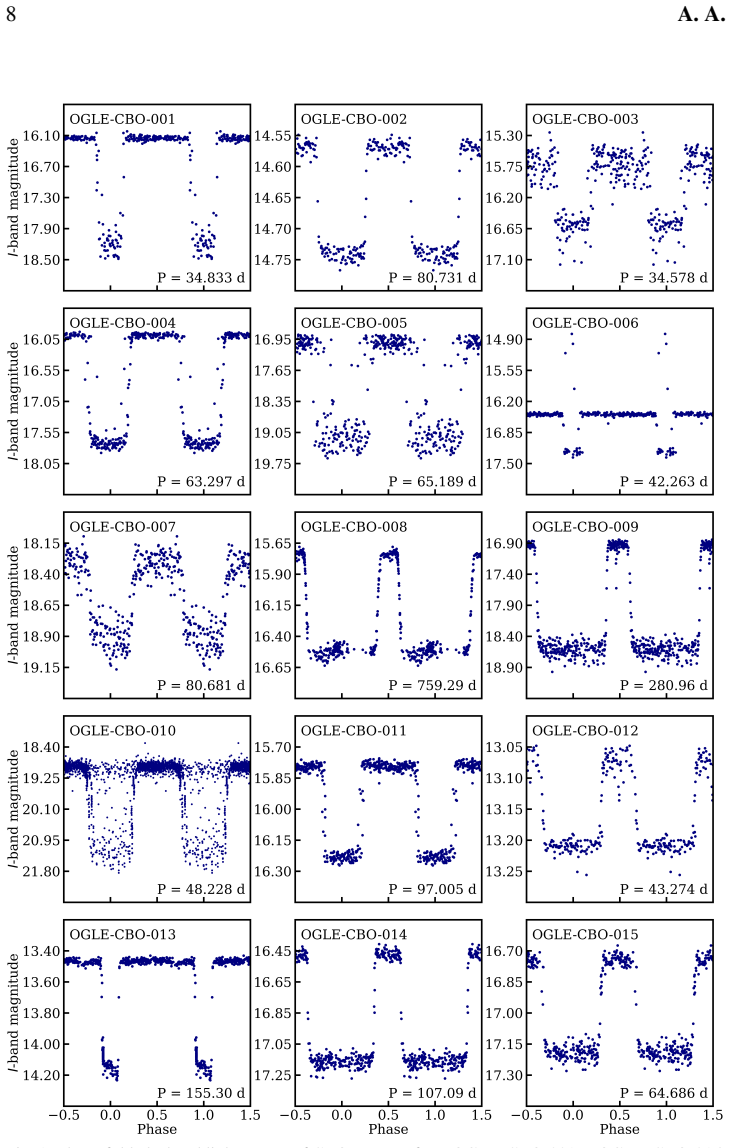
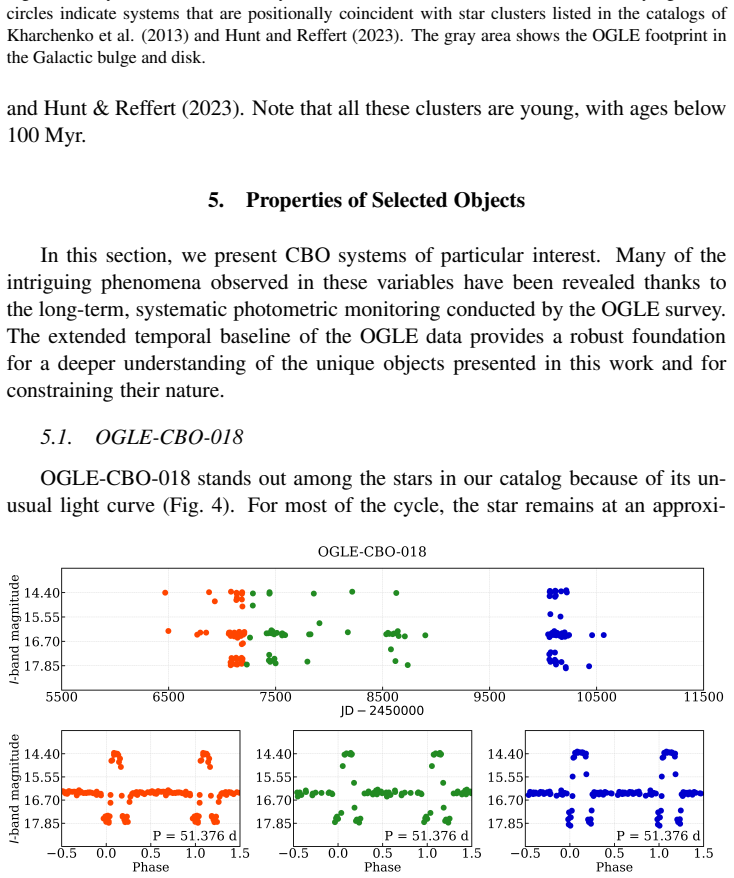
We present a catalog of 30 stars that are candidates for KH 15D-like binary systems, in which the observed brightness variations are caused by a circumbinary dusty disk that periodically obscures at least one of the stellar components as it moves along its orbit. Thanks to the regular observations conducted within the Optical Gravitational Lensing Experiment (OGLE) project, we provide unique light curves in the I and V bands with very long time baselines, in some cases beginning as early as 1997 and extending to the present day. Such long-term monitoring allows us to identify changes in eclipse widths, amplitudes, and light-curve shapes on timescales of many years. We highlight several circu
What carries the argument
Circumbinary disk occultation, the process in which a dusty disk shared by a close binary star pair periodically blocks light from one or both stars as the disk revolves around the binary center of mass.
If this is right
- Long time baselines reveal secular changes in eclipse width, amplitude, and shape over many years.
- Several individual systems are singled out as especially suitable for detailed follow-up.
- Spectra are obtained for three candidates to help classify their stellar and disk properties.
- The catalog increases the known population of such occultation systems by roughly an order of magnitude.
Where Pith is reading between the lines
- The expanded sample may enable statistical comparisons of disk lifetimes, inclinations, and precession rates across multiple systems.
- Targeted infrared or submillimeter imaging could directly confirm the presence and spatial extent of the disks.
- Similar long-cadence surveys in other star-forming regions could locate additional members of this class.
Load-bearing premise
That the periodic brightness variations and their long-term changes are produced by occultation from a circumbinary dusty disk rather than by other mechanisms such as starspots, pulsations, or unrelated variability.
What would settle it
Radial-velocity curves that show no orbital motion at the photometric period, or infrared observations that detect no excess emission from a disk, would rule out the circumbinary occultation model for individual systems.
Figures



read the original abstract
We present a catalog of 30 stars that are candidates for KH 15D-like binary systems, in which the observed brightness variations are caused by a circumbinary dusty disk that periodically obscures at least one of the stellar components as it moves along its orbit. Thanks to the regular observations conducted within the Optical Gravitational Lensing Experiment (OGLE) project, we provide unique light curves in the I and V bands with very long time baselines, in some cases beginning as early as 1997 and extending to the present day. Such long-term monitoring allows us to identify changes in eclipse widths, amplitudes, and light-curve shapes on timescales of many years. We highlight several circumbinary disk occultation (CBO) systems of particular interest and present spectra for three of them.
Editorial analysis
A structured set of objections, weighed in public.
Referee Report
Summary. The manuscript presents a catalog of 30 candidate KH 15D-like circumbinary disk occultation (CBO) systems drawn from OGLE I- and V-band photometry with baselines often exceeding 20 years. Candidates are identified by periodic dimming whose widths, depths, and shapes evolve secularly; the variability is interpreted as arising from a precessing circumbinary dusty disk that occults one or both stellar components. Spectra are shown for three objects; the remaining 27 are classified by photometric resemblance to the KH 15D prototype. Several systems of particular interest are highlighted.
Significance. If the candidate identifications hold, the work would enlarge the known sample of KH 15D analogs by an order of magnitude and supply the longest homogeneous light curves yet available for studying circumbinary disk dynamics and precession. The multi-decade OGLE baselines constitute a genuine observational strength that shorter surveys cannot replicate.
major comments (3)
- [Candidate selection (methods/results)] The manuscript provides no explicit quantitative selection criteria (e.g., amplitude thresholds, period ranges, shape metrics, or color constraints) used to extract the 30 systems from the OGLE database, nor any estimate of false-positive rate or completeness. This omission makes the catalog difficult to reproduce or to assess for contamination.
- [Verification and spectral analysis] Only three systems receive spectra; the remaining 27 are classified solely by light-curve morphology. No quantitative diagnostics (color evolution during fades, Fourier decomposition, period stability, or comparison with spot/pulsation templates) are presented to exclude alternative mechanisms such as evolving starspots or semi-regular pulsators.
- [Light-curve evolution discussion] Secular changes in eclipse width and depth are described but are not compared with any disk-precession model or with predicted observables (e.g., nodal precession rates, disk tilt evolution). Without such modeling the circumbinary-disk interpretation remains plausible but untested for most objects.
minor comments (2)
- [Abstract] The abstract should state explicitly how many of the 30 systems have spectroscopic confirmation.
- [Figures] Figure captions for the light-curve panels would benefit from indicating the adopted orbital period and the time span covered.
Simulated Author's Rebuttal
We thank the referee for the constructive review and for recognizing the value of the long OGLE baselines for studying circumbinary disk systems. We address each major comment below, indicating where revisions will be made to improve the manuscript.
read point-by-point responses
-
Referee: The manuscript provides no explicit quantitative selection criteria (e.g., amplitude thresholds, period ranges, shape metrics, or color constraints) used to extract the 30 systems from the OGLE database, nor any estimate of false-positive rate or completeness. This omission makes the catalog difficult to reproduce or to assess for contamination.
Authors: We agree that explicit criteria are needed for reproducibility. In the revised manuscript we will add a dedicated methods subsection that details the visual-inspection protocol, including the minimum amplitude threshold (~0.5 mag), eclipse-duration range, requirement for secular evolution in width and depth, and any color constraints applied where V-band data exist. A full Monte-Carlo completeness and false-positive analysis of the entire OGLE database lies beyond the scope of this discovery paper; we will state this limitation explicitly and identify it as future work. revision: partial
-
Referee: Only three systems receive spectra; the remaining 27 are classified solely by light-curve morphology. No quantitative diagnostics (color evolution during fades, Fourier decomposition, period stability, or comparison with spot/pulsation templates) are presented to exclude alternative mechanisms such as evolving starspots or semi-regular pulsators.
Authors: We acknowledge the limited spectroscopic coverage. The 27 photometric candidates are identified by the distinctive multi-year secular changes in eclipse shape that are not characteristic of starspots or pulsators. In revision we will add a short section that (i) presents available V–I color evolution during fades for objects with V-band coverage, (ii) notes the long-term period stability, and (iii) briefly contrasts the observed light-curve morphology with typical spot and semi-regular pulsator templates. Full spectroscopy for the remaining objects is planned but is outside the present work. revision: partial
-
Referee: Secular changes in eclipse width and depth are described but are not compared with any disk-precession model or with predicted observables (e.g., nodal precession rates, disk tilt evolution). Without such modeling the circumbinary-disk interpretation remains plausible but untested for most objects.
Authors: The paper is primarily an observational catalog that documents the secular changes. Quantitative precession modeling for each system requires binary masses, radii, and disk parameters that are not yet constrained. In the revised version we will expand the discussion to include qualitative comparisons with published nodal-precession timescales for KH 15D analogs and will cite the relevant theoretical expectations. Detailed dynamical modeling of individual objects is identified as the logical next step. revision: partial
Circularity Check
No circularity: purely observational catalog based on direct light-curve data and morphological classification
full rationale
The paper presents an observational catalog of 30 candidate systems identified from OGLE I- and V-band photometry spanning up to 25+ years. Candidate selection relies on visual and qualitative resemblance of periodic dimming events to the known prototype KH 15D, with long-term evolution in eclipse properties noted directly from the data. Spectra are supplied for only three objects; the remaining classifications are photometric. No equations, fitted parameters, predictions, or derivations are introduced that could reduce to author-defined inputs. Self-citations, if present, are limited to referencing the OGLE survey or the KH 15D prototype and do not bear load for any claimed result. The work is self-contained against external benchmarks (OGLE photometry) and contains no self-referential steps.
Axiom & Free-Parameter Ledger
axioms (1)
- domain assumption Periodic, deep, and evolving brightness variations in a binary system are produced by occultation from a circumbinary dusty disk
Lean theorems connected to this paper
-
IndisputableMonolith/Foundation/RealityFromDistinction.leanreality_from_one_distinction unclear?
unclearRelation between the paper passage and the cited Recognition theorem.
We present a catalog of 30 stars that are candidates for KH 15D-like binary systems, in which the observed brightness variations are caused by a circumbinary dusty disk that periodically obscures at least one of the stellar components as it moves along its orbit.
What do these tags mean?
- matches
- The paper's claim is directly supported by a theorem in the formal canon.
- supports
- The theorem supports part of the paper's argument, but the paper may add assumptions or extra steps.
- extends
- The paper goes beyond the formal theorem; the theorem is a base layer rather than the whole result.
- uses
- The paper appears to rely on the theorem as machinery.
- contradicts
- The paper's claim conflicts with a theorem or certificate in the canon.
- unclear
- Pith found a possible connection, but the passage is too broad, indirect, or ambiguous to say the theorem truly supports the claim.
Reference graph
Works this paper leans on
- [1]
- [2]
-
[3]
, Herbst, W., Cody, A.M., et al
Arulanantham, N.A. , Herbst, W., Cody, A.M., et al. 2016, AJ, 151,
work page 2016
-
[4]
M., Wilner, D.J., and Win n, J.N
Aronow R.A., Herbst, W., Hughes, A. M., Wilner, D.J., and Win n, J.N. 2018, AJ, 155,
work page 2018
-
[5]
2013, Peremennye Zvezdy Prilozhenie, 13,
Bernhard, K., Lloyd, C., and Huemmerich, S. 2013, Peremennye Zvezdy Prilozhenie, 13,
work page 2013
- [6]
-
[7]
Bernhard, K., Frank, P ., Moschner, W., and Reffke, U. 2024, BA V Journal, 92,
work page 2024
-
[8]
Buzzoni, B., Delabre, B., Dekker, H., et al. 1984, The Messenger, 38,
work page 1984
- [9]
- [10]
- [11]
-
[12]
Gaia Collaboration, V allenari, A., Brown, A.G.A., et al. 2023, A&A, 674,
work page 2023
- [13]
- [14]
- [15]
- [16]
-
[17]
Hu, Z., Zhu, W. , Dai, F., et al. 2024, ApJ, 977, L28. Hu, Z., Zhu, W., Wang, S., and Wang, S.X. 2026, arXiv e-prints, , arXiv:2601.16828. Hunt, E.L., and Reffert, S. 2023, A&A, 673,
- [18]
-
[19]
Kharchenko, N.V ., Piskunov, A.E., Schilbach, E., Röser, S., and Scholz, R.D. 2013, A&A, 558,
work page 2013
-
[20]
Lucas, P . W. , Smith, L.C., Guo, Z., et al. 2024, MNRAS, 528,
work page 2024
- [21]
-
[22]
Mróz, P ., Pietrukowicz, P ., Poleski, R.,et al. 2013, Acta Astron., 63,
work page 2013
-
[23]
Mróz, P ., Udalski, A., Poleski, R., et al. 2015, Acta Astron., 65,
work page 2015
-
[24]
Pietrukowicz, P ., Mróz, P ., Soszy´nski, I., et al. 2013, Acta Astron., 63,
work page 2013
-
[25]
Plavchan, P ., Gee, A.H., Stapelfeldt, K., and Becker, A. 2008, ApJ, 684,
work page 2008
-
[26]
, Güth, T., Laohakunakorn, N., and Parks, J.R
Plavchan, P . , Güth, T., Laohakunakorn, N., and Parks, J.R. 2013, A&A, 554,
work page 2013
- [27]
-
[28]
Rodríguez-Ledesma, M.V ., Mundt, R., Ibrahimov, M.,et al. 2012, A&A, 544,
work page 2012
-
[29]
Rodríguez-Ledesma, M.V ., Mundt, R., Pintado, O., et al. 2013, A&A, 551,
work page 2013
-
[30]
Soszy´nski, I., Udalski, A., Szyma ´nski, M.K., et al. 2013, Acta Astron., 63,
work page 2013
-
[31]
Soszy´nski, I., Pawlak, M., Pietrukowicz, P ., et al. 2016, Acta Astron., 66,
work page 2016
-
[32]
Soto, A.G., Ali, A., Newmark, A. et al. 2020, AJ, 159,
work page 2020
- [33]
- [34]
-
[35]
Udalski, A., Kubiak, M., and Szyma ´nski, M. 1997, Acta Astron., 47,
work page 1997
-
[36]
Udalski, A., Szyma ´nski, M.K., Soszy ´nski, I., and Poleski, R. 2008, Acta Astron., 58,
work page 2008
-
[37]
Udalski, A., Szyma ´nski, M.K., and Szyma ´nski, G. 2015, Acta Astron., 65,
work page 2015
-
[38]
Udalski, A., Soszy ´nski, I., Pietrukowicz, P .,et al. 2018, Acta Astron., 68,
work page 2018
- [39]
- [40]
-
[41]
Winn, J.N., Holman, M.J., Johnson, J.A., Stanek, K.Z., and G arnavich, P .M. 2004,ApJ, 603,
work page 2004
-
[42]
20 A. A. Wrona, M., Ratajczak, M., Kołaczek-Szyma ´nski, P .A.,et al. 2022, ApJS, 259,
work page 2022
- [43]
discussion (0)
Sign in with ORCID, Apple, or X to comment. Anyone can read and Pith papers without signing in.