Recognition: 1 theorem link
· Lean TheoremA mathematical study of periodic band inversion
Pith reviewed 2026-05-12 01:42 UTC · model grok-4.3
The pith
In the strong-coupling limit the low-lying bands converge to an effective Bloch Hamiltonian whose cosine-potential version produces periodic gap closings with Dirac cones and explicit Chern numbers.
A machine-rendered reading of the paper's core claim, the machinery that carries it, and where it could break.
Core claim
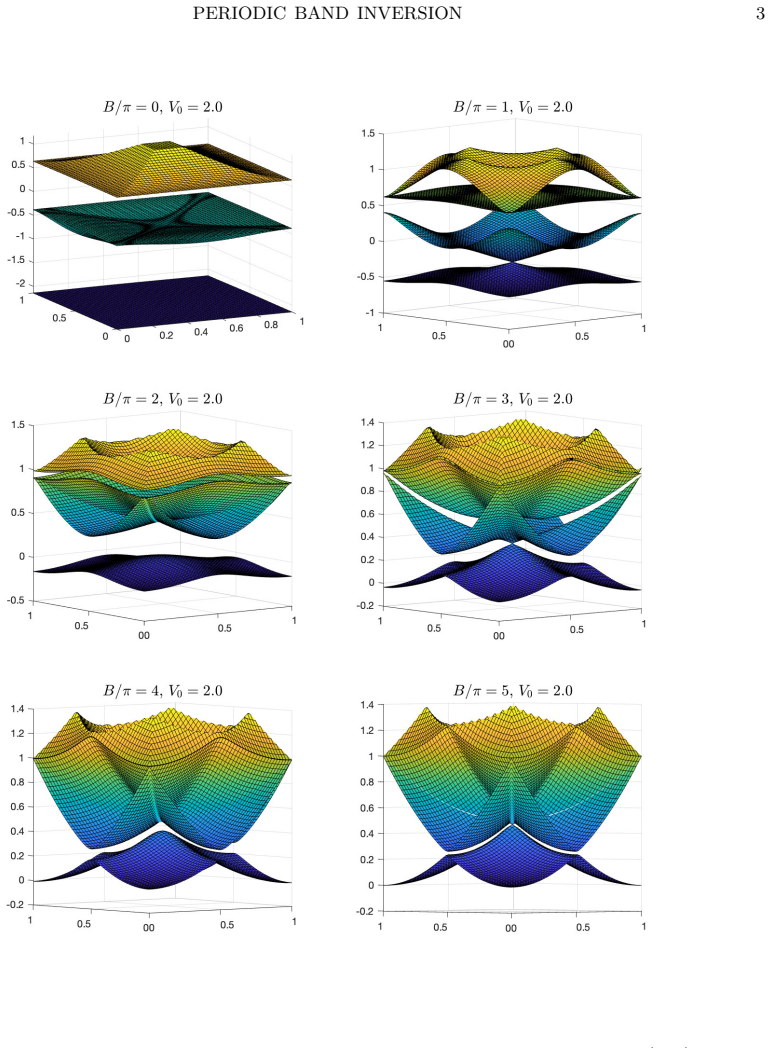
In the strong-coupling limit we derive an effective Bloch Hamiltonian and prove convergence of the low-lying bands. For a cosine potential, we explain the periodic closing and reopening of the first spectral gap, prove the existence and generic persistence of Dirac cones at the gap-closing points, and compute the Chern numbers associated to isolated band clusters. We also show that higher isolated band clusters cannot persist in the small-coupling regime. Finally, we resolve an apparent sign discrepancy between Berry curvature computations and Chern numbers by tracking the descent from the covering space to the Brillouin torus.
What carries the argument
The effective Bloch Hamiltonian obtained in the strong-coupling limit, which governs the low-lying bands and permits explicit tracking of gap closings, Dirac cones, and Chern numbers.
Where Pith is reading between the lines
- Similar effective models may be derivable for other periodic potentials that share the same symmetry as the cosine case.
- Direct numerical comparison between the full system and the effective Hamiltonian at strong but finite coupling would test the convergence rate.
- The topological protection of the Dirac cones could be examined under small symmetry-breaking perturbations to the potential.
- The covering-space descent technique for fixing sign discrepancies might apply to Berry-curvature calculations in other periodic systems on tori.
Load-bearing premise
The strong-coupling limit must dominate the physics and the cosine potential must permit exact calculations without higher-order corrections that would spoil the band convergence or the persistence of the Dirac cones.
What would settle it
Numerical diagonalization of the full coupled Hamiltonian at large but finite coupling strength, checking whether the low bands match the effective model's spectrum and whether Dirac cones appear exactly at the predicted gap-closing parameters.
Figures


read the original abstract
We give a mathematical analysis of the periodic band inversion phenomenon observed by Tan--Devakul for an electron in a two-dimensional periodic potential coupled to a circularly polarized photon cavity mode. In the strong-coupling limit, we derive an effective Bloch Hamiltonian and prove convergence of the low-lying bands. For a cosine potential, we explain the periodic closing and reopening of the first spectral gap, prove the existence and generic persistence of Dirac cones at the gap-closing points, and compute the Chern numbers associated to isolated band clusters. We also show that higher isolated band clusters cannot persist in the small-coupling regime. Finally, we resolve an apparent sign discrepancy between Berry curvature computations and Chern numbers by tracking the descent from the covering space to the Brillouin torus.
Editorial analysis
A structured set of objections, weighed in public.
Referee Report
Summary. The manuscript presents a mathematical analysis of periodic band inversion for an electron in a 2D periodic potential coupled to a circularly polarized photon cavity mode. In the strong-coupling limit, it derives an effective Bloch Hamiltonian and proves convergence of the low-lying bands. For a cosine potential, it explains the periodic closing and reopening of the first spectral gap, proves existence and generic persistence of Dirac cones at gap-closing points, computes Chern numbers for isolated band clusters, shows that higher isolated band clusters cannot persist in the small-coupling regime, and resolves an apparent sign discrepancy between Berry curvature computations and Chern numbers by tracking descent from the covering space to the Brillouin torus.
Significance. If the central claims hold, this work supplies a rigorous foundation for topological phenomena in cavity QED systems with periodic potentials, validating effective models through convergence proofs and delivering concrete results on Dirac cones and Chern numbers for the cosine case. The explicit treatment of gap dynamics and the covering-space resolution of the sign issue are strengths that could benchmark future studies in light-matter topological physics.
major comments (3)
- [Abstract and §3 (effective Hamiltonian)] Abstract and strong-coupling section: The stated proofs of convergence of low-lying bands and derivation of the effective Bloch Hamiltonian lack visible full derivations and quantitative error bounds; this is load-bearing because all subsequent claims on band clusters, gap closings, and topological invariants for the cosine potential rely on the leading-order model remaining accurate as the coupling tends to infinity.
- [§4–5 (cosine potential and Dirac cones)] Cosine potential analysis: The proof of generic persistence of Dirac cones at gap-closing points and the associated Chern number computations use only the leading-order effective Hamiltonian; no estimates are given showing that next-order corrections (from photon-mode interactions or the periodic potential) cannot introduce an effective mass term or shift the degeneracy loci by a non-vanishing amount, which would lift the cones and alter the invariants.
- [Final section on Berry curvature and covering space] Chern numbers and sign discrepancy: The resolution of the Berry curvature sign discrepancy via descent from the covering space to the Brillouin torus is presented as a fix, but the argument does not verify that the topological invariants computed in the effective model remain stable under the convergence to the full Hamiltonian, leaving open whether the reported Chern numbers are exact for the original system.
minor comments (2)
- [Notation and §2] Notation for the effective Hamiltonian parameters and the precise definition of the strong-coupling scaling could be made more explicit to aid readability.
- [Figures] Figures showing band structures and gap closings would benefit from annotations marking the Dirac points and the Brillouin zone paths used for the computations.
Simulated Author's Rebuttal
We thank the referee for the detailed and constructive report. We address each major comment below and indicate the revisions we will make to improve the clarity and completeness of the proofs.
read point-by-point responses
-
Referee: Abstract and §3 (effective Hamiltonian)] Abstract and strong-coupling section: The stated proofs of convergence of low-lying bands and derivation of the effective Bloch Hamiltonian lack visible full derivations and quantitative error bounds; this is load-bearing because all subsequent claims on band clusters, gap closings, and topological invariants for the cosine potential rely on the leading-order model remaining accurate as the coupling tends to infinity.
Authors: We appreciate this observation. Section 3 contains the derivation of the effective Bloch Hamiltonian via the strong-coupling limit together with a convergence statement for the low-lying bands, but the presentation condenses several technical steps and does not display explicit quantitative error bounds. In the revised manuscript we will expand Section 3 with a complete step-by-step derivation, explicit remainder estimates of the form O(1/λ) (where λ denotes the coupling strength), and a clearly stated convergence theorem with the required quantitative control. This will make the load-bearing approximation fully transparent and directly support the subsequent analysis. revision: yes
-
Referee: [§4–5 (cosine potential and Dirac cones)] Cosine potential analysis: The proof of generic persistence of Dirac cones at gap-closing points and the associated Chern number computations use only the leading-order effective Hamiltonian; no estimates are given showing that next-order corrections (from photon-mode interactions or the periodic potential) cannot introduce an effective mass term or shift the degeneracy loci by a non-vanishing amount, which would lift the cones and alter the invariants.
Authors: The referee correctly notes that the Dirac-cone and Chern-number statements are proved for the leading-order effective model. Because the convergence result of Section 3 shows that the low-lying spectrum of the full Hamiltonian approaches that of the effective model as the coupling tends to infinity, the topological features persist for sufficiently large coupling. In the revision we will add a short subsection (or remark) in Sections 4–5 that invokes standard perturbation theory for isolated band clusters: any higher-order correction is O(1/λ) and therefore cannot open a gap or shift the degeneracy loci by a finite amount once the coupling exceeds a threshold determined by the gap size of the effective model. This supplies the missing stability estimate without altering the existing proofs. revision: yes
-
Referee: [Final section on Berry curvature and covering space] Chern numbers and sign discrepancy: The resolution of the Berry curvature sign discrepancy via descent from the covering space to the Brillouin torus is presented as a fix, but the argument does not verify that the topological invariants computed in the effective model remain stable under the convergence to the full Hamiltonian, leaving open whether the reported Chern numbers are exact for the original system.
Authors: We agree that an explicit link between the effective-model Chern numbers and those of the full Hamiltonian is needed. The covering-space argument resolves the sign discrepancy inside the effective model; the convergence theorem already guarantees that the low-lying bands converge uniformly on compact sets of the Brillouin zone. Because Chern numbers are integers, they are stable under sufficiently small perturbations in the C^1 topology of the Berry curvature. In the revised final section we will add a short lemma stating that, for coupling strengths large enough that the approximation error lies below the minimal gap separating the cluster from the rest of the spectrum, the Chern numbers of the full Hamiltonian coincide with those computed for the effective model. This closes the stability gap. revision: yes
Circularity Check
No significant circularity; derivation is self-contained via standard asymptotic analysis and topological invariants.
full rationale
The paper derives an effective Bloch Hamiltonian in the strong-coupling limit and proves low-lying band convergence using spectral theory techniques, then performs explicit analysis on the cosine potential to locate gap closings, establish Dirac cones, and compute Chern numbers. These steps rely on direct mathematical estimates and standard invariants applied to the reduced model, without reducing to self-definitions, fitted inputs renamed as predictions, or load-bearing self-citations. The resolution of the Berry curvature sign discrepancy via covering space descent is likewise an independent topological argument. No load-bearing step collapses to its own inputs by construction.
Axiom & Free-Parameter Ledger
axioms (2)
- standard math Bloch theorem applies to the periodic potential in the effective model
- domain assumption Strong-coupling limit allows reduction to low-lying bands with proven convergence
Lean theorems connected to this paper
-
IndisputableMonolith/Foundation/RealityFromDistinction.leanreality_from_one_distinction unclearIn the strong-coupling limit, we derive an effective Bloch Hamiltonian and prove convergence of the low-lying bands. For a cosine potential, we explain the periodic closing and reopening of the first spectral gap, prove the existence and generic persistence of Dirac cones...
Reference graph
Works this paper leans on
-
[1]
M. Abramowitz and I.A. Stegun, eds. Handbook of Mathematical Functions with Formulas, Graphs, and Mathematical Tables. Applied Mathematics Series. Vol. 55
-
[2]
Band spectrum singularities for Schr\"odinger operators
A. Drouot and C. Lyman, Band spectrum singularities for Schrödinger operators ,\\ arXiv:2410.02092
work page internal anchor Pith review Pith/arXiv arXiv
-
[3]
C. Fefferman and M. Weinstein, Honeycomb lattice potentials and Dirac points, J. Amer. Math. Soc. 25 , 1169--1220, 2012
work page 2012
- [4]
- [5]
- [6]
- [7]
-
[8]
Zworski, Semiclassical Analysis, AMS, 2012
M. Zworski, Semiclassical Analysis, AMS, 2012
work page 2012
discussion (0)
Sign in with ORCID, Apple, or X to comment. Anyone can read and Pith papers without signing in.