Recognition: 2 theorem links
· Lean TheoremMinimal surfaces with closed curvature lines
Pith reviewed 2026-05-12 01:14 UTC · model grok-4.3
The pith
Complete non-orientable minimal surfaces of finite total curvature in R^3 with ends foliated by closed curvature lines cannot have one end.
A machine-rendered reading of the paper's core claim, the machinery that carries it, and where it could break.
Core claim
Complete non-orientable minimal surfaces of finite total curvature in R^3 whose ends are foliated by closed lines of curvature form a rigid class. In particular, no examples with one end exist, because the foliation condition, which is forced by the presence of any free-boundary piece inside a Euclidean ball, imposes strong geometric constraints that rule out the single-end case.
What carries the argument
Foliation of the ends by closed lines of curvature, which forces rigidity on the surface and is required by any free-boundary piece inside a Euclidean ball.
If this is right
- The closed curvature lines foliation condition is forced whenever the surface contains a free-boundary piece inside a Euclidean ball.
- The rigidity prevents existence of any one-ended example.
- Additional obstructions beyond the one-end case limit the possible surfaces in this class.
Where Pith is reading between the lines
- Similar rigidity may constrain the possible numbers of ends or topological types even when more than one end is allowed.
- The result connects free-boundary minimal surface problems inside balls to global properties of complete surfaces with finite total curvature.
- Multi-ended examples, if they exist, must satisfy extra compatibility conditions between the foliations at each end.
Load-bearing premise
The closed curvature lines foliation on the ends is necessary for any free-boundary piece inside a Euclidean ball and supplies enough rigidity to prove non-existence for one-ended surfaces.
What would settle it
An explicit example of a one-ended non-orientable minimal surface of finite total curvature whose ends are foliated by closed curvature lines would disprove the non-existence result.
Figures

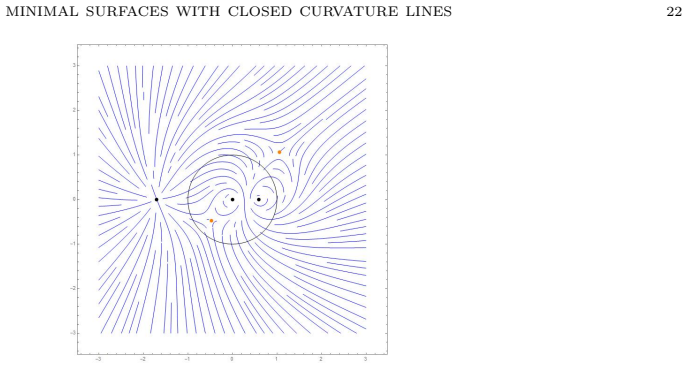
read the original abstract
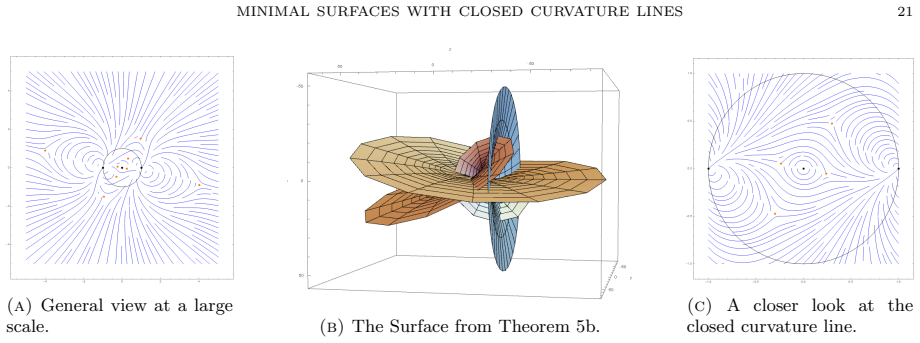
We investigate complete non-orientable minimal surfaces of finite total curvature in $\mathbb{R}^3$ such that their ends are foliated by closed lines of curvature. This condition on the ends is necessary if they have a piece inside some Euclidean ball that is free boundary. It turns out this is a rigid situation, and we are able to show, among further obstructions, that there are no such surfaces with one end.
Editorial analysis
A structured set of objections, weighed in public.
Referee Report
Summary. The paper studies complete non-orientable minimal surfaces of finite total curvature in R^3 whose ends are foliated by closed curvature lines. It shows that this foliation condition is necessary whenever the surface has a free-boundary piece inside a Euclidean ball. Via the Weierstrass representation and analysis of the Gauss map under the closed-line condition, the authors establish rigidity and prove, among other obstructions, that no such surfaces exist with exactly one end.
Significance. If the results hold, they provide new rigidity theorems for non-orientable finite-total-curvature minimal surfaces, linking end foliation conditions to free-boundary problems and yielding concrete non-existence statements. The use of Weierstrass data and Gauss-map analysis offers a structured approach that may extend to related classification questions in minimal surface theory.
minor comments (3)
- The abstract and introduction would benefit from a brief explicit statement of the Weierstrass representation data (meromorphic functions and the holomorphic quadratic differential) used to encode the closed-curvature-line condition on the ends.
- Section 3 (or wherever the Gauss-map analysis appears) should include a short remark clarifying why the non-orientability does not introduce additional branch points or covering issues in the Gauss map that could affect the one-end non-existence argument.
- The necessity proof for the foliation condition (free-boundary piece inside a ball) would be clearer if the authors added a one-sentence reference to the relevant boundary regularity result or maximum principle invoked.
Simulated Author's Rebuttal
We thank the referee for their careful reading and for recommending minor revision. Their summary accurately captures the main results and methods of the paper.
read point-by-point responses
-
Referee: The paper studies complete non-orientable minimal surfaces of finite total curvature in R^3 whose ends are foliated by closed lines of curvature. It shows that this foliation condition is necessary whenever the surface has a free-boundary piece inside a Euclidean ball. Via the Weierstrass representation and analysis of the Gauss map under the closed-line condition, the authors establish rigidity and prove, among other obstructions, that no such surfaces exist with exactly one end.
Authors: We appreciate the referee's concise and accurate summary of our results. The description correctly reflects the content of the manuscript, including the necessity of the foliation condition in the free-boundary setting, the use of Weierstrass data and Gauss map analysis, and the non-existence theorem for one-ended surfaces. No revisions are required in response to this comment. revision: no
Circularity Check
No significant circularity identified
full rationale
The derivation establishes rigidity and non-existence for one-ended non-orientable finite-total-curvature minimal surfaces whose ends are foliated by closed curvature lines, using the Weierstrass representation together with analysis of the Gauss map under the closed-line condition. The necessity of the foliation condition for free-boundary pieces inside balls is shown via geometric properties, and the obstructions (including one-end non-existence) follow from standard minimal-surface techniques without reducing to self-definitional equations, fitted inputs renamed as predictions, or load-bearing self-citation chains. No load-bearing step equates a claimed result to its own inputs by construction.
Axiom & Free-Parameter Ledger
axioms (3)
- standard math Minimal surfaces have vanishing mean curvature.
- domain assumption Finite total curvature implies controlled asymptotic behavior at the ends.
- domain assumption Closed curvature lines on ends are necessary for free-boundary pieces inside a Euclidean ball.
Lean theorems connected to this paper
-
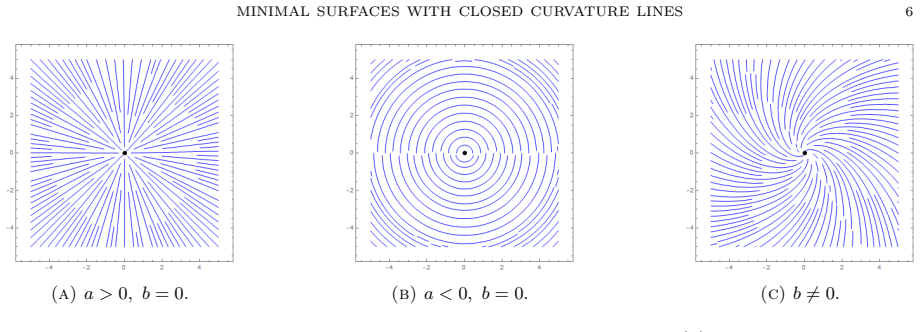
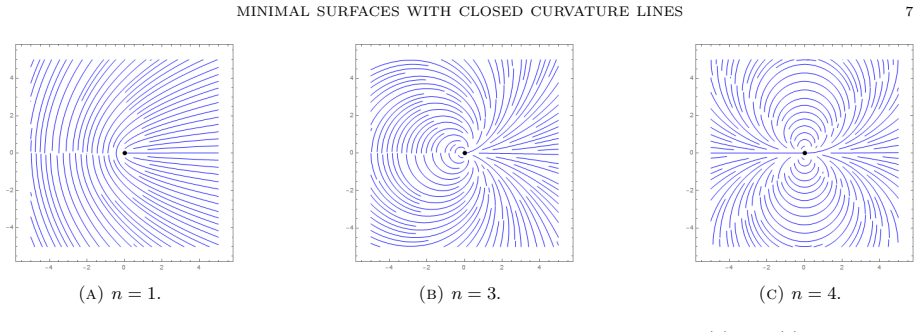
IndisputableMonolith/Cost/FunctionalEquation.leanwashburn_uniqueness_aczel unclearThe Hopf differential extends meromorphically to Σ... ord_pj QH = -2... closed curvature lines around the ends iff the associated complex function has a pole of order two with non-zero real quadratic limit at each end.
Reference graph
Works this paper leans on
-
[1]
Superf´ ıcies m´ ınimas, completas, n˜ ao orient´ aveis emR3 com curvatura total finita
A. Barros. “Superf´ ıcies m´ ınimas, completas, n˜ ao orient´ aveis emR3 com curvatura total finita”. In: Instituto de Matem´ atica Pura e Aplicada. Tese de Doutorado (1986)
work page 1986
-
[2]
Surfaces in Conformal Geometry
R. Bryant. “Surfaces in Conformal Geometry”. In: Proceedings of Symposia in Pure Mathematics 48 (1988), pp. 227–240.doi:10.1090/pspum/048/974338
-
[3]
C. Chen and F. Gackstatter. “Elliptische und hyperelliptische Funktionen und vollst¨ andige Min- imalfl¨ achen vom Enneperschen Typ”. In:Mathematische Annalen259 (1982), pp. 359–369.doi: 10.1007/BF01456948
-
[4]
Example of a complete minimal immersion inR 3 of genus one and three-embedded ends
C. Costa. “Example of a complete minimal immersion inR 3 of genus one and three-embedded ends”. In:Bol. Soc. Bras. Mat15 (1984), pp. 47–54.doi:10.1007/BF02584707
-
[5]
U. Dierkes et al. “Minimal surfaces inR 3”. In: (2010).doi:10.1007/978-3-642-11698-8
-
[6]
Complete minimal surfaces inR 3 with type Enneper end
N. do Espirito Santo. “Complete minimal surfaces inR 3 with type Enneper end”. In:Anais da Academia Brasileira de Ciˆ encias65 (Jan. 1993).doi:10.5802/aif.1408
-
[7]
Sharp eigenvalue bounds and minimal surfaces in the ball
A. Fraser and R. Schoen. “Sharp eigenvalue bounds and minimal surfaces in the ball”. In: Invent. Math. 203.3 (2016), pp. 823–890.doi:10.1007/s00222-015-0604-x
-
[8]
Introduction to Compact Riemann Surfaces and Dessins d’Enfants
E. Girondo and G. Gonzales. “Introduction to Compact Riemann Surfaces and Dessins d’Enfants”. In: (2012).doi:10.1017/CBO9781139048910
-
[9]
Principal lines on surfaces immersed with constant mean curva- ture
C. Guti´ errez and J. Sotomayor. “Principal lines on surfaces immersed with constant mean curva- ture”. In:Trans. Amer. Math. Soc.293.2 (1986), pp. 751–766.doi:10.2307/2000035
-
[10]
Nonorientable minimal surfaces with catenoidal ends
K. Hamada and S. Kato. “Nonorientable minimal surfaces with catenoidal ends”. In: Annali di Matematica 200 (2021), pp. 1573–1603.doi:10.1007/s10231-020-01048-4
-
[11]
Nonorientable minimal surfaces with various types of ends
K. Hamada and S. Kato. “Nonorientable minimal surfaces with various types of ends”. In: Modern Approaches to Differential Geometry and its Related Fields (2025)
work page 2025
-
[12]
¨Uber salche minimalfl¨ ache, welche eine vorgeschriebene ebene curve sur geod¨ atishen line haben
L. Henneberg. “ ¨Uber salche minimalfl¨ ache, welche eine vorgeschriebene ebene curve sur geod¨ atishen line haben”. In: Doctoral Dissertation, Eidgen¨ ossisches Polythechikum, Zurich (1875)
-
[13]
Complete embedded minimal surfaces of finite total curvature
D. Hoffman and W. Meeks. “Complete embedded minimal surfaces of finite total curvature”. In: Bulletin (New Series) of the American Mathematical Society12.1 (1985), pp. 134–136.doi:10. 1090/S0273-0979-1985-15318-2
work page 1985
-
[14]
Complete M¨ obius strips minimally immersed inR 3
T. Ishihara. “Complete M¨ obius strips minimally immersed inR 3”. In: Proc. Amer. Math. Soc 107.3 (1989).doi:10.2307/2048181
-
[15]
Complete nonorientable minimal surfaces inR 3
T. Ishihara. “Complete nonorientable minimal surfaces inR 3”. In: Transactions of the American Mathematical Society 333.2 (1992), pp. 889–901.doi:10.2307/2154069
-
[16]
Nonexistence of a projective plane minimally immersed with some embeddedness
T. Ishihara. “Nonexistence of a projective plane minimally immersed with some embeddedness”. In: J. Math. Tokushima Univ. 26 (1992), pp. 9–17
work page 1992
-
[17]
The topology of complete minimal surfaces of finite total Gaussian cur- vature
L. Jorge and W. Meeks. “The topology of complete minimal surfaces of finite total Gaussian cur- vature”. In:Topology22.2 (1983), pp. 203–221.doi:10.1016/0040-9383(83)90032-0
-
[18]
N. Kapouleas and M. Li. “Free boundary minimal surfaces in the unit three-ball via desingular- ization of the critical catenoid and the equatorial disc”. In: Journal f¨ ur die reine und angewandte Mathematik (Crelles Journal) 2021.776 (2021), pp. 201–254.doi:10.1515/crelle-2020-0050
-
[19]
Free boundary minimal surfaces of unbounded genus
D. Ketover. “Free boundary minimal surfaces of unbounded genus”. In: Preprint arXiv:1612.08691 (2016).doi:10.48550/arXiv.1612.08691. REFERENCES 24
-
[20]
Conformal geometry and complete minimal surfaces
R. Kusner. “Conformal geometry and complete minimal surfaces”. In:Bulletin (New Series) of the American Mathematical Society17.2 (1987), pp. 291–295.doi:10.1090/S0273- 0979-1987- 15564-9
-
[21]
The Spinor Representation of Minimal Surfaces
R. Kusner and N. Schmitt. “The Spinor Representation of Minimal Surfaces”. In: Preprint (1995). doi:10.48550/arXiv.dg-ga/9512003
-
[22]
A new approach to the Fraser-Li conjecture with the Weierstrass representation formula
J. Lee and E. Yeon. “A new approach to the Fraser-Li conjecture with the Weierstrass representation formula”. In: Proc. Amer. Math. Soc. 149 (2021), pp. 5331–5345.doi:10.1090/proc/15630
-
[23]
Complete minimal surfaces inR 3
F. L´ opez and F. Mart´ ın. “Complete minimal surfaces inR 3”. In:Publicacions Matem` atiques43 (1999), pp. 341–449.doi:10.5565/PUBLMAT\_43299\_01
-
[24]
A complete minimal Klein bottle inR 3
Francisco J. L´ opez. “A complete minimal Klein bottle inR 3”. In:Duke Mathematical Journal71.1 (1993), pp. 23–30.doi:10.1215/S0012-7094-93-07102-5
-
[25]
Complete nonorientable minimal surfaces and symme- tries
Francisco J. L´ opez and Francisco Mart´ ın. “Complete nonorientable minimal surfaces and symme- tries”. In:Duke Mathematical Journal79.3 (1995), pp. 667–686.doi:10.1215/S0012-7094-95- 07917-4
-
[26]
Minimal Surfaces of Least Total Curvature and Moduli Spaces of Plane Polygonal Arcs
M.Weber and M. Wolf. “Minimal Surfaces of Least Total Curvature and Moduli Spaces of Plane Polygonal Arcs”. In:GAFA, Geom. funct. anal.8 (1998), pp. 1129–1170.doi:10.1007/s000390050125
-
[27]
Superficies Minimales No Orientables enR 3
F. Martin. “Superficies Minimales No Orientables enR 3”. In: Tesis Doctoral (1996)
work page 1996
-
[28]
The classification of complete minimal surfaces inR 3 with total curvature greater than −8π
W. Meeks. “The classification of complete minimal surfaces inR 3 with total curvature greater than −8π”. In: Duke Math. J. 48.3 (1981), pp. 523–535.doi:10.1215/S0012-7094-81-04829-8
-
[29]
Stationary partitioning of convex bodies
J. Nitsche. “Stationary partitioning of convex bodies”. In: Arch. Rational Mech. Anal. 89 (1985), pp. 1–19.doi:10.1007/BF00281743
-
[30]
Some new examples of nonorientable minimal surfaces
M. Oliveira. “Some new examples of nonorientable minimal surfaces”. In: Proc. Amer. Math. Soc. 98 (1986), pp. 629–635.doi:10.2307/2045740
-
[31]
Global Properties of Minimal Surfaces inE 3 andE n
R. Osserman. “Global Properties of Minimal Surfaces inE 3 andE n”. In: 80.2 (1964), pp. 340–364. doi:https://doi.org/10.2307/1970396
- [32]
-
[33]
K. Sato. “Construction of higher genus minimal surfaces with one end and finite total curvature”. In:Tohoku Math. J.2.48 (1996), pp. 229–246.doi:10.2748/tmj/1178225378
-
[34]
M. Schulz. “Geometric analysis gallery.” In: ().url:https://mbschulz.github.io/
-
[35]
E. Thayer. “Higher-genus Chen–Gackstatter surfaces and the Weierstrass representation for surfaces of infinite genus”. In:Experiment. Math.4 (1995), pp. 19–39.url:http://projecteuclid.org/ euclid.em/1062621140
-
[36]
Non-existence of free boundary minimal M¨ obius bands in the unit three-ball
C. Toro. “Non-existence of free boundary minimal M¨ obius bands in the unit three-ball”. In:Proceed- ings of the American Mathematical Society153.5 (2025), pp. 2185–2198.doi:10.1090/proc/17163
-
[37]
Free boundary minimal surfaces inB 3
C. Toro. “Free boundary minimal surfaces inB 3”. In:Instituto de Matem´ atica Pura e Aplicada. Doctoral Thesis (2026)
work page 2026
-
[38]
Surfaces minimales non orientables de genre quelconque
E. Toubiana. “Surfaces minimales non orientables de genre quelconque”. In: Bull. Soc. math. France 121.183-195 (1993).url:http://www.numdam.org/item?id=BSMF_1993__121_2_183_0
work page 1993
-
[39]
On complete minimal immersionχ:RP 2 − {a, b} →R 3 with total curvature−10π
S. Zhang. “On complete minimal immersionχ:RP 2 − {a, b} →R 3 with total curvature−10π”. In: Lecture Notes in Math. 1369 (1989), pp. 339–350.doi:10.1007/BFb0087547. Instituto de Matem´atica Pura e Aplicada-Instituto de Matem ´atica e Estat´ıstica, Universidade Federal do Rio Grande do Sul, Brazil Email address:carlos.toroc@impa.br
discussion (0)
Sign in with ORCID, Apple, or X to comment. Anyone can read and Pith papers without signing in.