LE-PAVD: Learning-Enhanced Physics-Aware Vehicle Dynamics for High-Speed Autonomous Navigation
Reviewed by Pith2026-05-12 02:05 UTCgrok-4.3open to challenge →
The pith
A hybrid model blends physics tire forces and load transfer with neural learning to predict vehicle states more accurately than deep networks alone.
A machine-rendered reading of the paper's core claim, the machinery that carries it, and where it could break.
Core claim
LE-PAVD adds load-sensitive Pacejka tire forces, longitudinal load transfer, lateral tire-force effects, and rate-limited actuator inputs to a neural vehicle dynamics model. Trained end-to-end, the hybrid structure enforces physical consistency while learning nonlinearities from data, producing lower state prediction errors and better closed-loop performance than a deep dynamics baseline on both seen and unseen tracks.
What carries the argument
The integration of four physics components—load-sensitive Pacejka tire forces, longitudinal load transfer, lateral tire-force effects, and rate-limited actuator inputs—into an end-to-end neural dynamics model.
If this is right
- On unseen tracks the model reduces average displacement error by 16.1 percent and final displacement error by 20.6 percent.
- Yaw-rate root mean squared error drops 91.3 percent relative to a deep dynamics baseline.
- The model requires 21.6 percent fewer FLOPs and runs about 1.5 times faster during inference.
- Closed-loop simulations show 17.4 percent faster laps on a training track and 9.5 percent faster laps on a test track with no boundary violations.
Where Pith is reading between the lines
- The same pattern of adding targeted physics terms to neural models could be tested for other high-speed systems such as fixed-wing aircraft or underwater vehicles.
- The efficiency gains suggest the approach may scale to onboard hardware with limited compute in production autonomous vehicles.
- Further work could examine whether the same components improve robustness when the vehicle parameters change slightly, such as tire wear or payload shifts.
Load-bearing premise
That the four physics components can be added to a learned model in a way that keeps physical consistency, improves accuracy on new tracks, and avoids new inconsistencies or overfitting.
What would settle it
If the hybrid model produces higher average or final displacement errors, higher yaw-rate RMSE, or causes track boundary violations in closed-loop tests on an unseen track compared to the pure learned baseline, the claimed improvements would not hold.
Figures




read the original abstract
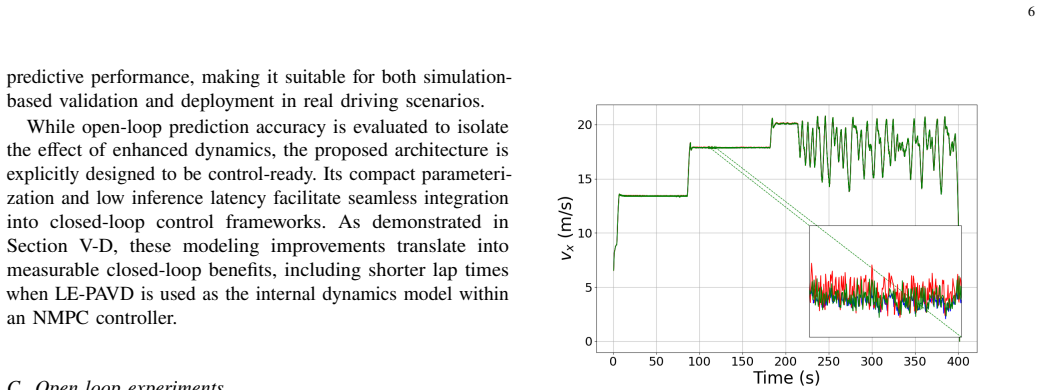
Accurate modeling of nonlinear vehicle dynamics is essential for high-speed autonomous racing, where controllers operate at the handling limits. Model-based methods are interpretable but rely on simplifying assumptions, while purely learned models capture nonlinearities yet often lack physical consistency and generalization. We propose LE-PAVD (Learning-Enhanced Physics-Aware Vehicle Dynamics), a hybrid model that integrates physics priors with learned components. Our architecture adds four components: load-sensitive Pacejka tire forces, longitudinal load transfer, lateral tire-force effects, and rate-limited actuator inputs. Trained end-to-end on simulation and real-world telemetry, LE-PAVD enforces physical consistency while improving state prediction accuracy. On an unseen track, LE-PAVD reduces average displacement error (ADE) by 16.1$\%$, final displacement error (FDE) by 20.6$\%$, and lowers yaw-rate root mean squared error (RMSE) by 91.3$\%$ versus a deep dynamics baseline, while using 21.6$\%$ fewer FLOPs and achieving approximately 1.50$\times$ faster inference. In closed-loop simulations, LE-PAVD consistently outperforms the baseline by achieving faster lap times by 17.4$\%$ on a training track and 9.5$\%$ on a test track, without any track boundary violations. Overall, LE-PAVD offers a compact, physics-grounded dynamics backbone that improves predictive fidelity and closed-loop performance while reducing inference cost.
Editorial analysis
A structured set of objections, weighed in public.
Referee Report
Summary. The paper proposes LE-PAVD, a hybrid vehicle dynamics model for high-speed autonomous racing that augments a learned backbone with four explicit physics components (load-sensitive Pacejka tire forces, longitudinal load transfer, lateral tire-force effects, and rate-limited actuator inputs). Trained end-to-end on simulation and real telemetry, the model claims to enforce physical consistency while delivering improved state prediction on unseen tracks (ADE reduced 16.1%, FDE 20.6%, yaw-rate RMSE 91.3%) and faster closed-loop lap times (17.4% training track, 9.5% test track) with lower FLOPs and faster inference versus a deep dynamics baseline.
Significance. If the reported gains and consistency enforcement hold, the work demonstrates a practical route to embedding targeted physics priors into end-to-end learned dynamics, yielding both better generalization to unseen tracks and reduced inference cost. This hybrid style could strengthen model-based controllers in handling-limit regimes where pure data-driven models often fail.
major comments (2)
- [Abstract and §3] Abstract and §3 (Architecture): the central claim that the four physics components can be integrated while preserving physical consistency and avoiding new inconsistencies is load-bearing, yet the manuscript provides no explicit loss terms, constraint formulation, or residual-connection equations showing how consistency is enforced during end-to-end training.
- [§4] §4 (Experiments): the 16.1% ADE, 20.6% FDE, and 91.3% yaw-rate RMSE reductions on an unseen track are presented without error bars, number of trials, or data-split details; this weakens the generalization claim and makes it impossible to judge whether the gains are robust or sensitive to post-hoc tuning.
minor comments (2)
- Clarify the exact measurement protocol for the 'approximately 1.50× faster inference' and 21.6% fewer FLOPs claims, including hardware and batch size.
- Define ADE, FDE, and RMSE at first use in the abstract and main text.
Simulated Author's Rebuttal
We thank the referee for their constructive and detailed review. We address each major comment below and indicate the changes incorporated in the revised manuscript.
read point-by-point responses
-
Referee: [Abstract and §3] Abstract and §3 (Architecture): the central claim that the four physics components can be integrated while preserving physical consistency and avoiding new inconsistencies is load-bearing, yet the manuscript provides no explicit loss terms, constraint formulation, or residual-connection equations showing how consistency is enforced during end-to-end training.
Authors: We agree that an explicit formulation strengthens the presentation. The four physics components are integrated as fixed additive terms in the state-transition equations, with the learned backbone predicting residuals around these physics-based predictions. This architectural design enforces the priors in every forward pass without additional loss terms. In the revised manuscript we have added the residual-connection equations and a step-by-step description of the integration in Section 3 to clarify how consistency is maintained. revision: yes
-
Referee: [§4] §4 (Experiments): the 16.1% ADE, 20.6% FDE, and 91.3% yaw-rate RMSE reductions on an unseen track are presented without error bars, number of trials, or data-split details; this weakens the generalization claim and makes it impossible to judge whether the gains are robust or sensitive to post-hoc tuning.
Authors: The referee correctly notes the missing statistical details. In the revised Section 4 we now report error bars as standard deviation over five independent runs with distinct random seeds, specify the data splits (70 % training, 15 % validation, 15 % test from combined simulation and real telemetry), and confirm that the unseen-track evaluation uses a completely held-out track. These additions show the gains are consistent across trials. revision: yes
Circularity Check
No significant circularity in the derivation chain
full rationale
The paper explicitly adds four physics components (load-sensitive Pacejka tire forces, longitudinal load transfer, lateral tire-force effects, and rate-limited actuator inputs) as priors into a hybrid architecture, then trains the full model end-to-end on simulation and real telemetry data. Evaluation metrics (ADE, FDE, yaw-rate RMSE, lap times) are reported on unseen tracks against a deep dynamics baseline, with no equations or claims showing that any prediction reduces by construction to the fitted inputs or to a self-citation. The central claims rest on empirical generalization results rather than tautological re-derivations, making the chain self-contained.
Axiom & Free-Parameter Ledger
Forward citations
Cited by 1 Pith paper
-
CAPE: Control Algorithm Performance Evaluation under Learned Vehicle Dynamics Models
CAPE benchmark shows the proposed EPM learned dynamics model yields faster laps and lower errors than DPM and DDM across five controllers in both nominal and disturbance-aware simulations.
Reference graph
Works this paper leans on
-
[1]
Autonomous robot racing competitions: Truly multivehicle autonomous racing competitions,
H. Moon, S. H. Kang, J. Eom, M. J. Hwang, Y. Kim, J. Wang, B. Kim, T. Kim, T. Ga, J. Choi,et al., “Autonomous robot racing competitions: Truly multivehicle autonomous racing competitions,”IEEE Robotics & Automation Magazine, vol. 31, no. 1, pp. 123–132, 2024
work page 2024
-
[2]
Hierarchical control for head-to-head autonomous racing,
R. S. Thakkar, A. S. Samyal, D. Fridovich-Keil, Z. Xu, and U. Topcu, “Hierarchical control for head-to-head autonomous racing,”Field Robotics, vol. 4, pp. 46–69, 2024
work page 2024
-
[3]
Autonomous driving small-scale cars: A survey of recent development,
D. Li, P. Auerbach, and O. Okhrin, “Autonomous driving small-scale cars: A survey of recent development,”IEEE Transactions on Intelligent Transportation Systems, 2025
work page 2025
-
[4]
Literature review and fundamental approaches for vehicle and tire state estimation,
K. B. Singh, M. A. Arat, and S. Taheri, “Literature review and fundamental approaches for vehicle and tire state estimation,”Vehicle system dynamics, vol. 57, pp. 1643–1665, 2019
work page 2019
-
[5]
H. B. Pacejka,Tire and Vehicle Dynamics. Amsterdam, The Netherlands: Elsevier, 2012
work page 2012
-
[6]
Neural network vehicle models for high- performance automated driving,
N. A. Spielberg et al., “Neural network vehicle models for high- performance automated driving,”Science Robotics, vol. 4, no. 28, p. eaaw1975, 2019
work page 2019
-
[7]
Model- and acceleration-based pursuit controller for high-performance autonomous racing,
J. Becker, N. Imholz, L. Schwarzenbach, E. Ghignone, N. Baumann, and M. Magno, “Model- and acceleration-based pursuit controller for high-performance autonomous racing,” inProc. IEEE Int. Conf. Robotics and Automation (ICRA), pp. 5276–5283, 2023
work page 2023
-
[8]
T. Kim, H. Lee, and W. Lee, “Physics embedded neural network vehicle model and applications in risk-aware autonomous driving using latent features,” inProc. IEEE/RSJ Int. Conf. Intell. Robots Syst., pp. 4182–4189, 2022
work page 2022
-
[9]
J. Chrosniak, J. Ning, and M. Behl, “Deep dynamics: Vehicle dynamics modeling with a physics-constrained neural network for autonomous racing,”IEEE Robotics and Automation Letters, vol. 9, pp. 5292 – 5297, 2024
work page 2024
-
[10]
Fine-tuning hybrid dynamics with physics-informed neural networks for vehicle dynamics estimation,
S. Fang and K. Yu, “Fine-tuning hybrid dynamics with physics-informed neural networks for vehicle dynamics estimation,”International Journal of Intelligent Robotics and Applications, pp. 1–17, 2025
work page 2025
-
[11]
Guiggiani,The science of vehicle dynamics: handling, braking, and ride of road and race cars
M. Guiggiani,The science of vehicle dynamics: handling, braking, and ride of road and race cars. Springer, 2018
work page 2018
-
[12]
Tube model predictive control for an autonomous race car,
A. Wischnewski, M. Euler, S. Gümüs, and B. Lohmann, “Tube model predictive control for an autonomous race car,”Vehicle System Dynamics, vol. 60, no. 9, pp. 3151–3173, 2022
work page 2022
-
[13]
T. Zhang, Y. Sun, Y. Wang, B. Li, Y. Tian, and F.-Y. Wang, “A survey of vehicle dynamics modeling methods for autonomous racing: Theoretical models, physical/virtual platforms, and perspectives,”IEEE Transactions on Intelligent Vehicles, vol. 9, no. 3, pp. 4312–4334, 2024. 9
work page 2024
-
[14]
An efficient minimum- time trajectory generation strategy for two-track car vehicles,
A. Rucco, G. Notarstefano, and J. Hauser, “An efficient minimum- time trajectory generation strategy for two-track car vehicles,”IEEE Transactions on Control Systems Technology, vol. 23, no. 4, pp. 1505– 1519, 2015
work page 2015
-
[15]
Deep neuralnetworkstopredictautonomousgroundvehiclebehavioronsloping terrain field,
C. Badgujar, S. Das, D. M. Figueroa, D. Flippo, and S. Welch, “Deep neuralnetworkstopredictautonomousgroundvehiclebehavioronsloping terrain field,”Journal of Field Robotics, vol. 40, no. 4, pp. 919–933, 2023
work page 2023
-
[16]
Learning dynamics models for velocity estimation in autonomous racing,
J. Węgrzynowski, G. Czechmanowski, P. Kicki, and K. Walas, “Learning dynamics models for velocity estimation in autonomous racing,” in2024 IEEE/RSJ International Conference on Intelligent Robots and Systems (IROS), pp. 972–979, IEEE, 2024
work page 2024
-
[17]
Deepracing: A framework for autonomous racing,
T. Weiss and M. Behl, “Deepracing: A framework for autonomous racing,” in Proc. IEEE Des. Automat. Test Eur. Conf. Exhib., pp. 1163–1168, 2020
work page 2020
-
[18]
Learning-based near-optimal motion planning for intelligent vehicles with uncertain dynamics,
Y. Lu, X. Zhang, X. Xu, and W. Yao, “Learning-based near-optimal motion planning for intelligent vehicles with uncertain dynamics,”IEEE Robotics and Automation Letters, vol. 9, no. 2, pp. 1532–1539, 2023
work page 2023
-
[19]
Digital twin of a driver- in-the-loop race car simulation with contextual reinforcement learning,
S. Ju, P. van Vliet, O. Arenz, and J. Peters, “Digital twin of a driver- in-the-loop race car simulation with contextual reinforcement learning,” IEEE Robotics and Automation Letters, vol. 8, no. 7, pp. 4107–4114, 2023
work page 2023
-
[20]
Learning based mpc for autonomous driving using a low dimensional residual model,
Y. Li, C. Huang, D. Yang, W. Liu, and J. Li, “Learning based mpc for autonomous driving using a low dimensional residual model,”arXiv preprint arXiv:2412.03874, 2024
-
[21]
A physics- informedapproachforlearningvehicledynamicsinhigh-speedautonomy,
M. P. Kolluri, S. V. Shelar, S. A. Sarwar, and Z. Hasnain, “A physics- informedapproachforlearningvehicledynamicsinhigh-speedautonomy,” in AIAA SCITECH 2025 Forum, p. 1726, 2025
work page 2025
-
[22]
Physics-informed adaptive deep koopman operator modeling for autonomous vehicle dynamics,
J. Zhang, Y. He, and H. Chen, “Physics-informed adaptive deep koopman operator modeling for autonomous vehicle dynamics,”arXiv preprint arXiv:2503.23396, 2025
-
[23]
Racecar-the dataset for high-speed autonomous racing,
A. Kulkarni, J. Chrosniak, E. Ducote, F. Sauerbeck, A. Saba, U. Chirimar, J. Link, M. Behl, and M. Cellina, “Racecar-the dataset for high-speed autonomous racing,” in2023 IEEE/RSJ International Conference on Intelligent Robots and Systems (IROS), pp. 11458–11463, IEEE, 2023
work page 2023
-
[24]
Bayesrace: Learning to race autonomously using prior experience,
A. Jain, M. O’Kelly, P. Chaudhari, and M. Morari, “Bayesrace: Learning to race autonomously using prior experience,” inProc. 4th Conf. Robot Learn., pp. 1918–1929, 2020
work page 1918
-
[25]
Social lstm: Human trajectory prediction in crowded spaces,
A. Alahi, K. Goel, V. Ramanathan, A. Robicquet, L. Fei-Fei, and S. Savarese, “Social lstm: Human trajectory prediction in crowded spaces,” in Proc. IEEE Conf. Comput. Vis. Pattern Recognit., pp. 961–971, 2016
work page 2016
discussion (0)
Sign in with ORCID, Apple, or X to comment. Anyone can read and Pith papers without signing in.