Recognition: no theorem link
Graduate Training in Quantum Information Science and Engineering: Lessons, Challenges, and a Roadmap from the NSF Research Traineeship Programs
Pith reviewed 2026-05-12 00:49 UTC · model grok-4.3
The pith
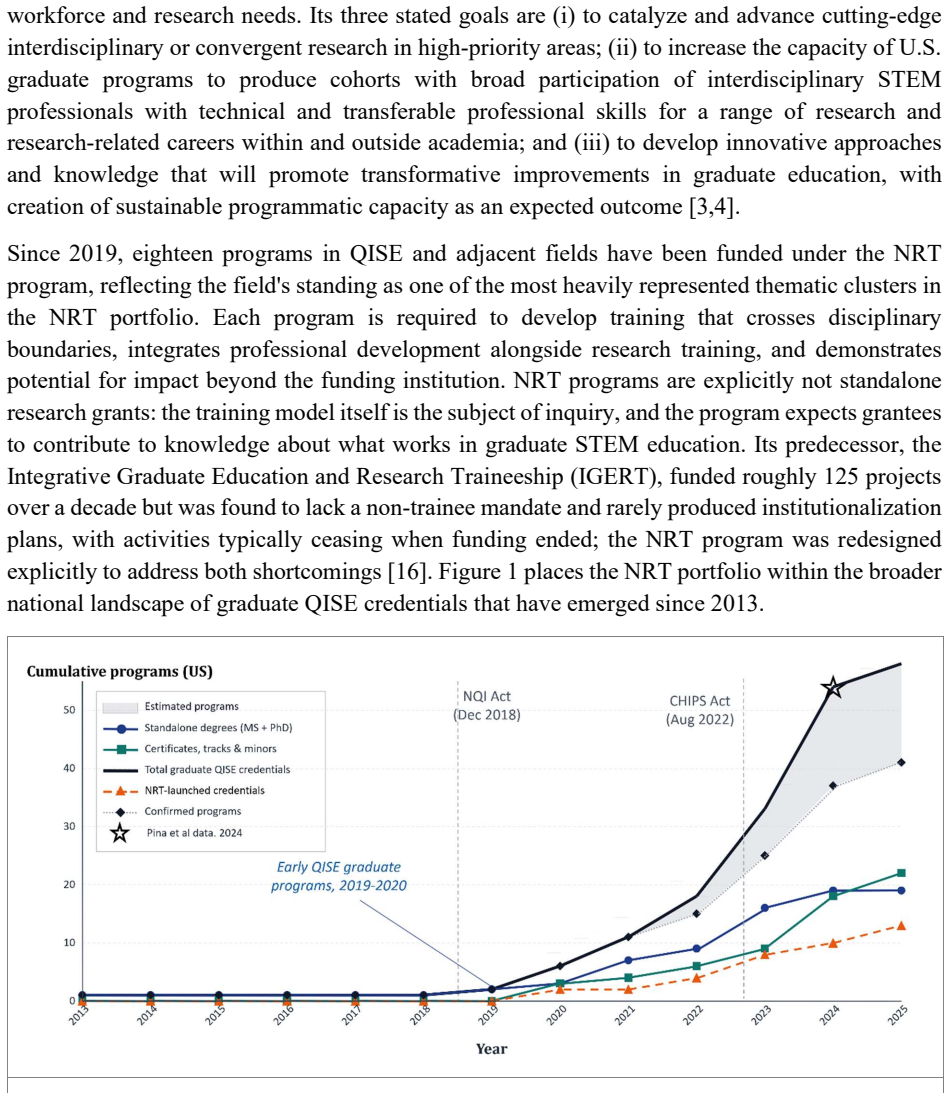
Eight concrete recommendations emerge from eighteen NSF-funded QISE training programs to help scale graduate education beyond elite research universities.
A machine-rendered reading of the paper's core claim, the machinery that carries it, and where it could break.
Core claim
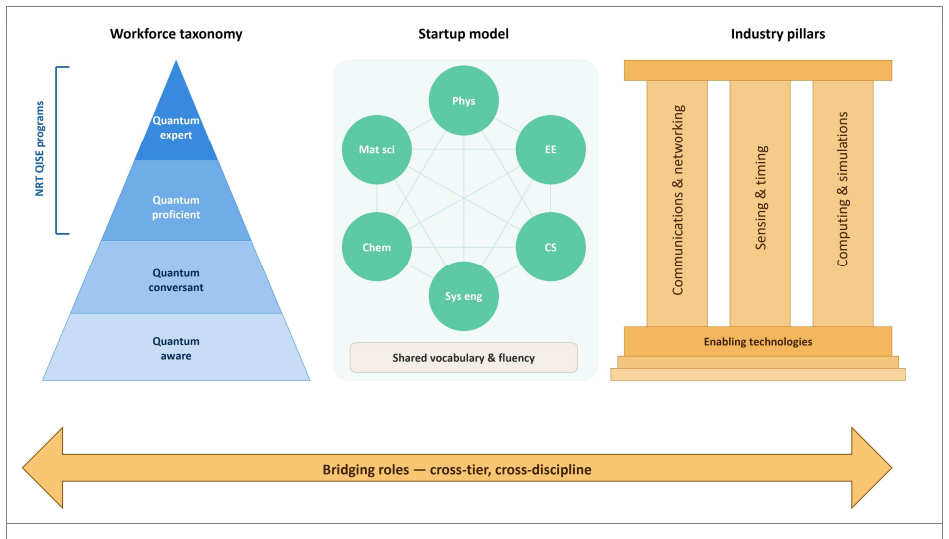
Drawing on the collective experience of these well-resourced programs, the paper claims that successful QISE graduate education requires negotiating three recurring tensions and adopting targeted structural changes. These include using team-based training models, developing dedicated curricula for sensing and communications, involving students in program governance, creating formal mechanisms for industrial partnerships, designing for long-term sustainability, producing textbooks that span all three pillars, establishing shared assessment tools, and supporting faculty professional development in QISE. The authors assess current progress and map twelve unresolved issues the community must now
What carries the argument
The three central tensions every QISE graduate program must negotiate—depth versus breadth, structured instruction versus experiential learning, and individual specialists versus collective team coverage—together with the eight recommendations derived from the NRT programs' innovations.
If this is right
- Adopting the startup model of team-based training will allow programs to cover all areas of QISE even when individual students specialize deeply.
- Investing in sensing and communication curriculum development will close gaps left by current computing-heavy offerings.
- Building student agency into program governance will increase ownership and alignment with learner needs.
- Establishing formal structural mechanisms for industrial engagement will reduce dependence on informal goodwill and improve practical relevance.
- Designing for sustainability from year one and developing shared outcome assessments will help programs persist and improve after initial funding.
Where Pith is reading between the lines
- The identified tensions and recommendations could inform training design in other fast-moving interdisciplinary domains such as synthetic biology or machine learning systems.
- Implementing shared assessment instruments across programs would enable direct comparison of which innovations improve specific student outcomes.
- The push for graduate-level textbooks spanning computing, sensing, and communications creates an opportunity for coordinated publishing efforts that individual programs cannot tackle alone.
- Testing the team-based model in smaller departments could reveal whether it requires a minimum scale of faculty or student numbers to function effectively.
Load-bearing premise
The experiences and innovations from these eighteen specific, well-resourced NRT programs are representative enough to guide QISE graduate education as it scales to a wider range of institutions.
What would settle it
A new QISE graduate program launched at a primarily undergraduate or regional institution that follows several of the eight recommendations but shows markedly lower rates of interdisciplinary collaboration, student retention, or industry placement than the original NRT programs would indicate the lessons do not generalize.
Figures

read the original abstract
Since 2019, eighteen NSF Research Traineeship (NRT) awards in quantum information science and engineering (QISE) and adjacent fields have been funded, constituting the largest NSF-coordinated investment in graduate QISE training in the United States. Synthesizing lessons from our programs, we work through the central tensions that every QISE graduate program must negotiate: between depth in a home discipline and breadth across the field, between structured instruction and open-ended experiential and hands-on learning, and between training individual specialists and cultivating teams that collectively cover all areas of QISE. We describe the structural and pedagogical innovations the NRT programs have developed in response, assess what is working and what remains unresolved, and sketch 12 open problems the community will need to address as QISE graduate education scales beyond the well-resourced research universities where it has up till now been mainly concentrated. Eight concrete recommendations follow: (1) adopt the startup model of team-based training as an organizing philosophy; (2) invest immediately in sensing and communication curriculum development; (3) build student agency into program governance, not just activities; (4) establish structural mechanisms for industrial engagement rather than depending on goodwill; (5) design for sustainability from year one; (6) develop graduate-level textbooks spanning all three QISE pillars: computing, sensing, and communications; (7) establish shared outcome assessment instruments across programs; and (8) develop structured mechanisms for faculty professional development in QISE.
Editorial analysis
A structured set of objections, weighed in public.
Referee Report
Summary. The manuscript synthesizes lessons from eighteen NSF Research Traineeship (NRT) programs in quantum information science and engineering (QISE) funded since 2019. It identifies central tensions in graduate training (depth in home discipline vs. breadth across QISE, structured instruction vs. experiential learning, and individual specialists vs. team-based coverage), describes structural and pedagogical innovations developed in response, assesses what is working, sketches twelve open problems for scaling, and offers eight concrete recommendations including team-based training models, curriculum investment in sensing and communication, student agency in governance, structured industrial engagement, sustainability planning, textbooks spanning computing/sensing/communications, shared assessment instruments, and faculty professional development.
Significance. If the lessons hold, the paper provides a timely, practitioner-informed roadmap for expanding QISE graduate education beyond its current concentration at well-resourced research universities. The explicit enumeration of tensions and the eight actionable recommendations represent a strength, offering concrete guidance that could shape future NSF investments and program design. The work credits the scale of the NRT investment and highlights practical mechanisms such as team-based training and industrial engagement structures.
major comments (2)
- [Abstract] Abstract: The assessment of 'what is working and what remains unresolved' and the derivation of the eight recommendations rest on qualitative synthesis by program participants without reported quantitative outcome metrics, success data, control comparisons to non-NRT cohorts, or independent verification; this is load-bearing for the central claim that the identified innovations constitute a scalable roadmap.
- [Abstract] Abstract (description of programs and open problems): The premise that experiences from these 18 competitively funded, well-resourced NRT programs are representative and generalizable to guide QISE graduate education at a wider range of institutions is untested, as no data or perspectives from less-resourced institutions or non-NRT programs are presented; if the tensions or recommended structures are artifacts of high-resource settings, the roadmap's applicability is undermined.
minor comments (2)
- The abstract is information-dense; separating the three tensions, the innovations, the open problems, and the numbered recommendations into distinct sentences or bullets would improve readability.
- The manuscript would benefit from additional citations to prior literature on interdisciplinary graduate training models in other STEM fields (e.g., outside QISE) to contextualize the NRT-specific innovations.
Simulated Author's Rebuttal
We thank the referee for the constructive review. The major comments raise valid points about the evidentiary basis and scope of our qualitative synthesis. We provide point-by-point responses and will make partial revisions to clarify these aspects in the manuscript.
read point-by-point responses
-
Referee: [Abstract] Abstract: The assessment of 'what is working and what remains unresolved' and the derivation of the eight recommendations rest on qualitative synthesis by program participants without reported quantitative outcome metrics, success data, control comparisons to non-NRT cohorts, or independent verification; this is load-bearing for the central claim that the identified innovations constitute a scalable roadmap.
Authors: The referee correctly identifies that our assessments and recommendations are based on qualitative synthesis by the program participants, without quantitative metrics or controls. This is a deliberate choice for this type of paper, which aims to share lessons learned rather than present empirical research findings. The claim is that these innovations offer a practitioner-informed roadmap, not that they have been validated through rigorous comparative studies. We will revise the abstract to better articulate the qualitative methodology and the provisional nature of the recommendations, thereby addressing the concern about what is load-bearing. revision: partial
-
Referee: [Abstract] Abstract (description of programs and open problems): The premise that experiences from these 18 competitively funded, well-resourced NRT programs are representative and generalizable to guide QISE graduate education at a wider range of institutions is untested, as no data or perspectives from less-resourced institutions or non-NRT programs are presented; if the tensions or recommended structures are artifacts of high-resource settings, the roadmap's applicability is undermined.
Authors: We recognize that the 18 NRT programs are competitively funded and typically at well-resourced institutions, and that our synthesis does not include data from other settings. The paper itself acknowledges this concentration and poses open problems for scaling. The roadmap is intended as guidance informed by these experiences, not as proven generalizable without further work. A partial revision will be made to the abstract to explicitly note the source of the lessons and the need for broader validation. revision: partial
- Lack of quantitative metrics and control data, as this is not an empirical study.
- Absence of perspectives from non-NRT or less-resourced institutions, which would require expanding the author team or scope beyond the current NRT-focused collaboration.
Circularity Check
No significant circularity in the synthesis of NRT program lessons
full rationale
The paper is an experience-based synthesis of lessons from 18 NSF NRT programs rather than a formal derivation with equations or first-principles claims. It explicitly frames its content as 'Synthesizing lessons from our programs' and proceeds by describing observed tensions, innovations, assessments of what is working, 12 open problems, and eight recommendations. No load-bearing steps reduce by construction to the inputs via self-definition, fitted parameters renamed as predictions, self-citation of uniqueness theorems, or ansatz smuggling. The authors' involvement in the programs is transparent but does not create a tautological loop; the output (recommendations) is not equivalent to the input (program experiences) by definition. This structure is self-contained as a standard educational roadmap paper without circular reduction.
Axiom & Free-Parameter Ledger
axioms (2)
- domain assumption Every QISE graduate program must negotiate tensions between depth and breadth, structured and experiential learning, and individual versus team training.
- domain assumption Lessons from the 18 funded NRT programs are sufficiently representative to guide broader scaling of QISE graduate education.
Reference graph
Works this paper leans on
-
[1]
C. D. Aiello, D. D. Awschalom, ..., M. Singh, ..., B. M. Zwickl, Achieving a Quantum Smart Workforce, Quantum Sci. Technol. 6, 030501 (2021). doi:10.1088/2058-9565/abfa64
-
[2]
A. Asfaw, A. Blais, K. R. Brown, ..., L. D. Carr, ..., H. M. Hurst, ..., H. J. Lewandowski, ..., C. Singh, Building a Quantum Engineering Undergraduate Program, IEEE Trans. Educ. 65, 220 (2022). doi:10.1109/TE.2022.3144943
-
[3]
National Science Foundation Research Traineeship (NRT) Program, NSF 21-536 (2021)
NSF, U.S. National Science Foundation Research Traineeship (NRT) Program, NSF 21-536 (2021). https://www.nsf.gov/pubs/2021/nsf21536/nsf21536.htm
work page 2021
-
[4]
National Science Foundation Research Traineeship (NRT) Program, NSF 24-597 (2024)
NSF, U.S. National Science Foundation Research Traineeship (NRT) Program, NSF 24-597 (2024). https://www.nsf.gov/funding/opportunities/us-national-science-foundation-research- traineeship-program/nsf24-597/solicitation
work page 2024
-
[5]
NSTC Subcommittee on QIS, Quantum Information Science and Technology Workforce Development National Strategic Plan (2022)
work page 2022
-
[6]
M. Bogobowicz, S. Gao, M. Masiowski, N. Mohr, H. Soller, R. Zemmel, M. Zesko. Quantum technology monitor. McKinsey Company (2023)
work page 2023
-
[7]
Building a Quantum Ready Workforce: A Roadmap For Colorado and the Mountain West Region
J. Bennett, M. B. Bennett, L. D. Carr, J. Douglass, K. Floyd, C. Gustavson, M. Huber, A. Krummel, T. Lei, H. Lewandowski, L. Sanders, M. R. Slot, and S. Sternberg, “Building a Quantum Ready Workforce: A Roadmap For Colorado and the Mountain West Region.” (2024) https://www.colorado.edu/today/2024/10/31/cu-boulder-releases-quantum-workforce-roadmap- econom...
work page 2024
- [8]
- [9]
-
[10]
A. Buzzell, T. J. Atherton, and R. Barthelemy, Quantum Mechanics Curriculum in the US: Quantifying the Instructional Time, Content Taught, and Paradigms Used, Phys. Rev. Phys. Educ. Res. 21, 010102 (2025)
work page 2025
-
[11]
S. Goorney, B. Munoz, and J. Sherson, Quantum Technology Master’s: A Shortcut to the Quantum Industry? EPJ Quantum Technol. 12, 2 (2025)
work page 2025
-
[12]
S. El-Adawy, A. R. Piña, B. M. Zwickl, and H. J. Lewandowski, Experimental Skills for Non- PhD Roles in the Quantum Industry, Quantum Workforce Report Series, Report 1, Univ. of Colorado Boulder and Rochester Institute of Technology (October 2025). arXiv:2510.12936
- [13]
- [14]
-
[15]
C. Hughes, D. Finke, D.-A. German, C. Merzbacher, P. M. Vora, and H. J. Lewandowski, Assessing the Needs of the Quantum Industry, IEEE Trans. Educ. 65, 592 (2022). doi:10.1109/TE.2022.3153841
-
[16]
J. Kumar, M. R. Worosz, S.-H. Shiu, P. H. Templer, and K. S. McNeal, Lessons learned from interdisciplinary US National Science Foundation Research Traineeship-supported graduate programs, PLOS One 21, e0343307 (2026). doi:10.1371/journal.pone.0343307
-
[17]
E. Barnes, ..., L. D. Carr, ..., H. J. Lewandowski, ..., B. M. Zwickl, Outcomes from a Workshop on a National Center for Quantum Education, EPJ Quantum Technol. 12, 40 (2025). arXiv:2410.23460
- [18]
-
[19]
S. El-Adawy, A. R. Piña, B. M. Zwickl, and H. J. Lewandowski, Industry Perspectives on Projected Quantum Workforce Needs, arXiv:2508.15055 [physics.ed-ph] (2025)
- [20]
-
[21]
F. Seifollahi and C. Singh, Preparing Students for the Quantum Information Revolution: Interdisciplinary Teaching, Curriculum Development, and Advising in QISE, Eur. J. Phys. 46, 055709 (2025). arXiv:2510.00150 49
- [22]
-
[23]
S. El-Adawy, A. R. Piña, B. M. Zwickl, and H. J. Lewandowski, Insights from Educators on Building a More Cohesive QISE Education Ecosystem, Phys. Rev. Phys. Educ. Res. 21, 020144 (2025). arXiv:2507.01578
-
[24]
Kono, Quantum Mechanics for Tomorrow’s Engineers (Cambridge University Press, Cambridge, 2022)
J. Kono, Quantum Mechanics for Tomorrow’s Engineers (Cambridge University Press, Cambridge, 2022). ISBN: 9781108842587
work page 2022
-
[25]
D. A. Cornell, C. F. M. Clewett, and M. S. Conradi, Versatile pulsed NMR system and experiments for students, Concepts Magn. Reson. 12, 257 (2000)
work page 2000
-
[26]
V. K. Sewani, H. H. Vallabhapurapu, Y. Yang, H. R. Firgau, C. Adambukulam, B. C. Johnson, J. J. Pla, and A. Laucht, Coherent control of NV⁻ centers in diamond in a quantum teaching lab, Am. J. Phys. 88, 1156 (2020). doi:10.1119/10.0001905
-
[27]
Y. Yang, H. H. Vallabhapurapu, V. K. Sewani, M. Isarov, H. R. Firgau, C. Adambukulam, B. C. Johnson, J. J. Pla, and A. Laucht, Observing hyperfine interactions of NV⁻ centers in diamond in an advanced quantum teaching lab, Am. J. Phys. 90, 550 (2022). doi:10.1119/5.0075519
-
[28]
K. A. Oliver, V. Borish, B. R. Wilcox, and H. J. Lewandowski, Education for Expanding the Quantum Workforce: Students’ Perceptions of the Quantum Industry in an Upper-Division Physics Capstone Course, Phys. Rev. Phys. Educ. Res. 21, 010129 (2025)
work page 2025
-
[29]
A. M. Price, C. J. Kim, E. W. Burkholder, A. V. Fritz, and C. E. Wieman, A detailed characterization of the expert problem-solving process in science and engineering: Guidance for teaching and assessment, CBE—Life Sci. Educ. 20, ar43 (2021)
work page 2021
-
[30]
N. G. Holmes, B. Keep, and C. E. Wieman, Developing scientific decision making by structuring and supporting student agency, Phys. Rev. Phys. Educ. Res. 16, 010109 (2020)
work page 2020
- [31]
-
[32]
S. Majidy, Addressing Misconceptions in University Physics: A Review and Experiences from Quantum Physics Educators, arXiv:2405.20923 [physics.ed-ph] (2025)
discussion (0)
Sign in with ORCID, Apple, or X to comment. Anyone can read and Pith papers without signing in.