Recognition: 2 theorem links
· Lean TheoremOn a PDE-based material parameter identification problem with contact constraints
Pith reviewed 2026-05-12 00:48 UTC · model grok-4.3
The pith
Contact constraints in a PDE parameter identification problem create both unique and non-unique reconstructions of the scalar coefficient.
A machine-rendered reading of the paper's core claim, the machinery that carries it, and where it could break.
Core claim
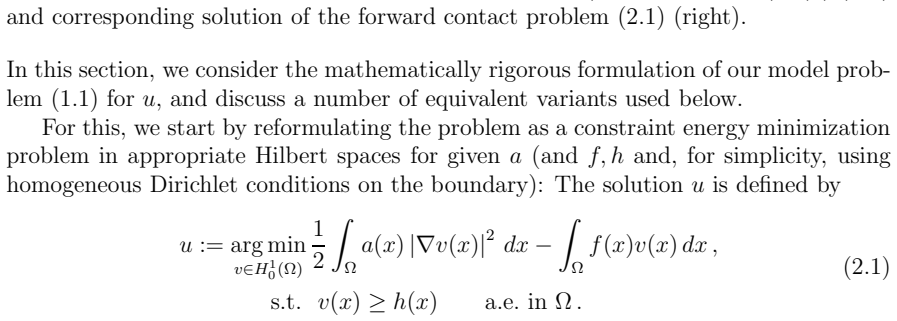
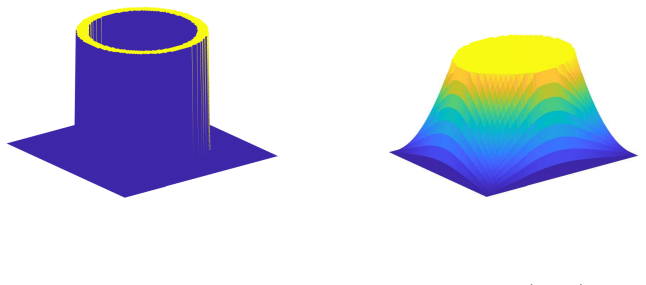
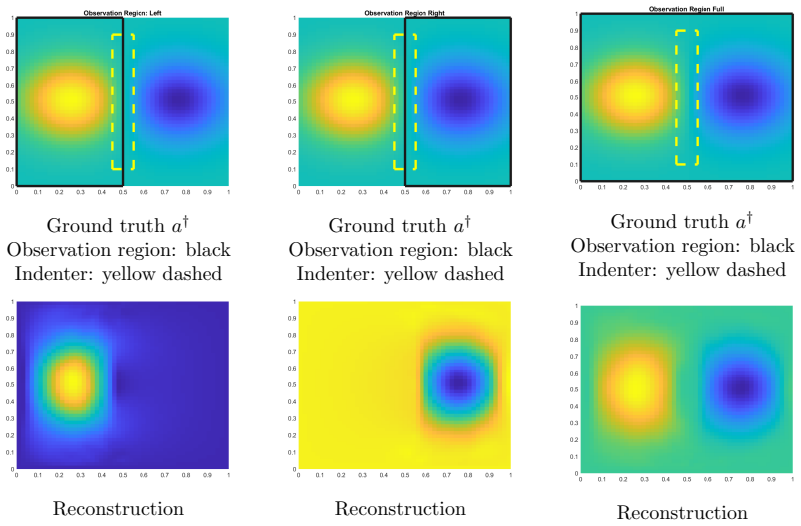
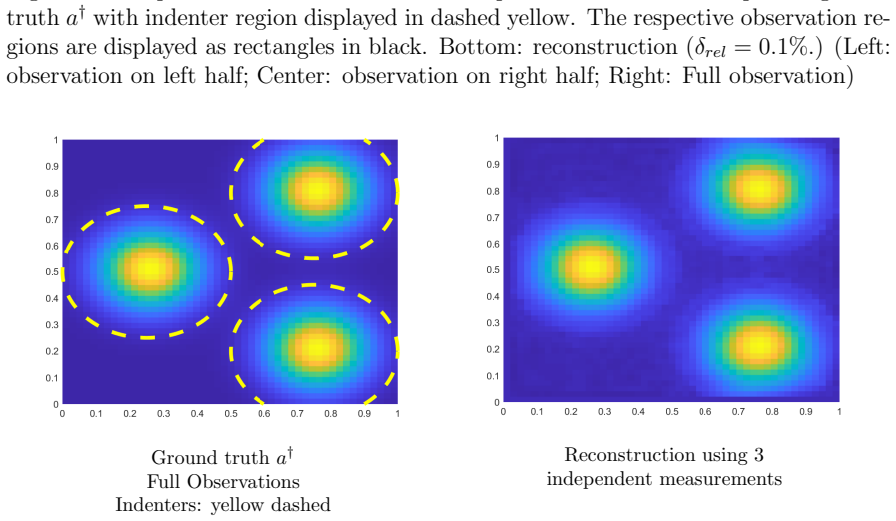
We consider the identification of a scalar coefficient in a PDE-based parameter estimation problem with contact constraints. The considered problem can be used as an idealized model of a membrane under forces, constrained by a barrier or indenter. We discuss both the forward and inverse parameter estimation problems, as well as uniqueness and non-uniqueness issues caused by the contact constraints. Furthermore, we consider the design and implementation of reconstruction approaches which we test on numerical examples, illustrating both uniqueness and non-uniqueness as well as parameter identifiability.
What carries the argument
The obstacle-constrained PDE together with the inverse map from observed data to the unknown scalar coefficient.
If this is right
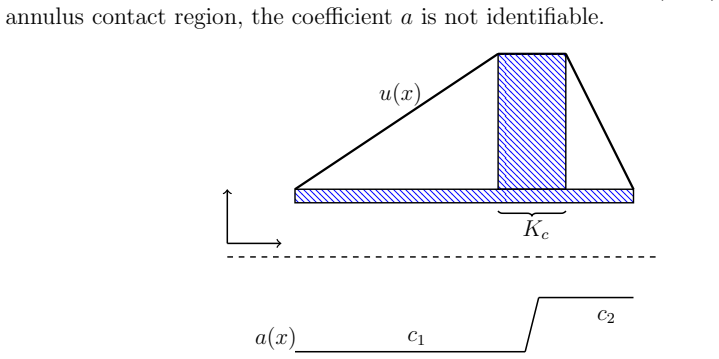
- When contact occurs over a sufficiently large region the coefficient becomes non-unique because variations inside the contact set are invisible to the data.
- In geometries where contact is only partial the coefficient remains uniquely determined by the measurements.
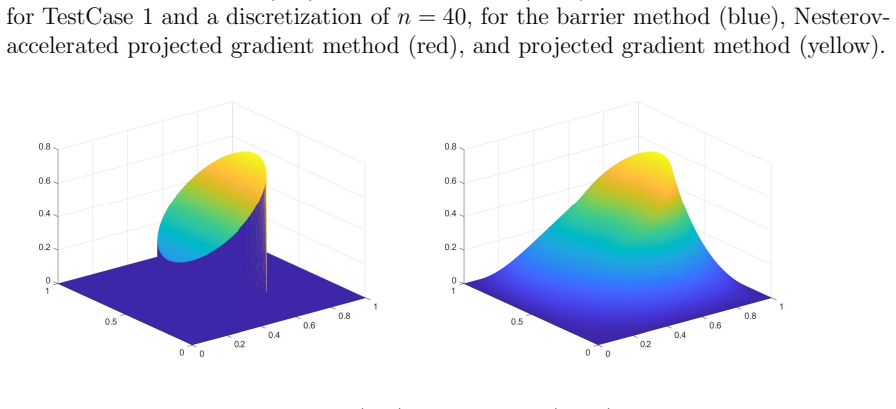
- Numerical reconstruction schemes can be built that succeed precisely when the identifiability analysis predicts uniqueness.
- The same framework supplies a controlled test bed for developing regularization strategies that handle the non-unique regime.
- The model isolates the effect of the contact constraint without additional modeling complications.
Where Pith is reading between the lines
- Varying the shape or position of the barrier could be used to design experiments that restore uniqueness even when full contact would otherwise occur.
- The same non-uniqueness mechanism is likely to appear in time-dependent or nonlinear contact problems, suggesting a general regularization principle based on contact-region detection.
- The benchmark could be used to compare different data-acquisition strategies, such as multiple indenter positions, for their ability to guarantee identifiability.
Load-bearing premise
The idealized PDE model with contact constraints captures the essential features of more complex physical contact problems.
What would settle it
A pair of distinct coefficients that produce identical data under the contact constraint, or a case in which the data uniquely determines the coefficient even though contact occurs over a positive-measure set.
Figures




read the original abstract
We consider the identification of a scalar coefficient in a PDE-based parameter estimation problem with contact constraints. The considered problem can be used as an idealized model of a membrane under forces, constrained by a barrier or indenter. More generally, it serves as a benchmark for the analysis of more complex contact problems and the development of corresponding reconstruction algorithms. In this paper, we discuss both the forward and inverse parameter estimation problems, as well as uniqueness and non-uniqueness issues caused by the contact constraints. Furthermore, we consider the design and implementation of reconstruction approaches which we test on numerical examples, illustrating both uniqueness and non-uniqueness as well as parameter identifyability.
Editorial analysis
A structured set of objections, weighed in public.
Referee Report
Summary. The paper formulates and analyzes a scalar coefficient identification problem for an elliptic PDE subject to contact constraints, modeled via a variational inequality. It examines the forward problem, derives conditions for uniqueness and non-uniqueness in the inverse problem induced by the contact set, designs reconstruction algorithms, and validates the theory through finite-element numerical experiments that exhibit both identifiable and non-identifiable regimes.
Significance. If the claims hold, the work supplies a clean benchmark problem illustrating how inequality constraints alter identifiability in PDE parameter estimation. The combination of variational-inequality analysis with concrete numerical tests on unique and non-unique cases is useful for algorithm development in contact mechanics and PDE-constrained optimization. The manuscript ships reproducible numerical examples that directly illustrate the theoretical distinctions.
minor comments (3)
- [Abstract] Abstract: the phrase 'parameter identifyability' contains a typographical error and should read 'parameter identifiability'.
- [Numerical experiments] Numerical section: the description of the finite-element discretization and the choice of solver for the variational inequality would benefit from explicit statements of mesh size, polynomial degree, and convergence tolerance to allow direct reproduction of the reported uniqueness/non-uniqueness transitions.
- [Uniqueness and non-uniqueness] Uniqueness analysis: the examples demonstrating non-uniqueness could be strengthened by an explicit statement of the contact set (or active set) on which the coefficient becomes invisible to the data.
Simulated Author's Rebuttal
We thank the referee for the positive assessment of our manuscript and the recommendation for minor revision. The provided summary accurately captures the formulation, analysis of the forward and inverse problems, uniqueness/non-uniqueness results induced by the contact set, and the numerical validation via finite-element experiments.
Circularity Check
No significant circularity; derivation self-contained
full rationale
The paper formulates the forward problem as a variational inequality for the contact-constrained PDE, analyzes identifiability via explicit examples of uniqueness and non-uniqueness induced by the constraints, and validates reconstruction methods through finite-element numerical tests that exhibit the predicted regimes. No load-bearing step reduces by construction to a fitted parameter renamed as prediction, a self-citation chain, or an imported uniqueness theorem; the central claims rest on direct theoretical analysis of the variational inequality and independent numerical illustration rather than self-referential definitions or ansatz smuggling.
Axiom & Free-Parameter Ledger
Lean theorems connected to this paper
-
IndisputableMonolith/Cost/FunctionalEquation.leanwashburn_uniqueness_aczel unclearWe consider the identification of a scalar coefficient a in the constrained PDE −div(a(x)∇u(x))=f(x) ∀x∈Ω∩{u>h}, u(x)≥h(x) a.e. in Ω, ... uniqueness and non-uniqueness issues caused by the contact constraints.
-
IndisputableMonolith/Foundation/AbsoluteFloorClosure.leanabsolute_floor_iff_bare_distinguishability unclearTheorem 3.1 ... there exists an ã(x):=a(x)+δa ... supported in a compact subset of D such that ua is also a solution ... a is not uniquely determined by ua in any compact subset of D.
Reference graph
Works this paper leans on
-
[1]
G. Alessandrini. On the identification of the leading coefficient of an elliptic equation. Boll. Un. Mat. Ital. C (6) , 4(1):87–111, 1985
work page 1985
- [2]
-
[3]
H. Attouch, G. Buttazzo, and G. Michaille. Variational analysis in Sobolev and BV spaces , volume 17 of MOS-SIAM Series on Optimization . Society for Industrial and Applied Mathematics (SIAM), Philadelphia, PA; Mathematical Optimization Society, Philade lphia, PA, second edition,
-
[4]
Applications to PDEs and optimization
-
[5]
G. Bal, F. Monard, and G. Uhlmann. Reconstruction of a fully aniso tropic elasticity tensor from knowledge of displacement fields. SIAM J. Appl. Math. , 75(5):2214–2231, 2015
work page 2015
-
[6]
G. Bal, W. Naetar, O. Scherzer, and J. Schotland. The Levenbe rg-Marquardt iteration for nu- merical inversion of the power density operator. J. Inv. Ill-Posed Problems , 21(2):265–280, 2013
work page 2013
- [7]
-
[8]
H. H. Bauschke and P. L. Combettes. Convex analysis and monotone operator theory in Hilbert spaces. Springer, 2017. 26
work page 2017
-
[9]
A. Beck. First-order methods in optimization , volume 25 of MOS-SIAM Series on Optimiza- tion. Society for Industrial and Applied Mathematics (SIAM), Philadelph ia, PA; Mathematical Optimization Society, Philadelphia, PA, 2017
work page 2017
-
[10]
A. Bensaada, E.-H. Essoufi, and A. Zafrar. Primal-dual formula tion for parameter estimation in elastic contact problem with friction. Appl. Math. Sci. Eng. , 32(1):Paper No. 2367025, 25, 2024
work page 2024
-
[11]
M. Bonnet and A. Constantinescu. Inverse problems in elasticit y. Inverse Problems , 21(2):R1– R50, 2005
work page 2005
-
[12]
A. P. Calder´ on. On an inverse boundary value problem. Computational & applied mathematics , 25(2-3):133–138, 2006
work page 2006
-
[13]
Y. Capdeboscq, J. Fehrenbach, F. de Gournay, and O. Kavian . Imaging by modification: Numeri- cal reconstruction of local conductivities from corresponding po wer density measurements. SIAM Journal on Imaging Sciences , 2(4):1003–1030, 2009
work page 2009
- [14]
-
[15]
C. Chicone and J. Gerlach. A note on the identifiability of distribut ed parameters in elliptic equations. SIAM J. Math. Anal. , 18(5):1378–1384, 1987
work page 1987
-
[16]
C. Christof and G. Wachsmuth. Differential sensitivity analysis o f variational inequalities with locally Lipschitz continuous solution operators. Appl. Math. Optim. , 81(1):23–62, 2020
work page 2020
-
[17]
C. Christof and G. Wachsmuth. Semismoothness for solution op erators of obstacle-type variational inequalities with applications in optimal control. SIAM J. Control Optim. , 61(3):1162–1186, 2023
work page 2023
-
[19]
C. Clason and V. H. Nhu. Bouligand-Landweber iteration for a no n-smooth ill-posed problem. Numer. Math. , 142(4):789–832, 2019
work page 2019
-
[20]
A. Constantinescu and N. Tardieu. On the identification of elast oviscoplastic constitutive laws from indentation tests. Inverse Problems in Engineering , 9(1):19–44, 2001
work page 2001
-
[21]
H. W. Engl, M. Hanke, and A. Neubauer. Regularization of inverse problems. Dordrecht: Kluwer Academic Publishers, 1996
work page 1996
-
[22]
H. W. Engl, K. Kunisch, and A. Neubauer. Convergence rates f or tikhonov regularisation of non-linear ill-posed problems. Inverse Problems , 5(4):523, 1989
work page 1989
-
[23]
P. Fernandez-Zelaia, V. J. Roshan, S. R. Kalidindi, and S. N. Melk ote. Estimating mechanical properties from spherical indentation using bayesian approaches . Materials & Design , 147:92–105, 2018
work page 2018
-
[24]
H. Gfrerer. On a globally convergent semismooth* Newton meth od in nonsmooth nonconvex optimzation. Comp. Optim. Appl. , 91:67–124, 2025
work page 2025
-
[25]
H. Gfrerer, S. Hubmer, and R. Ramlau. On SCD Semismooth ∗ Newton methods for the effi- cient minimization of Tikhonov functionals with non-smooth and non-c onvex penalties. Inverse Problems, 41(7):075002, 2025. Gold OA
work page 2025
-
[26]
H. Gfrerer, M. Mandlmayr, J. V. Outrata, and J. Valdman. On t he SCD semismooth* Newton method for generalized equations with application to a class of static contact problems with Coulomb friction. Comp. Optim. Appl. , 86:1159–1191, 2022
work page 2022
-
[27]
H. Gfrerer and J. V. Outrata. On a semismooth* Newton metho d for solving generalized equations. SIAM J. Optim. , 31(1):489–517, 2021. 27
work page 2021
-
[28]
M. S. Gockenbach, B. Jadamba, and A. A. Khan. Equation erro r approach for elliptic inverse problems with an application to the identification of Lam/’e parameter s. Inverse Problems in Science and Engineering , 16(3):349–367, 2008
work page 2008
-
[29]
M. S. Gockenbach and A. A. Khan. An abstract framework for elliptic inverse problems. I. An output least-squares approach. Math. Mech. Solids , 12(3):259–276, 2007
work page 2007
-
[30]
M. S. Gockenbach and A. A. Khan. An abstract framework for elliptic inverse problems. II. An augmented Lagrangian approach. Math. Mech. Solids , 14(6):517–539, 2009
work page 2009
-
[31]
J. Gwinner. An optimization approach to parameter identificatio n in variational inequalities of second kind. Optim. Lett. , 12(5):1141–1154, 2018
work page 2018
-
[32]
J. Gwinner. An optimization approach to parameter identificatio n in variational inequalities of second kind—II. In Deterministic and stochastic optimal control and inverse p roblems, pages 112–130. CRC Press, Boca Raton, FL, 2022
work page 2022
-
[33]
J. Gwinner, B. Jadamba, A. A. Khan, and F. Raciti. Uncertainty quantification in variational inequalities—theory, numerics, and applications . CRC Press, Boca Raton, FL, [2022] ©2022
work page 2022
-
[34]
J. Gwinner, B. Jadamba, A. A. Khan, and M. Sama. Identificatio n in variational and quasi- variational inequalities. J. Convex Anal. , 25(2):545–569, 2018
work page 2018
- [35]
-
[36]
B. Harrach and M. Ullrich. Monotonicity-based shape reconstr uction in electrical impedance tomography. SIAM J. Math. Anal. , 45(6):3382–3403, 2013
work page 2013
-
[37]
B. Hofmann, B. Kaltenbacher, C. P¨ oschl, and O. Scherzer. A convergence rates result for Tikhonov regularization in Banach spaces with non-smooth operators. Inverse Problems , 23(3):987–1010, 2007
work page 2007
-
[38]
D. Holder and A. Adler. Electrical impedance tomography: methods, history and app lications. Series in medical physics and biomedical engineering. CRC Press, sec ond edition edition, 2022
work page 2022
- [39]
-
[40]
S. Hubmer and R. Ramlau. Convergence analysis of a two-point g radient method for nonlinear ill-posed problems. Inverse Problems , 33(9):095004, 2017
work page 2017
- [41]
-
[42]
V. Isakov. Inverse Problems for Partial Differential Equations. Applied Mathematical Sciences. Springer, New York, NY, 2006
work page 2006
-
[43]
B. Jadamba, A. A. Khan, F. Raciti, and M. Sama. A variational ine quality based stochastic approximation for estimating the flexural rigidity in random fourth- order models. Commun. Nonlinear Sci. Numer. Simul. , 111:Paper No. 106406, 11, 2022
work page 2022
- [44]
-
[45]
B. Kaltenbacher. Regularization based on all-at-once formulat ions for inverse problems. SIAM J. Numer. Anal. , 54(4):2594–2618, 2016
work page 2016
-
[46]
B. Kaltenbacher. Minimization based formulations of inverse pro blems and their regularization. SIAM J. Optim. , 28(1):620–645, 2018. 28
work page 2018
-
[47]
B. Kaltenbacher, A. Kirchner, and B. Vexler. Goal oriented ad aptivity in the IRGNM for pa- rameter identification in PDEs: II. all-at-once formulations. Inverse Problems , 30(4):045002, 33, 2014
work page 2014
-
[48]
B. Kaltenbacher, A. Neubauer, and O. Scherzer. Iterative regularization methods for nonlinear ill-posed problems. Berlin: de Gruyter, 2008
work page 2008
-
[49]
B. Kaltenbacher, F. Sch¨ opfer, and T. Schuster. Iterative methods for nonlinear ill-posed problems in Banach spaces: convergence and applications to parameter iden tification problems. Inverse Problems, 25(6):065003 (19pp), 2009
work page 2009
-
[50]
A. A. Khan and D. Motreanu. Inverse problems for quasi-varia tional inequalities. J. Global Optim., 70(2):401–411, 2018
work page 2018
-
[51]
N. Kikuchi and J. T. Oden. Contact problems in elasticity: a study of variational ineq ualities and finite element methods , volume 8 of SIAM Studies in Applied Mathematics . Society for Industrial and Applied Mathematics (SIAM), Philadelphia, PA, 1988
work page 1988
-
[52]
S. Kindermann. On the tangential cone condition for electrical impedance tomography. Electron. Trans. Numer. Anal. , 57:17–34, 2022
work page 2022
-
[53]
R. V. Kohn and M. Vogelius. Relaxation of a variational method fo r impedance computed to- mography. Comm. Pure Appl. Math. , 40(6):745–777, 1987
work page 1987
-
[54]
Y. Ma, F. Liu, Z. Si, Q. Gerile, K. Yang, H. Li, and Y. Cheng. Param eter identification of contact model for tank saddle ring system based on genetic algorithm and bp neural network. Journal of Physics: Conference Series , 2478(12):122017, jun 2023
work page 2023
-
[55]
J. Mueller and S. Siltanen. Linear and Nonlinear Inverse Problems with Practical Appli cations. Society for Industrial and Applied Mathematics, Philadelphia, PA, 20 12
- [56]
-
[57]
J. Radov´ a and J. Machalov´ a. Parameter identification in cont act problems for Gao beam. Non- linear Anal. Real World Appl. , 77:Paper No. 104068, 22, 2024
work page 2024
-
[58]
A.-T. Rauls and G. Wachsmuth. Generalized derivatives for the s olution operator of the obstacle problem. Set-Valued Var. Anal., 28(2):259–285, 2020
work page 2020
-
[59]
G. R. Richter. An inverse problem for the steady state diffusion equation. SIAM J. Appl. Math. , 41(2):210–221, 1981
work page 1981
-
[60]
A. Rieder. On the regularization of nonlinear ill-posed problems via inexact Newton iterations. Inverse Problems , 15(1):309–327, 1999
work page 1999
- [61]
-
[62]
O. Scherzer, M. Grasmair, H. Grossauer, M. Haltmeier, and F. Lenzen. Variational methods in imaging, volume 167 of Applied Mathematical Sciences . Springer, New York, 2009
work page 2009
-
[63]
C. Sun, Q. Lin, B. Wang, J. Huang, and J. Chen. Modeling and inve rse identification method for the characterization of elastic-plastic contact behavior durin g flat punch indentation. Eur. J. Mech. A Solids , 96:Paper No. 104663, 15, 2022
work page 2022
-
[64]
N. Tardieu and A. Constantinescu. On the determination of elas tic coefficients from indentation experiments. Inverse Problems , 16(3):577–588, 2000
work page 2000
-
[65]
H. Zhang and L. V. Wang. Acousto-electric tomography. In Proceedings SPIE, Photons Plus Ultrasound: Imaging and Sensing, 5320(9) , page 145, 2004. 29
work page 2004
discussion (0)
Sign in with ORCID, Apple, or X to comment. Anyone can read and Pith papers without signing in.