Recognition: no theorem link
Results and Retrospective Analysis of the CODS 2025 AssetOpsBench Challenge
Pith reviewed 2026-05-12 01:43 UTC · model grok-4.3
The pith
In this 2025 multi-agent orchestration challenge, execution success came mostly from guardrail improvements like response selection and fallback handling rather than new agent architectures.
A machine-rendered reading of the paper's core claim, the machinery that carries it, and where it could break.
Core claim
The central claim is that successful execution methods improved guardrails such as response selection, contamination cleanup, fallback procedures, and context control instead of introducing novel agent architectures, while hidden evaluation produced different outcomes from public leaderboards and the composite score gave negligible weight to one of its terms.
What carries the argument
The multi-source retrospective that combines final rank sheets, a 300-submission server log, 149-team registrations, best-submission exports, and verified source trees to measure score correlations and classify rewarded behaviors.
If this is right
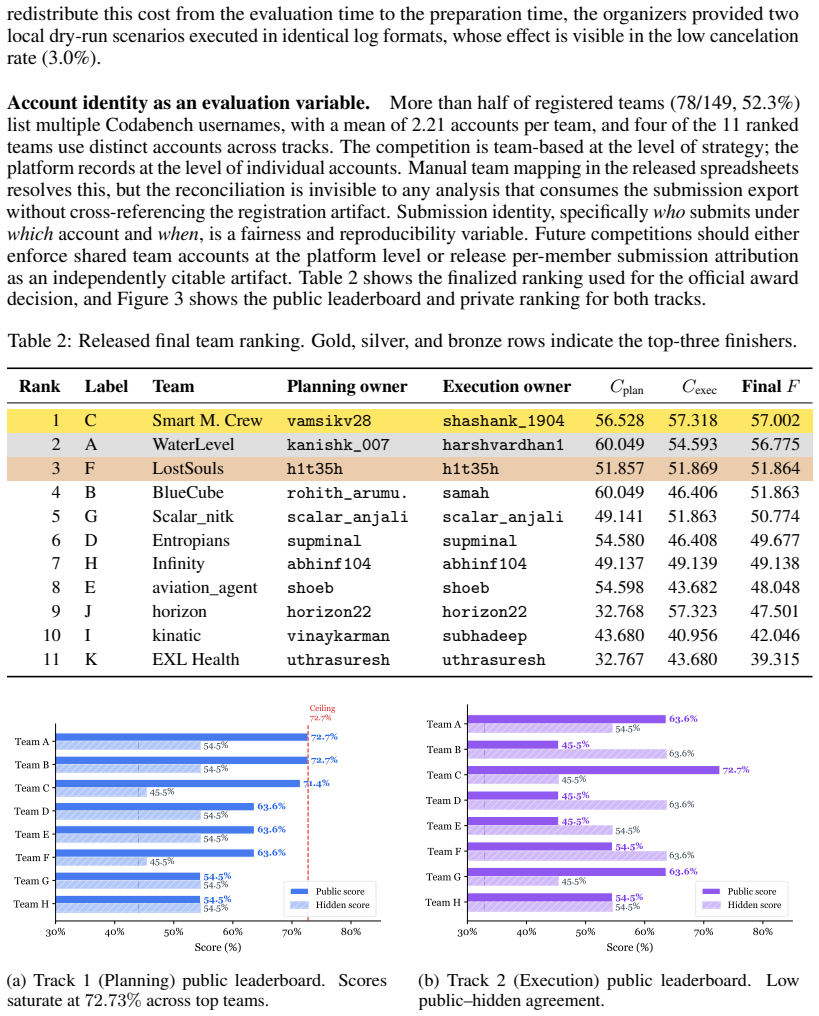
- Public planning performance saturated at 72.73 percent and gained nothing from richer prompts.
- Public and private execution scores correlated negatively at r equals -0.13, so some systems that scored 45.45 percent publicly reached 63.64 percent on the hidden set.
- The matching term contributed at most 0.05 points to the composite score on a 0-1 scale and could swap the top two teams if rescaled.
- Only 11 teams reached full rankings out of 149 registrations, with 52.3 percent of deduplicated registrations listing multiple usernames.
- Top execution methods succeeded through better response selection, contamination cleanup, fallback, and context control rather than architectural novelty.
Where Pith is reading between the lines
- Releasing versioned source trees and logs would let others replicate and extend the classification of what worked.
- Adding skill-level diagnostics could separate planning strength from execution strength more clearly than overall scores do.
- Making the composite scoring scale-aware would prevent small terms from becoming numerically inert.
- The negative correlation between public and private execution scores indicates that public test distributions may not match the hidden ones.
Load-bearing premise
The combined data from rank sheets, logs, registrations, exports, and source trees provide a complete and unbiased picture of all participating methods and behaviors.
What would settle it
Re-running the hidden execution evaluation on the top public submissions and finding that the same teams rank highest, or inspecting the source trees of top execution entries and finding novel agent architectures instead of guardrail changes, would show the main claim is incorrect.
Figures






read the original abstract
Competition retrospectives are useful when they explain what a leaderboard measured, how hidden evaluation changed conclusions, and which design patterns were rewarded. We revisit the CODS 2025 \assetopslive{} challenge, a privacy-aware Codabench competition on industrial multi-agent orchestration built on \assetops{}. We combine final rank sheets, a 300-submission server log, 149-team registrations, best-submission exports, the organizer winners report, the companion \assetopslive{} system paper, and verified planning-track source trees. Five results stand out. First, the public planning leaderboard saturates at 72.73\%, and richer prompts do not improve that peak. Second, hidden evaluation changes the story: public and private scores correlate moderately in planning ($r{=}0.69$) but negatively in execution ($r{=}{-}0.13$), with several 45.45\% public execution systems reaching 63.64\% on the hidden set. Third, the \tmatch{} term is numerically almost inert in the official composite -- combined on a 0--1 scale with 0--100 percentage scores, it contributes at most 0.05 points per track, and rescaling would swap the top two teams. Fourth, the competition is operationally account-based but substantively team-based: 149 registered teams reduce to 24 with non-zero public scores and 11 fully ranked, while 52.3\% of deduplicated registrations list multiple usernames. Fifth, successful execution methods mostly improve guardrails -- response selection, contamination cleanup, fallback, and context control -- rather than novel agent architectures. These findings identify which behaviors the evaluation rewarded, and motivate scale-aware composites, skill-level diagnostics, and versioned artifact release.
Editorial analysis
A structured set of objections, weighed in public.
Referee Report
Summary. The manuscript presents a retrospective analysis of the CODS 2025 AssetOpsBench Challenge, integrating final rank sheets, a 300-submission server log, 149-team registrations, best-submission exports, the organizer winners report, the companion system paper, and verified planning-track source trees. It reports five observational results: saturation of the public planning leaderboard at 72.73% with no gains from richer prompts; moderate positive correlation (r=0.69) between public and private planning scores but negative correlation (r=-0.13) in execution, with some public 45.45% systems reaching 63.64% privately; negligible contribution of the tmatch term to the composite score; the competition being substantively team-based despite account registration (52.3% multi-username deduplication, reduction to 24 non-zero and 11 fully ranked); and successful execution methods primarily improving guardrails (response selection, contamination cleanup, fallback, context control) rather than novel agent architectures.
Significance. If the empirical observations hold, the paper usefully documents what the AssetOpsBench evaluation actually rewarded, including the limited informativeness of public leaderboards and the outsized role of execution guardrails. This can inform the design of future multi-agent orchestration benchmarks and highlight the need for scale-aware scoring and versioned artifact releases. The multi-source data integration is a positive feature for transparency in competition retrospectives.
major comments (1)
- [Fifth result paragraph] Fifth result: The claim that successful execution methods 'mostly improve guardrails—response selection, contamination cleanup, fallback, and context control—rather than novel agent architectures' is based on inspection of best-submission exports and verified source trees from the 11 fully ranked teams. No coding scheme, inter-rater protocol, or quantitative breakdown (e.g., how many of the 11 were guardrail-only vs. architecture-plus-guardrail) is supplied, so the 'mostly' qualifier cannot be independently verified from the released artifacts. The pipeline from 149 registrations to 11 ranked teams (with 52.3% multi-username deduplication) introduces a plausible selection bias if teams with more architectural novelty were disproportionately filtered out by hidden evaluation.
minor comments (2)
- [Abstract and results] The abstract and results sections supply limited detail on the exact statistical procedures (e.g., how correlations were computed, handling of ties, or robustness checks) and any bias diagnostics applied to the filtered datasets.
- [Throughout] Notation such as tmatch, assetopslive, and assetops should be defined on first use, as readers may not be familiar with the specific challenge terminology.
Simulated Author's Rebuttal
We thank the referee for their thorough review and positive assessment of the manuscript's transparency and potential utility for future benchmark design. We address the single major comment below and will incorporate revisions to improve verifiability.
read point-by-point responses
-
Referee: [Fifth result paragraph] Fifth result: The claim that successful execution methods 'mostly improve guardrails—response selection, contamination cleanup, fallback, and context control—rather than novel agent architectures' is based on inspection of best-submission exports and verified source trees from the 11 fully ranked teams. No coding scheme, inter-rater protocol, or quantitative breakdown (e.g., how many of the 11 were guardrail-only vs. architecture-plus-guardrail) is supplied, so the 'mostly' qualifier cannot be independently verified from the released artifacts. The pipeline from 149 registrations to 11 ranked teams (with 52.3% multi-username deduplication) introduces a plausible selection bias if teams with more architectural novelty were disproportionately filtered out by hidden evaluation.
Authors: We agree that the current presentation relies on a qualitative inspection of the 11 source trees and best-submission exports without an explicit coding scheme or inter-rater protocol, which limits independent verification of the 'mostly' qualifier. We will revise the manuscript to add a dedicated subsection (or appendix table) that categorizes each of the 11 ranked teams' approaches according to whether they primarily modified guardrails (response selection, contamination cleanup, fallback, context control), introduced novel agent architectures, or combined both. This will include counts and brief descriptions drawn directly from the verified artifacts. Regarding selection bias, the 52.3% multi-username deduplication and reduction from 149 registrations to 11 fully ranked teams is already reported in the manuscript; we acknowledge that teams with greater architectural novelty could have been filtered by the hidden evaluation or by not submitting valid entries. We will expand the limitations paragraph to explicitly discuss this conditioning on successful ranked submissions and note that the analysis cannot rule out bias against more novel (but perhaps less robust) architectures. revision: yes
Circularity Check
No circularity: direct empirical summarization of external competition data
full rationale
The paper reports five results derived from external artifacts (rank sheets, server logs, registrations, best-submission exports, and verified source trees) without any derivations, equations, parameter fitting, or predictions. The fifth result classifies execution methods via code inspection of the 11 ranked trees; this is an empirical categorization, not a self-definitional reduction or fitted input renamed as prediction. No self-citation chains or uniqueness theorems are load-bearing for the central claims. The analysis is self-contained against the released competition data.
Axiom & Free-Parameter Ledger
axioms (1)
- domain assumption The provided competition artifacts (rank sheets, server logs, team registrations, source trees) are representative and complete for analyzing all submissions.
Reference graph
Works this paper leans on
-
[1]
Proceedings of the 13th international conference on data science (cods 2025)
ACM India. Proceedings of the 13th international conference on data science (cods 2025). In ACM India Joint International Conference on Data Science and Management of Data, Pune, India, 2025. Association for Computing Machinery. URL https://ikdd.acm.org/cods-2 025/. Formerly known as CODS-COMAD
work page 2025
-
[2]
Generative large model security challenge (tianchi platform)
Alibaba Tianchi. Generative large model security challenge (tianchi platform). https: //tianchi.aliyun.com/competition/entrance/532362, 2025. Accessed: 2026-04-12
work page 2025
-
[3]
AssetOpsBench. CODS 2025 Competition Release. h t t p s : / / g i t h u b . c o m / I B M /AssetOpsBench/tree/neurips_2026_codabench , 2025. GitHub repository, neurips_2026_codabenchbranch
work page 2025
-
[4]
A scenario-driven benchmark for industrial asset operations and maintenance
AssetOpsBench. A scenario-driven benchmark for industrial asset operations and maintenance. https://huggingface.co/datasets/ibm-research/AssetOpsBench , 2026. Version 1.0
work page 2026
-
[5]
AssetOpsBench Docker images, 2025
AssetOpsBench Team. AssetOpsBench Docker images, 2025. URL https://quay.i o/assetopsbench . Available at quay.io/assetopsbench/assetopsbench-basic and quay.io/assetopsbench/assetopsbench-extra
work page 2025
-
[6]
Math- arena: Evaluating llms on uncontaminated math competitions
Mislav Balunovic, Jasper Dekoninck, Ivo Petrov, Nikola Jovanovi´c, and Martin Vechev. Math- arena: Evaluating llms on uncontaminated math competitions. InThe Thirty-ninth Annual Conference on Neural Information Processing Systems Datasets and Benchmarks Track, 2025
work page 2025
-
[7]
Elron Bandel, Asaf Yehudai, Lilach Eden, Yehoshua Sagron, Yotam Perlitz, Elad Venezian, Natalia Razinkov, Natan Ergas, Shlomit Shachor Ifergan, Segev Shlomov, et al. General agent evaluation.ICLR 2026 Workshop Agents in the Wild: Safety, Security, and Beyond (AIWILD), 2026
work page 2026
-
[8]
Fair universe higgsml uncertainty dataset and competition
Wahid Bhimji, Ragansu Chakkappai, Po-Wen Chang, Yuan-Tang Chou, Sascha Diefenbacher, Jordan Dudley, Ibrahim Elsharkawy, Steven Farrell, Aishik Ghosh, Cristina Giordano, et al. Fair universe higgsml uncertainty dataset and competition. InThe Thirty-ninth Annual Conference on Neural Information Processing Systems Datasets and Benchmarks Track, 2025
work page 2025
-
[9]
Mert Cemri, Melissa Z Pan, Shuyi Yang, Lakshya A Agrawal, Bhavya Chopra, Rishabh Tiwari, Kurt Keutzer, Aditya Parameswaran, Dan Klein, Kannan Ramchandran, et al. Why do multi-agent llm systems fail? InThe Thirty-ninth Annual Conference on Neural Information Processing Systems Datasets and Benchmarks Track, 2025
work page 2025
-
[10]
Codalab and codabench newsletter: What happened in 2025?, 2025
CodaBench. Codalab and codabench newsletter: What happened in 2025?, 2025. URL https://docs.codabench.org/dev/Newsletters_Archive/CodaLab-in-2025/
work page 2025
-
[11]
Multi-Agent AI Competition on Industry 4.0 Tasks
CODS 2025 AssetOps. Multi-Agent AI Competition on Industry 4.0 Tasks. https://www.co dabench.org/competitions/10206/, 2025. Codabench competition page
work page 2025
-
[12]
Tim Cofala, Christian Kalfar, Jingge Xiao, Johanna Schrader, Michelle Tang, and Wolfgang Nejdl. Medai: Evaluating txagent’s therapeutic agentic reasoning in the neurips cure-bench competition.arXiv preprint arXiv:2512.11682, 2025
-
[13]
Edoardo Debenedetti, Javier Rando, Daniel Paleka, Fineas Silaghi, Dragos Albastroiu, Niv Cohen, Yuval Lemberg, Reshmi Ghosh, Rui Wen, Ahmed Salem, et al. Dataset and lessons learned from the 2024 satml llm capture-the-flag competition.Advances in Neural Information Processing Systems, 37:36914–36937, 2024
work page 2024
-
[14]
Mucong Ding, Bang An, Tahseen Rabbani, Chenghao Deng, Anirudh Satheesh, Souradip Chakraborty, Mehrdad Saberi, Yuxin Wen, Kyle Rui Sang, Aakriti Agrawal, et al. A technical report on “erasing the invisible”: The 2024 neurips competition on stress testing image wa- termarks. InThe Thirty-ninth Annual Conference on Neural Information Processing Systems Datas...
work page 2024
-
[15]
Cure-bench: Benchmarking ai reasoning for therapeutic decision-making at scale.https://curebench.ai,
Shanghua Gao, Richard Yuxuan Zhu, Zhenglun Kong, Xiaorui Su, Curtis Ginder, Sufian Aldogom, Ishita Das, Taylor Evans, Theodoros Tsiligkaridis, and Marinka Zitnik. Cure-bench: Benchmarking ai reasoning for therapeutic decision-making at scale.https://curebench.ai,
- [16]
-
[17]
BERTopic: Neural topic modeling with a class-based TF-IDF procedure
Maarten Grootendorst. Bertopic: Neural topic modeling with a class-based tf-idf procedure. arXiv preprint arXiv:2203.05794, 2022
work page internal anchor Pith review Pith/arXiv arXiv 2022
-
[18]
Workshop on deepfake detection, localization, and inter- pretability (ijcai 2025)
IJCAI 2025 Workshop Organizers. Workshop on deepfake detection, localization, and inter- pretability (ijcai 2025). https://deepfake-workshop-ijcai2025.github.io/main/in dex.html, 2025. Accessed: 2026-04-12
work page 2025
-
[19]
Sayash Kapoor, Peter Kirgis, Andrew Schwartz, Stephan Rabanser, J.J. Allaire, Rishi Bom- masani, Magda Dubois, Gillian Hadfield, Andy Hall, Sara Hooker, Seth Lazar, Steve Newman, Dimitris Papailiopoulos, Shoshannah Tekofsky, Helen Toner, Cozmin Ududec, and Arvind Narayanan. Open-world evaluations for measuring frontier ai capabilities. https://cruxevals.c...
work page 2026
-
[20]
Learning to run a power network challenge: a retrospective analysis
Antoine Marot, Benjamin Donnot, Gabriel Dulac-Arnold, Adrian Kelly, Aidan O’Sullivan, Jan Viebahn, Mariette Awad, Isabelle M Guyon, Patrick Panciatici, and Camilo Romero. Learning to run a power network challenge: a retrospective analysis. InNeural Information Processing Systems, 2021. URLhttps://api.semanticscholar.org/CorpusID:232110622
work page 2021
-
[21]
Meta crag-mm challenge: Comprehensive rag benchmark for multi-modal multi-turn question answering
Meta Reality Labs and Meta GenAI. Meta crag-mm challenge: Comprehensive rag benchmark for multi-modal multi-turn question answering. https://www.aicrowd.com/challenges /meta-crag-mm-challenge-2025, 2025. KDD Cup 2025 Challenge. Accessed: 2026
work page 2025
-
[22]
Dhaval Patel, Shuxin Lin, James Rayfield, Nianjun Zhou, Chathurangi Shyalika, Suryanarayana R
Dhaval Patel, Shuxin Lin, James Rayfield, Nianjun Zhou, Chathurangi Shyalika Jayakody, Suryanarayana R Yarrabothula, Roman Vaculin, Natalia Martinez, Fearghal O’Donncha, and Jayant Kalagnanam. Assetopsbench: A real-world evaluation benchmark for ai-driven task automation in industrial asset management.arXiv preprint arXiv:2506.03828, 2025
-
[23]
Dhaval Patel, Nianjun Zhou, Shuxin Lin, James Rayfield, Chathurangi Shyalika, and Surya- narayana Reddy Yarrabothula. Assetopsbench-live: Privacy-aware online evaluation of multi- agent performance in industrial operations. InProceedings of the AAAI Conference on Artificial Intelligence, volume 40, pages 41658–41660, 2026
work page 2026
-
[24]
Harsha Vardhan Simhadri, Martin Aumüller, Amir Ingber, Matthijs Douze, George Williams, Magdalen Dobson Manohar, Dmitry Baranchuk, Edo Liberty, Frank Liu, Ben Landrum, et al. Results of the big ann: Neurips’23 competition.39th Conference on Neural Information Processing Systems (NeurIPS 2025) Track on Datasets and Benchmarks, 2024
work page 2025
-
[25]
George Tsoukalas, Jasper Lee, John Jennings, Jimmy Xin, Michelle Ding, Michael Jennings, Amitayush Thakur, and Swarat Chaudhuri. Putnambench: Evaluating neural theorem-provers on the putnam mathematical competition.Advances in Neural Information Processing Systems, 37:11545–11569, 2024
work page 2024
-
[26]
Polina Turishcheva, Paul G Fahey, Michaela Vystrˇcilová, Laura Hansel, Rachel Froebe, Kayla Ponder, Yongrong Qiu, Konstantin F Willeke, Mohammad Bashiri, Ruslan Baikulov, et al. Retrospective for the dynamic sensorium competition for predicting large-scale mouse primary visual cortex activity from videos.Advances in Neural Information Processing Systems, ...
work page 2024
-
[27]
How we broke top ai agent benchmarks: And what comes next
Hao Wang, Qiuyang Mang, Alvin Cheung, Koushik Sen, and Dawn Song. How we broke top ai agent benchmarks: And what comes next. https://moogician.github.io/blog/2026/ trustworthy-benchmarks-cont/, 2026. Accessed: 2026-04-12
work page 2026
-
[28]
Codabench: Flexible, easy-to-use, and reproducible meta-benchmark platform.Patterns, 3(7), 2022
Zhen Xu, Sergio Escalera, Adrien Pavão, Magali Richard, Wei-Wei Tu, Quanming Yao, Huan Zhao, and Isabelle Guyon. Codabench: Flexible, easy-to-use, and reproducible meta-benchmark platform.Patterns, 3(7), 2022. 11
work page 2022
-
[29]
Ml4cfd competition: Results and retrospective analysis
Mouadh Yagoubi, David Danan, Milad Leyli-abadi, Jocelyn Ahmed Mazari, Jean-Patrick Brunet, Abbas Kabalan, Fabien Casenave, Yuxin Ma, Giovanni Catalani, Jean Fesquet, et al. Ml4cfd competition: Results and retrospective analysis. InThe Thirty-ninth Annual Conference on Neural Information Processing Systems Datasets and Benchmarks Track, 2025
work page 2025
-
[30]
Crag - comprehensive rag benchmark
Xiao Yang, Kai Sun, Hao Xin, Yushi Sun, Nikita Bhalla, Xiangsen Chen, Sajal Choudhary, Rongze Daniel Gui, Ziran Will Jiang, Ziyu Jiang, Lingkun Kong, Brian Moran, Jiaqi Wang, Yifan Ethan Xu, An Yan, Chenyu Yang, Eting Yuan, Hanwen Zha, Nan Tang, Lei Chen, Nicolas Scheffer, Yue Liu, Nirav Shah, Rakesh Wanga, Anuj Kumar, Wen-tau Yih, and Xin Luna Dong. Crag...
-
[31]
Gregory Yauney, Shahzaib Saqib Warraich, and Swabha Swayamdipta. How reliable is language model micro-benchmarking? InInternational Conference on Learning Representations (ICLR), 2026
work page 2026
-
[32]
Shaokun Zhang, Ming Yin, Jieyu Zhang, Jiale Liu, Zhiguang Han, Jingyang Zhang, Beibin Li, Chi Wang, Huazheng Wang, Yiran Chen, et al. Which agent causes task failures and when? on automated failure attribution of llm multi-agent systems.arXiv preprint arXiv:2505.00212, 2025. 12 A Technical appendices and supplementary material This appendix presents a str...
discussion (0)
Sign in with ORCID, Apple, or X to comment. Anyone can read and Pith papers without signing in.