Recognition: 1 theorem link
· Lean TheoremCoordinates of Capability: A Unified MTMM-Geometric Framework for LLM Evaluation
Pith reviewed 2026-05-12 01:37 UTC · model grok-4.3
The pith
LLM evaluation metrics can be unified as coordinates in a three-dimensional latent space.
A machine-rendered reading of the paper's core claim, the machinery that carries it, and where it could break.
Core claim
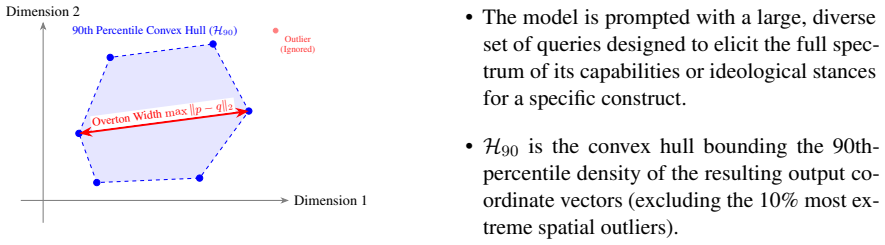
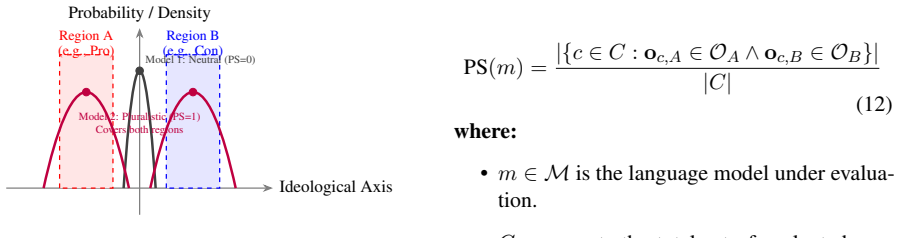
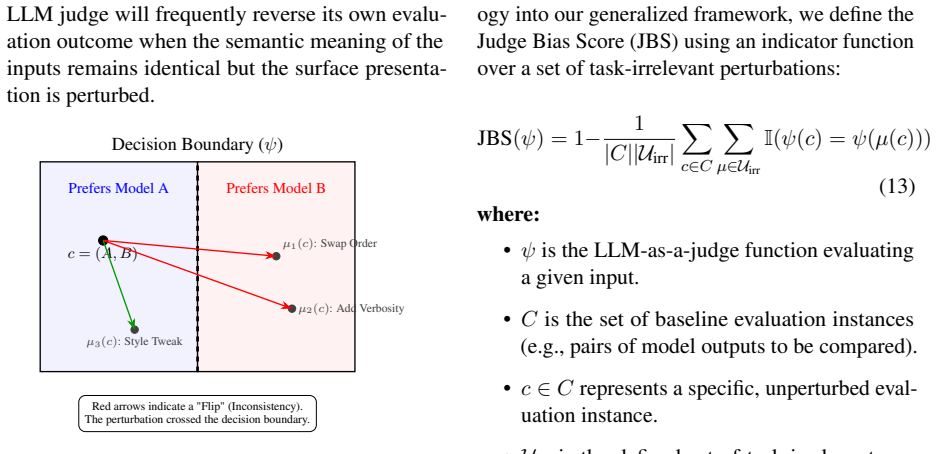
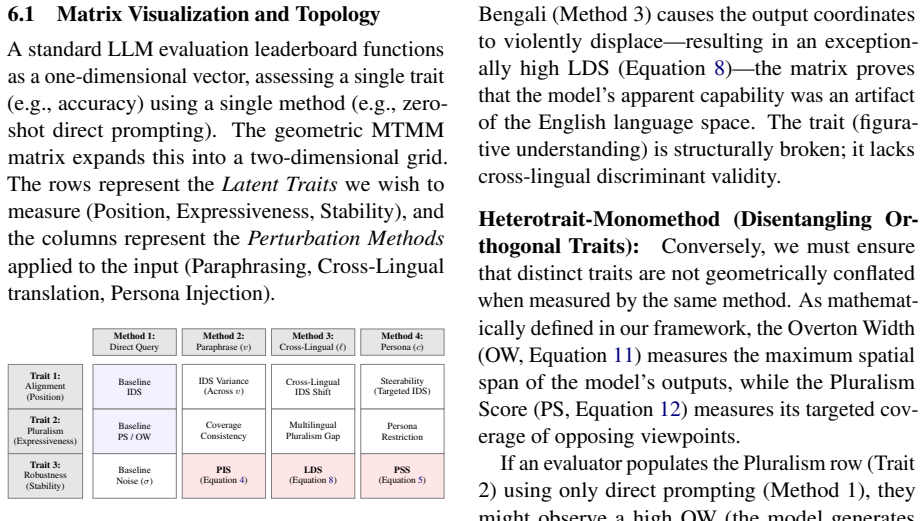
The paper formalizes nine evaluation metrics as geometric measurements inside a shared latent coordinate space under a generalized Multi-Trait Multi-Method framework. This factorization separates model behavior into three orthogonal latent dimensions: Instability and Sensitivity, Position and Alignment, and Coverage and Expressiveness. By doing so, the approach isolates task-irrelevant perturbations from true capability spans and supplies a domain-agnostic taxonomy for designing more robust benchmarks.
What carries the argument
The MTMM-Geometric Framework that projects nine metrics onto a shared latent coordinate space and factorizes model behavior into three orthogonal dimensions.
If this is right
- Task-irrelevant perturbations can be systematically separated from true capability spans.
- Benchmark design gains a theoretically grounded, domain-agnostic taxonomy that supports more stable comparisons.
- Model behavior becomes representable as positions in a continuous latent space rather than isolated scalar scores.
- Evaluations become less entangled with specific prompt methods or data sources.
- The same coordinate system can be used across different domains without task-specific recalibration.
Where Pith is reading between the lines
- The coordinate representation could let researchers plot and compare many models on one visual map instead of juggling separate leaderboards.
- If the three dimensions prove stable, new benchmarks could be generated automatically to probe only one axis at a time.
- The approach might connect to other geometric views of model outputs, such as embedding spaces, to test whether real responses lie on low-dimensional surfaces.
- Testing the framework on frontier models could reveal whether their capability manifolds remain low-dimensional or require additional axes.
Load-bearing premise
The nine metrics can be projected onto three orthogonal latent dimensions with little information loss, which assumes LLM capabilities form continuous geometric manifolds that fit this factorization.
What would settle it
Apply the framework to a new set of metrics and check whether the three dimensions still capture most of the variance or whether reconstruction error stays low when the original metric values are rebuilt from the coordinates.
Figures


read the original abstract
The evaluation of Large Language Models (LLMs) faces a critical challenge in construct validity, where fragmented benchmarks and ad hoc metrics frequently conflate method variance, such as prompt sensitivity, with true latent capabilities. Concurrently, emerging research suggests that LLM capabilities and outputs can be modeled as continuous geometric manifolds. In this Systematization of Knowledge (SoK), we bridge these paradigms by proposing a generalized Multi-Trait Multi-Method (MTMM) framework for LLM evaluation. We formalize and unify nine evaluation metrics, including Paraphrase Instability, Drift Score, Overton Width, and Pluralism Score, interpreting them not as isolated scalar values but as geometric measurements within a shared latent coordinate space. This spatial unification factorizes model behavior into three orthogonal latent dimensions: (1) Instability and Sensitivity, (2) Position and Alignment, and (3) Coverage and Expressiveness. By systematically separating task-irrelevant perturbations from true capability spans, the framework provides a theoretically grounded and domain-agnostic taxonomy for robust and empirically stable benchmark design.
Editorial analysis
A structured set of objections, weighed in public.
Referee Report
Summary. The manuscript is a Systematization of Knowledge (SoK) paper proposing a generalized Multi-Trait Multi-Method (MTMM) geometric framework for LLM evaluation. It unifies nine metrics (including Paraphrase Instability, Drift Score, Overton Width, and Pluralism Score) by reinterpreting them as geometric measurements in a shared latent coordinate space rather than isolated scalars. This unification is claimed to factorize model behavior into three orthogonal latent dimensions—(1) Instability and Sensitivity, (2) Position and Alignment, and (3) Coverage and Expressiveness—thereby separating task-irrelevant perturbations from true capability spans to support more robust, domain-agnostic benchmark design.
Significance. If the proposed factorization can be shown to hold with minimal information loss, the framework would offer a valuable conceptual bridge between fragmented LLM metrics and geometric manifold views of capabilities, potentially improving construct validity in evaluation. The attempt to systematize disparate metrics into an orthogonal coordinate system is a constructive contribution to the field of LLM assessment, though its significance remains prospective pending concrete mappings and tests.
major comments (2)
- [Abstract and §3] Abstract and §3: The central claim that the nine metrics factorize into three orthogonal dimensions without substantial information loss is asserted but not supported by any explicit mapping, projection formula, or derivation showing, for example, how Paraphrase Instability or Drift Score align with the Instability dimension versus the others.
- [§4 and §5] §4 and §5: No empirical validation, correlation analysis, or dimensionality-reduction results (e.g., via PCA or MTMM matrix decomposition on actual LLM outputs) are provided to test whether the claimed orthogonality holds or whether the three dimensions capture the variance in the original metrics.
minor comments (2)
- [Abstract] The abstract states that nine metrics are unified but explicitly names only four; a complete enumerated list or table early in the paper would aid readability.
- [§3] Notation for the latent dimensions and geometric measurements could be introduced more formally with consistent symbols to facilitate future extensions or comparisons.
Simulated Author's Rebuttal
We thank the referee for their insightful comments on our Systematization of Knowledge paper. We address each major comment point by point below, clarifying the conceptual nature of the contribution while agreeing to strengthen the manuscript where possible through revisions.
read point-by-point responses
-
Referee: [Abstract and §3] Abstract and §3: The central claim that the nine metrics factorize into three orthogonal dimensions without substantial information loss is asserted but not supported by any explicit mapping, projection formula, or derivation showing, for example, how Paraphrase Instability or Drift Score align with the Instability dimension versus the others.
Authors: We appreciate this observation. The factorization is presented as a conceptual outcome of reinterpreting the metrics through the MTMM-geometric lens, where dimensions arise from separating method variance (e.g., sensitivity) from trait variance (e.g., capability spans) in a shared latent space. However, we agree that explicit illustrations would improve clarity. In the revised manuscript, we will add a dedicated subsection in §3 with geometric interpretations, example projection formulas, and mappings (e.g., Paraphrase Instability to the Instability dimension and Drift Score to Position and Alignment) to demonstrate alignment and minimal information loss. revision: yes
-
Referee: [§4 and §5] §4 and §5: No empirical validation, correlation analysis, or dimensionality-reduction results (e.g., via PCA or MTMM matrix decomposition on actual LLM outputs) are provided to test whether the claimed orthogonality holds or whether the three dimensions capture the variance in the original metrics.
Authors: The paper is an SoK focused on theoretical systematization rather than new experiments, with orthogonality proposed from MTMM principles and manifold geometry. We acknowledge that empirical tests would strengthen the framework. In revision, we will expand §5 with a discussion of validation approaches, including suggested correlation analyses and dimensionality reduction methods like PCA on LLM outputs, while noting that full empirical results fall outside the current SoK scope. This provides a roadmap without altering the paper's primary contribution. revision: partial
Circularity Check
No significant circularity in the proposed conceptual framework
full rationale
The paper is a Systematization of Knowledge (SoK) that proposes a generalized MTMM-geometric framework to unify nine metrics (e.g., Paraphrase Instability, Drift Score) as geometric measurements in a shared latent space, factorizing behavior into three orthogonal dimensions by definition of the framework. No equations, fitted parameters, predictions, or derivations appear that reduce the central claim to self-defined inputs or self-citations. The unification is presented as a conceptual taxonomy and proposal rather than a derived result from prior assumptions within the paper itself. The contribution stands as an independent organizational structure without load-bearing circular steps.
Axiom & Free-Parameter Ledger
Lean theorems connected to this paper
-
IndisputableMonolith/Foundation/AlexanderDuality.leanalexander_duality_circle_linking echoes?
echoesECHOES: this paper passage has the same mathematical shape or conceptual pattern as the Recognition theorem, but is not a direct formal dependency.
This spatial unification factorizes model behavior into three orthogonal latent dimensions: (1) Instability and Sensitivity, (2) Position and Alignment, and (3) Coverage and Expressiveness.
What do these tags mean?
- matches
- The paper's claim is directly supported by a theorem in the formal canon.
- supports
- The theorem supports part of the paper's argument, but the paper may add assumptions or extra steps.
- extends
- The paper goes beyond the formal theorem; the theorem is a base layer rather than the whole result.
- uses
- The paper appears to rely on the theorem as machinery.
- contradicts
- The paper's claim conflicts with a theorem or certificate in the canon.
- unclear
- Pith found a possible connection, but the passage is too broad, indirect, or ambiguous to say the theorem truly supports the claim.
discussion (0)
Sign in with ORCID, Apple, or X to comment. Anyone can read and Pith papers without signing in.