Recognition: 2 theorem links
· Lean TheoremCosmological test of a length-preserving biconnection gravity
Pith reviewed 2026-05-12 01:15 UTC · model grok-4.3
The pith
Biconnection gravity induces effective dark energy in the Friedmann equations that fits observations as well as LambdaCDM for certain parametrizations.
A machine-rendered reading of the paper's core claim, the machinery that carries it, and where it could break.
Core claim
In this biconnection construction the symmetric combination of the two connections recovers the Levi-Civita connection and standard general relativity at background level, while the antisymmetric difference produces a mutual curvature that contributes geometric terms to the Friedmann equations; when these terms are parametrized with common dark-energy equations of state and confronted with current observations, the Barboza-Alcaniz and logarithmic choices yield Akaike, Bayesian, and Deviance Information Criterion values that indicate strong evidence and competitiveness with LambdaCDM.
What carries the argument
The mutual curvature, defined as the difference between the Schrödinger connection and its dual, which encodes the non-Riemannian geometric degrees of freedom that supply the effective dark energy sector while the symmetric part reduces to the Levi-Civita connection.
If this is right
- The biconnection model reproduces standard general relativity at the background level while adding geometric contributions that can be parametrized as dark energy.
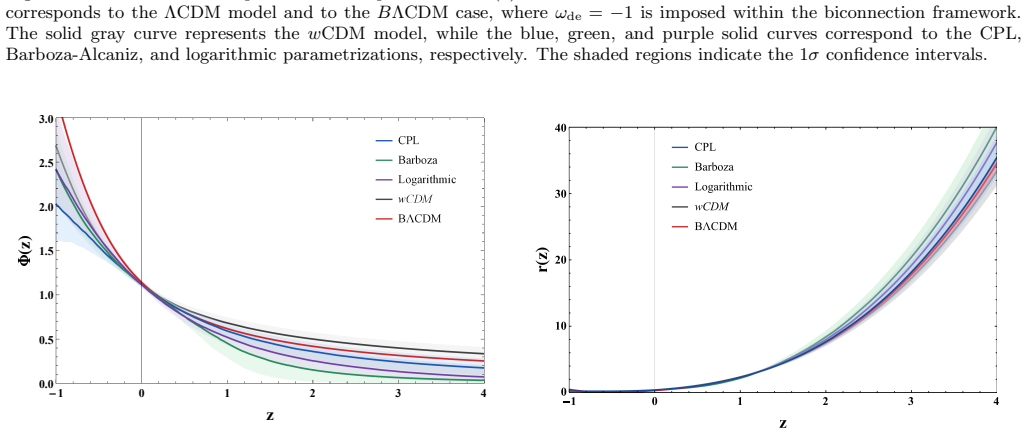
- Four of the five parametrizations produce nearly the same redshift of acceleration onset and the same current Hubble rate.
- The Barboza-Alcaniz and logarithmic parametrizations are statistically preferred by the Akaike, Bayesian, and Deviance Information Criteria and are competitive with LambdaCDM.
- Cosmographic tools (deceleration, jerk, snap, statefinder, Om(z)) provide a classification of the model relative to other dark-energy scenarios.
Where Pith is reading between the lines
- If the mutual curvature truly supplies the observed acceleration, then high-precision future measurements of expansion history alone could test a purely geometric origin of dark energy without new fields.
- The framework suggests that similar biconnection constructions applied to other gravitational theories might generate analogous effective dark-energy sectors that can be tested with the same data sets.
- Perturbation-level extensions of the model could produce distinctive signatures in structure growth that distinguish it from scalar-field dark energy.
Load-bearing premise
The assumption that the difference between the Schrödinger connection and its dual naturally encodes an effective dark energy sector in the generalized Friedmann equations.
What would settle it
A measurement of the present-day deceleration parameter, jerk, or Om(z) diagnostic that lies outside the narrow range predicted by the Barboza-Alcaniz and logarithmic parametrizations at low redshifts would show the model does not compete with LambdaCDM.
Figures



read the original abstract
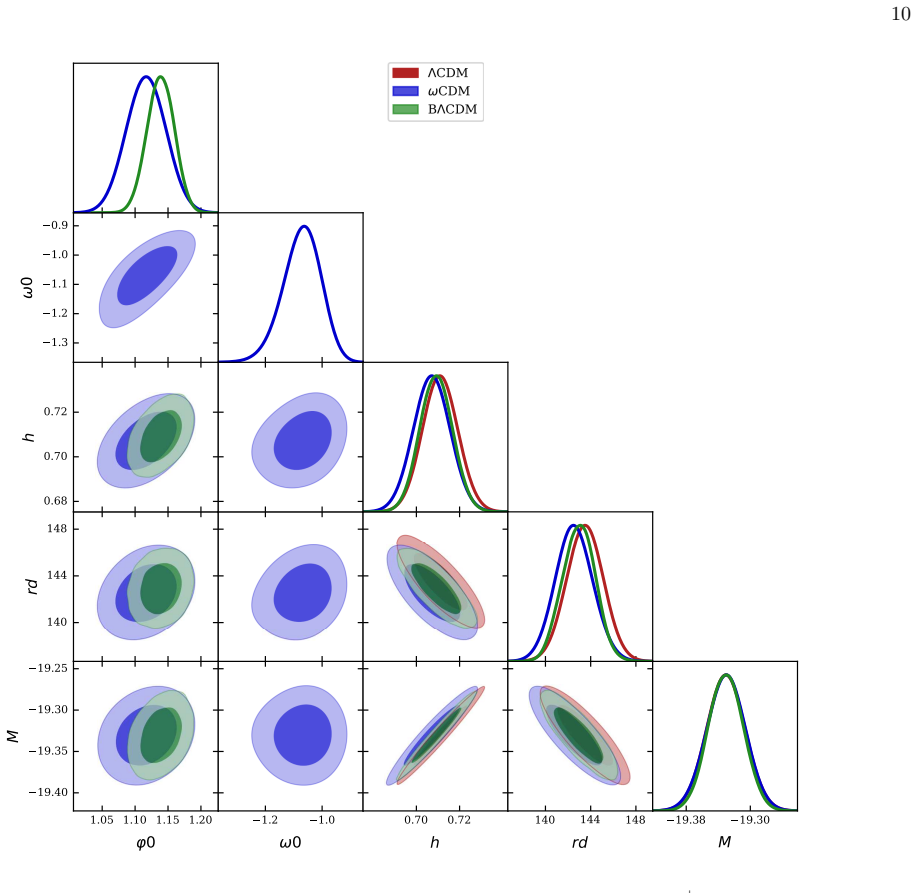
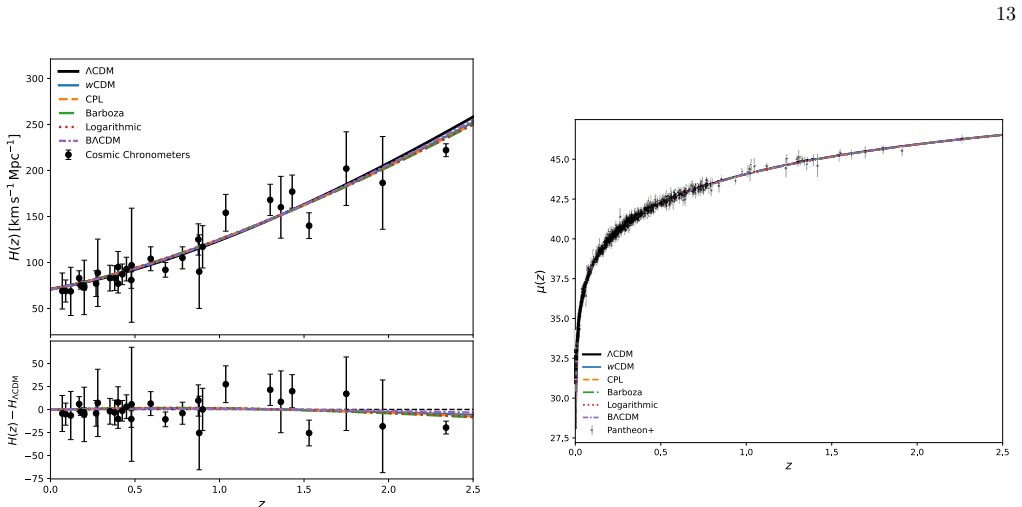
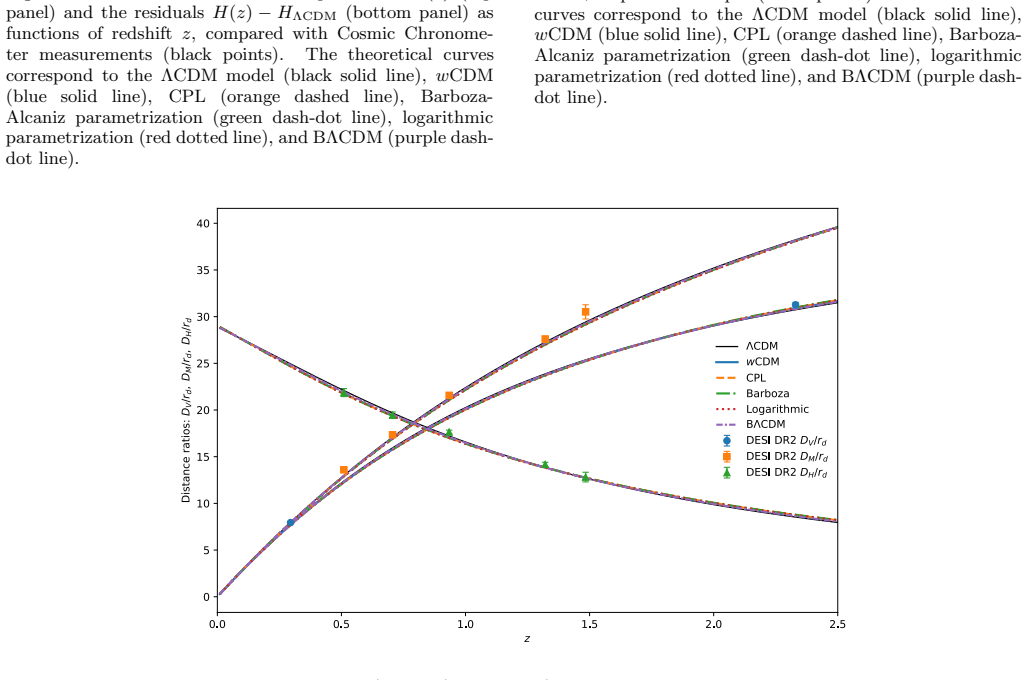
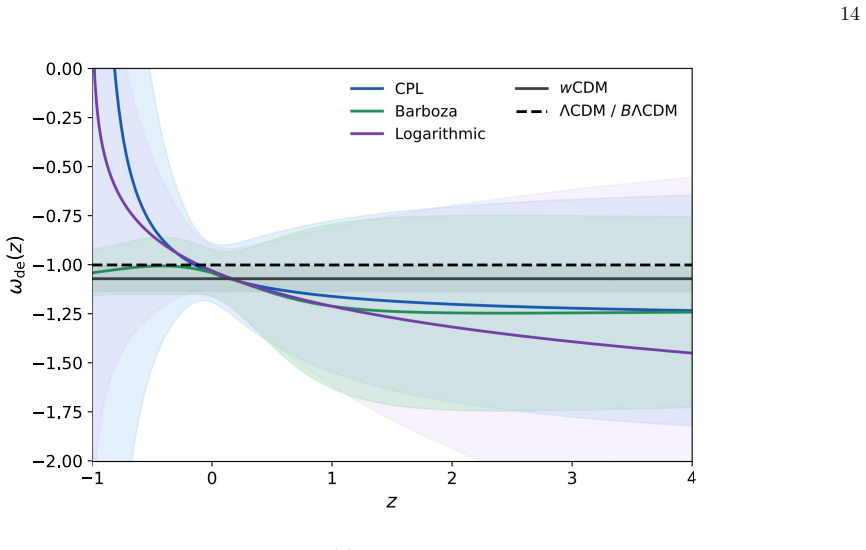
We investigate the cosmological implications of an extended gravitational framework based on biconnection gravity, constructed from the Schr$\ddot{o}$dinger connection and its dual. In this approach, the difference between the two connections defines the mutual curvature, which encodes the non-Riemannian geometric degrees of freedom, while their symmetric combination reduces to the Levi-Civita connection and hence reproduces general relativity at the background level. Within this setting, we derive the generalized Friedmann equations for a spatially flat Friedmann-Lema\^{i}tre-Robertson-Walker Universe. The resulting equations contain additional geometric contributions that may naturally encode an effective dark energy sector induced by the biconnection degrees of freedom. We explore this extra dark energy by adopting five commonly used parametrizations, namely B$\Lambda$CDM, $\omega$CDM, Chevallier-Polarski-Linder, Barboza-Alcaniz, and a logarithmic equations of state. These considerations are confronted with recent observational data, including DESI DR2, Pantheon$^+$, and CC observations. Our analysis shows that the four parameterizations enter the acceleration phase at almost the same redshifts and share the same current value of the Hubble rate. Furthermore, the statistical comparison based on the Akaike, Bayesian, and Deviance Information Criterion shows that Barboza-Alcaniz, and logarithmic parameterizations have strong evidence and are competitive with $\Lambda$CDM. To classify this biconnection gravity in the plethora theoretical models describing the current cosmic acceleration, we examine its implications through cosmographic tools, including the deceleration, jerk, and snap parameters, as well as through the Statefinder analysis and $Om(z)$ diagnostic.
Editorial analysis
A structured set of objections, weighed in public.
Referee Report
Summary. The manuscript develops a length-preserving biconnection gravity theory from the Schrödinger connection and its dual. Their difference is interpreted as a mutual curvature that supplies non-Riemannian degrees of freedom, while the symmetric part recovers the Levi-Civita connection and thus general relativity at the background level. Generalized Friedmann equations are derived for a flat FLRW universe; the extra geometric terms are interpreted as an effective dark-energy sector. Five standard phenomenological parametrizations (BΛCDM, ωCDM, CPL, Barboza-Alcaniz, logarithmic) are adopted for the equation-of-state of this sector and fitted to DESI DR2, Pantheon+, and cosmic-chronometer data. The authors report that the Barboza-Alcaniz and logarithmic forms are statistically competitive with ΛCDM according to AIC, BIC and DIC, that the models enter acceleration at similar redshifts, and that cosmographic (q, j, s) and diagnostic (Statefinder, Om(z)) analyses yield consistent results.
Significance. A geometric mechanism that generates an effective dark-energy sector without introducing new fields would be of clear interest. The present work, however, does not derive a specific functional form for w(z) from the mutual-curvature term; instead it imports five external parametrizations and performs standard likelihood fits. Consequently the reported statistical competitiveness tests the chosen parametrizations rather than the biconnection construction itself. The cosmographic and diagnostic sections add useful constraints but do not compensate for the missing link between geometry and the adopted equation-of-state forms.
major comments (3)
- [§3] §3 (generalized Friedmann equations): the explicit expression for the mutual-curvature contribution to the Friedmann equations is not displayed. Without the step-by-step reduction from the biconnection difference to the extra geometric term, it is impossible to verify whether this term can be identified with any of the five phenomenological w(z) parametrizations later adopted.
- [§4] §4 (parametrizations and data analysis): the five equations of state are introduced as standard phenomenological forms rather than being derived from the mutual curvature. The subsequent AIC/BIC/DIC comparison therefore evaluates the parametrizations against ΛCDM, not the biconnection framework; the claim that the geometry “naturally encodes” an effective dark-energy sector remains untested.
- [§5] §5 (observational constraints): the manuscript states that error propagation and full covariance treatment are performed, yet the text does not show the explicit propagation of the extra geometric parameters through the likelihood or the joint covariance matrix with the cosmological parameters. This omission prevents assessment of whether the reported constraints on the acceleration onset and H0 are robust.
minor comments (2)
- [Abstract, §2] The abstract and §2 contain several LaTeX rendering issues (e.g., Schr$ddot{o}$dinger) that should be corrected for readability.
- [Tables and figures] Table captions and figure legends should explicitly state the data combinations used (DESI DR2 + Pantheon+ + CC) and the priors adopted for the five parametrizations.
Simulated Author's Rebuttal
We thank the referee for the detailed and insightful report. We appreciate the opportunity to clarify the connection between the biconnection geometry and the effective dark energy sector. Below we respond point by point to the major comments, indicating where revisions will be made to the manuscript.
read point-by-point responses
-
Referee: [§3] §3 (generalized Friedmann equations): the explicit expression for the mutual-curvature contribution to the Friedmann equations is not displayed. Without the step-by-step reduction from the biconnection difference to the extra geometric term, it is impossible to verify whether this term can be identified with any of the five phenomenological w(z) parametrizations later adopted.
Authors: We agree that the explicit form and derivation are essential for verification. In the revised version, we will insert a dedicated subsection in §3 that provides the step-by-step reduction from the difference of the Schrödinger connection and its dual to the mutual-curvature term appearing in the generalized Friedmann equations. This will explicitly show the extra geometric contribution to the effective energy density. revision: yes
-
Referee: [§4] §4 (parametrizations and data analysis): the five equations of state are introduced as standard phenomenological forms rather than being derived from the mutual curvature. The subsequent AIC/BIC/DIC comparison therefore evaluates the parametrizations against ΛCDM, not the biconnection framework; the claim that the geometry “naturally encodes” an effective dark-energy sector remains untested.
Authors: The referee correctly notes that we adopt standard phenomenological parametrizations rather than deriving a specific w(z) from the mutual curvature. Our intent is to demonstrate that the extra geometric terms can be consistently interpreted as an effective dark-energy component whose dynamics are compatible with current data when using well-studied forms. We will revise the language in §4 and the abstract to emphasize that these are exploratory parametrizations used to test the viability of the biconnection-induced acceleration, and we will add a statement acknowledging that a first-principles derivation of w(z) from the geometry is left for future work. revision: partial
-
Referee: [§5] §5 (observational constraints): the manuscript states that error propagation and full covariance treatment are performed, yet the text does not show the explicit propagation of the extra geometric parameters through the likelihood or the joint covariance matrix with the cosmological parameters. This omission prevents assessment of whether the reported constraints on the acceleration onset and H0 are robust.
Authors: We will expand §5 to include the explicit formulas for propagating uncertainties from the geometric parameters and the form of the joint covariance matrix employed in the MCMC analysis. This addition will enable readers to assess the robustness of the derived constraints on the onset of acceleration and the Hubble constant. revision: yes
- A unique functional form for the equation of state derived directly from the mutual-curvature term without additional assumptions or parametrizations.
Circularity Check
No significant circularity in the derivation chain
full rationale
The paper first derives the generalized Friedmann equations for flat FLRW from the length-preserving biconnection, where the mutual curvature term supplies additional geometric contributions that are interpreted as possibly encoding effective dark energy. It then explicitly adopts five external phenomenological parametrizations (BΛCDM, ωCDM, CPL, Barboza-Alcaniz, logarithmic) for that sector and fits their parameters to DESI DR2 + Pantheon+ + CC data, reporting that certain parametrizations are statistically competitive with ΛCDM via AIC/BIC/DIC and share similar acceleration-onset redshifts and present-day Hubble values. These reported values are direct outputs of the data fits rather than first-principles outputs of the biconnection geometry, but the paper does not label them as predictions derived from the mutual curvature; it presents them as results of the adopted parametrizations. No step reduces by construction to a self-definition, a fitted quantity renamed as a geometric prediction, or a load-bearing self-citation whose content is unverified. The central geometric construction remains independent of the subsequent statistical comparison, which is a standard exploratory test of an extended framework.
Axiom & Free-Parameter Ledger
free parameters (1)
- EOS parameters in the five parametrizations (w0, wa, etc.)
axioms (2)
- domain assumption Spatially flat FLRW metric
- domain assumption Symmetric part of the two connections reduces to Levi-Civita
invented entities (1)
-
mutual curvature
no independent evidence
Lean theorems connected to this paper
-
IndisputableMonolith/Cost/FunctionalEquation.leanwashburn_uniqueness_aczel unclear?
unclearRelation between the paper passage and the cited Recognition theorem.
the difference between the two connections defines the mutual curvature, which encodes the non-Riemannian geometric degrees of freedom... additional geometric contributions that may naturally encode an effective dark energy sector
-
IndisputableMonolith/Foundation/AlphaCoordinateFixation.leanJ_uniquely_calibrated_via_higher_derivative contradicts?
contradictsCONTRADICTS: the theorem conflicts with this paper passage, or marks a claim that would need revision before publication.
we explore this extra dark energy by adopting five commonly used parametrizations
What do these tags mean?
- matches
- The paper's claim is directly supported by a theorem in the formal canon.
- supports
- The theorem supports part of the paper's argument, but the paper may add assumptions or extra steps.
- extends
- The paper goes beyond the formal theorem; the theorem is a base layer rather than the whole result.
- uses
- The paper appears to rely on the theorem as machinery.
- contradicts
- The paper's claim conflicts with a theorem or certificate in the canon.
- unclear
- Pith found a possible connection, but the passage is too broad, indirect, or ambiguous to say the theorem truly supports the claim.
Reference graph
Works this paper leans on
-
[1]
and [26], respectively. From another perspective, the challenge of explaining the late-time accelerated expansion of the Universe has motivated the exploration of a variety of gravitational theories be yond GR. In this context, a broad class of modified gravity models has been introduced and extensively studied. Indee d, to explain the available cosmologic...
-
[2]
by using the Schr¨ odinger connection and its dual, which also carries nonmetricity with an opposite sign. Inter- estingly enough, the symmetric combination of the aforementioned connections reduces identically to the Levi-Civita connection. As a result, the gravitational field equations evaluate d on a homogeneous and isotropic background coincide with th...
- [3]
- [4]
- [5]
-
[6]
H. E. S. Velten, R. F. vom Marttens, and W. Zimdahl, Eur. Ph ys. J. C 74, 3160 (2014)
work page 2014
- [7]
-
[8]
L. H. Ford, Phys. Rev. D 35, 2339 (1987)
work page 1987
- [9]
-
[10]
M. Bouhmadi-L´ opez, A. Errahmani, P. Martin-Moruno, T. Ouali, and Y. Tavakoli, Int. J. Mod. Phys. D 24, 1550078 (2015)
work page 2015
- [11]
- [12]
-
[13]
S. Dahmani, A. Bouali, I. El Bojaddaini, A. Errahmani, a nd T. Ouali, Gen. Relativ. Gravit. 55, 22 (2023)
work page 2023
-
[14]
S. Dahmani, A. Bouali, I. El Bojaddaini, A. Errahmani, a nd T. Ouali, Phys. Dark Universe 42, 101266 (2023)
work page 2023
- [15]
-
[16]
M. Malquarti, E. J. Copeland, A. R. Liddle, and M. Trodde n, Phys. Rev. D 67, 123503 (2003)
work page 2003
- [17]
- [18]
-
[19]
S. Wang, Y. Wang, and M. Li, Phys. Rep. 696, 1 (2017)
work page 2017
-
[20]
M. H. Belkacemi, M. Bouhmadi-L´ opez, A. Errahmani, and T. Ouali, Phys. Rev. D 85, 083503 (2012)
work page 2012
-
[21]
F. Bargach, A. Bargach, M. Bouhmadi-L´ opez, A. Errahma ni, and T. Ouali, Int. J. Mod. Phys. D 30, 2150076 (2021)
work page 2021
-
[22]
M. Bouhmadi-L´ opez, A. Errahmani, and T. Ouali, Phys. R ev. D 84, 083508 (2011)
work page 2011
- [23]
- [24]
- [25]
- [26]
-
[27]
H. Chaudhary, S. Capozziello, S. Praharaj, S. Kumar Jas Pacif, and G. Mustafa, JHEAp 50, 100507 (2026)
work page 2026
-
[28]
S. Capozziello, H. Chaudhary, T. Harko, and G. Mustafa, Physics of the Dark Universe 51, 102196 (2026)
work page 2026
-
[29]
H. A. Buchdahl, Mon. Not. R. Astron. Soc. 150, 1 (1970)
work page 1970
- [30]
- [31]
- [32]
-
[33]
T. Harko and F. S. N. Lobo, Extensions of f (R) Gravity: Curvature-Matter Couplings and Hybrid Metric-P alatini Theory, Cambridge Monographs on Mathematical Physics (Cambridge U niversity Press, Cambridge, 2019)
work page 2019
-
[34]
R. Hama, T. Harko, and S. V. Sabau, Eur. Phys. J. C 83, 1030 (2023)
work page 2023
-
[35]
R. Hama, T. Harko, and S. V. Sabau, Eur. Phys. J. C 82, 385 ( 2022)
work page 2022
- [36]
-
[37]
D. M. Ghilencea, Eur. Phys. J. C 83, 176 (2023)
work page 2023
-
[38]
D. M. Ghilencea, JHEP 10, 113 (2023)
work page 2023
-
[39]
C. Condeescu, D. M. Ghilencea, and A. Micu, Eur. Phys. J. C 84, 292 (2024)
work page 2024
- [40]
-
[41]
Schr¨ odinger,Space-Time Structure (Cambridge University Press, Cambridge, 1985)
E. Schr¨ odinger,Space-Time Structure (Cambridge University Press, Cambridge, 1985)
work page 1985
-
[42]
L. Ming, S.-D. Liang, H.-H. Zhang, and T. Harko, Phys. Re v. D 109, 024003 (2024)
work page 2024
-
[43]
S. L. Lauritzen, Statistical manifolds, in: Differenti al Geometry in Statistical Inferences, IMS Lecture Notes Mo nogr. Ser., 10, Inst. Math. Statist., Hayward California, pp. 96-163, 1 987
- [44]
-
[45]
Matsuoze, Advanced Studies in Pure Mathematics 57, 3 03 (2010)
H. Matsuoze, Advanced Studies in Pure Mathematics 57, 3 03 (2010)
work page 2010
- [46]
-
[47]
The Biconnection Variational Principle for General Relativity,
N. Tamanini, “The Biconnection Variational Principle for General Relativity,” in *Proceedings of the 13th Marcel Gross- mann Meeting on Recent Developments in Theoretical and Expe rimental General Relativity, Astrophysics, and Relativis tic Field Theories*, Stockholm, Sweden, 01–07 July 2012
work page 2012
- [48]
- [49]
-
[50]
Khosravi, General Relativity and Gravitation 47, 43 (2015)
N. Khosravi, General Relativity and Gravitation 47, 43 (2015)
work page 2015
- [51]
- [52]
- [53]
-
[54]
L. Csillag, R. Hama, M. Jozsa, T. Harko, and S. V. Sabau, J CAP 12, 034 (2024)
work page 2024
-
[55]
L. E. Padilla, L. O. Tellez, L. A. Escamilla, and J. A. Vaz quez, Universe 7, 213 (2021)
work page 2021
-
[56]
A. R. Liddle, Mon. Not. R. Astron. Soc. 377, L74 (2007)
work page 2007
- [57]
- [58]
-
[59]
D. J. Spiegelhalter, N. G. Best, B. P. Carlin, and A. van d er Linde, J. R. Stat. Soc. B 64, 583 (2002)
work page 2002
-
[60]
E. V. Linder, Phys. Rev. Lett. 90, 091301 (2003)
work page 2003
-
[61]
E. M. Barboza and J. S. Alcaniz, Phys. Lett. B 666, 415 (20 08)
- [62]
- [63]
- [64]
- [65]
- [66]
- [67]
- [68]
-
[69]
Data Release 1 of the Dark Energy Spectroscopic Instrument
M. Abdul-Karim et al. , arXiv:2503.14745 (2025)
work page internal anchor Pith review arXiv 2025
-
[70]
DESI Collaboration, arXiv:2503.14738 (2025)
work page internal anchor Pith review Pith/arXiv arXiv 2025
-
[71]
C. M. Hurvich and C.-L. Tsai, Biometrika 76, 297 (1989)
work page 1989
-
[72]
A. G. Riess et al. , Astrophys. J. 934, L7 (2022)
work page 2022
-
[73]
R. R. Caldwell, Phys. Lett. B 545, 23 (2002)
work page 2002
-
[74]
R. R. Caldwell and E. V. Linder, Phys. Rev. Lett. 95, 1413 01 (2005)
work page 2005
- [75]
-
[76]
A. Shafieloo, V. Sahni, and A. A. Starobinsky, Phys. Rev. D 86, 103527 (2012)
work page 2012
discussion (0)
Sign in with ORCID, Apple, or X to comment. Anyone can read and Pith papers without signing in.