Recognition: no theorem link
Fluid Antennas Assisted RIS-NOMA Communication Networks
Pith reviewed 2026-05-12 00:49 UTC · model grok-4.3
The pith
Fluid antennas with RIS and NOMA raise sum rates over fixed antennas and orthogonal access at high SNR.
A machine-rendered reading of the paper's core claim, the machinery that carries it, and where it could break.
Core claim
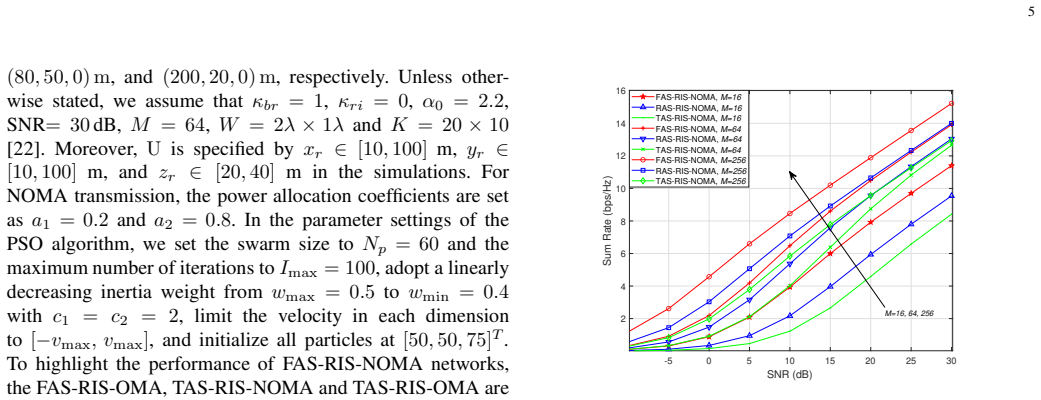
By placing planar fluid antennas at the non-orthogonal users of a RIS-assisted NOMA network and jointly tuning fluid ports, RIS position, and RIS phase shifts, the sum rate can be increased relative to fixed-antenna NOMA and to orthogonal multiple access under high-SNR conditions, with the improvement growing as the RIS element count or fluid-antenna aperture is enlarged.
What carries the argument
Alternating optimization that decomposes the joint non-convex problem into separate subproblems for fluid-port selection, RIS deployment, and phase-shift design.
If this is right
- Under high signal-to-noise ratio the combined system delivers higher total throughput than either conventional fixed-antenna NOMA or orthogonal multiple access.
- Raising the number of RIS elements produces substantial further increases in sum rate.
- Enlarging the fluid-antenna size likewise produces substantial sum-rate gains.
- The performance edge over orthogonal multiple access holds when the same optimization framework is applied.
Where Pith is reading between the lines
- The port-selection freedom could allow the network to adapt to user movement without mechanical repositioning of the entire antenna.
- The same alternating-optimization structure might be reused for other antenna technologies that admit discrete configuration choices.
- Real deployments would still need to account for the power and switching overhead of fluid antennas that the current simulations omit.
Load-bearing premise
The channel models and interference assumptions in the simulations match real propagation environments and the iterative solver reaches a solution good enough to realize the reported gains.
What would settle it
A hardware measurement campaign in an actual indoor or outdoor environment that records no throughput advantage for the fluid-antenna RIS-NOMA setup over fixed-antenna NOMA at high SNR would disprove the central performance claim.
Figures


read the original abstract
This paper introduces a fluid antenna system (FAS) into reconfigurable intelligent surface (RIS) assisted non-orthogonal multiple access (NOMA) communication networks, where the non-orthogonal users are equipped with planar fluid antennas. Specifically, we formulate a sum rate maximization problem for FAS-RIS-NOMA networks, which jointly optimizes the fluid ports, the RIS deployment, and the phase shift matrix. To solve the resulting non-convex optimization problem involving highly coupled variables, an iterative algorithm based on alternating optimization is employed to decompose the original problem into three subproblems. Exhaustive search is employed for optimizing the fluid ports, particle swarm optimization is used for the RIS deployment, and semidefinite relaxation with successive convex approximation is adopted for optimizing the phase shift matrix. Finally, the simulation results show that: 1) compared with traditional antenna systems and orthogonal multiple access, the FAS-RIS-NOMA networks achieve higher system throughput under high signal-to-noise ratio conditions; and 2) by increasing the number of RIS elements and enlarging the FAS size, the sum rate of FAS-RIS-NOMA networks can be significantly enhanced.
Editorial analysis
A structured set of objections, weighed in public.
Referee Report
Summary. The paper introduces fluid antenna systems (FAS) at the non-orthogonal users in a RIS-assisted NOMA network. It formulates a sum-rate maximization problem that jointly optimizes fluid port selection, RIS deployment position, and RIS phase-shift matrix. The resulting non-convex problem is addressed by an alternating-optimization algorithm that decomposes the variables into three subproblems solved respectively by exhaustive search, particle-swarm optimization, and semidefinite relaxation with successive convex approximation. Simulations are used to claim that the resulting FAS-RIS-NOMA configuration yields higher sum rate than conventional fixed-antenna NOMA and OMA baselines at high SNR, with further gains obtained by increasing the number of RIS elements or the FAS size.
Significance. If the iterative algorithm reliably produces solutions that are competitive with the global optimum, the work provides simulation evidence that the additional degrees of freedom offered by fluid antennas can improve high-SNR throughput in RIS-NOMA settings and that performance scales with RIS size and FAS aperture. The numerical results also illustrate practical design guidelines (larger FAS, more RIS elements). The absence of closed-form expressions or optimality guarantees, however, limits the result to an empirical demonstration rather than a definitive theoretical advance.
major comments (2)
- [Section IV] Section IV (alternating optimization framework): the manuscript provides no convergence analysis, no proof that the iterates reach a stationary point of the original problem, and no bound on the optimality gap introduced by the PSO and SDR-SCA sub-solvers. Because the central throughput-superiority claim rests entirely on the numerical outcomes of this heuristic procedure, the lack of such guarantees is load-bearing.
- [Section V] Section V (simulation results): the reported gains versus fixed-antenna NOMA and OMA baselines are obtained after unequal optimization effort (exhaustive search only for the small discrete port set, meta-heuristic PSO, and convex relaxation for the continuous variables). No small-scale exhaustive-search benchmark or multi-start comparison is presented to quantify how much of the observed advantage may be attributable to local-optima artifacts rather than the FAS-RIS-NOMA architecture itself.
minor comments (2)
- [Abstract] The abstract and introduction repeatedly use the phrase “high signal-to-noise ratio conditions” without defining the SNR range or the precise channel and interference model parameters that produce the claimed advantage.
- [Section II] Notation for the fluid-port selection vector and the RIS phase matrix is introduced without an explicit table of symbols, making it difficult to track the coupling between the three subproblems.
Simulated Author's Rebuttal
We thank the referee for the constructive feedback on our manuscript. We address each major comment point by point below and outline the revisions we will undertake.
read point-by-point responses
-
Referee: [Section IV] Section IV (alternating optimization framework): the manuscript provides no convergence analysis, no proof that the iterates reach a stationary point of the original problem, and no bound on the optimality gap introduced by the PSO and SDR-SCA sub-solvers. Because the central throughput-superiority claim rests entirely on the numerical outcomes of this heuristic procedure, the lack of such guarantees is load-bearing.
Authors: We acknowledge that the alternating optimization lacks a formal proof of convergence to a stationary point of the original non-convex problem and theoretical bounds on the optimality gap. The decomposition employs exhaustive search (optimal for the small discrete port set), PSO (for the non-convex continuous RIS position), and SDR-SCA (for the phase-shift subproblem). While deriving a rigorous guarantee is difficult given the problem structure and the meta-heuristic component, we will add numerical convergence plots in the revised manuscript. These will illustrate the behavior of the objective value over iterations across multiple channel realizations and parameter settings, along with results from multiple random initializations to demonstrate practical stability and repeatability of the obtained solutions. revision: partial
-
Referee: [Section V] Section V (simulation results): the reported gains versus fixed-antenna NOMA and OMA baselines are obtained after unequal optimization effort (exhaustive search only for the small discrete port set, meta-heuristic PSO, and convex relaxation for the continuous variables). No small-scale exhaustive-search benchmark or multi-start comparison is presented to quantify how much of the observed advantage may be attributable to local-optima artifacts rather than the FAS-RIS-NOMA architecture itself.
Authors: We agree that the differing optimization approaches for each variable warrant further validation. Exhaustive search is used for fluid ports precisely because the cardinality is small and the search is therefore both feasible and globally optimal for that subproblem. To address potential local-optima effects in the PSO step, we will incorporate multi-start experiments in the revised simulations, reporting both the best and average sum-rate performance over repeated PSO runs with different random seeds. In addition, we will include results for small-scale instances (reduced numbers of ports, RIS elements, and users) where a more exhaustive joint search is computationally tractable, providing a benchmark to quantify the gap between the proposed algorithm and near-optimal performance. revision: yes
- A rigorous mathematical proof that the alternating optimization converges to a stationary point of the original problem.
- Theoretical bounds on the optimality gap incurred by the PSO and SDR-SCA sub-solvers.
Circularity Check
No circularity: results are simulation outputs from optimization, not derivations reducing to inputs
full rationale
The paper formulates a joint sum-rate maximization problem over fluid ports, RIS deployment, and phase shifts, then applies an alternating optimization algorithm that decomposes it into three subproblems solved by exhaustive search, PSO, and SDR-SCA respectively. Performance claims (higher throughput at high SNR versus baselines) are obtained solely from numerical simulations of this procedure. No closed-form derivations, predictions, or first-principles results appear that equal their own inputs by construction, nor are there self-citations invoked as load-bearing uniqueness theorems or ansatzes. The central results therefore remain independent of the forbidden circular patterns.
Axiom & Free-Parameter Ledger
free parameters (2)
- number of fluid ports
- number of RIS elements
axioms (2)
- domain assumption Standard far-field channel models and perfect CSI assumptions hold for the FAS-RIS-NOMA setup.
- domain assumption The non-convex problem can be decomposed into three subproblems solvable by alternating optimization.
Reference graph
Works this paper leans on
-
[1]
Towards 6G wireless commun ication networks: Vision, enabling technologies, and new paradigm shifts,
X. Y ou, C. Wang, and J. Huang, “Towards 6G wireless commun ication networks: Vision, enabling technologies, and new paradigm shifts,” Sci.China Inform. Sci. , vol. 64, no. 1, pp. 110 301:1–110 301:74, Jan. 2021
work page 2021
-
[2]
On th e road to 6G: Visions, requirements, key technologies, and te stbeds,
C.-X. Wang, X. Y ou, X. Gao, X. Zhu, Z. Li, C. Zhang, H. Wang, Y . Huang, Y . Chen, H. Haas, J. S. Thompson, E. G. Larsson, M. D. Renzo, W. Tong, P . Zhu, X. Shen, H. V . Poor, and L. Hanzo, “On th e road to 6G: Visions, requirements, key technologies, and te stbeds,” IEEE Commun. Surveys Tutorials , vol. 25, no. 2, pp. 905–974, 2nd Quart. 2023
work page 2023
-
[3]
K.-K. Wong, A. Shojaeifard, K.-F. Tong, and Y . Zhang, “Fl uid antenna systems,” IEEE Trans. Wireless Commun., vol. 20, no. 3, pp. 1950–1962, Mar. 2021
work page 1950
-
[4]
W. K. New, K.-K. Wong, H. Xu, C. Wang, F. R. Ghadi, J. Zhang, J. Rao, R. Murch, P . Ram´ ırez-Espinosa, D. Morales-Jimenez , C.-B. Chae, and K.-F. Tong, “A tutorial on fluid antenna system for 6 G networks: Encompassing communication theory, optimizati on methods and hardware designs,” IEEE Commun. Surveys Tutorials , vol. 27, no. 4, pp. 2325–2377, Aug. 2025
work page 2025
-
[5]
A gaussian copula approach to the p er- formance analysis of fluid antenna systems,
F. Rostami Ghadi, K.-K. Wong, F. Javier L ´ opez-Mart´ ınez, C.-B. Chae, K.-F. Tong, and Y . Zhang, “A gaussian copula approach to the p er- formance analysis of fluid antenna systems,” IEEE Trans. Wireless Commun., vol. 23, no. 11, pp. 17 573–17 585, Nov. 2024
work page 2024
-
[6]
Reconfigurable intelligent surfaces: Principles and oppo rtunities,
Y . Liu, X. Liu, X. Mu, T. Hou, J. Xu, M. Di Renzo, and N. Al-Dh ahir, “Reconfigurable intelligent surfaces: Principles and oppo rtunities,” IEEE Commun. Surveys Tutorials , vol. 23, no. 3, pp. 1546–1577, thirdquarter 2021
work page 2021
-
[7]
Act ive simul- taneously transmitting and reflecting surface assisted NOM A networks,
X. Y ue, J. Xie, C. Ouyang, Y . Liu, X. Shen, and Z. Ding, “Act ive simul- taneously transmitting and reflecting surface assisted NOM A networks,” IEEE Trans. Wireless Commun. , vol. 23, no. 8, pp. 9912–9926, Aug. 2024
work page 2024
-
[8]
On performance of RIS-aided fluid antenna systems ,
F. Rostami Ghadi, K.-K. Wong, W. K. New, H. Xu, R. Murch, an d Y . Zhang, “On performance of RIS-aided fluid antenna systems ,” IEEE Wireless Commun. Lett. , vol. 13, no. 8, pp. 2175–2179, Aug. 2024
work page 2024
-
[9]
FAS-RIS communication: Model, analysis, and optimizatio n,
J. Y ao, J. Zheng, T. Wu, M. Jin, C. Y uen, K.-K. Wong, and F. A dachi, “FAS-RIS communication: Model, analysis, and optimizatio n,” IEEE Trans. V eh. Technol., vol. 74, no. 6, pp. 9938–9943, Jun. 2025
work page 2025
-
[10]
X. Zhang, D. Xu, J. Wang, S. Song, D. Wing Kwan Ng, and M. De bbah, “Fluid antenna meets RIS: Random matrix analysis and two-ti mescale design for multi-user communications,” IEEE J. Sel. Areas Commun. , vol. 44, pp. 1400–1416, 2026
work page 2026
-
[11]
Exploi ting movable-element STARS for wireless communications,
J. Zhao, Q. Zhou, X. Mu, K. Cai, Y . Zhu, and Y . Liu, “Exploi ting movable-element STARS for wireless communications,” IEEE Trans. Wireless Commun., vol. 25, pp. 11 465–11 479, 2026
work page 2026
-
[12]
Exploring fairness for FAS-assisted communication systems: From NOMA to OMA,
J. Y ao, L. Zhou, T. Wu, M. Jin, C. Pan, M. Elkashlan, and K. -K. Wong, “Exploring fairness for FAS-assisted communication systems: From NOMA to OMA,” IEEE Trans. Wireless Commun. , vol. 24, no. 4, pp. 3433–3449, Apr. 2025
work page 2025
-
[13]
Fluid antenna system enhancing orthogonal and non-orthog onal mul- tiple access,
W. K. New, K.-K. Wong, H. Xu, K.-F. Tong, C.-B. Chae, and Y . Zhang, “Fluid antenna system enhancing orthogonal and non-orthog onal mul- tiple access,” IEEE Commun. Lett. , vol. 28, no. 1, pp. 218–222, Jan. 2024
work page 2024
-
[14]
Performa nce of RIS- aided fluid antenna-enabled multiuser NOMA non-terrestria l networks,
S. Mondal, K. Singh, A. Kaushik, and C.-P . Li, “Performa nce of RIS- aided fluid antenna-enabled multiuser NOMA non-terrestria l networks,” IEEE J. Sel. Areas Commun. , vol. 44, pp. 1061–1076, 2026
work page 2026
-
[15]
K.-K. Wong, K.-F. Tong, and C.-B. Chae, “Fluid antenna s ystem—part iii: A new paradigm of distributed artificial scattering sur faces for massive connectivity,” IEEE Commun. Lett. , vol. 27, no. 8, pp. 1929– 1933, Aug. 2023
work page 1929
-
[16]
W. K. New, K.-K. Wong, H. Xu, K.-F. Tong, and C.-B. Chae, “ An information-theoretic characterization of MIMO-FAS: Opt imization, diversity-multiplexing tradeoff and q-outage capacity,” IEEE Trans. Wireless Commun., vol. 23, no. 6, pp. 5541–5556, Jun. 2024
work page 2024
-
[17]
T. Wu, K.-K. Wong, B. Liu, K.-F. Tong, and H. Shin, “Tamin g the bessel landscape: Joint antenna position optimization for spatial decorrelation in fluid mimo systems,” 2026. [Online]. Avail able: https://arxiv.org/abs/2603.07450
-
[18]
A STARS aided NOMA covert communication networks,
X. Y ue, X. Song, J. Zhao, C. Huang, H. Jin, and W. Xiang, “A STARS aided NOMA covert communication networks,” IEEE Trans. V eh. Tech- nol., vol. 74, no. 7, pp. 10 661–10 673, Jul. 2025
work page 2025
-
[19]
H. Zhou, M. Erol-Kantarci, Y . Liu, and H. V . Poor, “Heuri stic algorithms for RIS-assisted wireless networks: Exploring heuristic- aided machine learning,” IEEE Wireless Commun. Lett. , vol. 31, no. 4, pp. 106–114, Aug. 2024
work page 2024
-
[20]
Joint beamformi ng design and power splitting optimization in IRS-assisted sw ipt NOMA networks,
Z. Li, W. Chen, Q. Wu, K. Wang, and J. Li, “Joint beamformi ng design and power splitting optimization in IRS-assisted sw ipt NOMA networks,” IEEE Trans. Wireless Commun. , vol. 21, no. 3, pp. 2019– 2033, Mar. 2022
work page 2019
-
[21]
Fe derated learning in active STARS-aided uplink networks,
X. Y ue, X. Guo, X. Mu, J. Zhao, P . Y ang, J. Mu, and Z. Lu, “Fe derated learning in active STARS-aided uplink networks,” IEEE Trans. V eh. Technol., vol. 75, no. 1, pp. 1156–1170, Jan. 2026
work page 2026
-
[22]
Physical layer security over fluid ant enna sys- tems: Secrecy performance analysis,
F. Rostami Ghadi, K.-K. Wong, F. Javier L ´ opez-Mart´ ınez, W. Kiat New, H. Xu, and C.-B. Chae, “Physical layer security over fluid ant enna sys- tems: Secrecy performance analysis,” IEEE Trans. Wireless Commun. , vol. 23, no. 12, pp. 18 201–18 213, Dec. 2024
work page 2024
discussion (0)
Sign in with ORCID, Apple, or X to comment. Anyone can read and Pith papers without signing in.