Recognition: no theorem link
DSPE: An Energy-Efficient Edge Processor for DeepSeek Inference with MerkleTree-based Incremental Pruning, Multi-Stage Boothing Lookup and Dynamic Adaptive Posit Processing
Pith reviewed 2026-05-12 00:49 UTC · model grok-4.3
The pith
DSPE combines MerkleTree pruning, multi-stage boothing lookup, and a new adaptive posit format to reach 109.4 TFLOPS/W for DeepSeek inference on edge hardware.
A machine-rendered reading of the paper's core claim, the machinery that carries it, and where it could break.
Core claim
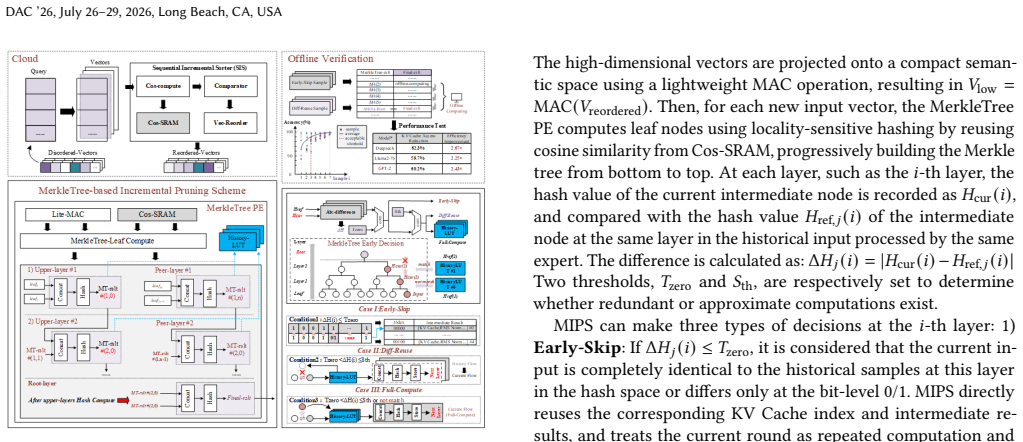
The DSPE architecture integrates the MerkleTree-based Incremental Pruning Scheme for secure reduction of redundant vectors, the Multi-Stage Boothing Lookup Method for bit-flip-aware approximate multiplication, and the Dynamic Adaptive Posit Processing Mechanism that introduces a new DA-Posit data format together with its matching hardware multiplier. When realized in 28nm CMOS, the combined processor delivers 109.4 TFLOPS/W energy efficiency for DeepSeek inference and is presented as a scalable base for edge deployment.
What carries the argument
The MerkleTree-based Incremental Pruning Scheme, Multi-Stage Boothing Lookup Method, and Dynamic Adaptive Posit Processing Mechanism with its DA-Posit format, which together prune redundant work, approximate multiplications safely, and adapt numeric precision at runtime to cut energy use.
If this is right
- DeepSeek inference becomes practical on battery-powered or thermally limited edge devices.
- The architecture supplies a concrete template for scaling similar large models to edge hardware.
- Secure incremental pruning reduces vector counts while preserving model integrity during execution.
- Approximate multiplication and adaptive precision together lower the dominant energy cost of matrix operations.
Where Pith is reading between the lines
- The same combination of tree-structured pruning and low-precision adaptive arithmetic could be tested on other large language models to check broader applicability.
- Hardware support for the new DA-Posit format might encourage adoption of similar variable-precision formats in future low-power accelerators.
- If the techniques prove robust, they could be combined with existing quantization flows to further reduce memory traffic on edge platforms.
Load-bearing premise
The three techniques can be combined in real silicon to produce the reported energy-efficiency gains without unacceptable drops in inference accuracy or prohibitive hardware overhead.
What would settle it
Fabricated-chip measurements showing energy efficiency well below 109.4 TFLOPS/W or accuracy loss exceeding a few percent on standard DeepSeek benchmarks would falsify the central claim.
Figures




read the original abstract
In recent years, DeepSeek has achieved strong inference performance but remains hard to deploy on energy-constrained edge devices. This paper presents the DeepSeek Processing Element (DSPE), an edge-oriented architecture that alleviates the model's heavy computational and energy demands. DSPE introduces three techniques: the MerkleTree-based Incremental Pruning Scheme (MIPS) for secure redundant-vector reduction, the Multi-Stage Boothing Lookup Method (MBLM) for bit-flip-aware approximate multiplication, and the Dynamic Adaptive Posit Processing Mechanism (DAPPM), which introduces a new DA-Posit format and its corresponding hardware multiplication architecture. Implemented in TSMC 28nm CMOS, DSPE achieves 109.4 TFLOPS/W energy efficiency compared with state-of-the-art designs and offers a scalable foundation for edge deployment.
Editorial analysis
A structured set of objections, weighed in public.
Referee Report
Summary. The paper proposes the DeepSeek Processing Element (DSPE), an edge-oriented hardware architecture for efficient inference of the DeepSeek model. It introduces three techniques: MerkleTree-based Incremental Pruning Scheme (MIPS) for secure redundant vector reduction, Multi-Stage Boothing Lookup Method (MBLM) for bit-flip-aware approximate multiplication, and Dynamic Adaptive Posit Processing Mechanism (DAPPM) that defines a new DA-Posit format along with its hardware multiplier. The design is implemented in TSMC 28nm CMOS and claims 109.4 TFLOPS/W energy efficiency relative to prior art, offering a scalable foundation for edge deployment of DeepSeek.
Significance. If the headline efficiency figure is substantiated with measured silicon data, accuracy preservation for the target DeepSeek model, and per-technique breakdowns, the work would represent a meaningful contribution to energy-efficient LLM accelerators for edge devices. The integration of tree-based pruning, approximate Booth-style multiplication, and a custom posit format targets relevant bottlenecks in compute and memory energy. No machine-checked proofs, open code, or parameter-free derivations are present to strengthen the assessment.
major comments (3)
- [Abstract] Abstract: The central claim that 'DSPE achieves 109.4 TFLOPS/W energy efficiency' is stated without reference to any table, figure, section, or measurement conditions (voltage, frequency, workload, power breakdown, or post-layout vs. silicon results). This directly undermines the headline result and prevents comparison with state-of-the-art designs.
- [Evaluation (absent)] No accuracy evaluation section or table: The manuscript provides no quantitative accuracy-vs-baseline results for DeepSeek inference under the combined MIPS + MBLM + DAPPM/DA-Posit scheme, nor any error analysis showing that accuracy loss remains acceptable. This is load-bearing for the claim that the techniques deliver efficiency 'without unacceptable accuracy loss'.
- [Implementation] Implementation section: No breakdown of area, power, or latency overheads for the new DA-Posit hardware multiplier or the Merkle-tree pruning logic is supplied, nor any comparison against standard posit or FP16 baselines on the same TSMC 28nm process.
minor comments (1)
- [Title] Title and abstract: 'Boothing' appears to be a typographical variant of 'Booth'; clarify whether this refers to a modified Booth multiplication algorithm.
Simulated Author's Rebuttal
We thank the referee for the constructive and detailed feedback. We agree that the current manuscript requires clarifications and additions to strengthen the presentation of results. We will revise the paper accordingly to address each point.
read point-by-point responses
-
Referee: [Abstract] Abstract: The central claim that 'DSPE achieves 109.4 TFLOPS/W energy efficiency' is stated without reference to any table, figure, section, or measurement conditions (voltage, frequency, workload, power breakdown, or post-layout vs. silicon results). This directly undermines the headline result and prevents comparison with state-of-the-art designs.
Authors: We agree that the abstract should explicitly reference the supporting data. In the revised version, we will add citations to the specific evaluation tables and figures that report the 109.4 TFLOPS/W figure, along with the associated conditions (voltage, frequency, workload, power breakdown) and clarification on whether results are post-layout estimates or silicon measurements. This will enable direct comparisons. revision: yes
-
Referee: [Evaluation (absent)] No accuracy evaluation section or table: The manuscript provides no quantitative accuracy-vs-baseline results for DeepSeek inference under the combined MIPS + MBLM + DAPPM/DA-Posit scheme, nor any error analysis showing that accuracy loss remains acceptable. This is load-bearing for the claim that the techniques deliver efficiency 'without unacceptable accuracy loss'.
Authors: We acknowledge the absence of a dedicated accuracy evaluation and agree it is necessary. We will add a new section with quantitative accuracy results for DeepSeek inference under the combined techniques, including baseline comparisons and error analysis to demonstrate that accuracy degradation remains within acceptable bounds for the target application. revision: yes
-
Referee: [Implementation] Implementation section: No breakdown of area, power, or latency overheads for the new DA-Posit hardware multiplier or the Merkle-tree pruning logic is supplied, nor any comparison against standard posit or FP16 baselines on the same TSMC 28nm process.
Authors: We will expand the implementation section to include detailed breakdowns of area, power, and latency overheads for the DA-Posit multiplier and Merkle-tree pruning logic. We will also add direct comparisons to standard posit and FP16 implementations synthesized on the same TSMC 28nm process to quantify the overheads and benefits. revision: yes
Circularity Check
No significant circularity; claims rest on hardware implementation rather than self-referential derivation
full rationale
The paper describes three novel techniques (MIPS, MBLM, DAPPM with new DA-Posit format) and reports a measured energy efficiency of 109.4 TFLOPS/W from TSMC 28nm CMOS implementation. No mathematical derivation chain, equations, or first-principles predictions are presented that reduce by construction to fitted inputs, self-definitions, or self-citation chains. The efficiency figure is positioned as an empirical hardware result, not a tautological output of internal definitions. No load-bearing self-citations or ansatz smuggling appear in the provided text. The architecture is self-contained via design and measurement, with no evidence of the central claims looping back to their own inputs.
Axiom & Free-Parameter Ledger
invented entities (1)
-
DA-Posit format
no independent evidence
Reference graph
Works this paper leans on
-
[1]
X. Bi, D. Chen, G. Chen, S. Chen, D. Dai, C. Deng, H. Ding, K. Dong, Q. Du, Z. Fu, and H. Gao. 2024. DeepSeek LLM: Scaling open-source language models with longtermism.arXiv preprint arXiv:2401.02954(2024)
work page internal anchor Pith review Pith/arXiv arXiv 2024
- [2]
-
[3]
J. Choquette and R. Krashinsky. 2022. NVIDIA Hopper GPU: Scaling performance. InProceedings of the IEEE Hot Chips Symposium (HCS)
work page 2022
-
[4]
M.-C. Huang, W. W. Mar, S. Kanade, B. Bai, A. Gayatri, K. Khairnar, A. Lai, Y.-H. Hsu, H.-J. Liao, Y. Wang, and T.-Y. J. Chang. 2024. A 3.3 GHz 1024×640 multi-bank single-port SRAM with frequency enhancing techniques and 0.55 V–1.35 V wide voltage range operation in 3nm FinFET for HPC applications. InProceedings of the IEEE Symposium on VLSI Technology an...
work page 2024
-
[5]
N. Jouppi, G. Kurian, S. Li, P. Ma, R. Nagarajan, L. Nai, N. Patil, S. Subramanian, A. Swing, B. Towles, and C. Young. 2023. TPU v4: An optically reconfigurable supercomputer for machine learning with hardware support for embeddings. In Proceedings of the 50th Annual International Symposium on Computer Architecture. 1–14
work page 2023
-
[6]
N. P. Jouppi, C. Young, N. Patil, D. Patterson, G. Agrawal, R. Bajwa, S. Bates, S. Bhatia, N. Boden, A. Borchers, and R. Boyle. 2017. In-datacenter performance analysis of a tensor processing unit. InProceedings of the 44th Annual International Symposium on Computer Architecture. 1–12
work page 2017
- [8]
-
[9]
S. Lee, K. Kim, S. Oh, et al . 2022. A 1ynm 1.25 V 8Gb, 16Gb/s/pin GDDR6- based accelerator-in-memory supporting 1TFLOPS MAC operation and various activation functions for deep-learning applications. In2022 IEEE International Solid-State Circuits Conference (ISSCC), Vol. 65. IEEE, 1–3
work page 2022
-
[10]
A. Liu, B. Feng, B. Xue, B. Wang, B. Wu, C. Lu, C. Zhao, C. Deng, C. Zhang, C. Ruan, and D. Dai. 2024. DeepSeek-V3 technical report.arXiv preprint arXiv:2412.19437 (2024)
work page internal anchor Pith review Pith/arXiv arXiv 2024
-
[11]
H. Peng, S. Huang, T. Geng, A. Li, W. Jiang, H. Liu, S. Wang, and C. Ding. 2021. Accelerating transformer-based deep learning models on FPGAs using column balanced block pruning. In2021 22nd International Symposium on Quality Elec- tronic Design (ISQED). IEEE, 142–148
work page 2021
-
[12]
A. Pinkus. 1999. Approximation theory of the MLP model in neural networks. Acta Numerica8 (1999), 143–195
work page 1999
-
[13]
T. Tambe, J. Zhang, C. Hooper, T. Jia, P. N. Whatmough, J. Zuckerman, M. C. Dos Santos, E. J. Loscalzo, D. Giri, K. Shepard, L. Carloni, A. Rush, D. Brooks, and G.-Y. Wei. 2023. 22.9 A 12nm 18.1 TFLOPs/W sparse transformer processor with entropy-based early exit, mixed-precision predication and fine-grained power management. InProceedings of the IEEE Inte...
-
[14]
H. Taud and J. F. Mas. 2017. Multilayer perceptron (MLP). InGeomatic Approaches for Modeling Land Change Scenarios. Springer International Publishing, Cham, 451–455
work page 2017
-
[15]
F. Tu, Z. Wu, Y. Wang, et al. 2022. A 28nm 15.59 𝜇J/token full-digital bitline- transpose CIM-based sparse transformer accelerator with pipeline/parallel re- configurable modes. In2022 IEEE International Solid-State Circuits Conference (ISSCC), Vol. 65. IEEE, 466–468
work page 2022
-
[16]
F. Tu, Z. Wu, Y. Wang, W. Wu, L. Liu, Y. Hu, S. Wei, and S. Yin. 2023. 16.1 MuITCIM: A 28nm 2.24 𝜇J/token attention-token-bit hybrid sparse digital CIM-based accel- erator for multimodal transformers. InProceedings of the IEEE International Solid- State Circuits Conference (ISSCC). 248–250. doi:10.1109/ISSCC42615.2023.10067842
-
[17]
B. Varghese, N. Wang, S. Barbhuiya, P. Kilpatrick, and D. S. Nikolopoulos. 2016. Challenges and opportunities in edge computing. In2016 IEEE International Conference on Smart Cloud (SmartCloud). IEEE, 20–26
work page 2016
-
[18]
H. Wang, Z. Zhang, and S. Han. 2021. SpAtten: Efficient sparse attention architec- ture with cascade token and head pruning. In2021 IEEE International Symposium on High-Performance Computer Architecture (HPCA). IEEE, 97–110
work page 2021
-
[19]
Y. Wang, Y. Qin, D. Deng, et al . 2022. A 28nm 27.5 TOPS/W approximate- computing-based transformer processor with asymptotic sparsity speculating and out-of-order computing. In2022 IEEE International Solid-State Circuits Conference (ISSCC), Vol. 65. IEEE, 1–3
work page 2022
-
[20]
Z. Wang, J. Wei, B. Han, H. He, L. Liu, S. Wei, and S. Yin. 2023. CPE: An energy- efficient edge-device training with multi-dimensional compression mechanism. In2023 60th ACM/IEEE Design Automation Conference (DAC). IEEE, 1–6
work page 2023
-
[21]
Z. Wang, J. Wei, X. Tang, B. Han, H. He, L. Liu, S. Wei, and S. Yin. 2023. TPE: A high-performance edge-device inference with multi-level transformational mechanism. In2023 IEEE 5th International Conference on Artificial Intelligence Circuits and Systems (AICAS). IEEE, 1–5
work page 2023
discussion (0)
Sign in with ORCID, Apple, or X to comment. Anyone can read and Pith papers without signing in.