Recognition: no theorem link
IPAD-CLIP: Teaching CLIP to Detect Image Local Perceptual Artifacts
Pith reviewed 2026-05-12 01:25 UTC · model grok-4.3
The pith
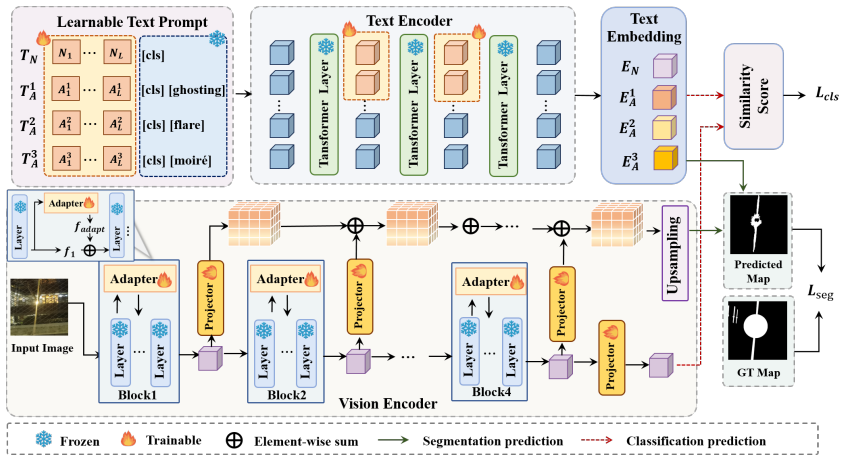
IPAD-CLIP adapts CLIP to detect local perceptual artifacts by learning artifact-aware text embeddings that anchor visual attention to subtle flaws.
A machine-rendered reading of the paper's core claim, the machinery that carries it, and where it could break.
Core claim
IPAD-CLIP teaches CLIP to detect local perceptual artifacts by learning artifact-aware text embeddings that capture object-artifact correlations, using them as anchors to shift the visual encoder's focus from high-level semantics to subtle low-level artifacts, resulting in superior performance on a new multi-class detection benchmark compared to anomaly and manipulation detection methods.
What carries the argument
Artifact-aware text embeddings that model object-artifact relationships and serve as anchors to guide the visual encoder toward localized subtle artifacts.
If this is right
- Provides the first public benchmark dataset and model specifically for multi-class local perceptual artifact detection with pixel-level masks.
- Demonstrates a resource-efficient way to adapt a pretrained vision-language model for fine-grained detection without full retraining.
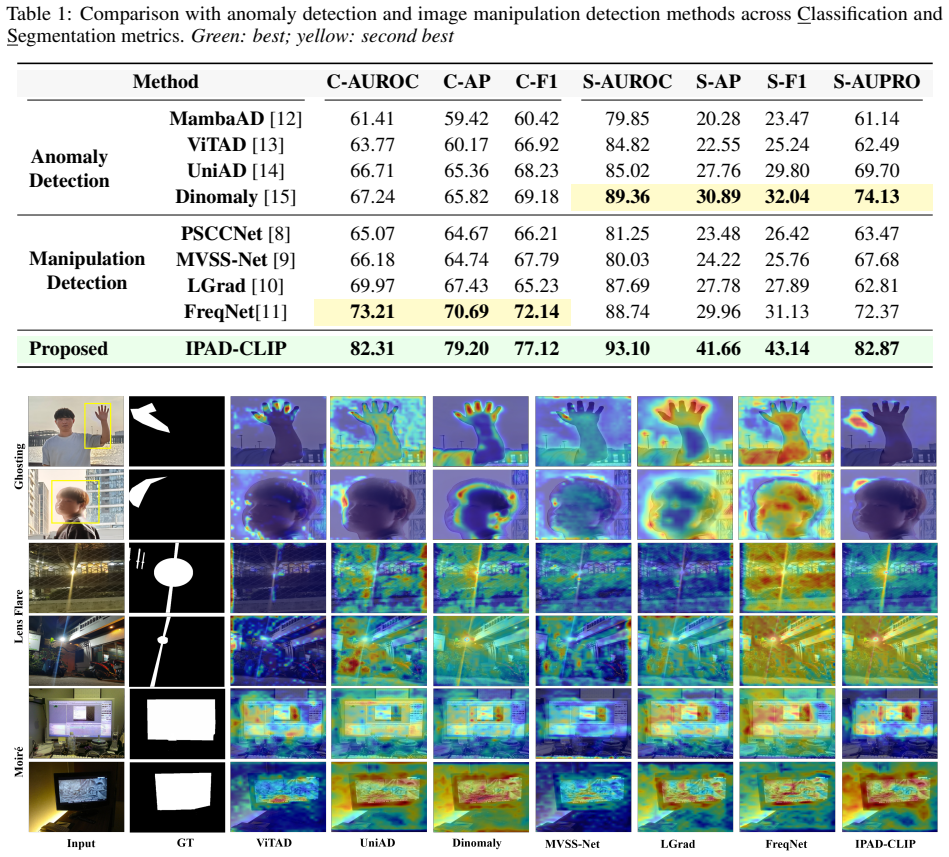
- Outperforms advanced image anomaly detection and manipulation detection methods on the IPAD benchmark.
- Preserves CLIP's broad generalization while adding explicit modeling of object-artifact relationships.
- Supplies localized masks that can directly support targeted artifact removal or correction pipelines.
Where Pith is reading between the lines
- The same anchoring approach with learned text embeddings could be tested on other subtle image degradations such as compression artifacts or sensor noise.
- Combining the detector with existing artifact-removal networks might produce closed-loop systems that both locate and correct local flaws.
- Scaling the dataset with additional artifact categories or more diverse real-world captures would clarify how far the assumed semantic correlations extend.
- Because the adaptation is lightweight, the method may transfer to video sequences or real-time camera pipelines with modest further engineering.
Load-bearing premise
Local artifacts exhibit strong correlations with specific semantic contexts, enabling artifact-aware text embeddings to enhance discrimination while preserving CLIP's generalization without overfitting to the new dataset.
What would settle it
Replacing the learned artifact-aware text embeddings in IPAD-CLIP with standard CLIP prompts and measuring whether detection performance on the benchmark falls to the level of unmodified CLIP or other baselines would test whether the embeddings are the decisive factor.
Figures


read the original abstract
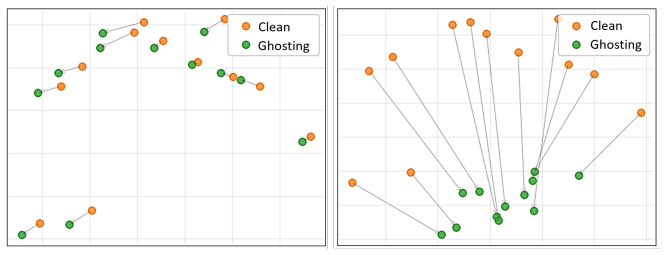
Current image quality assessment methods are heavily biased towards global distortions (e.g., noise, blur), neglecting local perceptual artifacts such as ghosting, lens flare, and moire effects. Although significant progress has been made in artifact removal, the fundamental problem of automatic artifact detection remains largely unexplored. In this paper, we formalize the Image Perceptual Artifact Detection (IPAD) task to address this gap. We contribute a benchmark dataset comprising 3,520 artifact images, including 520 real-captured and 3,000 synthetic samples, each paired with pixel-level masks across three representative artifact categories. The core challenge of IPAD lies in the localized, subtle, and semantically weak nature of these artifacts, which makes them prone to missed detection. To overcome this, we introduce IPAD-CLIP, a novel framework built upon CLIP that enhances artifact discrimination in both textual and visual spaces while preserving generalization capabilities. Our key insight is that local artifacts often exhibit strong correlations with specific semantic contexts. Accordingly, we learn artifact-aware text embeddings to explicitly model the object-artifact relationships, resulting in enhanced representations that clear differentiate between clean and artifact prompts. These text embeddings are then used as anchors to shift the visual encoder's attention from high-level semantics to subtle, low-level artifacts. Extensive experiments demonstrate that IPAD-CLIP offers a resource-efficient adaptation of CLIP for detection, significantly outperforming advanced image anomaly detection and manipulation detection methods on our benchmark. To the best of our knowledge, this is the first study addressing multi-class local perceptual artifact detection in terms of both dataset and model.
Editorial analysis
A structured set of objections, weighed in public.
Referee Report
Summary. The paper formalizes the Image Perceptual Artifact Detection (IPAD) task to detect localized, subtle perceptual artifacts (e.g., ghosting, lens flare, moiré) that current global-distortion IQA methods neglect. It contributes a benchmark of 3,520 images (520 real-captured + 3,000 synthetic) with pixel-level masks across three artifact categories and proposes IPAD-CLIP, a CLIP adaptation that learns artifact-aware text embeddings to model object-artifact relationships and uses them as anchors to redirect the visual encoder toward low-level features. The central claim is that this yields resource-efficient, superior detection performance over advanced anomaly and manipulation detectors on the benchmark while preserving generalization, and that it is the first multi-class study of this kind.
Significance. If the empirical claims hold, the work has moderate significance: it opens a new direction in image quality assessment by shifting focus from global to local perceptual artifacts and supplies the first dedicated benchmark. The CLIP-based adaptation is presented as efficient and generalizable, which could be useful if the semantic-context correlation insight proves robust. However, the small real-image count (520) and heavy reliance on synthetic data limit the immediate impact unless generalization is convincingly demonstrated.
major comments (2)
- [Abstract] Abstract: The method rests on the claim that 'local artifacts often exhibit strong correlations with specific semantic contexts,' which directly motivates learning artifact-aware text embeddings and the subsequent attention shift in the visual encoder. With only 520 real-captured images (the remainder synthetic), this correlation is at high risk of being dataset-specific or spurious; the manuscript must supply concrete validation (e.g., embedding similarity analysis, real-only ablation, or cross-dataset testing) because failure of the assumption would invalidate both the performance gains and the generalization argument.
- [Abstract] Abstract / Experiments (implied): The claim of 'significantly outperforming advanced image anomaly detection and manipulation detection methods' is central yet unsupported by any reported metrics, baselines, training details, or error analysis in the provided text. Without these, the outperformance result cannot be assessed for statistical significance, fairness of comparison, or sensitivity to the synthetic/real split.
minor comments (1)
- [Abstract] Abstract: 'clear differentiate' should read 'clearly differentiate.'
Simulated Author's Rebuttal
We thank the referee for the constructive and detailed feedback. We address each major comment point-by-point below, clarifying existing content in the full manuscript and outlining specific revisions to strengthen validation and experimental transparency.
read point-by-point responses
-
Referee: [Abstract] Abstract: The method rests on the claim that 'local artifacts often exhibit strong correlations with specific semantic contexts,' which directly motivates learning artifact-aware text embeddings and the subsequent attention shift in the visual encoder. With only 520 real-captured images (the remainder synthetic), this correlation is at high risk of being dataset-specific or spurious; the manuscript must supply concrete validation (e.g., embedding similarity analysis, real-only ablation, or cross-dataset testing) because failure of the assumption would invalidate both the performance gains and the generalization argument.
Authors: We acknowledge the concern that the semantic-artifact correlation could be influenced by the synthetic majority. The full manuscript already reports qualitative evidence of this correlation through attention visualizations and prompt differentiation in Section 3.2. For the revision we will add: (1) quantitative embedding similarity analysis (cosine similarities between learned artifact text embeddings and localized visual features, separated by real vs. synthetic subsets); (2) a real-only ablation training and evaluating IPAD-CLIP exclusively on the 520 real images, showing retained gains over baselines; and (3) explicit discussion of generalization limits given the absence of prior public datasets for this task. These additions will directly test and support the assumption. revision: yes
-
Referee: [Abstract] Abstract / Experiments (implied): The claim of 'significantly outperforming advanced image anomaly detection and manipulation detection methods' is central yet unsupported by any reported metrics, baselines, training details, or error analysis in the provided text. Without these, the outperformance result cannot be assessed for statistical significance, fairness of comparison, or sensitivity to the synthetic/real split.
Authors: The complete manuscript contains these details in Section 4 and the supplementary material, which may not have been visible in the excerpt reviewed. We report mIoU, F1, and pixel-level precision/recall against PatchCore, CFA (anomaly detection), ManTra-Net, and MVSS-Net (manipulation detection), with training on an 80/20 synthetic/real split, 5-run averages with standard deviations, and paired t-test p-values < 0.01. Hyperparameters and the exact data split protocol are in Section 3.3. In the revision we will (1) promote the main quantitative table to the primary results section, (2) add a sensitivity plot varying the synthetic/real ratio, and (3) include a dedicated error-analysis subsection with failure-case examples. revision: yes
Circularity Check
No significant circularity; empirical adaptation with external evaluation
full rationale
The paper introduces the IPAD task and a new benchmark dataset (3,520 images with pixel masks), then proposes IPAD-CLIP as a CLIP adaptation that learns artifact-aware text embeddings motivated by the stated insight on semantic correlations. This insight functions as a design assumption rather than a derived claim. The method is trained and evaluated on the benchmark in a standard supervised setup, with outperformance measured against external baselines on held-out data. No equations, predictions, or central results reduce to fitted inputs or self-citations by construction; the framework remains self-contained against external benchmarks without load-bearing self-referential steps.
Axiom & Free-Parameter Ledger
axioms (1)
- domain assumption CLIP provides useful joint image-text representations that can be adapted for low-level artifact detection
Reference graph
Works this paper leans on
-
[1]
Yuekun Dai, Chongyi Li, Shangchen Zhou, Ruicheng Feng, and Chen Change Loy. Flare7k: A phenomenological nighttime flare removal dataset.Advances in Neural Information Processing Systems, 35:3926–3937, 2022
work page 2022
-
[2]
How to train neural networks for flare removal
Yicheng Wu, Qiurui He, Tianfan Xue, Rahul Garg, Jiawen Chen, Ashok Veeraraghavan, and Jonathan T Barron. How to train neural networks for flare removal. InProceedings of the IEEE/CVF international conference on computer vision, pages 2239–2247, 2021
work page 2021
-
[3]
Cong Yang, Zhenyu Yang, Yan Ke, Tao Chen, Marcin Grzegorzek, and John See. Doing more with moiré pattern detection in digital photos.IEEE Transactions on Image Processing, 32:694–708, 2023
work page 2023
-
[4]
Xinyue Li, Zhangkai Ni, Hang Wu, Wenhan Yang, Hanli Wang, Lianghua He, and Sam Kwong. Rethinking artifact mitigation in hdr reconstruction: From detection to optimization.IEEE Transactions on Image Processing, 34:8435–8446, 2025
work page 2025
-
[5]
Juan Wang, Zewen Chen, Chunfeng Yuan, Bing Li, Wentao Ma, and Weiming Hu. Hierarchical curriculum learning for no-reference image quality assessment.International Journal of Computer Vision, 131(11):3074–3093, 2023
work page 2023
-
[6]
Zewen Chen, Haina Qin, Juan Wang, Chunfeng Yuan, Bing Li, Weiming Hu, and Liang Wang. Promptiqa: Boosting the performance and generalization for no-reference image quality assessment via prompts. InEuropean conference on computer vision, pages 247–264. Springer, 2024
work page 2024
-
[7]
Teacher-guided learning for blind image quality assessment
Zewen Chen, Juan Wang, Bing Li, Chunfeng Yuan, Weihua Xiong, Rui Cheng, and Weiming Hu. Teacher-guided learning for blind image quality assessment. InProceedings of the Asian Conference on Computer Vision, pages 2457–2474, 2022
work page 2022
-
[8]
Xiaohong Liu, Yaojie Liu, Jun Chen, and Xiaoming Liu. Pscc-net: Progressive spatio-channel correlation network for image manipulation detection and localization.IEEE Transactions on Circuits and Systems for Video Technology, 32(11):7505–7517, 2022
work page 2022
-
[9]
Chengbo Dong, Xinru Chen, Ruohan Hu, Juan Cao, and Xirong Li. Mvss-net: Multi-view multi-scale supervised networks for image manipulation detection.IEEE Transactions on Pattern Analysis and Machine Intelligence, 45(3):3539–3553, 2022
work page 2022
-
[10]
Learning on gradients: Generalized artifacts representation for gan-generated images detection
Chuangchuang Tan, Yao Zhao, Shikui Wei, Guanghua Gu, and Yunchao Wei. Learning on gradients: Generalized artifacts representation for gan-generated images detection. InProceedings of the IEEE/CVF Conference on Computer Vision and Pattern Recognition, pages 12105–12114, 2023
work page 2023
-
[11]
Chuangchuang Tan, Yao Zhao, Shikui Wei, Guanghua Gu, Ping Liu, and Yunchao Wei. Frequency-aware deepfake detection: Improving generalizability through frequency space domain learning. InProceedings of the AAAI Conference on Artificial Intelligence, volume 38, pages 5052–5060, 2024. 12
work page 2024
-
[12]
Haoyang He, Yuhu Bai, Jiangning Zhang, Qingdong He, Hongxu Chen, Zhenye Gan, Chengjie Wang, Xiangtai Li, Guanzhong Tian, and Lei Xie. Mambaad: Exploring state space models for multi-class unsupervised anomaly detection.Advances in Neural Information Processing Systems, 37:71162–71187, 2024
work page 2024
-
[13]
Jiangning Zhang, Xuhai Chen, Yabiao Wang, Chengjie Wang, Yong Liu, Xiangtai Li, Ming-Hsuan Yang, and Dacheng Tao. Exploring plain vit reconstruction for multi-class unsupervised anomaly detection.arXiv preprint arXiv:2312.07495, 2023
-
[14]
Zhiyuan You, Lei Cui, Yujun Shen, Kai Yang, Xin Lu, Yu Zheng, and Xinyi Le. A unified model for multi-class anomaly detection.Advances in Neural Information Processing Systems, 35:4571–4584, 2022
work page 2022
-
[15]
Dinomaly: The less is more philosophy in multi-class unsupervised anomaly detection
Jia Guo, Shuai Lu, Weihang Zhang, Fang Chen, Huiqi Li, and Hongen Liao. Dinomaly: The less is more philosophy in multi-class unsupervised anomaly detection. InProceedings of the Computer Vision and Pattern Recognition Conference, pages 20405–20415, 2025
work page 2025
-
[16]
Learning transferable visual models from natural language supervision
Alec Radford, Jong Wook Kim, Chris Hallacy, Aditya Ramesh, Gabriel Goh, Sandhini Agarwal, Girish Sastry, Amanda Askell, Pamela Mishkin, Jack Clark, et al. Learning transferable visual models from natural language supervision. InInternational conference on machine learning, pages 8748–8763. PmLR, 2021
work page 2021
-
[17]
Zhou Wang, A.C. Bovik, H.R. Sheikh, and E.P. Simoncelli. Image quality assessment: from error visibility to structural similarity.IEEE Transactions on Image Processing, 13(4):600–612, 2004
work page 2004
-
[18]
Blind image quality assessment via vision-language correspondence: A multitask learning perspective
Weixia Zhang, Guangtao Zhai, Ying Wei, Xiaokang Yang, and Kede Ma. Blind image quality assessment via vision-language correspondence: A multitask learning perspective. InProceedings of the IEEE/CVF conference on computer vision and pattern recognition, pages 14071–14081, 2023
work page 2023
-
[19]
Exploring clip for assessing the look and feel of images
Jianyi Wang, Kelvin CK Chan, and Chen Change Loy. Exploring clip for assessing the look and feel of images. In Association for the Advancement of Artificial Intelligence., 2023
work page 2023
-
[20]
Chaofeng Chen, Sensen Yang, Haoning Wu, Liang Liao, Zicheng Zhang, Annan Wang, Wenxiu Sun, Qiong Yan, and Weisi Lin. Q-ground: Image quality grounding with large multi-modality models.arXiv preprint arXiv:2407.17035, 2024
-
[21]
Zewen Chen, Juan Wang, Wen Wang, Sunhan Xu, Hang Xiong, Yun Zeng, Jian Guo, Shuxun Wang, Chunfeng Yuan, and Bing Li. Seagull: No-reference image quality assessment for regions of interest via vision-language instruction tuning. 2024
work page 2024
-
[22]
Hanwei Zhu, Haoning Wu, Yixuan Li, Zicheng Zhang, Baoliang Chen, Lingyu Zhu, Yuming Fang, Guangtao Zhai, Weisi Lin, and Shiqi Wang. Adaptive image quality assessment via teaching large multimodal model to compare.arXiv preprint arXiv:2405.19298, 2024
-
[23]
Q-bench: A benchmark for general-purpose foundation models on low-level vision
Haoning Wu, Zicheng Zhang, Erli Zhang, Chaofeng Chen, Liang Liao, Annan Wang, Chunyi Li, Wenxiu Sun, Qiong Yan, Guangtao Zhai, and Weisi Lin. Q-bench: A benchmark for general-purpose foundation models on low-level vision. InIEEE Transactions on Pattern Analysis and Machine Intelligence, 2024
work page 2024
-
[24]
Q-instruct: Improving low-level visual abilities for multi-modality foundation models
Haoning Wu, Zicheng Zhang, Erli Zhang, Chaofeng Chen, Liang Liao, Annan Wang, Kaixin Xu, Chunyi Li, Jingwen Hou, Guangtao Zhai, et al. Q-instruct: Improving low-level visual abilities for multi-modality foundation models. InIEEE Conference on Computer Vision and Pattern Recognition., pages 25490–25500, 2024
work page 2024
-
[25]
Ian J. Goodfellow, Jean Pouget-Abadie, Mehdi Mirza, Bing Xu, David Warde-Farley, Sherjil Ozair, Aaron Courville, and Yoshua Bengio. Generative adversarial nets. In Z. Ghahramani, M. Welling, C. Cortes, N. Lawrence, and K.Q. Weinberger, editors,Advances in Neural Information Processing Systems, volume 27. Curran Associates, Inc., 2014
work page 2014
-
[26]
Denoising diffusion probabilistic models
Jonathan Ho, Ajay Jain, and Pieter Abbeel. Denoising diffusion probabilistic models. InAdvances in neural information processing systems, volume 33, pages 6840–6851, 2020
work page 2020
-
[27]
Yuan Wang, Kun Yu, Chen Chen, Xiyuan Hu, and Silong Peng. Dynamic graph learning with content-guided spatial-frequency relation reasoning for deepfake detection. In2023 IEEE/CVF Conference on Computer Vision and Pattern Recognition (CVPR), pages 7278–7287, 2023
work page 2023
-
[28]
Trufor: Leveraging all-round clues for trustworthy image forgery detection and localization
Fabrizio Guillaro, Davide Cozzolino, Avneesh Sud, Nicholas Dufour, and Luisa Verdoliva. Trufor: Leveraging all-round clues for trustworthy image forgery detection and localization. InProceedings of the IEEE/CVF Conference on Computer Vision and Pattern Recognition (CVPR), pages 20606–20615, June 2023
work page 2023
-
[29]
Hierarchical fine-grained image forgery detection and localization
Xiao Guo, Xiaohong Liu, Zhiyuan Ren, Steven Grosz, Iacopo Masi, and Xiaoming Liu. Hierarchical fine-grained image forgery detection and localization. InCVPR, 2023
work page 2023
-
[30]
Legion: Learning to ground and explain for synthetic image detection
Hengrui Kang, Siwei Wen, Zichen Wen, Junyan Ye, Weijia Li, Peilin Feng, Baichuan Zhou, Bin Wang, Dahua Lin, Linfeng Zhang, et al. Legion: Learning to ground and explain for synthetic image detection. InProceedings of the IEEE/CVF International Conference on Computer Vision, pages 18937–18947, 2025. 13
work page 2025
-
[31]
Aa-clip: Enhancing zero-shot anomaly detection via anomaly-aware clip
Wenxin Ma, Xu Zhang, Qingsong Yao, Fenghe Tang, Chenxu Wu, Yingtai Li, Rui Yan, Zihang Jiang, and S Kevin Zhou. Aa-clip: Enhancing zero-shot anomaly detection via anomaly-aware clip. InProceedings of the Computer Vision and Pattern Recognition Conference, pages 4744–4754, 2025
work page 2025
-
[32]
arXiv preprint arXiv:2310.18961 , year=
Qihang Zhou, Guansong Pang, Yu Tian, Shibo He, and Jiming Chen. Anomalyclip: Object-agnostic prompt learning for zero-shot anomaly detection.arXiv preprint arXiv:2310.18961, 2023
-
[33]
Deep high dynamic range imaging of dynamic scenes.ACM Trans
Nima Khademi Kalantari, Ravi Ramamoorthi, et al. Deep high dynamic range imaging of dynamic scenes.ACM Trans. Graph., 36(4):144–1, 2017
work page 2017
-
[34]
Attention-guided network for ghost-free high dynamic range imaging
Qingsen Yan, Dong Gong, Qinfeng Shi, Anton van den Hengel, Chunhua Shen, Ian Reid, and Yanning Zhang. Attention-guided network for ghost-free high dynamic range imaging. InProceedings of the IEEE/CVF conference on computer vision and pattern recognition, pages 1751–1760, 2019
work page 2019
-
[35]
Ghost-free high dynamic range imaging with context-aware transformer
Zhen Liu, Yinglong Wang, Bing Zeng, and Shuaicheng Liu. Ghost-free high dynamic range imaging with context-aware transformer. InEuropean Conference on computer vision, pages 344–360. Springer, 2022
work page 2022
-
[36]
Maple: Multi-modal prompt learning
Muhammad Uzair Khattak, Hanoona Rasheed, Muhammad Maaz, Salman Khan, and Fahad Shahbaz Khan. Maple: Multi-modal prompt learning. InProceedings of the IEEE/CVF conference on computer vision and pattern recognition, pages 19113–19122, 2023. 14
work page 2023
discussion (0)
Sign in with ORCID, Apple, or X to comment. Anyone can read and Pith papers without signing in.