Recognition: no theorem link
TS-Verkle: A TypeScript Native Verkle Library With On-chain Verifier
Pith reviewed 2026-05-12 00:50 UTC · model grok-4.3
The pith
Basic Verkle tree implementations incur higher costs than Merkle trees without advanced optimizations.
A machine-rendered reading of the paper's core claim, the machinery that carries it, and where it could break.
Core claim
TS-Verkle supplies a TypeScript-native Verkle tree implementation compatible with web3 environments together with a matching Solidity verifier contract. Evaluation demonstrates that basic Verkle trees produce higher costs than comparable Merkle trees, even though their proof sizes are smaller. This observation runs counter to prior suggestions in the literature and underscores the necessity of optimization techniques for any practical Verkle tree deployment aimed at blockchain scalability and data availability.
What carries the argument
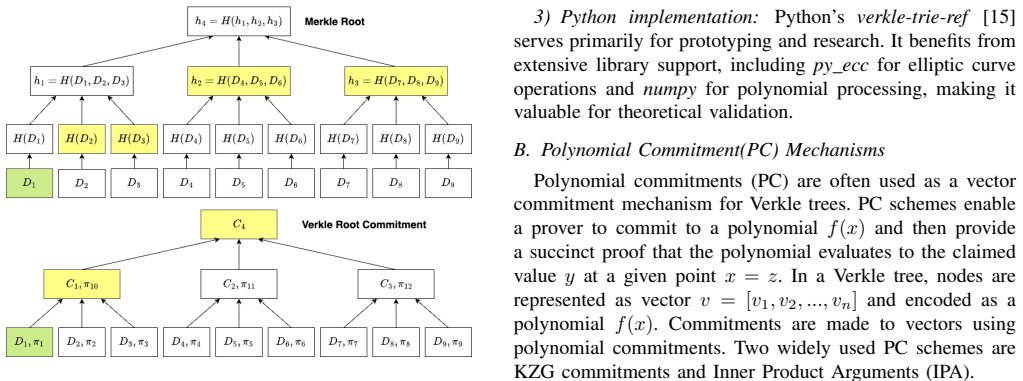
Verkle tree structure that merges Merkle-tree branching with vector commitments, realized in a TypeScript library and verified on-chain via Solidity.
If this is right
- Verkle trees require targeted optimizations to realize any cost advantage over Merkle trees in practice.
- On-chain verification of Verkle proofs is feasible using standard Solidity contracts.
- TypeScript-native libraries can integrate Verkle trees into web3 backend workflows.
- Performance data from basic implementations should guide choices about scaling storage and proofs in decentralized ledgers.
Where Pith is reading between the lines
- Developers may need to prioritize optimization research before Verkle trees can deliver the efficiency gains long anticipated.
- Fair head-to-head benchmarks at matched optimization levels would clarify when Verkle trees become preferable.
- Wider availability of such libraries could speed empirical testing across different blockchain platforms.
- The cost findings may apply to other hybrid commitment schemes that combine tree structures with vector commitments.
Load-bearing premise
The authors' unoptimized Verkle implementation represents the typical cost behavior of Verkle trees and the Merkle baseline was built at a similar level of optimization.
What would settle it
A side-by-side gas-cost or execution-time measurement of an advanced-optimized Verkle verifier against an equivalently optimized Merkle verifier inside a live blockchain environment.
Figures


read the original abstract
Blockchain systems face significant scalability challenges due to growing data volumes and increasing transaction demands, necessitating more efficient data structures and verification mechanisms. Verkle trees, a novel data structure combining the efficiency of Merkle trees with the compactness of vector commitments, have gained attention for their potential to optimize blockchain storage and improve scalability. However, their practical implementation, especially at the smart contract level, has remained unexplored. To address these challenges, we present TS-verkle, the first known TypeScript-native implementation of Verkle trees designed for web3 backend compatibility, coupled with a corresponding on-chain verifier written in Solidity. Our work bridges this gap by providing a concrete implementation of Verkle trees and demonstrating their feasibility for on-chain verification. While previous literature suggests Verkle trees should outperform Merkle trees due to their succinct proof size, our empirical evaluation reveals that basic implementations of Verkle trees actually incur higher costs than Merkle trees without advanced optimization techniques. This finding represents a crucial insight for blockchain developers and researchers considering Verkle tree adoption. The paper discusses implementation strategies and performance characteristics while exploring implications for scaling and data availability in decentralized blockchain systems.
Editorial analysis
A structured set of objections, weighed in public.
Referee Report
Summary. The manuscript introduces TS-Verkle, presented as the first TypeScript-native Verkle tree library for web3 backend compatibility, together with a corresponding Solidity on-chain verifier. It supplies implementation strategies and reports an empirical evaluation whose central finding is that basic (unoptimized) Verkle implementations incur higher costs than Merkle trees, contrary to expectations based on succinct proof size.
Significance. If the performance comparison can be substantiated with complete, reproducible experimental data, the work would deliver a usable artifact for blockchain developers and a practically relevant counter-example to purely theoretical claims about Verkle-tree advantages. The combination of an off-chain TypeScript library and an on-chain verifier is a concrete strength that supports end-to-end feasibility studies.
major comments (2)
- [Abstract and empirical evaluation] Abstract and empirical evaluation section: the claim that 'basic implementations of Verkle trees actually incur higher costs than Merkle trees without advanced optimization techniques' is presented as a key insight, yet the manuscript provides no benchmark parameters (tree arity, depth, leaf count, commitment-scheme constants), raw gas or timing figures, exclusion criteria, error analysis, benchmark scripts, or side-by-side source for the Merkle baseline. Without these, it is impossible to confirm that the two implementations were developed at comparable optimization levels, which is load-bearing for the central performance conclusion.
- [Implementation and verifier sections] Implementation and verifier sections: the Solidity on-chain verifier is described as part of the contribution, but no gas-cost breakdown, proof-size measurements, or comparison against a Merkle-Patricia trie verifier under identical conditions is supplied, leaving the practical on-chain overhead unquantified.
minor comments (2)
- [Abstract] The abstract refers to 'gas measurements' implicitly through cost comparisons but never states the exact metric (gas, CPU time, or both) or the execution environment; this notation should be clarified in the evaluation section.
- No supplementary material or repository link is mentioned for the benchmark harness or raw data, which would be required for reproducibility of the reported cost comparison.
Simulated Author's Rebuttal
We thank the referee for the constructive feedback on our manuscript. We address each major comment below and will revise the paper to provide the requested details and measurements.
read point-by-point responses
-
Referee: [Abstract and empirical evaluation] Abstract and empirical evaluation section: the claim that 'basic implementations of Verkle trees actually incur higher costs than Merkle trees without advanced optimization techniques' is presented as a key insight, yet the manuscript provides no benchmark parameters (tree arity, depth, leaf count, commitment-scheme constants), raw gas or timing figures, exclusion criteria, error analysis, benchmark scripts, or side-by-side source for the Merkle baseline. Without these, it is impossible to confirm that the two implementations were developed at comparable optimization levels, which is load-bearing for the central performance conclusion.
Authors: We agree that the empirical evaluation lacks the detailed parameters and raw data needed to substantiate the performance comparison. In the revised manuscript we will expand the relevant section to report tree arity, depth, leaf count, commitment-scheme constants, raw gas costs, timing figures, exclusion criteria, error analysis, benchmark scripts, and a description of the Merkle baseline implementation. These additions will allow independent verification that both implementations were developed at comparable optimization levels. revision: yes
-
Referee: [Implementation and verifier sections] Implementation and verifier sections: the Solidity on-chain verifier is described as part of the contribution, but no gas-cost breakdown, proof-size measurements, or comparison against a Merkle-Patricia trie verifier under identical conditions is supplied, leaving the practical on-chain overhead unquantified.
Authors: We acknowledge that the implementation and verifier sections currently omit quantitative gas-cost breakdowns, proof-size measurements, and a direct comparison to a Merkle-Patricia trie verifier. We will revise these sections to include the missing measurements and a side-by-side evaluation under identical conditions so that the on-chain overhead is fully quantified. revision: yes
Circularity Check
No circularity: implementation and empirical measurement paper
full rationale
The paper describes a TypeScript-native Verkle tree library and Solidity on-chain verifier, followed by direct empirical cost comparisons against Merkle trees. No equations, derivations, fitted parameters, or predictions appear in the provided text. The central empirical claim rests on side-by-side measurements rather than any self-referential construction, self-citation chain, or renaming of prior results. This matches the default case of a self-contained implementation study with no load-bearing circular steps.
Axiom & Free-Parameter Ledger
axioms (1)
- standard math Standard cryptographic assumptions underlying vector commitments and Merkle/Verkle tree security
Reference graph
Works this paper leans on
-
[1]
A digital signature based on a conventional encryption function,
R. C. Merkle, “A digital signature based on a conventional encryption function,” inConference on the theory and application of cryptographic techniques. Springer, 1987, pp. 369–378
work page 1987
-
[2]
Merkle signature schemes, merkle trees and their cryptanal- ysis,
G. Becker, “Merkle signature schemes, merkle trees and their cryptanal- ysis,”Ruhr-University Bochum, Tech. Rep, vol. 12, p. 19, 2008
work page 2008
-
[3]
Review and investigation of merkle tree’s technical principles and related application fields,
S. Jing, X. Zheng, and Z. Chen, “Review and investigation of merkle tree’s technical principles and related application fields,” in2021 Inter- national Conference on Artificial Intelligence, Big Data and Algorithms (CAIBDA), 2021, pp. 86–90
work page 2021
-
[4]
Merkle tree: A fundamental component of blockchains,
H. Liu, X. Luo, H. Liu, and X. Xia, “Merkle tree: A fundamental component of blockchains,” in2021 International Conference on Elec- tronic Information Engineering and Computer Science (EIECS), 2021, pp. 556–561
work page 2021
-
[5]
Optimal trade-off for merkle tree traversal,
P. Berman, M. Karpinski, and Y . Nekrich, “Optimal trade-off for merkle tree traversal,”Theoretical Computer Science, vol. 372, no. 1, pp. 26–36, 2007
work page 2007
-
[6]
Optimization of merkle tree structures: A focus on subtree implementation,
P. Ayyalasomayajula and M. Ramkumar, “Optimization of merkle tree structures: A focus on subtree implementation,” in2023 International Conference on Cyber-Enabled Distributed Computing and Knowledge Discovery (CyberC), 2023, pp. 59–67
work page 2023
-
[7]
Optimizing merkle proof size for blockchain transactions,
A. Mizrahi, N. Koren, and O. Rottenstreich, “Optimizing merkle proof size for blockchain transactions,” in2021 International Conference on COMmunication Systems & NETworkS (COMSNETS), 2021, pp. 299– 307
work page 2021
- [8]
-
[9]
A post-quantum digital signature using verkle trees and lattices
M. Iavich, T. Kuchukhidze, and R. Bocu, “A post-quantum digital signature using verkle trees and lattices.”Symmetry (20738994), vol. 15, no. 12, 2023
work page 2023
-
[10]
A file verification scheme based on verkle trees,
K.-W. Lin and Y .-C. Chen, “A file verification scheme based on verkle trees,” in2023 International Conference on Consumer Electronics - Taiwan (ICCE-Taiwan), 2023, pp. 295–296
work page 2023
-
[11]
Minimizing block in- centive volatility through verkle tree-based dynamic transaction storage,
X. Zhao, G. Zhang, H.-W. Long, and Y .-W. Si, “Minimizing block in- centive volatility through verkle tree-based dynamic transaction storage,” Decision Support Systems, vol. 180, p. 114180, 2024
work page 2024
-
[12]
Distributed systems log protection from cyberattacks by verkle trees,
V . Boiko, N. Vasilenko, and V . Slatvinska, “Distributed systems log protection from cyberattacks by verkle trees,” inInternational Scientific- Practical Conference” Information Technology for Education, Science and Technics”. Springer, 2024, pp. 221–234
work page 2024
-
[13]
C. Crypto, “rust-verkle,” 2024. [Online]. Available: https://github.com/crate-crypto/rust-verkle
work page 2024
-
[14]
ethereum, “go-verkle,” 2024. [Online]. Available: https://github.com/ethereum/go-verkle?tab=readme-ov-file
work page 2024
-
[15]
C. Crypto, “verkle-trie-ref,” 2022. [Online]. Avail- able: https://github.com/crate-crypto/verkle-trie-ref?tab=readme-ov- file#terminology
work page 2022
-
[16]
Constant-size commitments to polynomials and their applications,
A. Kate, G. M. Zaverucha, and I. Goldberg, “Constant-size commitments to polynomials and their applications,” inAdvances in Cryptology- ASIACRYPT 2010: 16th International Conference on the Theory and Application of Cryptology and Information Security, Singapore, Decem- ber 5-9, 2010. Proceedings 16. Springer, 2010, pp. 177–194
work page 2010
-
[17]
K. Jie, “libkzg,” 2020. [Online]. Available: https://github.com/weijiekoh/libkzg
work page 2020
-
[18]
Efficient zero- knowledge arguments for arithmetic circuits in the discrete log setting,
J. Bootle, A. Cerulli, P. Chaidos, J. Groth, and C. Petit, “Efficient zero- knowledge arguments for arithmetic circuits in the discrete log setting,” inAdvances in Cryptology–EUROCRYPT 2016: 35th Annual Interna- tional Conference on the Theory and Applications of Cryptographic Techniques, Vienna, Austria, May 8-12, 2016, Proceedings, Part II 35. Springer,...
work page 2016
-
[19]
Adaptive merkle trees for enhanced blockchain scal- ability,
O. Kuznetsov, D. Kanonik, A. Rusnak, A. Yezhov, O. Domin, and K. Kuznetsova, “Adaptive merkle trees for enhanced blockchain scal- ability,”Internet of Things, vol. 27, p. 101315, 2024
work page 2024
discussion (0)
Sign in with ORCID, Apple, or X to comment. Anyone can read and Pith papers without signing in.