Recognition: no theorem link
On Composite Adaptive Continuous Finite-Time Control of a class of Euler-Lagrange systems
Pith reviewed 2026-05-12 01:04 UTC · model grok-4.3
The pith
Composite adaptive controllers based on DREM achieve finite-time regulation for Euler-Lagrange systems with uncertain potential energy.
A machine-rendered reading of the paper's core claim, the machinery that carries it, and where it could break.
Core claim
Several composite adaptive controllers, each built from a PD-based nonlinear feedback term and a finite-time parameter estimation law derived via the DREM technique, achieve finite-time regulation to a desired constant set-point for Euler-Lagrange systems whose potential energy parameters are uncertain but confined to a known compact set. The closed-loop trajectories are shown to satisfy finite-time stability of the origin for the state and parameter errors under the standard structural properties of the inertia and Coriolis matrices.
What carries the argument
The Dynamic Regressor Extension and Mixing (DREM) technique, which converts the original vector regressor into a scalar equation whose persistent excitation enables a finite-time parameter update law without invoking the conventional Slotine-Li adaptive structure.
Load-bearing premise
The extended regressor generated by the DREM procedure must be persistently exciting, which requires the uncertain potential-energy parameters to lie inside a known compact set and the system motion to satisfy a suitable richness condition.
What would settle it
A simulation or experiment in which the closed-loop position error starting from a nonzero initial condition fails to reach and remain at zero after a finite, explicitly bounded time would disprove the finite-time regulation claim.
Figures


read the original abstract
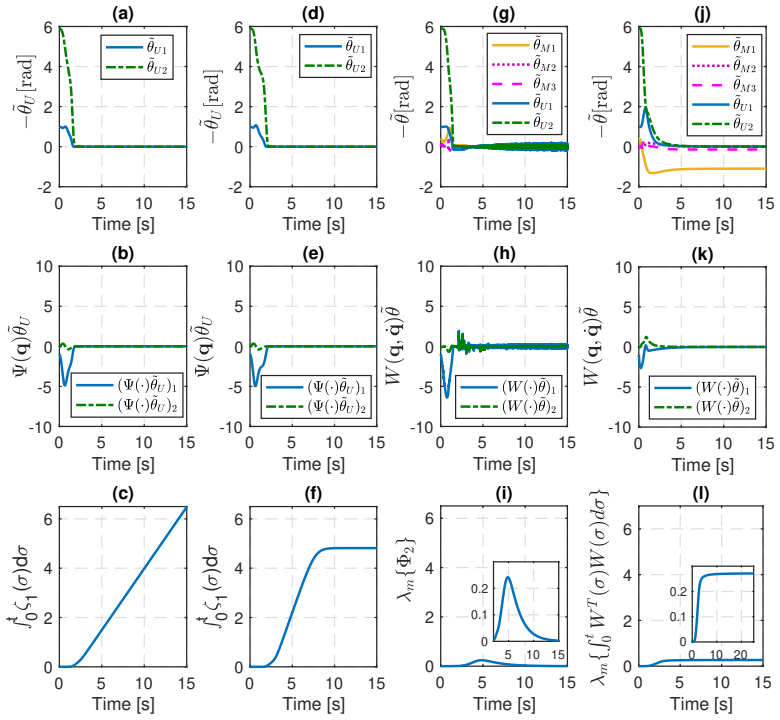
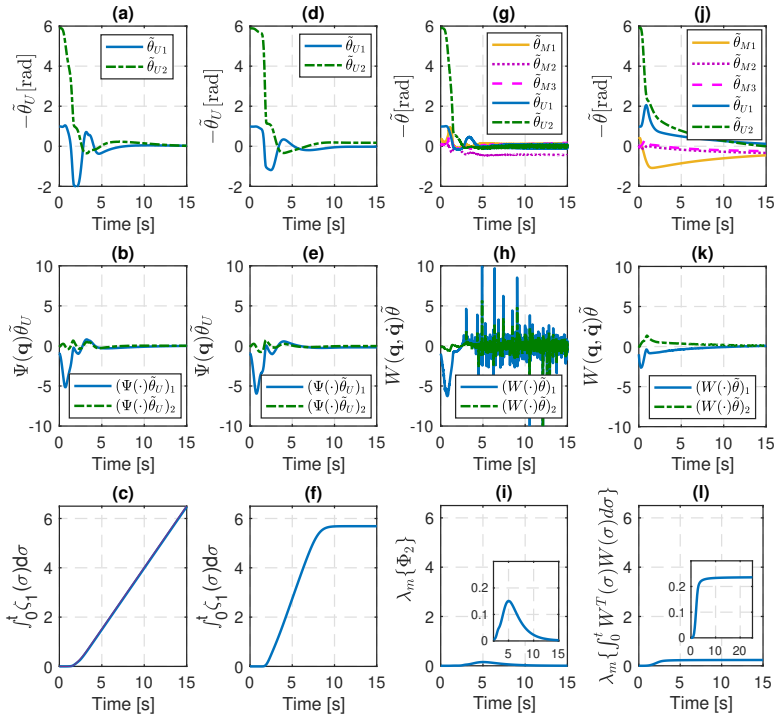
In this paper, we propose several set-point control schemes for achieving finite-time regulation in a class of Euler--Lagrange systems with $n$ degrees of freedom and uncertain potential energy. The proposed controllers are based on composite adaptive control approaches. Each control scheme consists of two main components: a Proportional--Derivative (PD)-based nonlinear feedback term and a finite-time parameter estimation law. The estimation laws rely on the Dynamic Regressor Extension and Mixing (DREM) technique, which can be designed using either the Kreisselmeier or the least-squares dynamic regressor extensions. These results extend recent advances in finite-time adaptive control for Euler-Lagrange systems. To the best of the authors' knowledge, the composite adaptive control formulation proposed here, which does not employ well-known Slotine and Li adaptive control structure, has not been studied in detail yet. The properties of the proposed controllers are rigorously analyzed using Lyapunov methods. The performance of the controllers is thoroughly evaluated through extensive simulation studies.
Editorial analysis
A structured set of objections, weighed in public.
Referee Report
Summary. The manuscript proposes several composite adaptive control schemes for finite-time set-point regulation of n-DOF Euler-Lagrange systems with uncertain potential energy. Each scheme combines a PD-based nonlinear feedback term with a finite-time parameter estimation law based on the Dynamic Regressor Extension and Mixing (DREM) technique, using either Kreisselmeier or least-squares dynamic regressor extensions. The properties are rigorously analyzed using Lyapunov methods, and performance is evaluated through extensive simulation studies. The work claims novelty in avoiding the standard Slotine-Li adaptive structure.
Significance. If the finite-time regulation claims hold, this would represent a useful extension of adaptive finite-time control methods to Euler-Lagrange systems by employing composite DREM-based estimators. The rigorous Lyapunov analysis and extensive simulations are strengths that support the contribution, particularly the avoidance of the Slotine-Li parameterization.
major comments (2)
- [Stability analysis (Section 4)] The central finite-time regulation result relies on DREM delivering finite-time parameter convergence, which in turn requires the mixed regressor to satisfy a rank condition (e.g., det(∫ΩΩᵀ dτ) bounded away from zero after finite time). However, under set-point regulation the position q(t) converges to the constant q_d, so the potential-energy regressor Y(q) approaches the constant Y(q_d) and the filtered DREM signals become linearly dependent, violating the excitation condition in the closed loop. This issue is load-bearing for the finite-time claim and is not addressed in the stability analysis.
- [Controller design and main results (Section 3)] The abstract and introduction assert finite-time regulation via the composite laws, but the Lyapunov analysis only appears to establish asymptotic stability under the standard EL properties (positive-definite bounded inertia, skew-symmetry of Coriolis, compact parameter set). No additional closed-loop persistence-of-excitation guarantee or modification (e.g., probing signal) is provided to recover the finite-time DREM property once the state has converged.
minor comments (2)
- [Abstract] The abstract states that the controllers 'do not employ well-known Slotine and Li adaptive control structure' but does not explicitly contrast the proposed composite laws with that structure or cite the relevant prior DREM finite-time results.
- [Preliminaries] Notation for the filtered regressor signals and the mixing matrix in the DREM extensions could be introduced with a short self-contained summary equation block for readers who may not have the cited DREM references at hand.
Simulated Author's Rebuttal
We are grateful to the referee for the thorough review and valuable feedback on our manuscript. The comments highlight important aspects of the stability analysis and the precise conditions for finite-time convergence. We address each major comment below and indicate the revisions we plan to make.
read point-by-point responses
-
Referee: [Stability analysis (Section 4)] The central finite-time regulation result relies on DREM delivering finite-time parameter convergence, which in turn requires the mixed regressor to satisfy a rank condition (e.g., det(∫ΩΩᵀ dτ) bounded away from zero after finite time). However, under set-point regulation the position q(t) converges to the constant q_d, so the potential-energy regressor Y(q) approaches the constant Y(q_d) and the filtered DREM signals become linearly dependent, violating the excitation condition in the closed loop. This issue is load-bearing for the finite-time claim and is not addressed in the stability analysis.
Authors: We agree with the referee that the finite-time parameter convergence via DREM depends on the mixed regressor satisfying the rank condition det(∫ΩΩ^T dτ) > 0 after some finite time. In the closed-loop set-point regulation, as q(t) → q_d, Y(q) → Y(q_d), which is constant, and thus the signals may lose excitation. Our current analysis uses a Lyapunov function that proves asymptotic stability of the equilibrium, but the finite-time aspect is inherited from the DREM estimator assuming the condition. This point was not explicitly discussed in Section 4. We will revise the stability analysis section to include a remark acknowledging this potential loss of excitation in the limit and clarify that the finite-time convergence of parameters occurs if the excitation condition is met during the transient phase. If the condition fails, the convergence reverts to asymptotic. This revision will be made to accurately reflect the properties. revision: yes
-
Referee: [Controller design and main results (Section 3)] The abstract and introduction assert finite-time regulation via the composite laws, but the Lyapunov analysis only appears to establish asymptotic stability under the standard EL properties (positive-definite bounded inertia, skew-symmetry of Coriolis, compact parameter set). No additional closed-loop persistence-of-excitation guarantee or modification (e.g., probing signal) is provided to recover the finite-time DREM property once the state has converged.
Authors: The referee is correct that the abstract and introduction claim finite-time regulation, while the Lyapunov analysis in the paper establishes asymptotic stability using the standard properties of Euler-Lagrange systems. The finite-time property is tied to the DREM-based estimator. We did not provide a closed-loop persistence-of-excitation guarantee or introduce a probing signal, as the goal was to avoid additional modifications to the standard PD feedback. We will revise the abstract, introduction, and main results section to more carefully state the conditions under which finite-time regulation is achieved, specifically noting the reliance on the DREM rank condition and the absence of a guaranteed closed-loop PE. This will prevent overstatement of the results. revision: yes
Circularity Check
No circularity: derivations rely on standard external Lyapunov and DREM techniques
full rationale
The paper applies composite adaptive laws via DREM (Kreisselmeier or LS extensions) plus PD feedback and analyzes closed-loop stability with Lyapunov methods under standard EL structural properties and compact parameter sets. No equation reduces the finite-time regulation claim to a fitted input, self-definition, or self-citation chain; the DREM regressor excitation is treated as an assumption imported from prior literature rather than constructed inside the paper. The claim of extending recent advances is a standard citation, not load-bearing for the central result. The derivation chain remains self-contained against external benchmarks.
Axiom & Free-Parameter Ledger
axioms (2)
- domain assumption The inertia matrix is symmetric, positive definite, and bounded; the Coriolis matrix satisfies the skew-symmetry property.
- domain assumption Potential energy parameters belong to a known compact set and the regressor is persistently exciting under the DREM extension.
Reference graph
Works this paper leans on
-
[1]
V. Andrieu, L. Praly, and A. Astolfi. Homogeneous approximation, recursive observer design and output feedback.SIAM Journal of Control and Optimization, 47(4):1814–1850, 2008
work page 2008
-
[2]
M. A. Arteaga. On the exact parameter estimation for robot manipulators without persistence of excitation. IEEE Transactions on Automatic Control, 69(1):410–417, 2024
work page 2024
-
[3]
A. Bacciotti and L. Rosier.Lyapunov functions and stability in control theory. Springer-Verlag, New York, 2nd edition, 2005
work page 2005
-
[4]
S. Basu Roy, S. Bhasin, and I. N. Kar. Composite adaptive control of uncertain Euler-Lagrange systems with parameter convergence without PE condition.Asian Journal of Control, 22(1):1–10, 2020
work page 2020
-
[5]
D. S. Bernstein.Matrix Mathematics: theory, facts, and formulas. Princeton University Press, New Jersey, 2009
work page 2009
- [6]
-
[7]
M. Cai, Z. Xiang, and J. Guo. Adaptive finite-time control for uncertain nonlinear systems with application to mechanical systems.Nonlinear Dynamics, 84(2):943–958, 2016
work page 2016
-
[8]
E. Cruz-Zavala, J. A. Moreno, and A. Lor´ ıa. On adaptive continuous finite-time regulators for euler-lagrange systems.Int. J. Nonlinear and Robust Control, (online) 2025
work page 2025
-
[9]
E. Cruz-Zavala, E. Nu˜ no, and J. A. Moreno. Robust trajectory-tracking in finite-time for robot manipulators using nonlinear proportional-derivative control plus feed-forward compensation.International Journal of Robust and Nonlinear Control, 31(9):3878–3907, 2021
work page 2021
-
[10]
E. Cruz-Zavala, E. Nu˜ no, and J.A. Moreno. Continuous finite-time regulation of Euler-Lagrange systems via energy shaping.International Journal of Control, 93(12):2931–2940, 2020
work page 2020
-
[11]
M. R. Hestenes.Calculus of variations and optimal control theory. JohnWiley & Sons, New York, 1966
work page 1966
-
[12]
Y. Hong, J. Wang, and D. Cheng. Adaptive finite-time control of nonlinear systems with parametric uncer- tainty.IEEE Transactions on Automatic Control, 51(5):858–862, 2006
work page 2006
- [13]
-
[14]
P. Ioannou and J. Sun.Robust adaptive control. Prentice Hall, New Jersey, USA, 1996
work page 1996
-
[15]
R. Kelly. PD control with desired gravity compensation of robotic manipulators: A review.The International Journal of Robotics Research, 16(5):660–672, 1997
work page 1997
-
[16]
M. Korotina, S. Aranovskiy, R. Ushirobira, and A. Vedyakov. On parameter tuning and convergence prop- erties of the DREM procedure. InProc. European Control Conference (ECC), pages 53–58, 2020
work page 2020
-
[17]
G. Kreisselmeier. Adaptive observers with exponential rate of convergence.IEEE Transactions on Automatic Control, 22(1):2–8, 1977
work page 1977
-
[18]
G. Kreisselmeier and G. Rietze-Augst. Richness and excitation on an interval-with application to continuous- time adaptive control.IEEE Transactions on Automatic Control, 35(2):165–171, 1990
work page 1990
-
[19]
A. Lor´ ıa and E. Panteley. Uniform exponential stability of linear time-varying systems: revisited.Systems & Control Letters, 47(1):13–24, 2002
work page 2002
-
[20]
J.A. Moreno. Lyapunov approach for analysis and design of second order sliding mode algorithms. In L. Fridman, J. Moreno, and R. Iriarte, editors,Sliding Modes after the first decade of the 21st Century, LNCIS, 412, pages 113–150. Springer-Verlag, Berlin - Heidelberg, 2011
work page 2011
-
[21]
E. Moulay and W. Perruquetti. Finite time stability conditions for non-autonomous continuous systems.Int. J. Control, 81(5):797–803, 2008. 29
work page 2008
-
[22]
J. Na, M. N. Mahyuddin, G. Herrmann, X. Ren, and P. Barber. Robust adaptive finite-time parame- ter estimation and control for robotic systems.International Journal of Robust and Nonlinear Control, 25(16):3045–3071, 2015
work page 2015
- [23]
-
[24]
R. Ortega, J.G. Romero, and S. Aranovskiy. A new least squares parameter estimator for nonlinear regression equations with relaxed excitation conditions and forgetting factor.Systems & Control Letters, 169:105377, 2022
work page 2022
-
[25]
J.G. Romero and R. Ortega. Two high performance global tracking composite adaptive controllers for fully actuated Euler-Lagrange systems.IFAC-PapersOnLine, 58(6):202–207, 2024
work page 2024
- [26]
-
[27]
J.-J. E. Slotine and W. Li. Composite adaptive control of robot manipulators.Automatica, 25(4):509–519, 1989
work page 1989
- [28]
-
[29]
M. Spong and M. Vidyasagar.Robot Dynamics and Control. John Wiley & Sons, New York, 1989
work page 1989
-
[30]
Z.-Y. Sun, Y. Shao, and C.-C. Chen. Fast finite-time stability and its application in adaptive control of high-order nonlinear system.Automatica, 106:339–348, 2019
work page 2019
-
[31]
Terminal sliding mode control for rigid robots.Automatica, 34(1):51–56, 1998
Y Tang. Terminal sliding mode control for rigid robots.Automatica, 34(1):51–56, 1998
work page 1998
-
[32]
P. Tomei. Adaptive PD control for robot manipulators,.IEEE Trans. on Robotics Automat., 7(4):565–570, 1991
work page 1991
-
[33]
P. Tomei. Adaptive PD controller for robot manipulators.IEEE Transactions on robotics and automation, 7(4):565–570, 1991
work page 1991
-
[34]
M. Van, M. Mavrovouniotis, and S.S. Ge. An adaptive backstepping nonsingular fast terminal sliding mode control for robust fault tolerant control of robot manipulators.IEEE Transactions on Systems, Man, and Cybernetics: Systems, 49(7):1448–1458, 2019
work page 2019
-
[35]
S.T. Venkataraman and S. Gulati. Terminal slider control of robot systems.Journal of Intelligent and Robotic Systems, 5:31–55, 1993
work page 1993
-
[36]
J. Wang, D. Efimov, and A. Bobtsov. On robust parameter estimation in finite-time without persistence of excitation.IEEE Transactions on Automatic Control, 65(5):1731–1738, 2020
work page 2020
-
[37]
Y. Yang, C. Hua, J. Li, and X. Guan. Robust adaptive uniform exact tracking control for uncertain Euler- Lagrange system.International Journal of Control, 90(12):2711–2720, 2017
work page 2017
-
[38]
M. Zhihong, M. O’Day, and X. Yu. A robust adaptive terminal sliding mode control for rigid robotic manipulators.Journal of Intelligent and Robotic Systems, 24:23–41, 1999
work page 1999
-
[39]
K. Zimenko, D. Efimov, and A. Polyakov. On condition for output finite-time stability and adaptive finite- time control scheme. InProc. IEEE Conference on Decision and Control, pages 7099–7103, 2019. 30
work page 2019
discussion (0)
Sign in with ORCID, Apple, or X to comment. Anyone can read and Pith papers without signing in.