Recognition: no theorem link
Time-Controlled Resonances in 2-D Metasurfaces via Equivalent Circuits
Pith reviewed 2026-05-12 02:35 UTC · model grok-4.3
The pith
Time modulation provides dynamic control over resonances in thin 2D metasurfaces using an equivalent circuit model.
A machine-rendered reading of the paper's core claim, the machinery that carries it, and where it could break.
Core claim
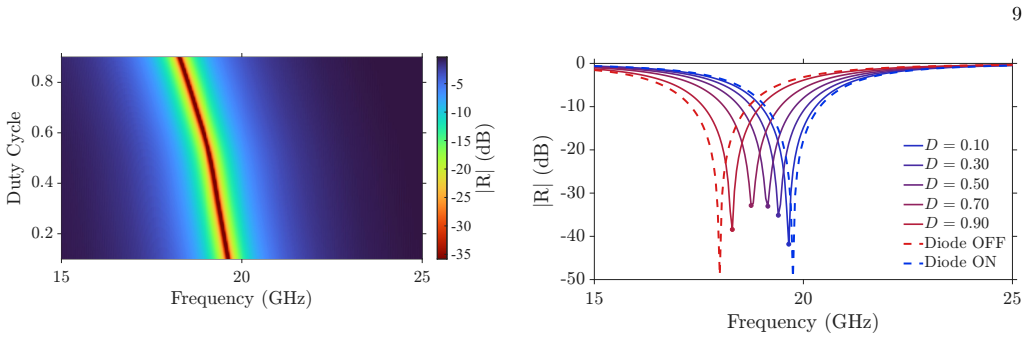
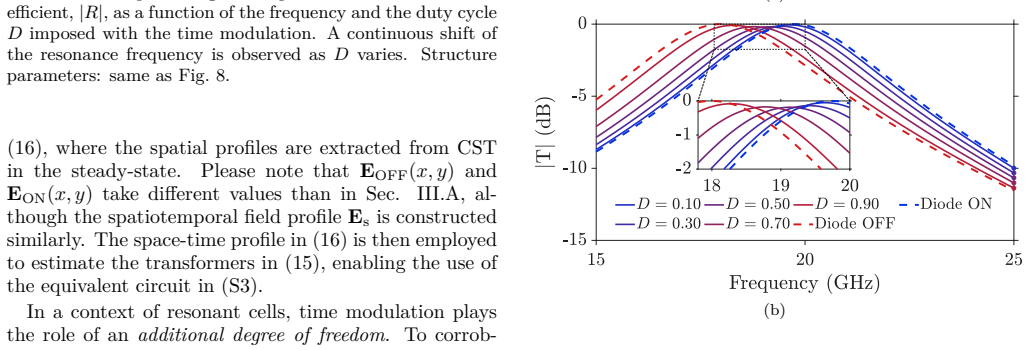
The work shows that space-time periodic metasurfaces controlled by PIN diodes can be modeled with an equivalent circuit obtained after treating the Floquet expansions of the scattered fields. This description provides physical insight into frequency mixing and spatiotemporal scattering, and demonstrates that time acts as an additional design parameter for dynamically tuning resonances in resonant metasurfaces to achieve multi-band and wideband performance from very thin structures.
What carries the argument
Equivalent circuit model derived from Floquet expansions for the scattered fields of a space-time periodic metasurface unit cell modeled as a waveguide discontinuity.
If this is right
- Dynamic tuning of resonances is possible by varying the time-modulation parameters in resonant metasurfaces.
- Multi-band and wideband behaviors become accessible in very thin metasurfaces through temporal coupling.
- The model predicts frequency mixing and other spatiotemporal scattering effects in space-time systems.
- Design of reconfigurable electromagnetic devices is facilitated by the physical insight from the circuit representation.
Where Pith is reading between the lines
- The framework might apply to analyzing time-modulated structures in other contexts like antennas or periodic waveguides.
- Real-time adaptive metasurfaces could use feedback to adjust modulation and maintain desired resonances.
- Validation would require fabricating a prototype and checking if measured responses match the circuit predictions for different modulation rates.
- Time modulation may serve as an alternative to increasing the number of layers or complexity in spatial metasurface designs.
Load-bearing premise
The space-time periodic structure permits a clean reduction of the scattered fields to an equivalent circuit via Floquet expansions without significant unaccounted losses or higher-order effects.
What would settle it
Experimental measurements on a fabricated time-modulated metasurface prototype showing large differences between observed scattering parameters and those predicted by the equivalent circuit model for varying modulation frequencies.
Figures



read the original abstract
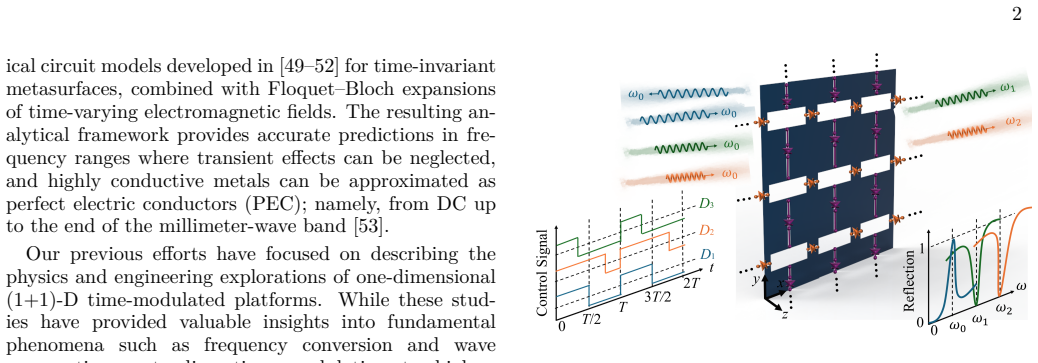
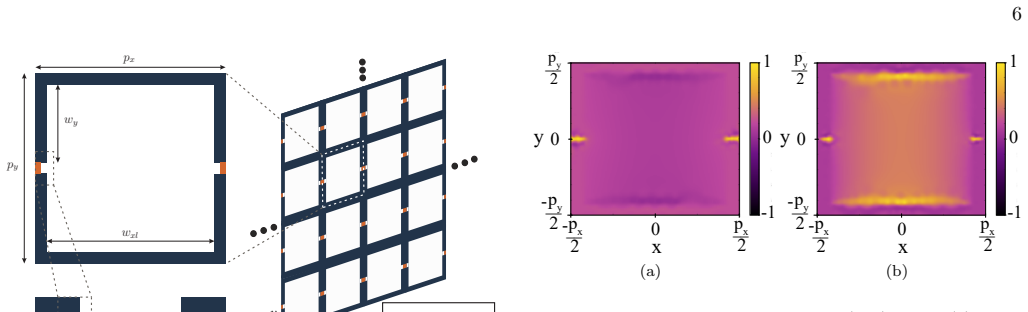
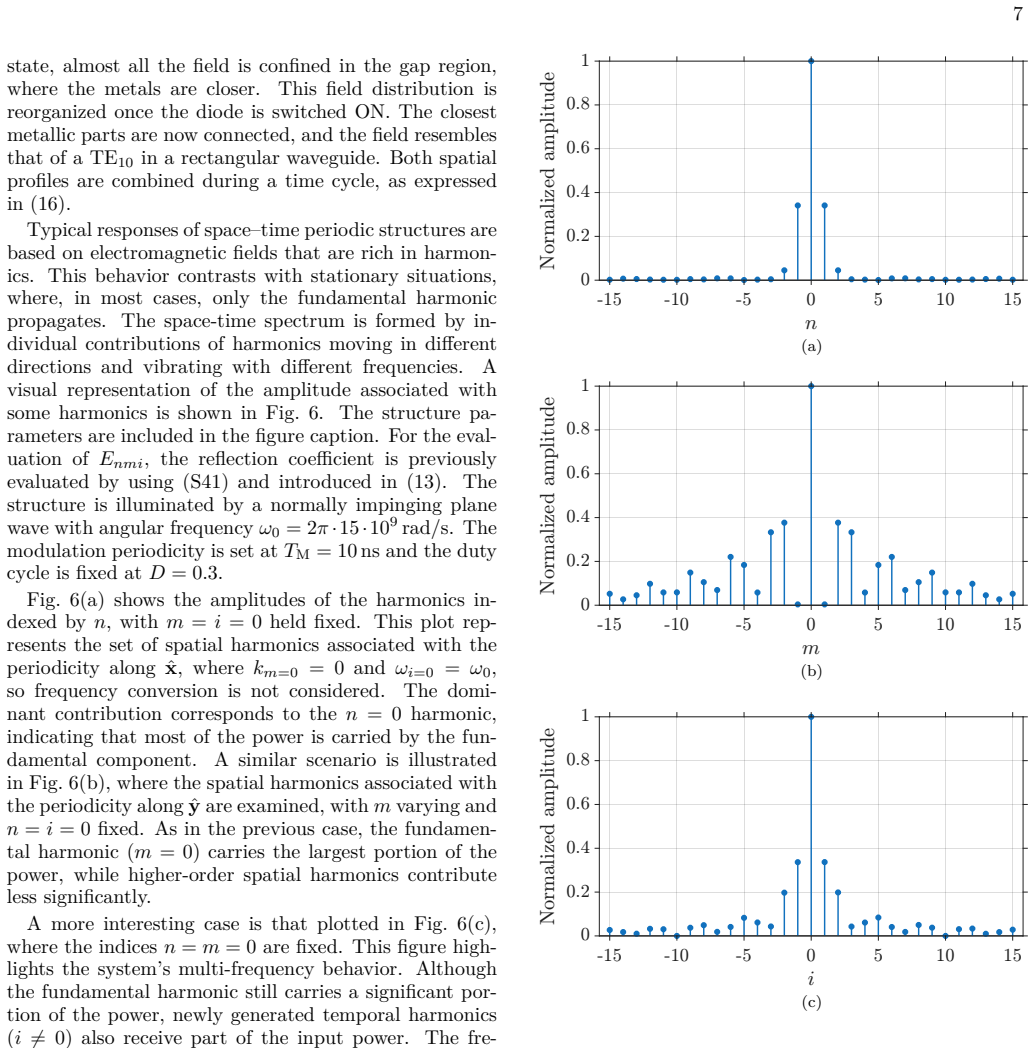
This work introduces a semi-analytical frequency-domain framework for the analysis of two-dimensional, time-modulated (2+1)-D metasurfaces controlled by PIN diodes. The formulation focuses on the unit-cell level, modeled as a waveguide discontinuity problem, where the space-time periodicity of the structure enables the representation of scattered fields via Floquet expansions. After appropriate mathematical treatment, these expansions lead to an equivalent circuit description of the metasurface, providing physical insight into its spatiotemporal scattering behavior and facilitating the design of reconfigurable electromagnetic devices. The model is employed to explore key phenomena present in space-time systems, such as frequency mixing and spatiotemporal scattering. In addition, dynamic tuning is explored in resonant metasurfaces, where time becomes an additional degree of freedom for the design. The dynamic control of resonances opens a new way to explore multi-band and wideband behaviors from very thin metasurfaces under temporal coupling.
Editorial analysis
A structured set of objections, weighed in public.
Referee Report
Summary. The paper presents a semi-analytical frequency-domain framework for modeling 2D time-modulated metasurfaces controlled by PIN diodes. The unit cell is treated as a waveguide discontinuity problem; space-time periodicity allows Floquet expansions of the scattered fields that are reduced to an equivalent-circuit representation. This circuit is then used to analyze frequency mixing, spatiotemporal scattering, and dynamic resonance tuning, with the claim that time modulation provides an additional degree of freedom for achieving multi-band and wideband responses in electrically thin metasurfaces.
Significance. If the Floquet-to-circuit reduction is shown to be accurate and convergent, the approach would supply a computationally efficient design tool that yields physical insight into time-controlled resonances and could accelerate the development of reconfigurable metasurface devices. The emphasis on an equivalent-circuit description is a strength when it remains parameter-light and directly links modulation parameters to observable scattering features.
major comments (3)
- [§3] §3 (Floquet expansion and circuit reduction): The derivation truncates the infinite harmonic sum generated by time modulation. No explicit statement is given of the number of retained harmonics, nor is a convergence study provided against the number of modes or against full-wave time-domain data. In the thin-metasurface regime, evanescent Floquet modes and near-field coupling through the diode nonlinearity are precisely the terms that control resonance shifts and bandwidth; their uncontrolled truncation directly undermines the central claim that the circuit accurately predicts time-controlled multi-band behavior.
- [§4–5] §4–5 (numerical results and dynamic tuning): The reported resonance shifts and multi-band responses are obtained from the equivalent circuit alone. No quantitative comparison (error norms, resonance-frequency deviation, or bandwidth error) is shown against either full-wave simulation or measurement. Without such validation, it is impossible to assess whether the claimed “new way to explore multi-band and wideband behaviors” survives the approximations inherent in the circuit model.
- [Eq. (equivalent-circuit admittance matrix)] Eq. (equivalent-circuit admittance matrix): The mapping from the Floquet-mode voltages/currents to the lumped-element parameters of the PIN-diode model is not accompanied by an error bound or sensitivity analysis with respect to the modulation depth and frequency. Because the diode response is nonlinear (or switched), small changes in retained harmonics can produce large changes in the effective resonance condition; this sensitivity must be quantified for the design claims to be load-bearing.
minor comments (2)
- [Abstract] The abstract states that the model is “employed to explore key phenomena” but supplies no numerical values or figures; the reader must reach the results section to understand the magnitude of the reported resonance shifts.
- [§2] Notation for the time-modulation function (e.g., the periodic switching waveform of the PIN diode) is introduced without an explicit Fourier-series definition or reference to the corresponding equation number.
Simulated Author's Rebuttal
We thank the referee for the constructive and detailed comments, which help improve the rigor of our semi-analytical framework. We address each major point below and will incorporate the suggested clarifications and validations in the revised manuscript.
read point-by-point responses
-
Referee: [§3] §3 (Floquet expansion and circuit reduction): The derivation truncates the infinite harmonic sum generated by time modulation. No explicit statement is given of the number of retained harmonics, nor is a convergence study provided against the number of modes or against full-wave time-domain data. In the thin-metasurface regime, evanescent Floquet modes and near-field coupling through the diode nonlinearity are precisely the terms that control resonance shifts and bandwidth; their uncontrolled truncation directly undermines the central claim that the circuit accurately predicts time-controlled multi-band behavior.
Authors: We agree that explicit truncation details and convergence evidence are required. The original derivation retains a finite number of harmonics for practical computation, but this was not stated. In the revision we will specify the retained harmonics (typically up to the fifth order for the presented cases) and add a dedicated convergence subsection. This will show that resonance frequencies, bandwidths, and scattering parameters stabilize with increasing harmonic count, including verification that evanescent-mode contributions are adequately captured in the thin-metasurface limit. revision: yes
-
Referee: [§4–5] §4–5 (numerical results and dynamic tuning): The reported resonance shifts and multi-band responses are obtained from the equivalent circuit alone. No quantitative comparison (error norms, resonance-frequency deviation, or bandwidth error) is shown against either full-wave simulation or measurement. Without such validation, it is impossible to assess whether the claimed “new way to explore multi-band and wideband behaviors” survives the approximations inherent in the circuit model.
Authors: We acknowledge that quantitative validation against full-wave data is essential to support the design claims. The equivalent-circuit model is obtained from the exact Floquet expansion in the limit of infinite harmonics, yet the manuscript presents only circuit results. In the revised version we will add direct comparisons with full-wave time-domain simulations, reporting error norms, resonance-frequency deviations, and bandwidth errors to quantify the accuracy of the predicted dynamic tuning and multi-band responses. revision: yes
-
Referee: [Eq. (equivalent-circuit admittance matrix)] Eq. (equivalent-circuit admittance matrix): The mapping from the Floquet-mode voltages/currents to the lumped-element parameters of the PIN-diode model is not accompanied by an error bound or sensitivity analysis with respect to the modulation depth and frequency. Because the diode response is nonlinear (or switched), small changes in retained harmonics can produce large changes in the effective resonance condition; this sensitivity must be quantified for the design claims to be load-bearing.
Authors: We concur that sensitivity of the admittance matrix to truncation and modulation parameters should be quantified. The current manuscript does not include such an analysis. In the revision we will add a sensitivity study that examines how the effective resonance conditions and multi-band features vary with the number of retained harmonics and modulation depth/frequency, providing explicit error bounds where feasible. revision: yes
Circularity Check
Standard Floquet-to-circuit reduction with no self-referential inputs
full rationale
The derivation begins from the space-time periodicity of the metasurface, applies Floquet expansions to the waveguide-discontinuity fields, and obtains an equivalent-circuit representation through standard mathematical treatment. This chain relies on established electromagnetic theory rather than any fitted parameter, self-citation load-bearing premise, or ansatz that is later renamed as a prediction. The dynamic resonance control results are applications of the obtained circuit model, not reductions back to the model's own inputs. No quoted step equates a claimed output to a prior fit or self-citation by construction.
Axiom & Free-Parameter Ledger
axioms (1)
- standard math Floquet theorem applies to space-time periodic structures
Reference graph
Works this paper leans on
-
[1]
Presence and Impact of the PIN diode Regarding the PIN diodes and their impact on the field profile, they can be modeled at RF and microwave fre- quencies using the simplified equivalent circuit shown in Fig. 3 [64]. A PIN diode essentially behaves as a switch with two operating states: ON and OFF. In the ON state, the diode is modeled as a series connect...
-
[2]
C. Caloz and Z.-L. Deck-Léger, Spacetime metamaterials—part I: General concepts, IEEE Trans- actions on Antennas and Propagation 68, 1569 (2020)
work page 2020
-
[3]
C. Caloz and Z.-L. Deck-Léger, Spacetime metamaterials—part II: Theory and applications, IEEE Transactions on Antennas and Propagation 68, 1583 (2020)
work page 2020
- [4]
-
[5]
G. Ptitcyn, M. S. Mirmoosa, A. Sotoodehfar, and S. A. Tretyakov, A tutorial on the basics of time-varying elec- tromagnetic systems and circuits: Historic overview and basic concepts of time-modulation, IEEE Antennas and Propagation Magazine 65, 10 (2023)
work page 2023
-
[6]
Engheta, Four-dimensional optics using time-varying metamaterials, Science 379, 1190 (2023)
N. Engheta, Four-dimensional optics using time-varying metamaterials, Science 379, 1190 (2023)
work page 2023
-
[7]
D. Ramaccia, D. L. Sounas, A. Alù, F. Bilotti, and A. Toscano, Nonreciprocity in antenna radiation induced by space-time varying metamaterial cloaks, IEEE Anten- nas and Wireless Propagation Letters 17, 1968 (2018)
work page 1968
-
[8]
Y. Wang, B. Yousefzadeh, H. Chen, H. Nassar, G. Huang, and C. Daraio, Observation of nonreciprocal wave prop- agation in a dynamic phononic lattice, Phys. Rev. Lett. 121, 194301 (2018)
work page 2018
-
[9]
F. R. Prudêncio and M. G. Silveirinha, Synthetic axion response with space-time crystals, Phys. Rev. Appl. 19, 024031 (2023)
work page 2023
-
[10]
A. Alex-Amor, C. Molero, and M. G. Silveirinha, Anal- ysis of metallic space-time gratings using Lorentz trans- formations, Phys. Rev. Appl. 20, 014063 (2023)
work page 2023
-
[11]
T. T. Koutserimpas and R. Fleury, Electromagnetic waves in a time periodic medium with step-varying refractive index, IEEE Transactions on Antennas and Propagation 66, 5300 (2018)
work page 2018
-
[12]
J. B. Pendry, E. Galiffi, and P. A. Huidobro, Gain in time-dependent media—a new mechanism, J. Opt. Soc. Am. B 38, 3360 (2021)
work page 2021
-
[13]
M. Lyubarov, Y. Lumer, A. Dikopoltsev, E. Lustig, Y. Sharabi, and M. Segev, Amplified emission and las- ing in photonic time crystals, Science 377, 425 (2022)
work page 2022
-
[14]
J. Gaxiola-Luna and P. Halevi, Growing fields in a tem- poral photonic (time) crystal with a square profile of the permittivity ε (t), Applied Physics Letters 122 (2023)
work page 2023
-
[15]
J. Feinberg, D. E. Fernandes, B. Shapiro, and M. G. Sil- veirinha, Plasmonic time crystals, Phys. Rev. Lett. 134, 183801 (2025)
work page 2025
-
[16]
Y. Xiao, G. P. Agrawal, and D. N. Maywar, Spectral and temporal changes of optical pulses propagating through time-varying linear media, Opt. Lett. 36, 505 (2011)
work page 2011
-
[17]
K. Yi, M. Collet, and S. Karkar, Frequency conversion induced by time-space modulated media, Phys. Rev. B 96, 104110 (2017)
work page 2017
-
[18]
I. Liberal, J. E. Vázquez-Lozano, and V. Pacheco-Peña, Quantum antireflection temporal coatings: Quantum state frequency shifting and inhibited thermal noise amplification, Laser & Photonics Reviews 17, 2200720 (2023)
work page 2023
-
[19]
V. Pacheco-Peña, M. Fink, and N. Engheta, Temporal chirp, temporal lensing, and temporal routing via space- time interfaces, Phys. Rev. B 111, L100306 (2025)
work page 2025
-
[20]
F. Morgenthaler, Velocity modulation of electromagnetic waves, IRE Transactions on Microwave Theory and Tech- niques 6, 167 (1958)
work page 1958
-
[21]
J.-C. Simon, Action of a progressive disturbance on a guided electromagnetic wave, IRE Transactions on Mi- crowave Theory and Techniques 8, 18 (1960)
work page 1960
-
[22]
E. Cassedy and A. Oliner, Dispersion relations in time- space periodic media: Part I—stable interactions, Pro- ceedings of the IEEE 51, 1342 (1963)
work page 1963
-
[23]
L. Felsen and G. Whitman, Wave propagation in time- varying media, IEEE Transactions on Antennas and Propagation 18, 242 (1970)
work page 1970
-
[24]
R. Fante, Transmission of electromagnetic waves into time-varying media, IEEE Transactions on Antennas and Propagation 19, 417 (1971)
work page 1971
-
[25]
Fante, On the propagation of electromagnetic waves through a time-varying dielectric layer, Appl
R. Fante, On the propagation of electromagnetic waves through a time-varying dielectric layer, Appl. Sci. Res. 27, 341–354 (1973)
work page 1973
-
[26]
A. Kord, D. L. Sounas, and A. Alù, Magnet-less circula- tors based on spatiotemporal modulation of bandstop fil- ters in a delta topology, IEEE Transactions on Microwave Theory and Techniques 66, 911 (2018)
work page 2018
-
[27]
X. Wu, X. Liu, M. D. Hickle, D. Peroulis, J. S. Gómez- Díaz, and A. Á. Melcón, Isolating bandpass filters using time-modulated resonators, IEEE Transactions on Mi- crowave Theory and Techniques 67, 2331 (2019)
work page 2019
- [28]
-
[29]
G.-B. Wu, J. Y. Dai, Q. Cheng, T. J. Cui, and C. H. Chan, Sideband-free space–time-coding metasurface an- tennas, Nature electronics 5, 808 (2022)
work page 2022
-
[30]
Y. Yao, R. Shankar, M. A. Kats, Y. Song, J. Kong, M. Loncar, and F. Capasso, Electrically tunable metasur- face perfect absorbers for ultrathin mid-infrared optical modulators, Nano Letters 14, 6526 (2014)
work page 2014
- [31]
-
[32]
K. Pang and et al. , Adiabatic frequency conversion us- ing a time-varying epsilon-near-zero metasurface, Nano Letters 21, 5907 (2021)
work page 2021
- [33]
-
[34]
H. Wu, R. Shao, Z. Xu, J. wu, S. Tan, X. Wang, Z. J. Qi, Q. Cheng, Y. Zheng, Y. Luo, and T. Cui, A programmable metasurface antenna that approaches the wireless information mapping limit, Nature Electronics 8, 179 (2025)
work page 2025
-
[35]
T. R. Jones, A. V. Kildishev, M. Segev, and D. Per- oulis, Time‑reflection of microwaves by a fast opti- cally‑controlled time‑boundary, Nature Communications 15, 6786 (2024)
work page 2024
- [36]
-
[37]
S. Taravati and G. V. Eleftheriades, Generalized space- time-periodic diffraction gratings: Theory and applica- tions, Phys. Rev. Applied 12, 024026 (2019)
work page 2019
-
[38]
V. Tiukuvaara, T. J. Smy, and S. Gupta, Floquet anal- ysis of space-time modulated metasurfaces with Lorentz dispersion, IEEE Transactions on Antennas and Propa- gation 69, 7667 (2021)
work page 2021
-
[39]
A. Alex-Amor, S. Moreno-Rodríguez, P. Padilla, J. F. Valenzuela-Valdés, and C. Molero, Diffraction phenom- ena in time-varying metal-based metasurfaces, Phys. Rev. Appl. 19, 044014 (2023)
work page 2023
-
[40]
S. Moreno-Rodríguez, A. Alex-Amor, P. Padilla, J. F. Valenzuela-Valdés, and C. Molero, Space-time metallic metasurfaces for frequency conversion and beamforming, Phys. Rev. Appl. 21, 064018 (2024). 12
work page 2024
-
[41]
J. R. Zurita-Sánchez, P. Halevi, and J. C. Cervantes- González, Reflection and transmission of a wave incident on a slab with a time-periodic dielectric function ε(t), Phys. Rev. A 79, 053821 (2009)
work page 2009
-
[42]
S. Moreno-Rodríguez, A. Alex-Amor, P. Padilla, J. F. Valenzuela-Valdés, and C. Molero, Time-periodic metal- lic metamaterials defined by floquet circuits, IEEE Access 11, 116665 (2023)
work page 2023
-
[43]
D. Ramaccia, A. Alù, A. Toscano, and F. Bilotti, Tempo- ral multilayer structures for designing higher-order trans- fer functions using time-varying metamaterials, Applied Physics Letters 118, 101901 (2021)
work page 2021
-
[44]
G. Castaldi, V. Pacheco-Peña, M. Moccia, N. Engheta, and V. Galdi, Exploiting space-time duality in the syn- thesis of impedance transformers via temporal metama- terials, Nanophotonics 10, 3687 (2021)
work page 2021
- [45]
-
[46]
Y. Vahabzadeh, N. Chamanara, and C. Caloz, General- ized sheet transition condition FDTD simulation of meta- surface, IEEE Transactions on Antennas and Propaga- tion 66, 271 (2018)
work page 2018
-
[47]
S. A. Stewart, T. J. Smy, and S. Gupta, Finite-difference time-domain modeling of space–time-modulated meta- surfaces, IEEE Transactions on Antennas and Propaga- tion 66, 281 (2018)
work page 2018
-
[48]
P. H. Zapata Cano, S. Amanatiadis, Z. D. Zaharis, T. V. Yioultsis, P. I. Lazaridis, and N. V. Kantartzis, Robust FDTD modeling of graphene-based conductive materi- als with transient features for advanced antenna applica- tions, Nanomaterials 13 (2023)
work page 2023
-
[49]
S. Taravati, A. A. Kishk, and G. V. Eleftheriades, Finite- difference time-domain simulation of wave propagation in space-time-varying media: Derivation of schemes, ex- tended framework, and illustrative examples, IEEE An- tennas and Propagation Magazine , 2 (2025)
work page 2025
-
[50]
F. Mesa, R. Rodriguez-Berral, and F. Medina, Unlocking complexity using the ECA: The equivalent circuit model as an efficient and physically insightful tool for microwave engineering, IEEE Microwave Magazine 19, 44 (2018)
work page 2018
-
[51]
R. Rodriguez-Berral, F. Mesa, and F. Medina, Analyti- cal multimodal network approach for 2-D arrays of pla- nar patches/apertures embedded in a layered medium, IEEE Transactions on Antennas and Propagation 63, 1969 (2015)
work page 1969
-
[52]
A. Alex-Amor, S. Moreno-Rodríguez, P. Padilla, J. F. Valenzuela-Valdés, and C. Molero, Analytical equivalent circuits for three-dimensional metamaterials and meta- gratings, Phys. Rev. Appl. 20, 044010 (2023)
work page 2023
-
[53]
M. Pérez-Escribano, S. Moreno-Rodríguez, C. Molero, J. F. Valenzuela-Valdés, P. Padilla, and A. Alex-Amor, Analytical framework to model reconfigurable metasur- faces including lumped elements, IEEE Transactions on Circuits and Systems II: Express Briefs 71, 1784 (2024)
work page 2024
-
[54]
P. H. Zapata-Cano, S. Moreno-Rodríguez, S. Amana- tiadis, A. Alex-Amor, Z. D. Zaharis, and C. Molero, Transient states to control the electromagnetic response of space-time dispersive media, Phys. Rev. B 110, 235125 (2024)
work page 2024
- [55]
-
[56]
R. Rodríguez-Berral, F. Mesa, and F. Medina, Analyti- cal multimodal network approach for 2-D arrays of pla- nar patches/apertures embedded in a layered medium, IEEE Transactions on Antennas and Propagation 63, 1969 (2015)
work page 1969
-
[57]
G. Floquet, Sur les équations différentielles linéaires à coefficients périodiques, Annales scientifiques de l’École Normale Supérieure 2, 12, 47 (1883)
-
[58]
S. Moreno-Rodríguez, A. Alex-Amor, P. Padilla, J. F. Valenzuela-Valdés, and C. Molero, Analytical circuit models: From purely spatial to space-time structures, in 2024 18th European Conference on Antennas and Prop- agation (EuCAP) (2024) pp. 1–5
work page 2024
-
[59]
S. Rengarajan, Choice of basis functions for accurate characterization of infinite array of microstrip reflectar- ray elements, IEEE Antennas and Wireless Propagation Letters 4, 47 (2005)
work page 2005
-
[60]
P. Rodríguez-Ulibarri, M. Navarro-Cía, R. Rodríguez- Berral, F. Mesa, F. Medina, and M. Beruete, Annu- lar apertures in metallic screens as extraordinary trans- mission and frequency selective surface structures, IEEE Transactions on Microwave Theory and Techniques 65, 4933 (2017)
work page 2017
-
[61]
F. Mesa, R. Rodríguez-Berral, M. García-Vigueras, F. Medina, and J. R. Mosig, Simplified modal expan- sion to analyze frequency-selective surfaces: An equiv- alent circuit approach, IEEE Transactions on Antennas and Propagation 64, 1106 (2016)
work page 2016
-
[62]
F. Mesa, R. Rodríguez-Berral, M. García-Vigueras, and F. Medina, Efficient hybrid full-wave/circuital approach for stacks of frequency selective surfaces, IEEE Antennas and Wireless Propagation Letters 17, 1925 (2018)
work page 1925
-
[63]
C. Molero and M. García-Vigueras, Circuit modeling of 3-D cells to design versatile full-metal polarizers, IEEE Transactions on Microwave Theory and Techniques 67, 1357 (2019)
work page 2019
-
[64]
A. Alex-Amor, F. Mesa, A. Palomares-Caballero, C. Molero, and P. Padilla, Exploring the potential of the multi-modal equivalent circuit approach for stacks of 2- D aperture arrays, IEEE Transactions on Antennas and Propagation 69, 6453 (2021)
work page 2021
-
[65]
Pérez-Escribano, Ángel Palomares-Caballero, P
M. Pérez-Escribano, Ángel Palomares-Caballero, P. Padilla, J. F. Valenzuela-Valdés, and E. Márquez- Segura, Broadband parasitic modeling of diodes in the millimeter-wave band, AEU - International Journal of Electronics and Communications 177, 155216 (2024)
work page 2024
-
[66]
MACOM Technology Solutions Inc., MA4AGP907 and MA4AGFCP910 AlGaAs Flip‑Chip PIN Diodes Datasheet (2025), revision V5
work page 2025
-
[67]
X. Wan, Q. Xiao, Y. Z. Zhang, Y. Li, J. Eisenbeis, J. W. Wang, Z. A. Huang, H. X. Liu, T. Zwick, and T. J. Cui, Reconfigurable sum and difference beams based on a binary programmable metasurface, IEEE Antennas and Wireless Propagation Letters 20, 381 (2021)
work page 2021
-
[68]
A. Palomares-Caballero, M. Pérez-Escribano, C. Molero, P. Padilla, M. García-Vigueras, and R. Gillard, Broad- band 1-bit reconfigurable intelligent surface at millimeter waves: Overcoming pin-diode degradation with slotline ring topology, IEEE Transactions on Antennas and Prop- agation , 1 (2025)
work page 2025
- [69]
-
[70]
S. Moreno-Rodríguez, A. Alex-Amor, M. Pérez- Escribano, J. F. Valenzuela-Valdés, P. Padilla, and C. Molero, Overcoming the passivity bounds in commu- nications systems with spacetime modulations, in 2025 19th European Conference on Antennas and Propagation (EuCAP) (2025) pp. 1–5
work page 2025
-
[71]
B. A. Munk, Frequency Selective Surfaces: Theory and Design (John Wiley & Sons, Inc., 2000)
work page 2000
- [72]
-
[73]
M. Q. Cui, Tie Jun Qi, X. Wan, J. Zhao, and Q. Cheng, Coding metamaterials, digital metamaterials, and pro- grammable metamaterials, Light: Science and Applica- tions 3 (2014). 1 Supplementary Material Time-Controlled Resonances in 2-D Metasurfaces via Equivalent Circuits J. Rafael Sánchez Martínez ∗, Mario Pérez-Escribano †, Antonio Alex-Amor ‡, Juan F. ...
work page 2014
discussion (0)
Sign in with ORCID, Apple, or X to comment. Anyone can read and Pith papers without signing in.