Recognition: 1 theorem link
· Lean TheoremThe Stellar Abundances and Galactic Evolution Survey (SAGES). V. The First Data Release of the DDO51 Band
Pith reviewed 2026-05-12 02:16 UTC · model grok-4.3
The pith
The SAGES survey's first DDO51-band data release covers 2500 square degrees and separates late-type dwarf and giant stars via surface-gravity sensitivity.
A machine-rendered reading of the paper's core claim, the machinery that carries it, and where it could break.
Core claim
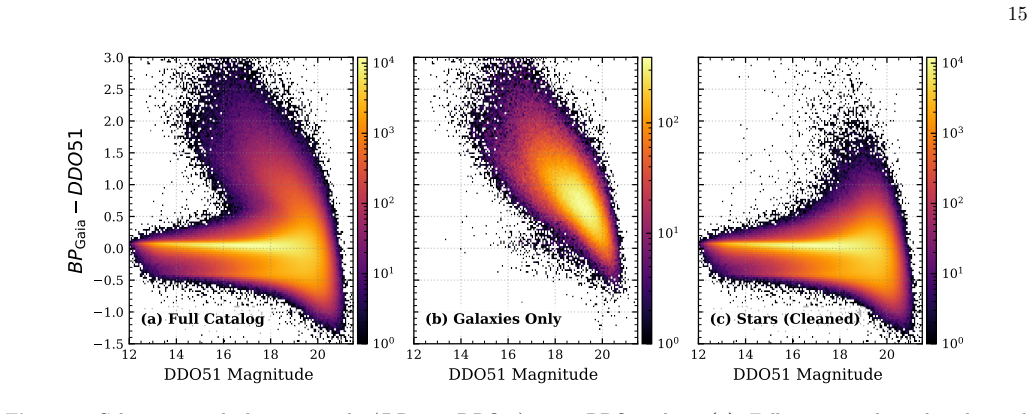
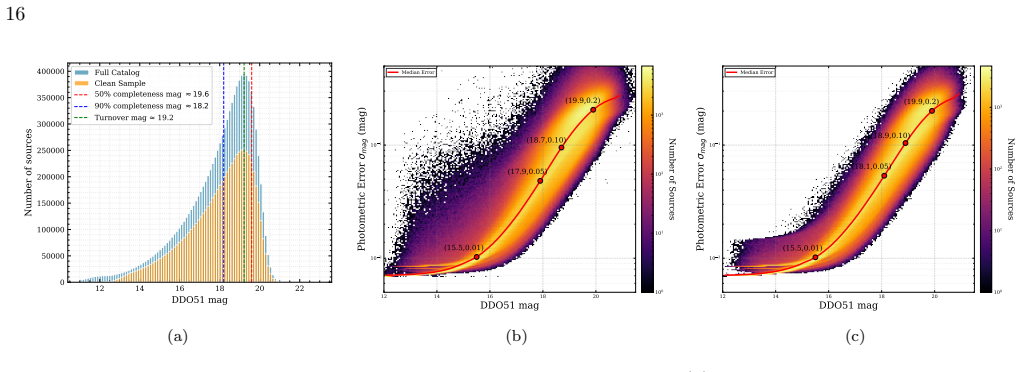
This paper presents the first public data release of the DDO51 band from the SAGES survey, covering approximately 2500 square degrees with over 10 million sources and achieving a point-source depth of ~18.9 mag at S/N~10 with internal photometric precision of 6-7 mmag. The DDO51 filter, centered near the Mg I b triplet and MgH feature, is shown through preliminary color-color diagrams with Gaia photometry to produce a clear photometric separation between dwarf and giant sequences for late-type stars, thereby confirming its sensitivity to stellar surface gravity.
What carries the argument
The DDO51 filter centered near the Mg I b triplet and adjacent MgH feature, which supplies photometric sensitivity to stellar surface gravity and enables dwarf-giant separation in color-color space.
If this is right
- The new DDO51 photometry, when combined with the survey's existing bands, supplies a tool for disentangling Milky Way substructures.
- The dataset enables photometric identification of late-type dwarfs and giants across a wide northern-sky area.
- Public availability of the catalog supports immediate use in studies of stellar populations and galactic evolution.
Where Pith is reading between the lines
- Combining these DDO51 measurements with Gaia astrometry could refine photometric distances for faint late-type stars without spectroscopy.
- The demonstrated separation suggests the band may help isolate metal-poor halo stars from disk populations in future wide-field analyses.
- Extending the same filter to southern-sky telescopes would create an all-sky gravity-sensitive photometric layer.
Load-bearing premise
The photometric calibration that ties DDO51 magnitudes to synthetic photometry from Gaia XP spectra introduces no large systematic offsets capable of erasing the reported dwarf-giant separation.
What would settle it
An independent set of DDO51 observations that shows either no dwarf-giant split in color-color space or large systematic differences from the Gaia-XP-based synthetic magnitudes.
Figures




read the original abstract
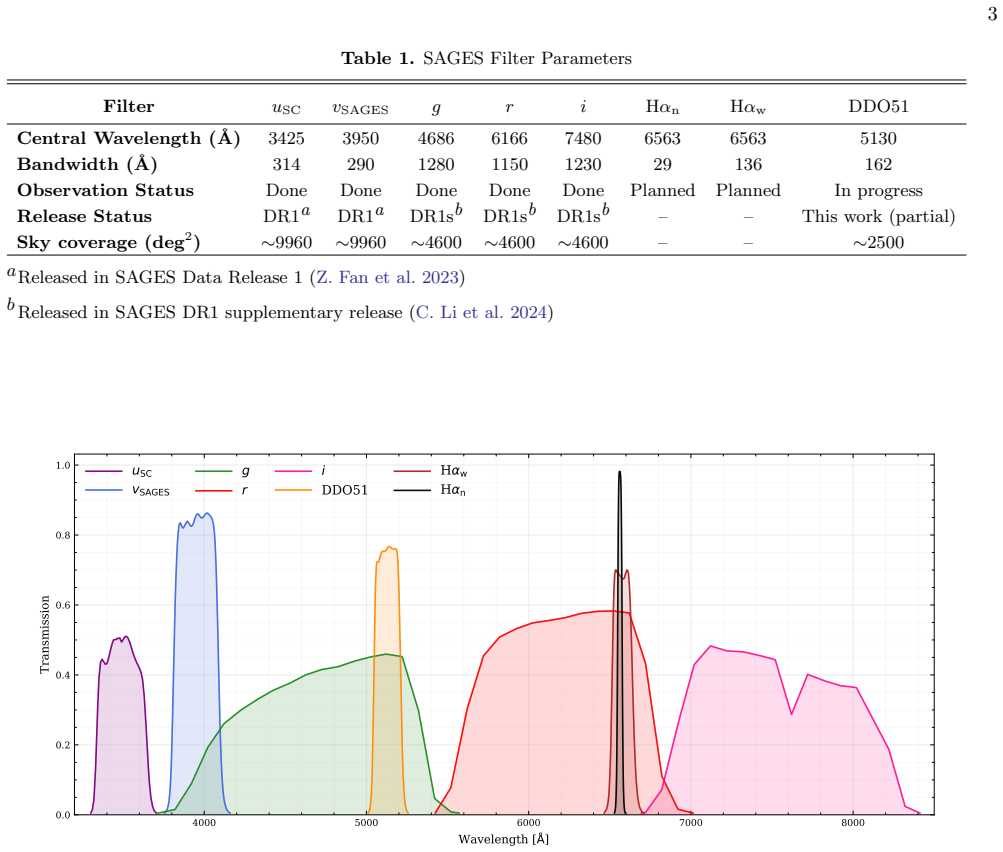
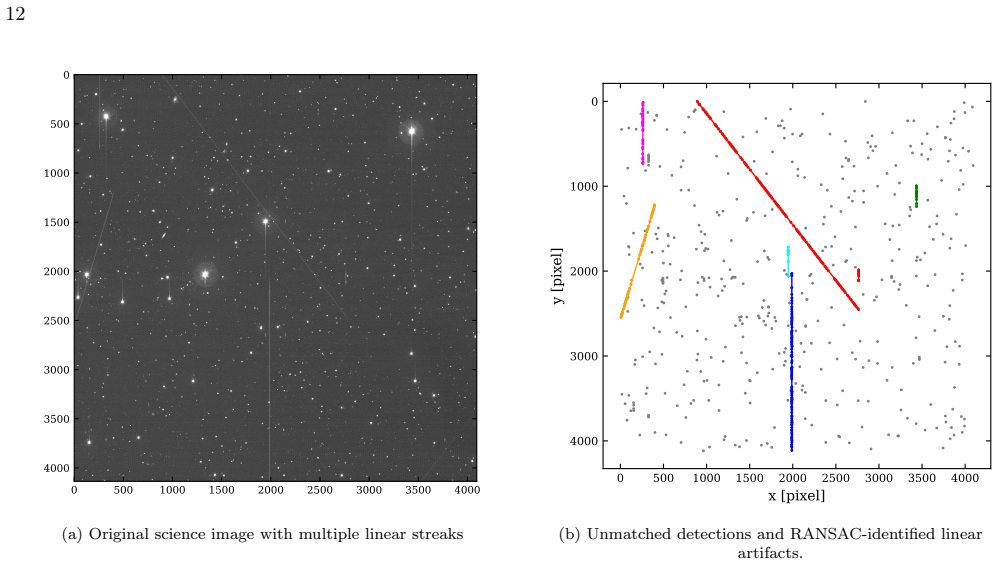
We present the first public data release of DDO51 band from the Stellar Abundances and Galactic Evolution Survey (SAGES), based on Nanshan One-meter Wide-field Telescope (NOWT) observations obtained between 2023 September and 2024 January. This release initiates the DDO51-band component of the survey, covering $\sim$ 2,500 deg$^2$ of the northern sky and including more than 10 million sources. The DDO51 filter is centered near the \ion{Mg}{1}~$b$ triplet and the adjacent MgH feature, offering sensitivity to stellar surface gravity. The data reduction pipeline incorporates an improved astrometric solution anchored to Gaia DR3 and a photometric calibration strategy tied to synthetic photometry from Gaia XP spectra. These procedures yield a point-source depth of $\sim$18.9 mag at S/N$\sim$10 and an internal photometric precision $\approx$6-7 mmag at the bright end. A preliminary color--color analysis using Gaia broadband photometry confirms the expected sensitivity of the DDO51 band to stellar surface gravity, demonstrating a clear photometric separation between dwarf and giant sequences for late-type stars. This dataset, when combined with existing SAGES photometry in other bands, provides a crucial tool for disentangling the substructures of the Milky Way. All data products from this release upon publication will be available.
Editorial analysis
A structured set of objections, weighed in public.
Referee Report
Summary. The paper presents the first data release of the DDO51 band photometry from the SAGES survey. Based on observations with the Nanshan One-meter Wide-field Telescope from September 2023 to January 2024, it covers about 2500 square degrees of the northern sky with over 10 million sources. The pipeline uses Gaia DR3 for astrometry and synthetic photometry from Gaia XP spectra for calibration, achieving a depth of 18.9 mag and precision of 6-7 mmag. A preliminary color-color analysis demonstrates the DDO51 band's sensitivity to surface gravity through separation of dwarf and giant sequences in late-type stars.
Significance. This data release offers a large photometric catalog with gravity-sensitive measurements that can aid in dissecting the Milky Way's stellar populations and substructures when integrated with other SAGES data. The public availability enhances its value for the astronomical community. The initial validation of the filter's utility supports its use in future galactic evolution studies.
major comments (2)
- [Data reduction pipeline] The photometric calibration tied to synthetic photometry from Gaia XP spectra (described in the data reduction pipeline) may suffer from systematic offsets because XP spectra have insufficient resolution to accurately model the narrow DDO51 filter transmission centered on the Mg I b triplet and MgH feature. The paper provides no quantitative tests, such as magnitude residuals versus independent DDO51 observations or versus spectroscopic log g, to show that these offsets do not affect the claimed separation in the color-color diagram.
- [Preliminary color-color analysis] The abstract reports a clear photometric separation between dwarf and giant sequences, but lacks supporting details including the size of the separation, the stellar sample size, or any statistical measures. Furthermore, no completeness or purity metrics are given for the separation, which is important for assessing its robustness.
minor comments (1)
- [Abstract] The internal photometric precision is given as ≈6-7 mmag; clarifying whether this is the rms or median error and over what magnitude range would improve precision.
Simulated Author's Rebuttal
We thank the referee for the constructive and detailed review of our manuscript on the first DDO51 data release from the SAGES survey. We have carefully considered the major comments and provide point-by-point responses below, outlining specific revisions that will be incorporated to address the concerns raised.
read point-by-point responses
-
Referee: The photometric calibration tied to synthetic photometry from Gaia XP spectra (described in the data reduction pipeline) may suffer from systematic offsets because XP spectra have insufficient resolution to accurately model the narrow DDO51 filter transmission centered on the Mg I b triplet and MgH feature. The paper provides no quantitative tests, such as magnitude residuals versus independent DDO51 observations or versus spectroscopic log g, to show that these offsets do not affect the claimed separation in the color-color diagram.
Authors: We acknowledge that the limited spectral resolution of Gaia XP spectra could introduce systematic uncertainties when generating synthetic DDO51 photometry for the narrow filter. In the revised manuscript, we will add quantitative validation by cross-matching a subset of our sources with spectroscopic catalogs (e.g., LAMOST or APOGEE) to examine DDO51 magnitude residuals as a function of spectroscopic log g. We will also report any trends or offsets observed and discuss their potential impact on the dwarf-giant separation. This will provide the requested evidence that calibration systematics do not undermine the preliminary results. revision: yes
-
Referee: The abstract reports a clear photometric separation between dwarf and giant sequences, but lacks supporting details including the size of the separation, the stellar sample size, or any statistical measures. Furthermore, no completeness or purity metrics are given for the separation, which is important for assessing its robustness.
Authors: We agree that the abstract and the preliminary color-color analysis section would benefit from additional quantitative details. In the revision, we will expand this section to specify the sample size (number of late-type stars selected via Gaia colors), the typical separation between dwarf and giant sequences in the relevant color index (e.g., in magnitudes), and basic statistical measures such as the standard deviation within each sequence. We will further include estimates of completeness and purity for the separation, derived from cross-matching with spectroscopic surveys for a representative subsample. revision: yes
Circularity Check
No circularity: empirical calibration and separation rest on external Gaia references
full rationale
The paper is a data-release description whose central demonstration is an empirical color-color diagram showing dwarf/giant separation in DDO51 vs. Gaia colors. The photometric zero-points and color terms are derived from synthetic photometry on external Gaia XP spectra and positions; the separation is then measured directly in the calibrated data against independent Gaia broadband photometry. No equations, fitted parameters, or self-citations are invoked to define the separation in terms of itself, nor is any internal model prediction reduced to the calibration inputs by construction. The chain is therefore self-contained against external benchmarks and receives the default non-circularity finding.
Axiom & Free-Parameter Ledger
axioms (1)
- domain assumption Gaia DR3 positions and XP spectra provide an accurate external reference for astrometry and synthetic photometry.
Lean theorems connected to this paper
-
IndisputableMonolith/Cost/FunctionalEquation.leanwashburn_uniqueness_aczel unclear?
unclearRelation between the paper passage and the cited Recognition theorem.
A preliminary color-color analysis using Gaia broadband photometry confirms the expected sensitivity of the DDO51 band to stellar surface gravity, demonstrating a clear photometric separation between dwarf and giant sequences for late-type stars.
What do these tags mean?
- matches
- The paper's claim is directly supported by a theorem in the formal canon.
- supports
- The theorem supports part of the paper's argument, but the paper may add assumptions or extra steps.
- extends
- The paper goes beyond the formal theorem; the theorem is a base layer rather than the whole result.
- uses
- The paper appears to rely on the theorem as machinery.
- contradicts
- The paper's claim conflicts with a theorem or certificate in the canon.
- unclear
- Pith found a possible connection, but the passage is too broad, indirect, or ambiguous to say the theorem truly supports the claim.
Reference graph
Works this paper leans on
-
[1]
Astropy Collaboration, Robitaille, T. P., Tollerud, E. J., et al. 2013, A&A, 558, A33, doi: 10.1051/0004-6361/201322068 Astropy Collaboration, Price-Whelan, A. M., Sip˝ ocz, B. M., et al. 2018, AJ, 156, 123, doi: 10.3847/1538-3881/aabc4f Astropy Collaboration, Price-Whelan, A. M., Lim, P. L., et al. 2022, ApJ, 935, 167, doi: 10.3847/1538-4357/ac7c74
-
[2]
2020, Research in Astronomy and Astrophysics, 20, 211 21
Bai, C.-H., Feng, G.-J., Zhang, X., et al. 2020, Research in Astronomy and Astrophysics, 20, 211 21
work page 2020
-
[3]
Beaton, R. L., Oelkers, R. J., Hayes, C. R., et al. 2021, The Astronomical Journal, 162, 302
work page 2021
-
[4]
2006, in Astronomical Data Analysis Software and Systems XV, Vol
Bertin, E. 2006, in Astronomical Data Analysis Software and Systems XV, Vol. 351, 112
work page 2006
-
[5]
1996, Astronomy and astrophysics supplement series, 117, 393
Bertin, E., & Arnouts, S. 1996, Astronomy and astrophysics supplement series, 117, 393
work page 1996
-
[6]
Bessell, M. S. 2005, Annu. Rev. Astron. Astrophys., 43, 293
work page 2005
-
[7]
Brown, A., et al. 2024, PyGaia: Python toolkit for Gaia science performance simulation and astrometric catalogue data manipulation., https://github.com/agabrown/PyGaia
work page 2024
-
[8]
Casagrande, L., & VandenBerg, D. A. 2014, Monthly Notices of the Royal Astronomical Society, 444, 392
work page 2014
-
[9]
Schlaufman, K. C. 2018, Monthly Notices of the Royal Astronomical Society, 478, 2812
work page 2018
-
[10]
e., Moles, M., Crist´ obal-Hornillos, D., et al
Cenarro, A. e., Moles, M., Crist´ obal-Hornillos, D., et al. 2019, Astronomy & Astrophysics, 622, A176
work page 2019
-
[11]
Chambers, K. C., Magnier, E., Metcalfe, N., et al. 2016, arXiv preprint arXiv:1612.05560
work page internal anchor Pith review Pith/arXiv arXiv 2016
-
[12]
Clark, J. P. A., & McClure, R. D. 1979, PASP, 91, 507, doi: 10.1086/130529
-
[13]
2018, Progress In Astronomy, 36, 101
Fan, Z., Zhao, G., Wang, W., et al. 2018, Progress In Astronomy, 36, 101
work page 2018
-
[14]
2023, The Astrophysical Journal Supplement Series, 268, 9
Fan, Z., Zhao, G., Wang, W., et al. 2023, The Astrophysical Journal Supplement Series, 268, 9
work page 2023
-
[15]
Summary of the content and survey properties
Fischler, M. A., & Bolles, R. C. 1981, Communications of the ACM, 24, 381 Gaia Collaboration, Vallenari, A., Brown, A. G. A., et al. 2023a, A&A, 674, A1, doi: 10.1051/0004-6361/202243940 Gaia Collaboration, Montegriffo, P., Bellazzini, M., et al. 2023b, A&A, 674, A33, doi: 10.1051/0004-6361/202243709
-
[16]
1984, Publications of the Astronomical Society of the Pacific, 96, 723
Geisler, D. 1984, Publications of the Astronomical Society of the Pacific, 96, 723
work page 1984
-
[17]
1990, Publications of the Astronomical Society of the Pacific, 102, 344
Geisler, D. 1990, Publications of the Astronomical Society of the Pacific, 102, 344
work page 1990
-
[18]
M., Guhathakurta, P., Beaton, R
Gilbert, K. M., Guhathakurta, P., Beaton, R. L., et al. 2012, The Astrophysical Journal, 760, 76
work page 2012
-
[19]
2025, The Astrophysical Journal Supplement Series, 277, 19
Gu, H., Fan, Z., Zhao, G., et al. 2025, The Astrophysical Journal Supplement Series, 277, 19
work page 2025
-
[20]
Hong, J., Beers, T. C., Lee, Y. S., et al. 2024, The Astrophysical Journal Supplement Series, 273, 12
work page 2024
- [21]
-
[22]
2024, The Astrophysical Journal Supplement Series, 271, 13
Huang, B., Yuan, H., Xiang, M., et al. 2024, The Astrophysical Journal Supplement Series, 271, 13
work page 2024
-
[23]
Huang, Y., Beers, T. C., Yuan, H., et al. 2023, The Astrophysical Journal, 957, 65 Ivezi´ c,ˇZ., Beers, T. C., & Juri´ c, M. 2012, Annual Review of Astronomy and Astrophysics, 50, 251 Ivezi´ c,ˇZ., Sesar, B., Juri´ c, M., et al. 2008, The Astrophysical Journal, 684, 287
work page 2023
- [24]
-
[25]
W., Mierle, K., Blanton, M., & Roweis, S
Lang, D., Hogg, D. W., Mierle, K., Blanton, M., & Roweis, S. 2010, The astronomical journal, 139, 1782
work page 2010
-
[26]
2024, arXiv preprint arXiv:2410.10218
Li, C., Fan, Z., Zhao, G., et al. 2024, arXiv preprint arXiv:2410.10218
-
[27]
Majewski, S. R., Nidever, D. L., Munoz, R. R., et al. 2008, Proceedings of the International Astronomical Union, 4, 51
work page 2008
-
[28]
Patterson, R. J. 2000, The Astronomical Journal, 120, 2550
work page 2000
-
[29]
Mink, D. J. 2002, in Astronomical Data Analysis Software and Systems XI, Vol. 281, 169
work page 2002
-
[30]
Morrison, H. L., Olszewski, E. W., Mateo, M., et al. 2001, The Astronomical Journal, 121, 283
work page 2001
-
[31]
Nidever, D. L., Majewski, S. R., Munoz, R. R., et al. 2011, The Astrophysical Journal Letters, 733, L10 ¨Ohman, Y. 1936, Stockholms Observatoriums Annaler, vol. 12, pp. 3.1-3.13, 12, 3
work page 2011
-
[32]
2025, arXiv preprint arXiv:2509.10883
Perryman, M. 2025, arXiv preprint arXiv:2509.10883
- [33]
-
[34]
2021, Progress in Astronomy, 39, 118
Shan, X.-m., Zhong, J., Zhang, Y., et al. 2021, Progress in Astronomy, 39, 118
work page 2021
-
[35]
Teig, M. J. 2007, PhD thesis, University of California, Irvine
work page 2007
-
[36]
1939, Monthly Notices of the Royal Astronomical Society, Vol
Thackeray, A. 1939, Monthly Notices of the Royal Astronomical Society, Vol. 99, p. 492, 99, 492
work page 1939
-
[37]
Tollerud, E. J., Beaton, R. L., Geha, M. C., et al. 2012, The Astrophysical Journal, 752, 45
work page 2012
- [38]
-
[39]
2013, Proceedings of the International Astronomical Union, 9, 326
Wang, W., Zhao, G., Chen, Y., & Liu, Y. 2013, Proceedings of the International Astronomical Union, 9, 326
work page 2013
-
[40]
G., Adelman, J., Anderson Jr, J
York, D. G., Adelman, J., Anderson Jr, J. E., et al. 2000, The Astronomical Journal, 120, 1579
work page 2000
-
[41]
2015, The Astrophysical Journal, 799, 133 22
Yuan, H., Liu, X., Xiang, M., et al. 2015, The Astrophysical Journal, 799, 133 22
work page 2015
-
[42]
Zasowski, G., Johnson, J. A., Frinchaboy, P., et al. 2013, The Astronomical Journal, 146, 81
work page 2013
-
[43]
2025, The Astrophysical Journal, 993, 170
Zhang, Q., Fan, Z., Zhao, G., et al. 2025, The Astrophysical Journal, 993, 170
work page 2025
-
[44]
2024, Progress in Astronomy, 42, 698
ZHENG, J., WANG, W., FAN, Z., LI, C., & ZHAO, G. 2024, Progress in Astronomy, 42, 698
work page 2024
-
[45]
2018, Research in Astronomy and Astrophysics, 18, 147
Zheng, J., Zhao, G., Wang, W., et al. 2018, Research in Astronomy and Astrophysics, 18, 147
work page 2018
-
[46]
2019, Astronomical Research and Technology, 16, 93
Zheng, J., Zhao, G., Wang, W., et al. 2019, Astronomical Research and Technology, 16, 93
work page 2019
discussion (0)
Sign in with ORCID, Apple, or X to comment. Anyone can read and Pith papers without signing in.