Recognition: no theorem link
Deterministic Decomposition of Stochastic Generative Dynamics
Pith reviewed 2026-05-12 02:24 UTC · model grok-4.3
The pith
The deterministic velocity field in stochastic generative processes splits into a transport component and an osmotic component fixed by the marginal score.
A machine-rendered reading of the paper's core claim, the machinery that carries it, and where it could break.
Core claim
The deterministic field b_t of a stochastic generative process admits a natural transport-osmotic decomposition b_t = u_t + d_t, where u_t governs marginal probability transport and d_t captures an osmotic effect induced by diffusion and determined by the marginal score. Based on this decomposition, Bridge Matching learns the decomposed dynamics through marginal and conditional formulations, and recombining as b_t = u_t + λ_d d_t enables interpretable control over the osmotic contribution during sampling.
What carries the argument
The transport-osmotic decomposition b_t = u_t + d_t of the deterministic velocity field, with the osmotic term d_t fixed by the marginal score.
If this is right
- Recombining the learned components as b_t = u_t + λ_d d_t allows adjustable control over the diffusion-induced osmotic effect in generated samples.
- The Bridge Matching framework supports learning via both marginal probability paths and conditional formulations.
- Separating transport from osmotic effects clarifies the distinct contributions of deterministic evolution and stochastic fluctuation.
Where Pith is reading between the lines
- The same split could be applied to analyze probability flows in other stochastic differential equation models outside generative tasks.
- Scaling the osmotic term might provide a practical dial for balancing sample fidelity against diversity in downstream applications.
- Closed-form expressions for u_t and d_t might be derivable for common diffusion schedules, simplifying implementation.
Load-bearing premise
The decomposition b_t = u_t + d_t is natural and unique, with d_t fully determined by the marginal score and recombining via a scalar λ_d producing no new artifacts.
What would settle it
An experiment or derivation showing that the osmotic component cannot be recovered uniquely from the marginal score, or that varying λ_d produces sampling trajectories inconsistent with the original stochastic dynamics.
Figures




read the original abstract
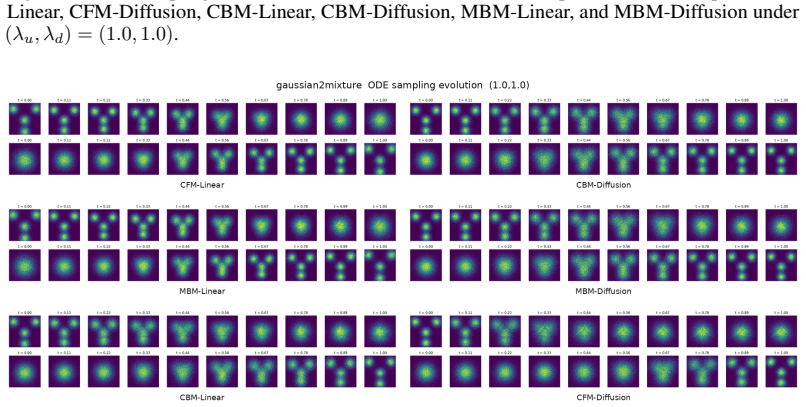
Modern generative models can be understood as probability transport from a simple base distribution to a target data distribution. Deterministic transport models offer tractable velocity-field parameterizations, whereas stochastic generative models capture richer density evolution through drift and diffusion. Yet when stochastic dynamics are described through deterministic velocity fields, the effects of drift and diffusion are often compressed into a single effective field, obscuring the distinct roles of deterministic evolution and stochastic fluctuation. In this work, we show that the deterministic field \(b_t\) of a stochastic generative process admits a natural transport--osmotic decomposition that separates deterministic transport from stochastic, diffusion-induced effects: \(b_t = u_t + d_t\), where \(u_t\) governs marginal probability transport and \(d_t\) captures an osmotic effect induced by diffusion and determined by the marginal score. Based on this decomposition, we propose Bridge Matching, a flow-based framework for learning decomposed generative dynamics through both marginal and conditional formulations. In generative modeling experiments, we recombine the learned components as \(b_t = u_t + \lambda_d d_t\), showing that the proposed decomposition enables interpretable and controllable sampling by adjusting the osmotic contribution in probability transport.
Editorial analysis
A structured set of objections, weighed in public.
Referee Report
Summary. The manuscript claims that the deterministic field b_t of a stochastic generative process admits a natural transport-osmotic decomposition b_t = u_t + d_t, with u_t governing marginal probability transport and d_t the osmotic term fixed by the marginal score. It introduces Bridge Matching, a flow-based learning framework for the decomposed dynamics in marginal and conditional forms, and shows in generative modeling experiments that recombining as b_t = u_t + λ_d d_t enables interpretable and controllable sampling by varying the osmotic contribution.
Significance. If the control via λ_d can be shown to be meaningful while keeping distribution mismatch bounded and quantified, the decomposition could provide a useful lens for separating transport from diffusion effects in generative models and add a controllable knob to sampling. The underlying decomposition itself is a direct and standard consequence of the Fokker-Planck continuity equation, so significance hinges on the Bridge Matching procedure and the empirical demonstration that the control is useful rather than merely artifactual.
major comments (2)
- [Experiments] Experiments section (recombination with λ_d): the claim that b_t = u_t + λ_d d_t yields 'interpretable and controllable sampling' without new artifacts is load-bearing for the utility of the work, yet altering λ_d modifies the effective drift while leaving the diffusion coefficient unchanged; the Fokker-Planck marginal evolution is therefore altered and the generated distribution generally shifts from the target. The manuscript must report quantitative measures of this mismatch (e.g., FID, MMD, or log-likelihood on held-out data) across λ_d values and demonstrate that the observed control remains useful after accounting for the shift.
- [§4] Bridge Matching framework (§4): it is unclear whether the marginal score required to isolate d_t is obtained from an independent estimator or from the same model being trained on the decomposed fields; if the latter, the training procedure risks circularity because the osmotic component depends on a quantity that itself depends on the learned dynamics. The manuscript should provide an explicit training diagram or pseudocode clarifying the information flow and any auxiliary score-matching loss.
minor comments (2)
- [§2] Notation: the symbol σ_t for the diffusion coefficient is introduced without an explicit statement of whether it is time-dependent or constant; this should be fixed in the SDE definition and carried consistently through the decomposition.
- [Abstract / §3] The abstract states the decomposition but supplies no derivation steps; while the full text presumably contains them, a short self-contained derivation in §3 would improve readability.
Simulated Author's Rebuttal
We thank the referee for their constructive comments, which help clarify the contributions and limitations of our work. We address the major comments below, agreeing that additional quantitative analysis and clarification of the training procedure will strengthen the manuscript.
read point-by-point responses
-
Referee: [Experiments] Experiments section (recombination with λ_d): the claim that b_t = u_t + λ_d d_t yields 'interpretable and controllable sampling' without new artifacts is load-bearing for the utility of the work, yet altering λ_d modifies the effective drift while leaving the diffusion coefficient unchanged; the Fokker-Planck marginal evolution is therefore altered and the generated distribution generally shifts from the target. The manuscript must report quantitative measures of this mismatch (e.g., FID, MMD, or log-likelihood on held-out data) across λ_d values and demonstrate that the observed control remains useful after accounting for the shift.
Authors: We acknowledge that varying λ_d alters the drift term and consequently the marginal distribution evolution, resulting in a shift from the target distribution. The manuscript currently presents qualitative demonstrations of controllability through visual inspection of generated samples for different λ_d. To rigorously address this, we will incorporate quantitative metrics such as FID and MMD computed on held-out data for a range of λ_d values. These additions will quantify the distribution mismatch and illustrate the range over which the control via λ_d remains useful before significant degradation occurs. We plan to include a new table or figure in the revised Experiments section discussing these trade-offs. revision: yes
-
Referee: [§4] Bridge Matching framework (§4): it is unclear whether the marginal score required to isolate d_t is obtained from an independent estimator or from the same model being trained on the decomposed fields; if the latter, the training procedure risks circularity because the osmotic component depends on a quantity that itself depends on the learned dynamics. The manuscript should provide an explicit training diagram or pseudocode clarifying the information flow and any auxiliary score-matching loss.
Authors: In the Bridge Matching framework, the marginal score used to compute the osmotic component d_t is obtained from a separate, pre-trained score estimator that is not part of the training loop for the decomposed dynamics. This separation ensures no circularity in the learning process. The training of u_t and d_t proceeds using the fixed score to define d_t, with losses applied in both marginal and conditional settings. To make this explicit, we will add a training diagram and pseudocode to §4 in the revision, outlining the information flow, the role of the auxiliary score-matching loss, and confirming the independence of the score estimator. revision: yes
Circularity Check
No circularity: decomposition is standard FP identity; new framework is independent
full rationale
The claimed transport-osmotic split b_t = u_t + d_t with d_t fixed by the marginal score is an immediate algebraic consequence of the Fokker-Planck continuity equation for any Itô SDE dx = b_t dt + σ dW; the paper simply names the two summands and applies the identity to generative modeling. No equation in the provided text reduces the split to a fitted parameter, a self-citation, or an ansatz imported from the authors' prior work. The Bridge Matching objective and the λ_d recombination experiments are new constructions that operate on top of the identity rather than being definitionally equivalent to it. The derivation chain is therefore self-contained against external stochastic-process benchmarks.
Axiom & Free-Parameter Ledger
free parameters (1)
- lambda_d
axioms (1)
- domain assumption The deterministic field of a stochastic generative process admits a natural transport-osmotic decomposition.
Reference graph
Works this paper leans on
-
[1]
A Downsampled Variant of ImageNet as an Alternative to the CIFAR datasets
Patryk Chrabaszcz, Ilya Loshchilov, and Frank Hutter. A downsampled variant of ImageNet as an alternative to the CIFAR datasets.arXiv preprint arXiv:1707.08819,
-
[2]
Scaling Rectified Flow Transformers for High-Resolution Image Synthesis
Patrick Esser, Sumith Kulal, Andreas Blattmann, Rahim Entezari, Jonas Müller, Harry Saini, Yam Levi, Dominik Lorenz, Axel Sauer, Frederic Boesel, Dustin Podell, Tim Dockhorn, Zion En- glish, Kyle Lacey, Alex Goodwin, Yannik Marek, and Robin Rombach. Scaling rectified flow transformers for high-resolution image synthesis.arXiv preprint arXiv:2403.03206,
work page internal anchor Pith review arXiv
-
[3]
Zach Evans, Julian D. Parker, CJ Carr, Zack Zukowski, Josiah Taylor, and Jordi Pons. Stable audio open.arXiv preprint arXiv:2407.14358,
-
[4]
Han Gao, Sebastian Kaltenbach, and Petros Koumoutsakos
Accessed: 2026-05-06. Han Gao, Sebastian Kaltenbach, and Petros Koumoutsakos. Generative learning for forecasting the dynamics of high-dimensional complex systems.Nature Communications, 15(1):8904,
work page 2026
-
[5]
Mean Flows for One-step Generative Modeling
doi: 10.1038/s41467-024-53165-w. Zhengyang Geng, Mingyang Deng, Xingjian Bai, J. Zico Kolter, and Kaiming He. Mean flows for one-step generative modeling.arXiv preprint arXiv:2505.13447,
work page internal anchor Pith review Pith/arXiv arXiv doi:10.1038/s41467-024-53165-w
-
[6]
Gottwald, Fengyi Li, Youssef Marzouk, and Sebastian Reich
Georg A. Gottwald, Fengyi Li, Youssef Marzouk, and Sebastian Reich. Stable generative modeling using schrödinger bridges.arXiv preprint arXiv:2401.04372,
-
[7]
11 Tero Karras, Miika Aittala, Timo Aila, and Samuli Laine
doi: 10.1016/j.jmva.2025.105486. 11 Tero Karras, Miika Aittala, Timo Aila, and Samuli Laine. Elucidating the design space of diffusion- based generative models. InAdvances in Neural Information Processing Systems,
-
[8]
Yaron Lipman, Marton Havasi, Peter Holderrieth, Neta Shaul, Matt Le, Brian Karrer, Ricky T. Q. Chen, David Lopez-Paz, Heli Ben-Hamu, and Itai Gat. Flow matching guide and code.arXiv preprint arXiv:2412.06264,
work page internal anchor Pith review arXiv
-
[9]
Haohe Liu, Zehua Chen, Yi Yuan, Xinhao Mei, Xubo Liu, Danilo Mandic, Wenwu Wang, and Mark D. Plumbley. AudioLDM: Text-to-audio generation with latent diffusion models. InInternational Conference on Machine Learning, pages 21450–21474, 2023a. Xingchao Liu, Chengyue Gong, and Qiang Liu. Flow straight and fast: Rectified flow. InInternational Conference on L...
-
[10]
Jeongwoo Shin, Jinhwan Sul, Joonseok Lee, Jaewong Choi, and Jaemoo Choi
Accessed: 2026-05-06. Jeongwoo Shin, Jinhwan Sul, Joonseok Lee, Jaewong Choi, and Jaemoo Choi. Efficient generative modeling beyond memoryless diffusion via adjoint schrödinger bridge matching.arXiv preprint arXiv:2602.15396,
-
[11]
Zhicong Tang, Tiankai Hang, Shuyang Gu, Dong Chen, and Baining Guo. Incorporating pre-trained diffusion models in solving the schrödinger bridge problem.arXiv preprint arXiv:2508.18095,
-
[12]
Improving and generalizing flow-based generative models with minibatch optimal transport
Alexander Tong et al. Improving and generalizing flow-based generative models with minibatch optimal transport.arXiv preprint arXiv:2302.00482,
work page internal anchor Pith review arXiv
-
[13]
For all BM variants, we fix λu = 1.0 and vary λd ∈ {0.0,0.5,1.0,1.5} . The dashed horizontal lines indicate the corresponding CFM baselines, while solid curves show the BM variants. G.3 Additional image generation samples We provide additional generated samples from the image-generation experiments. The samples are generated from the final evaluated check...
work page 2024
-
[14]
and the PyTorch Flow Matching implementation of Shihara (2023) as implementation references. These resources provide standard utilities for Flow Matching training, sampling, and evaluation, while our supplementary code adds the proposed Bridge Matching objectives, the transport–osmotic decomposition, and the sampling-time recombination of learned fields. ...
work page 2023
discussion (0)
Sign in with ORCID, Apple, or X to comment. Anyone can read and Pith papers without signing in.