Recognition: 2 theorem links
· Lean TheoremCoLVR: Enhancing Exploratory Latent Visual Reasoning via Contrastive Optimization
Pith reviewed 2026-05-13 07:04 UTC · model grok-4.3
The pith
CoLVR replaces hard alignment losses with contrastive objectives to let latent states explore a wider semantic space during visual reasoning.
A machine-rendered reading of the paper's core claim, the machinery that carries it, and where it could break.
Core claim
CoLVR learns exploratory latent representations by optimizing a contrastive objective that uses angle-based perturbations to expand the semantic latent space, then applies a latent trajectory contrastive reward in RL post-training to encourage diverse reasoning behaviors without forcing matches to predefined visual features.
What carries the argument
Latent contrastive objective with angle-based perturbation plus latent trajectory contrastive reward for RL post-training.
If this is right
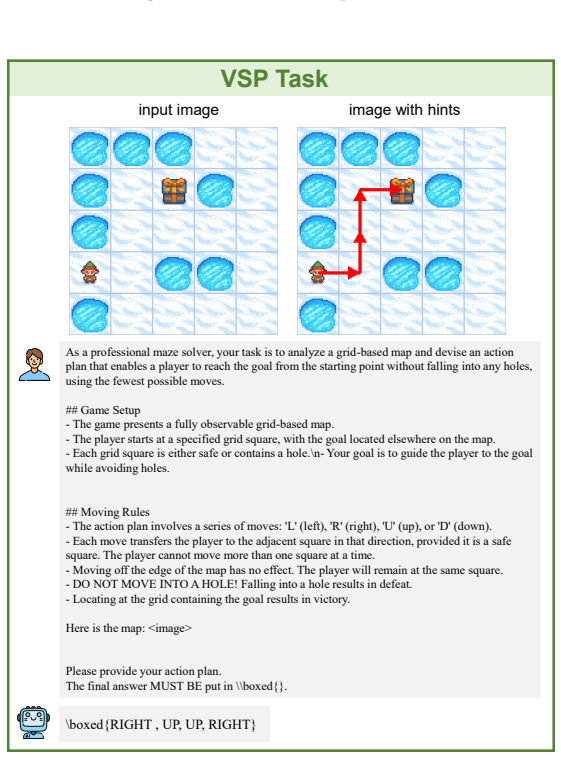
- Latent representations become measurably more diverse, producing 5.83 percent average gains on VSP and 8.00 percent on Jigsaw.
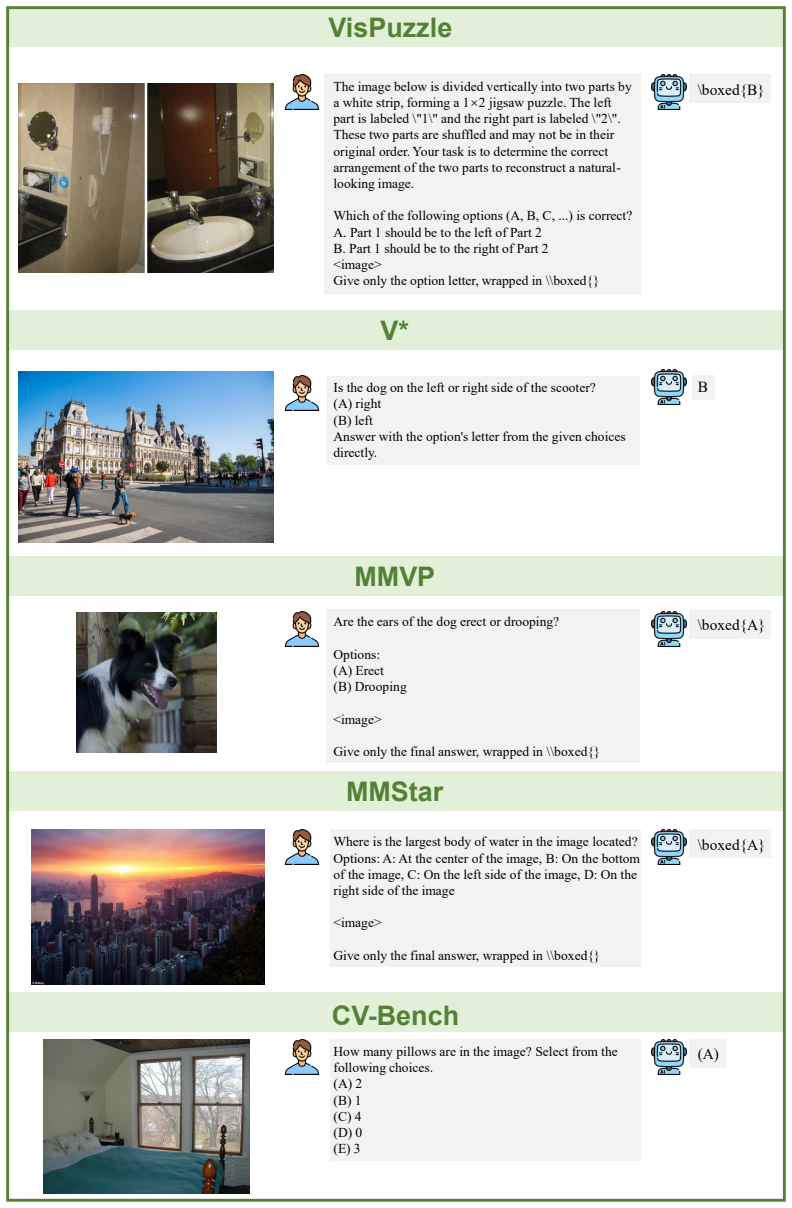
- Out-of-domain generalization improves, shown by a 3.40 percent gain on MMStar.
- Reasoning can stay in continuous latent space longer before any token decoding is required.
- RL post-training can be guided directly by trajectory-level contrastive signals rather than outcome-only rewards.
Where Pith is reading between the lines
- The same contrastive machinery could be tested on other latent-sequence tasks such as long-horizon planning or audio reasoning.
- If angle perturbation proves robust, future models might drop explicit visual-feature alignment stages entirely.
- Diverse latent trajectories may reduce the need for large numbers of sampled reasoning chains at inference time.
Load-bearing premise
Angle-based perturbations and trajectory contrastive rewards will reliably enlarge the useful semantic space and produce diverse behaviors without adding new biases or hurting performance on ordinary tasks.
What would settle it
Training a multimodal model with CoLVR yields no gain or a drop on VSP and Jigsaw relative to the hard-alignment baseline, or produces lower scores on standard visual question answering tasks.
Figures


read the original abstract
Due to the potential for exploratory reasoning of Latent Visual Reasoning, recent works tend to enable MLLMs (Multimodal Large Language Models) to perform visual reasoning by propagating continuous hidden states instead of decoding intermediate steps into discrete tokens. However, existing works typically rely on hard alignment objectives to force latent representations to match predefined visual features, thereby severely limiting the exploratory of latent reasoning process. To address this problem, we propose CoLVR (Contrastive Optimization for Latent Visual Reasoning). To obtain a more exploratory visual reasoning, CoLVR introduces a latent contrastive training framework. Firstly, CoLVR learns diverse and exploratory representations with a latent contrastive objective guided by angle-based perturbation, which expands the semantic latent space and avoids over-constrained embedding. Then, CoLVR employs a latent trajectory contrastive reward for RL (Reinforcement Learning) post-training to enable fine-grained optimization of latent visual reasoning process and thus fostering diverse reasoning behaviors. Experiments demonstrate that CoLVR significantly enhances the exploratory capability of latent representations, achieving average improvements of 5.83% on VSP and 8.00% on Jigsaw, while also outperforming existing latent models on out of domain benchmarks, with a 3.40% gain on MMStar. The data, codes, and models are released at https://github.com/Oscar-dzy/CoLVR.
Editorial analysis
A structured set of objections, weighed in public.
Referee Report
Summary. The manuscript proposes CoLVR, a contrastive optimization framework for latent visual reasoning in MLLMs. It replaces hard alignment objectives with a latent contrastive objective that uses angle-based perturbation to expand the semantic space, followed by a trajectory contrastive reward in RL post-training to promote diverse reasoning trajectories. Experiments report average gains of 5.83% on VSP, 8.00% on Jigsaw, and 3.40% on out-of-domain MMStar relative to prior latent models, with public code and model release.
Significance. If the reported gains prove robust, the approach offers a concrete alternative to over-constrained latent embeddings, potentially improving exploratory capacity in multimodal reasoning without sacrificing standard-task performance. The explicit contrastive objectives and public code release are strengths that support reproducibility and further testing of the exploration hypothesis.
major comments (3)
- [§4.2] §4.2 (latent contrastive objective): the angle-based perturbation is described as expanding the semantic space, but the manuscript does not specify whether the perturbation radius or sampling distribution is held constant across datasets or tuned per model; this leaves open whether the reported VSP/Jigsaw gains are attributable to the contrastive term or to implicit hyperparameter search.
- [Table 3] Table 3 (ablation on RL post-training): removing the trajectory contrastive reward drops performance by only 1.2–1.8 points on two of the three benchmarks; this modest delta weakens the central claim that the RL stage is required to foster diverse reasoning behaviors.
- [§5.3] §5.3 (out-of-domain evaluation): the 3.40% MMStar gain is presented without error bars, without a non-latent baseline, and without a statistical significance test; the improvement cannot yet be distinguished from run-to-run variance.
minor comments (3)
- [Abstract] Abstract, line 3: 'exploratory of latent reasoning process' is grammatically incomplete; rephrase to 'exploratory nature of the latent reasoning process'.
- [§3.1] §3.1: the contrastive loss notation mixes cosine similarity with an unspecified temperature parameter; align the symbols with standard InfoNCE notation for clarity.
- [Figure 2] Figure 2: the trajectory visualization lacks axis labels and a legend distinguishing positive/negative pairs; this reduces interpretability of the claimed diversity gain.
Simulated Author's Rebuttal
We thank the referee for the positive assessment and constructive feedback on our manuscript. We address each of the major comments below and have revised the manuscript accordingly to improve clarity and robustness.
read point-by-point responses
-
Referee: [§4.2] §4.2 (latent contrastive objective): the angle-based perturbation is described as expanding the semantic space, but the manuscript does not specify whether the perturbation radius or sampling distribution is held constant across datasets or tuned per model; this leaves open whether the reported VSP/Jigsaw gains are attributable to the contrastive term or to implicit hyperparameter search.
Authors: We will revise the manuscript to specify that the angle-based perturbation radius and the sampling distribution were held constant across datasets and models. The values were chosen based on preliminary experiments on a held-out validation set and kept fixed for all main experiments to allow fair comparisons. Supporting ablations in Table 2 show that the contrastive objective contributes significantly to the performance gains. revision: yes
-
Referee: [Table 3] Table 3 (ablation on RL post-training): removing the trajectory contrastive reward drops performance by only 1.2–1.8 points on two of the three benchmarks; this modest delta weakens the central claim that the RL stage is required to foster diverse reasoning behaviors.
Authors: The observed drop of 1.2-1.8 points indicates a meaningful contribution from the trajectory contrastive reward, particularly when considering the cumulative effect with the latent contrastive training. We will include additional discussion and metrics on reasoning diversity in the revised manuscript to reinforce the importance of the RL stage for fostering exploratory behaviors. revision: partial
-
Referee: [§5.3] §5.3 (out-of-domain evaluation): the 3.40% MMStar gain is presented without error bars, without a non-latent baseline, and without a statistical significance test; the improvement cannot yet be distinguished from run-to-run variance.
Authors: We agree that error bars, a non-latent baseline, and statistical testing would strengthen the out-of-domain results. We will update §5.3 to include standard deviations from multiple runs, comparisons to non-latent models, and the results of a statistical significance test. revision: yes
Circularity Check
No significant circularity in the derivation chain
full rationale
The CoLVR framework defines its latent contrastive objective (angle-based perturbation) and trajectory contrastive reward explicitly as new training components, then measures resulting exploratory gains on independent external benchmarks (VSP, Jigsaw, MMStar). No equations reduce the reported improvements to fitted parameters or self-referential quantities inside the same loop; the central claims rest on standard contrastive optimization applied to latent states rather than any self-definition, self-citation load-bearing step, or renamed known result. The derivation is therefore self-contained against external evaluation.
Axiom & Free-Parameter Ledger
axioms (2)
- domain assumption Contrastive objectives with angular perturbations expand semantic coverage without over-constraining embeddings
- domain assumption Trajectory-level contrastive rewards in RL produce more diverse reasoning behaviors than standard objectives
Lean theorems connected to this paper
-
IndisputableMonolith/Cost/FunctionalEquation.leanwashburn_uniqueness_aczel unclear?
unclearRelation between the paper passage and the cited Recognition theorem.
CoLVR introduces a latent contrastive training framework... angle-based perturbation... latent trajectory contrastive reward for RL post-training
-
IndisputableMonolith/Foundation/BranchSelection.leanbranch_selection unclear?
unclearRelation between the paper passage and the cited Recognition theorem.
hard alignment objectives... severely limiting the exploratory of latent reasoning process
What do these tags mean?
- matches
- The paper's claim is directly supported by a theorem in the formal canon.
- supports
- The theorem supports part of the paper's argument, but the paper may add assumptions or extra steps.
- extends
- The paper goes beyond the formal theorem; the theorem is a base layer rather than the whole result.
- uses
- The paper appears to rely on the theorem as machinery.
- contradicts
- The paper's claim conflicts with a theorem or certificate in the canon.
- unclear
- Pith found a possible connection, but the passage is too broad, indirect, or ambiguous to say the theorem truly supports the claim.
Reference graph
Works this paper leans on
-
[1]
Qwen2.5-vl technical report, 2025
Shuai Bai, Keqin Chen, Xuejing Liu, Jialin Wang, Wenbin Ge, Sibo Song, Kai Dang, Peng Wang, Shijie Wang, Jun Tang, Humen Zhong, Yuanzhi Zhu, Mingkun Yang, Zhaohai Li, Jianqiang Wan, Pengfei Wang, Wei Ding, Zheren Fu, Yiheng Xu, Jiabo Ye, Xi Zhang, Tianbao Xie, Zesen Cheng, Hang Zhang, Zhibo Yang, Haiyang Xu, and Junyang Lin. Qwen2.5-vl technical report, 2025
work page 2025
-
[2]
Are we on the right way for evaluating large vision-language models?, 2024
Lin Chen, Jinsong Li, Xiaoyi Dong, Pan Zhang, Yuhang Zang, Zehui Chen, Haodong Duan, Jiaqi Wang, Yu Qiao, Dahua Lin, and Feng Zhao. Are we on the right way for evaluating large vision-language models?, 2024
work page 2024
-
[3]
Shuhang Chen, Yunqiu Xu, Junjie Xie, Aojun Lu, Tao Feng, Zeying Huang, Ning Zhang, Yi Sun, Yi Yang, and Hangjie Yuan. Cogflow: Bridging perception and reasoning through knowledge internalization for visual mathematical problem solving, 2026
work page 2026
-
[4]
Internvl: Scaling up vision foundation models and aligning for generic visual-linguistic tasks
Zhe Chen, Jiannan Wu, Wenhai Wang, Weijie Su, Guo Chen, Sen Xing, Muyan Zhong, Qinglong Zhang, Xizhou Zhu, Lewei Lu, et al. Internvl: Scaling up vision foundation models and aligning for generic visual-linguistic tasks. InProceedings of the IEEE/CVF conference on computer vision and pattern recognition, pages 24185–24198, 2024
work page 2024
-
[5]
Geonmo Gu, Byeongho Heo, Jaemyung Yu, Jaehui Hwang, Taekyung Kim, Sangmin Lee, HeeJae Jun, Yoohoon Kang, Sangdoo Yun, and Dongyoon Han. Muco: Multi-turn contrastive learning for multimodal embedding model.arXiv preprint arXiv:2602.06393, 2026
-
[6]
Thinkmorph: Emergent properties in multimodal interleaved chain-of-thought reasoning
Jiawei Gu, Yunzhuo Hao, Huichen Will Wang, Linjie Li, Michael Qizhe Shieh, Yejin Choi, Ranjay Krishna, and Yu Cheng. Thinkmorph: Emergent properties in multimodal interleaved chain-of-thought reasoning. InThe F ourteenth International Conference on Learning Representations, 2026
work page 2026
-
[7]
Training large language models to reason in a continuous latent space
Shibo Hao, Sainbayar Sukhbaatar, DiJia Su, Xian Li, Zhiting Hu, Jason E Weston, and Yuandong Tian. Training large language models to reason in a continuous latent space. InSecond Conference on Language Modeling
-
[8]
Momentum contrast for unsupervised visual representation learning
Kaiming He, Haoqi Fan, Yuxin Wu, Saining Xie, and Ross Girshick. Momentum contrast for unsupervised visual representation learning. InProceedings of the IEEE/CVF conference on computer vision and pattern recognition, pages 9729–9738, 2020
work page 2020
-
[9]
Diffthinker: Towards generative multimodal reasoning with diffusion models, 2025
Zefeng He, Xiaoye Qu, Yafu Li, Tong Zhu, Siyuan Huang, and Yu Cheng. Diffthinker: Towards generative multimodal reasoning with diffusion models, 2025
work page 2025
-
[10]
Internvl3.5: Advancing open-source multimodal models in versatility, reasoning, and efficiency, 2025
Shanghai AI Laboratory InternVL Team. Internvl3.5: Advancing open-source multimodal models in versatility, reasoning, and efficiency, 2025
work page 2025
-
[11]
Hallucination augmented contrastive learning for multimodal large language model
Chaoya Jiang, Haiyang Xu, Mengfan Dong, Jiaxing Chen, Wei Ye, Ming Yan, Qinghao Ye, Ji Zhang, Fei Huang, and Shikun Zhang. Hallucination augmented contrastive learning for multimodal large language model. InProceedings of the IEEE/CVF Conference on Computer Vision and Pattern Recognition, pages 27036–27046, 2024
work page 2024
-
[12]
Ang Li, Charles L. Wang, Deqing Fu, Kaiyu Yue, Zikui Cai, Wang Bill Zhu, Ollie Liu, Peng Guo, Willie Neiswanger, Furong Huang, Tom Goldstein, and Micah Goldblum. Zebra-cot: A dataset for interleaved vision-language reasoning. InThe F ourteenth International Conference on Learning Representations, 2026. 10
work page 2026
-
[13]
Bangzheng Li, Ximeng Sun, Jiang Liu, Ze Wang, Jialian Wu, Xiaodong Yu, Emad Barsoum, Muhao Chen, and Zicheng Liu. Latent visual reasoning. InThe F ourteenth International Conference on Learning Representations, 2026
work page 2026
-
[14]
Jizheng Ma, Xiaofei Zhou, Yanlong Song, and Han Yan. Cocova: Chain of continuous vision-language thought for latent space reasoning.arXiv e-prints, pages arXiv–2511, 2025
work page 2025
-
[15]
Umap: Uniform manifold approximation and projection for dimension reduction, 2020
Leland McInnes, John Healy, and James Melville. Umap: Uniform manifold approximation and projection for dimension reduction, 2020
work page 2020
- [16]
- [17]
-
[18]
Yiming Qin, Bomin Wei, Jiaxin Ge, Konstantinos Kallidromitis, Stephanie Fu, Trevor Darrell, and XuDong Wang. Chain-of-visual-thought: Teaching vlms to see and think better with continuous visual tokens.arXiv preprint arXiv:2511.19418, 2025
-
[19]
Zhihong Shao, Peiyi Wang, Qihao Zhu, Runxin Xu, Junxiao Song, Xiao Bi, Haowei Zhang, Mingchuan Zhang, Y . K. Li, Y . Wu, and Daya Guo. Deepseekmath: Pushing the limits of mathematical reasoning in open language models, 2024
work page 2024
-
[20]
Qingyong Su, Chong Feng, Ge Shi, Bo Wang, and Yan Zhuang. Enhancing discriminative ability in multimodal llms: A contrastive learning approach for ct report generation.Information Fusion, 123:103240, 2025
work page 2025
-
[21]
Gemini Team. Gemini 2.5: Pushing the frontier with advanced reasoning, multimodality, long context, and next generation agentic capabilities, 2025
work page 2025
- [22]
-
[23]
Cambrian-1: A fully open, vision-centric exploration of multimodal llms, 2024
Shengbang Tong, Ellis Brown, Penghao Wu, Sanghyun Woo, Manoj Middepogu, Sai Charitha Akula, Jihan Yang, Shusheng Yang, Adithya Iyer, Xichen Pan, Ziteng Wang, Rob Fergus, Yann LeCun, and Saining Xie. Cambrian-1: A fully open, vision-centric exploration of multimodal llms, 2024
work page 2024
-
[24]
Eyes wide shut? exploring the visual shortcomings of multimodal llms, 2024
Shengbang Tong, Zhuang Liu, Yuexiang Zhai, Yi Ma, Yann LeCun, and Saining Xie. Eyes wide shut? exploring the visual shortcomings of multimodal llms, 2024
work page 2024
-
[25]
Monet: Reasoning in latent visual space beyond images and language, 2025
Qixun Wang, Yang Shi, Yifei Wang, Yuanxing Zhang, Pengfei Wan, Kun Gai, Xianghua Ying, and Yisen Wang. Monet: Reasoning in latent visual space beyond images and language, 2025
work page 2025
-
[26]
Forest before trees: Latent superposition for efficient visual reasoning, 2026
Yubo Wang, Juntian Zhang, Yichen Wu, Yankai Lin, Nils Lukas, and Yuhan Liu. Forest before trees: Latent superposition for efficient visual reasoning, 2026
work page 2026
-
[27]
V*: Guided visual search as a core mechanism in multimodal llms, 2023
Penghao Wu and Saining Xie. V*: Guided visual search as a core mechanism in multimodal llms, 2023
work page 2023
-
[28]
Vi- sual planning: Let’s think only with images
Yi Xu, Chengzu Li, Han Zhou, Xingchen Wan, Caiqi Zhang, Anna Korhonen, and Ivan Vuli ´c. Vi- sual planning: Let’s think only with images. InThe F ourteenth International Conference on Learning Representations, 2026
work page 2026
-
[29]
Zeyuan Yang, Xueyang Yu, Delin Chen, Maohao Shen, and Chuang Gan. Machine mental imagery: Empower multimodal reasoning with latent visual tokens.arXiv preprint arXiv:2506.17218, 2025
-
[30]
Cot-vla: Visual chain-of-thought reasoning for vision-language-action models
Qingqing Zhao, Yao Lu, Moo Jin Kim, Zipeng Fu, Zhuoyang Zhang, Yecheng Wu, Zhaoshuo Li, Qianli Ma, Song Han, Chelsea Finn, Ankur Handa, Tsung-Yi Lin, Gordon Wetzstein, Ming-Yu Liu, and Donglai Xiang. Cot-vla: Visual chain-of-thought reasoning for vision-language-action models. In2025 IEEE/CVF Conference on Computer Vision and Pattern Recognition (CVPR), p...
work page 2025
-
[31]
1\" and the right part is labeled \
Ziwei Zheng, Michael Yang, Jack Hong, Chenxiao Zhao, Guohai Xu, Le Yang, Chao Shen, and XingYu. Deepeyes: Incentivizing ”thinking with images” via reinforcement learning. InThe F ourteenth Interna- tional Conference on Learning Representations, 2026. 11 A Appendix A.1 Detailed Experimental Settings All training procedures for CoLVR are conducted using the...
work page 2026
discussion (0)
Sign in with ORCID, Apple, or X to comment. Anyone can read and Pith papers without signing in.