Recognition: 2 theorem links
· Lean TheoremBloch Siegert Physics in a Reconfigurable Photonic Binary Lattice
Pith reviewed 2026-05-12 01:37 UTC · model grok-4.3
The pith
A reconfigurable photonic circuit realizes the Bloch-Siegert shift as resonant long-range tunneling between odd-spaced sites in a binary lattice.
A machine-rendered reading of the paper's core claim, the machinery that carries it, and where it could break.
Core claim
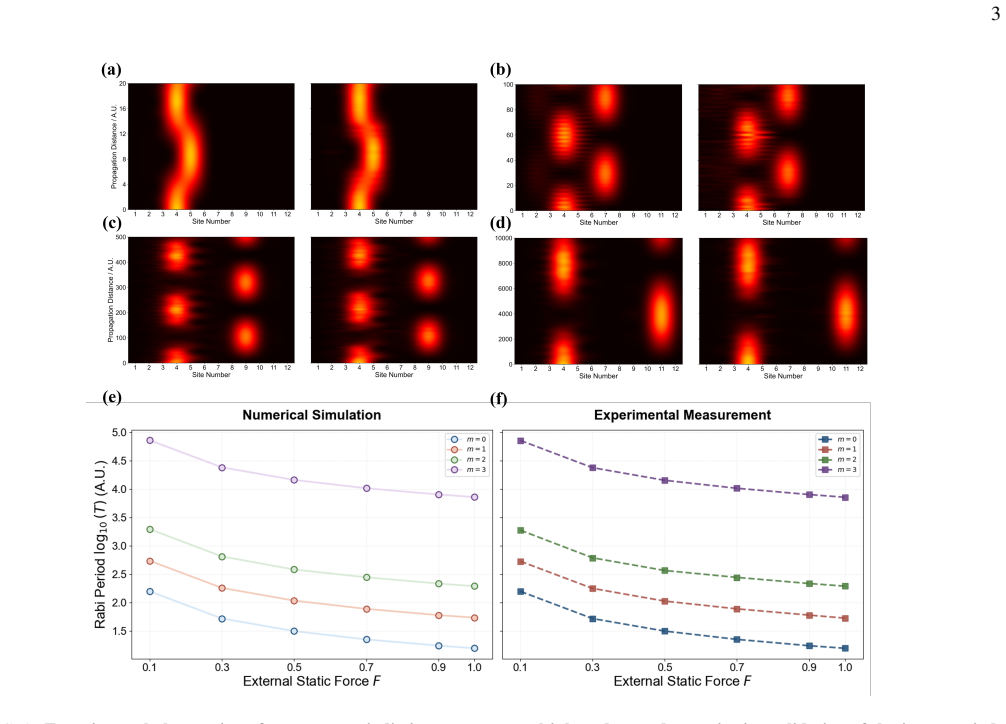
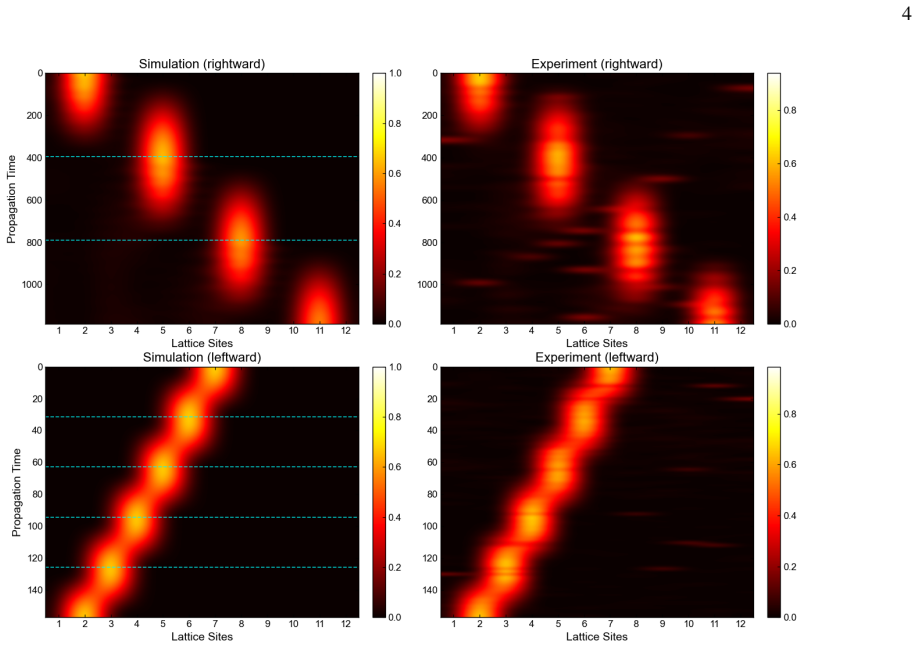
The Bloch-Siegert shift has an exact counterpart in binary lattices under static forcing, where it governs resonant long-range tunneling between sites separated by odd lattice spacings. This correspondence is realized experimentally in a 12-mode programmable photonic integrated circuit with sub-percent control of on-site detuning, producing coherent periodic jumps across four resonance orders that quantitatively match the predicted period law and the level-anticrossing picture of the semiclassical Rabi model. Exploiting the underlying parity structure, adaptive sign reversal of the staggered potential converts intrinsically bidirectional oscillations into cascaded unidirectional transport.
What carries the argument
The exact correspondence between the Bloch-Siegert shift in driven two-level systems and resonant long-range tunneling in statically forced binary lattices, implemented via a reconfigurable 12-mode photonic integrated circuit that isolates the effect through precise detuning control and parity manipulation.
If this is right
- Coherent periodic jumps across multiple resonance orders can be directly observed and controlled in a photonic platform.
- The Bloch-Siegert period law holds quantitatively over the entire accessible parameter space.
- Bidirectional resonant oscillations can be converted to unidirectional transport by adaptive reversal of the staggered potential sign.
- Programmable photonic lattices function as a scalable testbed for Floquet-engineered transport and strongly driven quantum-optical phenomena.
Where Pith is reading between the lines
- The same hardware could test whether the correspondence survives in larger lattices or with added disorder.
- Similar parity-based sign-reversal techniques might apply to other Floquet systems to engineer directed flow.
- The platform opens a route to analog simulation of counter-rotating effects without needing high-frequency drives in atomic systems.
Load-bearing premise
The reconfigurable photonic circuit with sub-percent on-site detuning control faithfully implements the static-forcing binary lattice model and isolates Bloch-Siegert physics without dominant experimental artifacts or deviations from the semiclassical Rabi picture.
What would settle it
Measured resonance periods that systematically deviate from the predicted period law by more than experimental uncertainty, or observed dynamics that fail to match the semiclassical level-anticrossing picture across the full parameter space, would falsify the claimed realization.
Figures



read the original abstract
The Bloch Siegert shift, a hallmark correction arising from counter-rotating interactions in driven two-level systems, has an exact counterpart in binary lattices under static forcing, where it governs resonant long-range tunneling between sites separated by odd lattice spacings. Here we report the first experimental realization of this correspondence using a 12 mode programmable photonic integrated circuit. By implementing a reconfigurable binary lattice with sub-percent control of on-site detuning, we observe coherent periodic jumps across four resonance orders and quantitatively verify the predicted period law over the full parameter space. The measured dynamics exhibit the extreme resonance sensitivity characteristic of Bloch Siegert physics and agree closely with the level-anticrossing picture of the semiclassical Rabi model. Exploiting the underlying parity structure, we further convert intrinsically bidirectional oscillations into cascaded unidirectional transport through adaptive sign reversal of the staggered potential, achieving fidelities exceeding 0.95 and 0.98 on the same hardware platform. Our results establish programmable photonic lattices as a scalable testbed for strongly driven quantum-optical phenomena and Floquet-engineered transport.
Editorial analysis
A structured set of objections, weighed in public.
Referee Report
Summary. The manuscript reports the first experimental realization of the Bloch-Siegert correspondence in a binary lattice, implemented via a 12-mode programmable photonic integrated circuit. The authors claim to observe coherent periodic jumps across four resonance orders, quantitatively verify the predicted period law over the full parameter space with close agreement to the semiclassical Rabi/level-anticrossing model, and demonstrate conversion of bidirectional oscillations to cascaded unidirectional transport via adaptive parity-based sign reversal of the staggered potential, achieving fidelities exceeding 0.95 and 0.98.
Significance. If the reconfigurable circuit faithfully implements the ideal static-forcing binary lattice model, this establishes programmable photonic lattices as a scalable experimental testbed for strongly driven quantum-optical phenomena and Floquet-engineered transport. The quantitative verification of the period law and high-fidelity results would provide direct confirmation of the lattice analog to counter-rotating interactions in driven two-level systems.
major comments (2)
- [Experimental results and methods] The central claim of quantitative verification of the period law and isolation of Bloch-Siegert physics rests on the assumption that the 12-mode circuit realizes the ideal model without dominant artifacts. Explicit error budgeting or bounds on nearest-neighbor crosstalk, propagation loss, and on-site detuning deviations (beyond the stated sub-percent control) are needed to rule out coincidental agreement; without this, shifts in resonance locations or damping of periodic jumps cannot be excluded.
- [Results on period law verification] The abstract states fidelities exceeding 0.95 and 0.98 for unidirectional transport, but the manuscript should include a direct comparison (e.g., via a table or figure) of measured resonance positions and periods against the theoretical predictions from the level-anticrossing picture, with error bars, to substantiate the 'close agreement' and 'parameter-free' verification over the full parameter space.
minor comments (2)
- [Introduction] The notation for the staggered potential and parity structure should be defined more explicitly in the introduction or theory section to aid readers unfamiliar with the binary lattice mapping.
- [Figures] Figure captions for the dynamics plots should specify the exact parameter values used for each resonance order and the number of experimental repetitions for the fidelity measurements.
Simulated Author's Rebuttal
We thank the referee for their positive assessment of our work and for the constructive comments, which will help strengthen the manuscript. We address each major comment point by point below.
read point-by-point responses
-
Referee: [Experimental results and methods] The central claim of quantitative verification of the period law and isolation of Bloch-Siegert physics rests on the assumption that the 12-mode circuit realizes the ideal model without dominant artifacts. Explicit error budgeting or bounds on nearest-neighbor crosstalk, propagation loss, and on-site detuning deviations (beyond the stated sub-percent control) are needed to rule out coincidental agreement; without this, shifts in resonance locations or damping of periodic jumps cannot be excluded.
Authors: We agree that explicit error budgeting strengthens the central claims and helps exclude potential artifacts. In the revised manuscript we will add a dedicated error-analysis subsection that reports measured bounds on nearest-neighbor crosstalk (<0.5 % from calibration data), propagation loss (quantified via transmission spectra), and residual on-site detuning deviations (maintained at the sub-percent level with active feedback). We will also propagate these uncertainties to the extracted resonance positions and oscillation periods to demonstrate that they cannot account for the observed quantitative agreement with the level-anticrossing model. revision: yes
-
Referee: [Results on period law verification] The abstract states fidelities exceeding 0.95 and 0.98 for unidirectional transport, but the manuscript should include a direct comparison (e.g., via a table or figure) of measured resonance positions and periods against the theoretical predictions from the level-anticrossing picture, with error bars, to substantiate the 'close agreement' and 'parameter-free' verification over the full parameter space.
Authors: We thank the referee for this suggestion. Although quantitative comparisons appear in the main text and supplementary material, a single consolidated figure or table will improve clarity. In the revision we will add a new figure that directly plots the measured resonance positions and extracted periods for all four resonance orders against the theoretical predictions of the semiclassical level-anticrossing model, including experimental error bars obtained from repeated measurements. This will explicitly substantiate the close, parameter-free agreement across the full parameter space. revision: yes
Circularity Check
No significant circularity: experimental verification of externally derived Bloch-Siegert correspondence
full rationale
The paper's central claims rest on implementing a reconfigurable photonic binary lattice to observe and verify the period law and resonance behaviors predicted by the semiclassical Rabi/level-anticrossing model for Bloch-Siegert physics in driven two-level systems. This correspondence is presented as an established theoretical mapping (with the experiment providing the first realization and quantitative check across parameter space), not derived within the paper itself. No equations or steps reduce a prediction to a fitted input by construction, no self-citations are invoked as load-bearing uniqueness theorems, and no ansatz or renaming of known results is smuggled in to create the claimed results. The derivation chain for the period law and parity-based transport is external to this work, with the photonic circuit serving as a testbed rather than a self-referential definition of the physics.
Axiom & Free-Parameter Ledger
Lean theorems connected to this paper
-
IndisputableMonolith/Cost/FunctionalEquation.leanwashburn_uniqueness_aczel unclear?
unclearRelation between the paper passage and the cited Recognition theorem.
The Hamiltonian ... Ĥ = −V ∑(|n⟩⟨n+1| + H.C.) + ∑(nF + ε/2 (−1)^n)|n⟩⟨n| ... resonance condition ε ≈ (2m+1)F ... period T = 2π/Δ_min
-
IndisputableMonolith/Foundation/RealityFromDistinction.leanreality_from_one_distinction unclear?
unclearRelation between the paper passage and the cited Recognition theorem.
quantitatively verify the predicted period law over the full parameter space ... fidelities exceeding 0.95 and 0.98
What do these tags mean?
- matches
- The paper's claim is directly supported by a theorem in the formal canon.
- supports
- The theorem supports part of the paper's argument, but the paper may add assumptions or extra steps.
- extends
- The paper goes beyond the formal theorem; the theorem is a base layer rather than the whole result.
- uses
- The paper appears to rely on the theorem as machinery.
- contradicts
- The paper's claim conflicts with a theorem or certificate in the canon.
- unclear
- Pith found a possible connection, but the passage is too broad, indirect, or ambiguous to say the theorem truly supports the claim.
Reference graph
Works this paper leans on
- [1]
-
[2]
P. Forn-D ´ıaz, J. Lisenfeld, D. Marcos, J. J. Garcia-Ripoll, E. Solano, C. Harmans, and J. Mooij, Physical review letters 105, 237001 (2010)
work page 2010
-
[3]
X. Li, M. Bamba, Q. Zhang, S. Fallahi, G. C. Gardner, W. Gao, M. Lou, K. Yoshioka, M. J. Manfra, and J. Kono, Nature Pho- tonics12, 324 (2018)
work page 2018
-
[4]
G. H. Wannier, Physical Review117, 432 (1960)
work page 1960
- [5]
-
[6]
Bloch, Zeitschrift f ¨ur physik52, 555 (1929)
F. Bloch, Zeitschrift f ¨ur physik52, 555 (1929)
work page 1929
- [7]
-
[8]
T. Hartmann, F. Keck, H. Korsch, and S. Mossmann, New Jour- nal of Physics6, 2 (2004)
work page 2004
- [9]
-
[10]
F. Dreisow, A. Szameit, M. Heinrich, T. Pertsch, S. Nolte, A. T ¨unnermann, and S. Longhi, Physical review letters102, 076802 (2009)
work page 2009
-
[11]
Duan, Physical Review B108, 174306 (2023)
L. Duan, Physical Review B108, 174306 (2023)
work page 2023
-
[12]
R. Nagarajan, C. H. Joyner, R. P. Schneider, J. S. Bostak, T. Butrie, A. G. Dentai, V . G. Dominic, P. W. Evans, M. Kato, M. Kauffman,et al., IEEE Journal of Selected Topics in Quan- tum Electronics11, 50 (2005)
work page 2005
-
[13]
P. Dong, Y .-K. Chen, G.-H. Duan, and D. T. Neilson, Nanopho- tonics3, 215 (2014)
work page 2014
-
[14]
B. Jalali and S. Fathpour, Journal of lightwave technology24, 4600 (2007)
work page 2007
-
[15]
Z. Ye, H. Jia, Z. Huang, C. Shen, J. Long, B. Shi, Y .-H. Luo, L. Gao, W. Sun, H. Guo,et al., Photonics Research11, 558 (2023)
work page 2023
-
[16]
R. Chen, Z. Fang, C. Perez, F. Miller, K. Kumari, A. Saxena, J. Zheng, S. J. Geiger, K. E. Goodson, and A. Majumdar, Na- ture Communications14, 3465 (2023)
work page 2023
- [17]
-
[18]
J. M. Freedman, M. J. Storey, D. Dominguez, A. Leenheer, S. Magri, N. T. Otterstrom, and M. Eichenfield, Nature Com- munications16, 10959 (2025)
work page 2025
-
[19]
M. B. On, F. Ashtiani, D. Sanchez-Jacome, D. Perez-Lopez, S. B. Yoo, and A. Blanco-Redondo, Nature Communications 15, 629 (2024)
work page 2024
-
[20]
Z.-S. Xu, J. Gao, A. Iovan, I. M. Khaymovich, V . Zwiller, and A. W. Elshaari, npj Nanophotonics1, 8 (2024)
work page 2024
- [21]
-
[22]
A. W. Elshaari, W. Pernice, K. Srinivasan, O. Benson, and V . Zwiller, Nature photonics14, 285 (2020)
work page 2020
- [23]
-
[24]
E. Pelucchi, G. Fagas, I. Aharonovich, D. Englund, E. Figueroa, Q. Gong, H. Hannes, J. Liu, C.-Y . Lu, N. Matsuda,et al., Nature Reviews Physics4, 194 (2022)
work page 2022
-
[25]
J. Bao, Z. Fu, T. Pramanik, J. Mao, Y . Chi, Y . Cao, C. Zhai, Y . Mao, T. Dai, X. Chen,et al., Nature Photonics17, 573 (2023). 7
work page 2023
-
[26]
S. Shekhar, W. Bogaerts, L. Chrostowski, J. E. Bowers, M. Hochberg, R. Soref, and B. J. Shastri, Nature Communi- cations15, 751 (2024)
work page 2024
-
[27]
H. Shu, L. Chang, Y . Tao, B. Shen, W. Xie, M. Jin, A. Nether- ton, Z. Tao, X. Zhang, R. Chen,et al., Nature605, 457 (2022)
work page 2022
-
[28]
K. Y . Yang, C. Shirpurkar, A. D. White, J. Zang, L. Chang, F. Ashtiani, M. A. Guidry, D. M. Lukin, S. V . Pericherla, J. Yang,et al., Nature communications13, 7862 (2022)
work page 2022
-
[29]
J. Riemensberger, N. Kuznetsov, J. Liu, J. He, R. N. Wang, and T. J. Kippenberg, Nature612, 56 (2022)
work page 2022
- [30]
-
[31]
W. Xu, Y . Guo, X. Li, C. Liu, L. Lu, J. Chen, and L. Zhou, Journal of Lightwave Technology41, 832 (2022)
work page 2022
-
[32]
Y . Shen, N. C. Harris, S. Skirlo, M. Prabhu, T. Baehr-Jones, M. Hochberg, X. Sun, S. Zhao, H. Larochelle, D. Englund, et al., Nature photonics11, 441 (2017)
work page 2017
-
[33]
M. J. Filipovich, Z. Guo, M. Al-Qadasi, B. A. Marquez, H. D. Morison, V . J. Sorger, P. R. Prucnal, S. Shekhar, and B. J. Shas- tri, Optica9, 1323 (2022)
work page 2022
-
[34]
S. Xu, J. Wang, S. Yi, and W. Zou, Nature communications13, 7970 (2022)
work page 2022
-
[35]
S. Hua, E. Divita, S. Yu, B. Peng, C. Roques-Carmes, Z. Su, Z. Chen, Y . Bai, J. Zou, Y . Zhu,et al., Nature640, 361 (2025)
work page 2025
-
[36]
J. Feldmann, N. Youngblood, M. Karpov, H. Gehring, X. Li, M. Stappers, M. Le Gallo, X. Fu, A. Lukashchuk, A. S. Raja, et al., Nature589, 52 (2021)
work page 2021
-
[37]
E. Galiffi, R. Tirole, S. Yin, H. Li, S. Vezzoli, P. A. Huidobro, M. G. Silveirinha, R. Sapienza, A. Al `u, and J. B. Pendry, Ad- vanced Photonics4, 014002 (2022)
work page 2022
-
[38]
K. Wang, X. Qiu, L. Xiao, X. Zhan, Z. Bian, W. Yi, and P. Xue, Physical review letters122, 020501 (2019)
work page 2019
-
[39]
M. C. Rechtsman, J. M. Zeuner, Y . Plotnik, Y . Lumer, D. Podol- sky, F. Dreisow, S. Nolte, M. Segev, and A. Szameit, Nature 496, 196 (2013)
work page 2013
-
[40]
L. J. Maczewsky, J. M. Zeuner, S. Nolte, and A. Szameit, Na- ture communications8, 13756 (2017)
work page 2017
-
[41]
Z.-S. Xu, J. Gao, G. Krishna, S. Steinhauer, V . Zwiller, and A. W. Elshaari, Photonics Research10, 2901 (2022)
work page 2022
-
[42]
M. J ¨urgensen, S. Mukherjee, and M. C. Rechtsman, Nature 596, 63 (2021)
work page 2021
- [43]
discussion (0)
Sign in with ORCID, Apple, or X to comment. Anyone can read and Pith papers without signing in.