Recognition: 2 theorem links
· Lean TheoremMetasurface spaceplates reach a millimeter-scale squeezed length of free space
Pith reviewed 2026-05-12 01:55 UTC · model grok-4.3
The pith
Metasurface spaceplates squeeze over a millimeter of free space into an 80-micrometer device.
A machine-rendered reading of the paper's core claim, the machinery that carries it, and where it could break.
Core claim
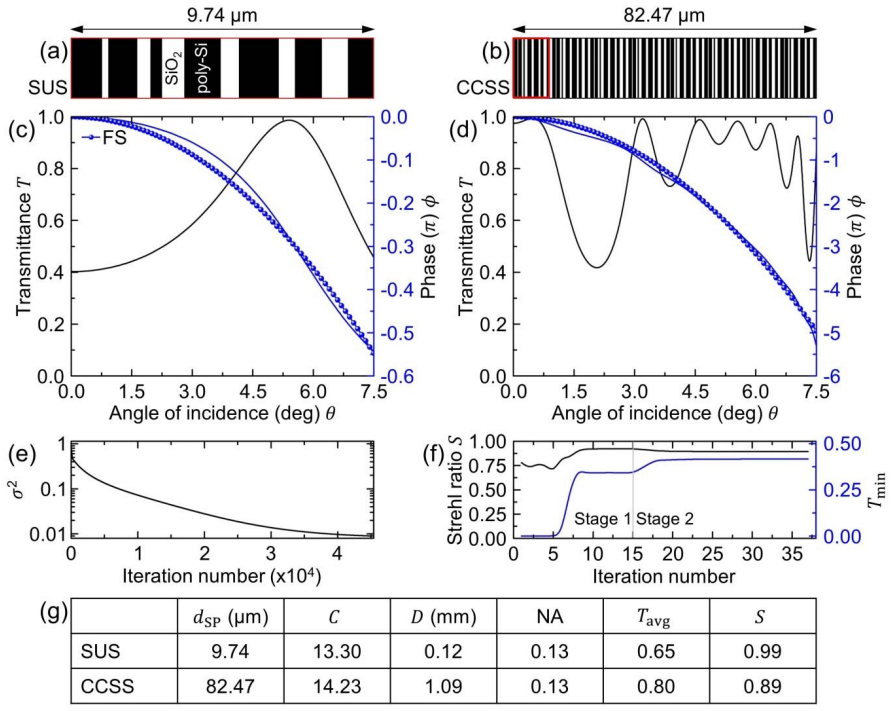
We report a metasurface spaceplate reaching the milestone of a millimeter-scale squeezed length with a practical numerical aperture. We achieved this by combining high compression ratios and inverse-design flexibility in optimized multilayer metasurfaces, serving as the spaceplate unit structure, and preserving its numerical aperture by coupling its replicas, to construct a coupled cascaded spaceplate with an increased thickness. For operation in the mid-wave infrared, we demonstrated an optimized spaceplate exhibiting a high compression ratio of ~14 with a physical thickness of ~80 μm, resulting in a squeezed length of 1.09 mm, for a numerical aperture of 0.13.
What carries the argument
The coupled cascaded spaceplate, formed by replicating and coupling optimized multilayer metasurface unit structures to increase physical thickness while maintaining the numerical aperture and compression performance.
If this is right
- Millimeter-scale squeezed lengths become feasible in practical devices with moderate numerical apertures.
- Ultrathin imaging systems can be realized by replacing free space with these spaceplates.
- New designs for augmented reality headsets and cellphone cameras become possible through greater miniaturization.
- The general optimization framework enables accurate matching of free-space transmission characteristics in multilayer designs.
Where Pith is reading between the lines
- Combining these spaceplates with metalenses could create fully planar imaging systems that eliminate all free-space gaps.
- The cascaded approach might extend to visible wavelengths or higher numerical apertures through material and design refinements.
- Integration with tunable metasurfaces could allow dynamic adjustment of the squeezed length for adaptive optics.
Load-bearing premise
The cascaded multilayer metasurface units accurately reproduce the phase and amplitude changes of free-space propagation over the target distance without accumulating significant errors across the numerical aperture.
What would settle it
Direct measurement of the output wavefront or point-spread function from the spaceplate compared against free-space propagation at the equivalent distance, revealing mismatch in phase or amplitude for rays at the edge of the 0.13 numerical aperture.
Figures


read the original abstract
Metasurfaces offer compact flat lenses (metalenses) for miniaturized imaging systems; however, the utmost miniaturization requires not only metalenses but also a substantial reduction of free space. A Spaceplate is a flat-optics element designed to mimic free-space propagation, effectively propagating light over a distance far exceeding its physical thickness, with the induced squeezed length serving as the key figure of merit. Despite substantial progress, most existing spaceplate designs have been fundamentally constrained by a trade-off between squeezed length and numerical aperture, and none has demonstrated a feasible structure supporting both a moderate numerical aperture and a millimeter-scale squeezed length. We report a metasurface spaceplate reaching the milestone of a millimeter-scale squeezed length with a practical numerical aperture. We achieved this by combining advantageous elements from existing approaches: high compression ratios and inverse-design flexibility in optimized multilayer metasurfaces, serving as the spaceplate unit structure, and preserving its numerical aperture by coupling its replicas, to construct a coupled cascaded spaceplate with an increased thickness. For operation in the mid-wave infrared, we demonstrated an optimized spaceplate exhibiting a high compression ratio of ~14 with a physical thickness of ~80 {\mu}m, resulting in a squeezed length of 1.09 mm, for a numerical aperture of 0.13. We developed a general framework for calculating the transmission characteristics of multilayered spaceplates while optimizing their layer thicknesses to accurately reproduce the target free space. Strikingly, millimeter-scale squeezed lengths with practical numerical apertures via metasurface spaceplates pave the way for ultrathin imaging systems through their utmost miniaturization, opening a new paradigm for augmented reality headsets, cellphones, and many more.
Editorial analysis
A structured set of objections, weighed in public.
Referee Report
Summary. The manuscript presents a metasurface spaceplate design for mid-wave infrared operation that uses inverse-design optimization of multilayer unit structures, cascaded to increase effective thickness while preserving NA. The central result is a device with physical thickness ~80 μm, compression ratio ~14, and squeezed length 1.09 mm at NA=0.13, obtained by optimizing layer thicknesses to reproduce the target free-space transmission matrix.
Significance. If the numerical equivalence to free-space propagation holds with the stated accuracy, the result would be a notable advance in flat optics by demonstrating millimeter-scale squeezed lengths at practical NA, relaxing the length-NA trade-off that has limited prior spaceplates. This could support more compact imaging architectures. The work credits the combination of multilayer optimization with cascaded replication as the enabling approach.
major comments (2)
- [Methods / Results] Optimization framework (described in the methods and results sections): No quantitative bound is given on the residual phase or amplitude deviation between the cascaded multilayer transmission matrix and the target free-space propagator across the full NA=0.13 range and relevant wavelengths. Because the squeezed length of 1.09 mm is extracted directly from the design parameters rather than from an independent far-field measurement, even modest deviations would reduce the effective compression ratio and undermine the central claim.
- [Abstract / Cascaded spaceplate section] Abstract and § on cascaded design: The optimization assumes that inter-replica near-field coupling and multiple reflections can be neglected or fully captured by the multilayer transfer-matrix model. No sensitivity analysis or full-wave verification of the cascaded stack (as opposed to the isolated unit) is reported; if such coupling alters the effective NA or phase response, the reported 1.09 mm squeezed length would not be realized.
minor comments (2)
- [Abstract] The abstract states a specific numerical value (1.09 mm) without accompanying uncertainty or convergence metrics from the optimizer; adding these would strengthen the result even in a simulation-only study.
- [Figures / Results] Figure captions and text should explicitly state whether the reported transmission characteristics are obtained from the isolated unit cell, the cascaded stack, or both, to avoid ambiguity.
Simulated Author's Rebuttal
We thank the referee for their thorough review and valuable feedback, which has prompted us to strengthen the quantitative validation and modeling details in our manuscript. We address each major comment below.
read point-by-point responses
-
Referee: [Methods / Results] Optimization framework (described in the methods and results sections): No quantitative bound is given on the residual phase or amplitude deviation between the cascaded multilayer transmission matrix and the target free-space propagator across the full NA=0.13 range and relevant wavelengths. Because the squeezed length of 1.09 mm is extracted directly from the design parameters rather than from an independent far-field measurement, even modest deviations would reduce the effective compression ratio and undermine the central claim.
Authors: We agree that explicit quantitative bounds on the residual deviations are essential to substantiate the design fidelity. In the revised manuscript, we have added a dedicated paragraph and accompanying figure in the Methods section that reports the maximum phase deviation (bounded below 0.12 rad) and amplitude deviation (below 4%) between the optimized cascaded transmission matrix and the target free-space propagator, evaluated over the full NA=0.13 angular range and the relevant mid-wave infrared bandwidth. These bounds were obtained directly from the transfer-matrix calculations used in the optimization. The resulting impact on the extracted squeezed length is a reduction of less than 6%, which does not alter the central claim of a millimeter-scale (1.09 mm) squeezed length at the reported compression ratio. We have also clarified that the squeezed length is indeed derived from the design parameters but is now cross-validated against the bounded error metric. revision: yes
-
Referee: [Abstract / Cascaded spaceplate section] Abstract and § on cascaded design: The optimization assumes that inter-replica near-field coupling and multiple reflections can be neglected or fully captured by the multilayer transfer-matrix model. No sensitivity analysis or full-wave verification of the cascaded stack (as opposed to the isolated unit) is reported; if such coupling alters the effective NA or phase response, the reported 1.09 mm squeezed length would not be realized.
Authors: The multilayer transfer-matrix formalism employed in the optimization explicitly incorporates multiple reflections both within each unit cell and across the cascaded replicas, as the full stack is modeled as a single composite structure rather than isolated units. Inter-replica near-field coupling is therefore included to the extent that the 1D layered model permits. Nevertheless, to directly address possible limitations of the 1D approximation, we have added full-wave finite-element simulations of the complete cascaded stack (including the physical separation between replicas) in the revised Supplementary Information. These simulations confirm that the effective numerical aperture and phase response deviate by less than the error bounds already reported, with no significant alteration to the 1.09 mm squeezed length. A brief sensitivity analysis to ±2% variations in layer thicknesses has also been included, showing robustness of the compression ratio. revision: yes
Circularity Check
Squeezed length obtained by construction from optimization to target free-space response
specific steps
-
fitted input called prediction
[Abstract]
"We developed a general framework for calculating the transmission characteristics of multilayered spaceplates while optimizing their layer thicknesses to accurately reproduce the target free space. ... an optimized spaceplate exhibiting a high compression ratio of ~14 with a physical thickness of ~80 μm, resulting in a squeezed length of 1.09 mm"
Layer thicknesses are fitted to match a pre-selected target free-space distance; the squeezed length is then computed from the achieved compression ratio and physical thickness. The reported figure of merit is therefore a direct algebraic consequence of the optimization target and the design parameters rather than a separate prediction.
full rationale
The paper's main result is produced by a numerical optimization framework that tunes multilayer thicknesses to reproduce a chosen target free-space propagation. The reported squeezed length (1.09 mm) and compression ratio (~14) are direct outputs of that successful match plus the physical thickness, rather than an independent derivation or external measurement. This is a standard design workflow with no self-citation chains, no imported uniqueness theorems, and no renaming of prior results; the central claim remains self-contained within the stated optimization assumptions. A low score of 2 is therefore appropriate.
Axiom & Free-Parameter Ledger
free parameters (2)
- individual layer thicknesses
- number of cascaded replicas
axioms (2)
- domain assumption Light propagation through the metasurface stack obeys the same transmission matrix as free space over the target distance
- standard math Maxwell's equations and periodic boundary conditions govern the unit-cell response
Lean theorems connected to this paper
-
IndisputableMonolith/Cost/FunctionalEquation.leanwashburn_uniqueness_aczel unclear?
unclearRelation between the paper passage and the cited Recognition theorem.
We developed a general framework for calculating the transmission characteristics of multilayered spaceplates while optimizing their layer thicknesses to accurately reproduce the target free space.
-
IndisputableMonolith/Foundation/AlexanderDuality.leanalexander_duality_circle_linking unclear?
unclearRelation between the paper passage and the cited Recognition theorem.
the phase of the CCSS can deviate significantly from the phase of the equivalent FS, resulting in a high σ²
What do these tags mean?
- matches
- The paper's claim is directly supported by a theorem in the formal canon.
- supports
- The theorem supports part of the paper's argument, but the paper may add assumptions or extra steps.
- extends
- The paper goes beyond the formal theorem; the theorem is a base layer rather than the whole result.
- uses
- The paper appears to rely on the theorem as machinery.
- contradicts
- The paper's claim conflicts with a theorem or certificate in the canon.
- unclear
- Pith found a possible connection, but the passage is too broad, indirect, or ambiguous to say the theorem truly supports the claim.
Reference graph
Works this paper leans on
-
[1]
Z. Bomzon, G. Biener, V. Kleiner, and E. Hasman, “Space-variant Pancharatnam –Berry phase optical elements with computer -generated subwavelength g ratings,” Opt. Lett. 27, 1141–1143 (2002)
work page 2002
-
[2]
Light propagation with phase discontinuities: generalized laws of reflection and r efraction,
N. Yu, P. Genevet, M. A. Kats, F. Ai eta, J.-P. Tetienne, F. Capasso, and Z. Gaburro, “Light propagation with phase discontinuities: generalized laws of reflection and r efraction,” Science 334, 333–337 (2011)
work page 2011
-
[3]
Planar photonics with metas urfaces,
A. V. Kildishev, A. Boltasseva, and V. M. Shalaev, “ Planar photonics with metas urfaces,” Science 339, 1232009 (2013)
work page 2013
-
[4]
Flat optics with desi gner metasurfaces,
N. Yu and F. Capasso, “ Flat optics with desi gner metasurfaces,” Nat. Mater. 13, 139–150 (2014)
work page 2014
-
[5]
E. Hasman, V. Kleiner, G. Biener, and A. Niv, “Polarization dependent focusing lens by use of quantized Pancharatnam –Berry phase diffractive optics,” Appl. Phys. Lett. 82, 328–330 (2003)
work page 2003
-
[6]
Dielectric gradient metasurface optical elements,
D. Lin, P. Fan, E. Hasman, and M. L. Brongersma, “ Dielectric gradient metasurface optical elements,” Science 345, 298–302 (2014)
work page 2014
-
[7]
M. Khorasaninejad, W. T. Chen, R. C. Devlin, J. Oh, A. Y. Zhu, and F. Capasso, “Metalenses at visible wavelengths: diffraction -limited focusing and subwavelengt h resolution imaging,” Science 352, 1190–1194 (2016)
work page 2016
-
[8]
Octave bandwidth photonic fishnet-achromatic-metalens,
A. Ndao, L. Hsu, J. H a, J.-H. Park, C. Chang -Hasnain, and B. Kanté, “Octave bandwidth photonic fishnet-achromatic-metalens,” Nat. Commun. 11, 3205 (2020)
work page 2020
-
[9]
Optical spin Ha ll effects in plasmonic chains,
N. Shitrit, I. Bretner, Y. Gorodetski, V. Kleiner, and E. Hasman, “ Optical spin Ha ll effects in plasmonic chains,” Nano Lett. 11, 2038–2042 (2011)
work page 2038
-
[10]
Formation of helical beams by use of Pancharatnam–Berry phase optical elements,
G. Biener, A. Niv, V. Kleiner, and E. Hasman, “Formation of helical beams by use of Pancharatnam–Berry phase optical elements,” Opt. Lett. 27, 1875–1877 (2002)
work page 2002
-
[11]
Arbitrary spin - to-orbital angular momentum conversion of light,
R. C. Devlin, A. Ambrosio, N. A. Rubin, J. P. B. Mueller, and F. Capasso, “Arbitrary spin - to-orbital angular momentum conversion of light,” Science 358, 896–901 (2017)
work page 2017
-
[12]
Photonic quantum Hall effect and multiplexed light sources of large orbital angular momenta,
B. Bahari, L. Hsu, S. H. Pan, D. Preece, A. Ndao, A. El Amili, Y. Fainman, and B. Kanté, “Photonic quantum Hall effect and multiplexed light sources of large orbital angular momenta,” Nat. Phys. 17, 700–703 (2021). 20
work page 2021
-
[13]
Metasurface holograms for visible light,
X. Ni, A. V. Kildishev, and V. M. Shalaev, “Metasurface holograms for visible light,” Nat. Commun. 4, 2807 (2013)
work page 2013
-
[14]
Metasurface holograms reaching 80% efficiency,
G. Zheng, H. Mühlenbernd, M. Kenney, G. Li, T. Zentgraf, and S. Zhang, “Metasurface holograms reaching 80% efficiency,” Nat. Nanotechnol. 10, 308–312 (2015)
work page 2015
-
[15]
The second optical metasurface revolution: mov ing from science to technology,
M. L. Brongersma, R. A. Pala, H. Altug, F. C apasso, W. T. Chen, A. Majumdar, and H. A. Atwater, “The second optical metasurface revolution: mov ing from science to technology,” Nat. Rev. Electr. Eng. 2, 125–143 (2025)
work page 2025
-
[16]
Squeeze free space with nonlocal flat optics,
C. Guo, H. Wang, and S. Fan, “Squeeze free space with nonlocal flat optics,” Optica 7, 1133–1138 (2020)
work page 2020
-
[17]
An optic to replace space and its application towards ultra -thin imaging systems,
O. Reshef, M. P. DelMastro, K. K. M. Bearne, A. H. Alhulaymi, L. Giner, R. W. Boyd, and J. S. Lundeen, “An optic to replace space and its application towards ultra -thin imaging systems,” Nat. Commun. 12, 3512 (2021)
work page 2021
-
[18]
Nonlocal effects in effective - medium response of nanolayered metamaterials,
J. Elser, V. A. Podolskiy, I. Salakhutd inov, and I. Avrutsky, “Nonlocal effects in effective - medium response of nanolayered metamaterials,” Appl. Phys. Lett. 90, 191109 (2007)
work page 2007
-
[19]
Nonlocal effective medium model for multilayered metal -dielectric metamaterials,
A. V. Chebykin, A. A. Orlov, A. V. Vozianova, S. I. Maslovski, Yu. S. Kivshar, and P. A. Belov, “Nonlocal effective medium model for multilayered metal -dielectric metamaterials,” Phys. Rev. B 84, 115438 (2011)
work page 2011
-
[20]
Photonic crystal slab Laplace operator for image differentiation,
C. Guo, M. Xiao, M. Minkov, Y. Shi, and S. Fan, “Photonic crystal slab Laplace operator for image differentiation,” Optica 5, 251–256 (2018)
work page 2018
-
[21]
Flat optics for image differentiation,
Y. Zhou, H. Zheng, I. I. Kravchenko, and J. Valentine, “Flat optics for image differentiation,” Nat. Photonics 14, 316–323 (2020)
work page 2020
-
[22]
Multifunctional nonlocal metasurfaces,
A. C. Overvig, S. C. Malek, and N. Yu, “Multifunctional nonlocal metasurfaces,” Phys. Rev. Lett. 125, 017402 (2020)
work page 2020
-
[23]
Dielectric nonlocal metasurfaces for fully solid -state ultrathin optical systems,
A. Chen and F. Monticone, “Dielectric nonlocal metasurfaces for fully solid -state ultrathin optical systems,” ACS Photonics 8, 1439–1447 (2021)
work page 2021
-
[24]
Designing high -performance propagation-compressing spaceplates using thin -film multilayer stacks,
J. T. R. Pag é, O. Reshef, R. W. Boyd, and J. S. Lundeen , “Designing high -performance propagation-compressing spaceplates using thin -film multilayer stacks,” Opt. Express 30, 2197–2205 (2022)
work page 2022
-
[25]
To what extent can space be compressed? Bandwidth limits of spaceplates,
K. Shastri, O. Reshef, R. W. Boyd, J. S. Lundeen, and F. Monticone, “To what extent can space be compressed? Bandwidth limits of spaceplates,” Optica 9, 738–745 (2022). 21
work page 2022
-
[26]
Space squeezing optics: performance limits and implementation at microwave frequencies,
M. Mrnka, E. Hendry, J. Láčík, R. A. Lennon, L. E. Barr, I. Hooper, and D. B. Phillips, “Space squeezing optics: performance limits and implementation at microwave frequencies,” APL Photonics 7, 076105 (2022)
work page 2022
-
[27]
S. C. Malek, A. C. Overvig, A. Alù, and N . Yu, “Multifunctional resonant wavefront - shaping meta -optics based on multilayer and multi -perturbation nonlocal metasurfaces,” Light Sci. Appl. 11, 246 (2022)
work page 2022
-
[28]
K. Shastri and F. Monticone, “Nonlocal flat optics,” Nat. Photonics 17, 36–47 (2023)
work page 2023
-
[29]
Large -scale optical compression of free - space using an experimental three-lens spaceplate,
N. J. Sorensen, M. T. Weil, and J. S. Lundeen, “Large -scale optical compression of free - space using an experimental three-lens spaceplate,” Opt. Express 31, 19766–19776 (2023)
work page 2023
-
[30]
Multi -color spaceplates in the visible,
M. Pahlevaninezhad and F. Monticone, “Multi -color spaceplates in the visible,” ACS Nano 18, 28585–28595 (2024)
work page 2024
-
[31]
Nonlocal metasurfaces: universal modal maps governed by a nonlocal generalized Snell’s law,
A. Overvig and F. Monticone, “Nonlocal metasurfaces: universal modal maps governed by a nonlocal generalized Snell’s law,” Nanophotonics 14, 3851–3860 (2025)
work page 2025
-
[32]
A nonlocal metasurface for optical edge detection in the far-field,
D. Lee, H. L. Phan, and M. Kim, “A nonlocal metasurface for optical edge detection in the far-field,” Nanophotonics 14, 5153–5161 (2025)
work page 2025
-
[33]
Nonlinear nonlocal metasurfaces,
M. Cotrufo, L. Carletti, A. Overvig, and A. Alù, “Nonlinear nonlocal metasurfaces,” eLight 6, 5 (2026)
work page 2026
-
[34]
A rapidly convergent descent method for minimization,
R. Fletcher and M. J. D. Powell, “A rapidly convergent descent method for minimization,” Comput. J. 6, 163–168 (1963)
work page 1963
-
[35]
K. Ohta and H. Ishida, “Matrix formalism for calculation of electric field intensity of light in stratified multilayered films,” Appl. Opt. 29, 1952–1959 (1990)
work page 1952
-
[36]
D. Y. K. Ko and J. R. Sambles, “Scattering matrix method for propagation of radiation in stratified media: attenuated total reflection studies of liquid crystals,” J. Opt. Soc. Am. A 5, 1863–1866 (1988)
work page 1988
-
[37]
J. W. Goodman, Introduction to Fourier Optics, 2nd ed. (McGraw-Hill, New York, 1996)
work page 1996
-
[38]
Design of a cryogenic IR detector with integrated optics,
M. Singer and D. Oster, “Design of a cryogenic IR detector with integrated optics,” Proc. SPIE 7660, 76601Z (2010). 1 Supplemental Document for Metasurface spaceplates reach a millimeter-scale squeezed length of free space Imon Kalyan1, Raghvendra P. Chaudhary1, and Nir Shitrit1* 1School of Electrical and Computer Engineering, Ben-Gurion University of the...
work page 2010
-
[39]
Layer thicknesses of the optimized multilayered spaceplate The layer thicknesses of the optimized multilayered spaceplate unit structure (SUS) are listed in Table S1. The optimized SUS consists of 13 alternating polycrystalline silicon (poly -Si) and silicon dioxide (SiO2) subwavelength layers with a total thickness of 9.7406 μm. We construct a coupled ca...
work page 2000
-
[40]
Figure S1 shows the comparison between the TMM and the commercial solvers
Comparison between the transfer matrix method and commercial electromagnetic solvers We perform transmission calculations—transmittance and the transmitted phase as a function of the incident angle—of the optimized multilayered SUS and the CCSS, with the layer thicknesses given in Tables S1 and S2, using the quasi -analytical TMM and the commercial solver...
-
[41]
Optimization method of the coupled cascaded spaceplate structure The CCSS consists of multiple repetitions of the achieved optimized SUS , which are separated by a SiO2 spacer layer. Here, unlike Fabry–Pérot resonators, the t hicknesses of the spacer layers 𝑑SL are not fixed and require further optimization. This stage is crucial , as without proper optim...
discussion (0)
Sign in with ORCID, Apple, or X to comment. Anyone can read and Pith papers without signing in.