Recognition: 2 theorem links
· Lean TheoremDrain-Vortex Optimization: A Population-Based Metaheuristic Inspired by Multi-Drain Free-Vortex Flow
Pith reviewed 2026-05-12 00:54 UTC · model grok-4.3
The pith
Drain-Vortex Optimization models candidate solutions as particles spiraling in a multi-drain free-vortex field to improve continuous optimization.
A machine-rendered reading of the paper's core claim, the machinery that carries it, and where it could break.
Core claim
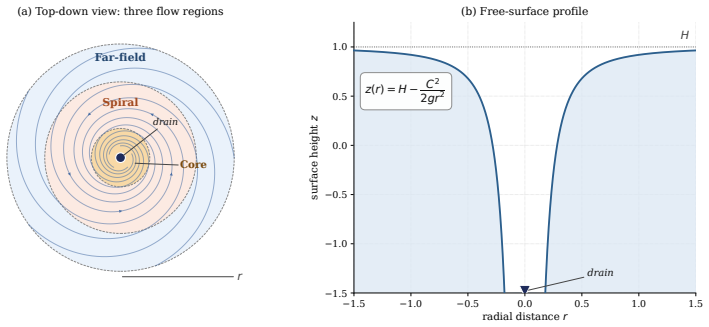
DVO represents each population member as a particle whose velocity decomposes into a radial component directed at one of several drain centers and a tangential component obeying the regularized free-vortex law. The normalized distance to the assigned drain triggers a three-phase transition: far-field exploration when distant, spiral inward motion at intermediate range, and localized exploitation near the core. Adaptive spiral length, population-wide vortex-basin assignment, and stochastic basin switching are added to maintain structured diversity. On the CEC 2017 suite this yields the lowest average log10 error on 34 of 58 functions, the best Friedman rank of 1.67, and statistically superior
What carries the argument
The distance-triggered three-phase update rule inside the multi-drain free-vortex field, which couples radial attraction to each drain center with tangential velocity that follows the regularized free-vortex law.
If this is right
- On the CEC 2017 suite DVO records the best mean log10 error on 34 of 58 cases and the lowest Friedman rank of 1.67, with Holm-corrected Wilcoxon tests showing significance against all seven baselines.
- On CEC 2022 DVO obtains the best Friedman rank of 2.13 and is significantly better than five of the seven baselines, though the gaps versus PSO and SVOA are not significant.
- Performance is weaker on simple unimodal classical functions and on small constrained engineering designs, indicating that the method is tuned for high-dimensional multimodal landscapes.
- The algorithm admits a vectorized GPU implementation that runs independent trials in parallel without extra communication overhead.
Where Pith is reading between the lines
- The free-vortex tangential component could be replaced by other distance-dependent rotation laws to test whether the performance gain is tied to the specific 1/r decay or to the phase-switching logic itself.
- Because basin assignment is performed at the population level, the same structure might be transplanted into other swarm or evolutionary frameworks that already maintain multiple subpopulations.
- The operating regime identified on classical and engineering problems suggests that DVO would be most useful as a component inside hybrid solvers that first locate promising basins and then hand them to a vortex-based local refiner.
Load-bearing premise
The particular mix of vortex-law regularization, three-phase distance thresholds, and basin-assignment rules yields a real performance gain that persists on optimization problems outside the CEC collections used for tuning and validation.
What would settle it
Apply the final DVO configuration and the same baselines to an untouched benchmark collection such as CEC 2020 or CEC 2024 and test whether the Friedman ranking and pairwise significance pattern remain unchanged.
Figures


read the original abstract
This paper proposes Drain-Vortex Optimization (DVO), a population-based metaheuristic for continuous optimization. DVO models each candidate solution as a particle moving in a multi-drain vortex field. Its update rule decomposes motion into radial attraction toward selected drain centres and tangential rotation governed by a regularized free-vortex law. A three-phase mechanism switches between far-field exploration, spiral inward motion, and localized core exploitation according to the normalized distance to the assigned drain. The method also uses adaptive spiral exploitation, population-level vortex basin assignment, and optional stochastic basin switching to support structured diversity. DVO is evaluated against PSO, GWO, WOA, SCA, AOA, EO, and SVOA using a calibration--validation protocol. CEC 2022 is used only to select the final DVO configuration, while CEC 2017, classical functions, and five constrained engineering design problems are used for out-of-sample validation. On CEC 2017, DVO achieves the best mean $\log_{10}$ error on 34 of 58 cases and the best Friedman average rank (1.67), and is significantly better than every baseline under Holm-corrected Wilcoxon tests. On CEC 2022, DVO obtains the best Friedman rank (2.13) and is significantly better than five of the seven baselines; the differences against PSO and SVOA are not significant. DVO is less competitive on simple scalable classical functions and on small constrained engineering designs, which clarifies its operating regime. The algorithm is implemented in a vectorized GPU form that executes independent runs in parallel.
Editorial analysis
A structured set of objections, weighed in public.
Referee Report
Summary. The manuscript proposes Drain-Vortex Optimization (DVO), a population-based metaheuristic in which candidate solutions are modeled as particles in a multi-drain vortex field. Motion decomposes into radial attraction toward assigned drain centers and tangential rotation governed by a regularized free-vortex law. A three-phase switching rule based on normalized distance to the drain selects among far-field exploration, spiral inward motion, and localized exploitation; additional mechanisms include adaptive spiral exploitation, population-level basin assignment, and optional stochastic basin switching. The algorithm is evaluated with a calibration-validation protocol that tunes the final configuration exclusively on CEC 2022 and reports out-of-sample results on CEC 2017 (best mean log10 error on 34 of 58 cases, Friedman rank 1.67, Holm-corrected significance versus all seven baselines), CEC 2022, classical functions, and five constrained engineering problems. The paper notes weaker competitiveness on simple classical functions and small engineering designs.
Significance. If the performance advantage on CEC 2017 is shown to arise from the vortex dynamics rather than from hyperparameter fitting, DVO would constitute a useful physics-inspired addition to the metaheuristics literature, particularly for structured multimodal landscapes. The calibration-validation split and the vectorized GPU implementation that enables parallel independent runs are clear methodological strengths. The explicit delimitation of the operating regime (weaker results on classical functions) is also constructive.
major comments (2)
- The calibration-validation protocol selects the final DVO configuration (including the vortex regularization constant, three phase-transition distance thresholds, and basin-switching probability) exclusively on CEC 2022 and then reports superior results on CEC 2017. Because the two suites share overlapping categories of unimodal, multimodal, hybrid, and composition functions at comparable dimensions, the reported best mean log10 error on 34/58 CEC 2017 cases and Friedman rank of 1.67 could reflect tuning to CEC-style landscapes rather than an intrinsic advantage of the multi-drain free-vortex model. An ablation that isolates the three-phase switching and basin-assignment rules from the tuned thresholds is required to substantiate the central performance claim.
- The manuscript does not report standard deviations, confidence intervals, or per-run error distributions alongside the mean log10 errors in the CEC 2017 tables. While Holm-corrected Wilcoxon tests are performed, the absence of these statistics makes it impossible to judge the practical magnitude and stability of the reported improvements over PSO, GWO, WOA, SCA, AOA, EO, and SVOA.
minor comments (2)
- The abstract and experimental section should state the exact numerical values of the final tuned parameters (vortex regularization constant, phase thresholds, basin-switching probability) so that the configuration is fully reproducible.
- The definition of 'normalized Euclidean distance to the assigned drain' and the precise form of the regularized free-vortex tangential velocity should be given explicitly with equation numbers in the algorithm description section.
Simulated Author's Rebuttal
We thank the referee for the constructive review, the recognition of our calibration-validation protocol and GPU implementation as strengths, and the clear delimitation of operating regimes in the manuscript. We address each major comment point by point below.
read point-by-point responses
-
Referee: The calibration-validation protocol selects the final DVO configuration (including the vortex regularization constant, three phase-transition distance thresholds, and basin-switching probability) exclusively on CEC 2022 and then reports superior results on CEC 2017. Because the two suites share overlapping categories of unimodal, multimodal, hybrid, and composition functions at comparable dimensions, the reported best mean log10 error on 34/58 CEC 2017 cases and Friedman rank of 1.67 could reflect tuning to CEC-style landscapes rather than an intrinsic advantage of the multi-drain free-vortex model. An ablation that isolates the three-phase switching and basin-assignment rules from the tuned thresholds is required to substantiate the central performance claim.
Authors: We appreciate the referee's concern regarding potential implicit tuning effects due to shared function categories between the suites. The calibration-validation split follows established practice in the metaheuristics community to ensure out-of-sample evaluation, with CEC 2022 used solely for final parameter selection and CEC 2017 reserved for validation; the distinct problem instances and our additional results on classical functions and engineering designs provide further support. Nevertheless, we agree that an explicit ablation isolating the three-phase switching rule and population-level basin assignment from the tuned thresholds would more directly attribute performance gains to the vortex dynamics. In the revised manuscript we will add this ablation study, comparing the full DVO against variants that replace the three-phase mechanism with fixed-distance rules and disable adaptive basin assignment while retaining the same tuned parameters. revision: yes
-
Referee: The manuscript does not report standard deviations, confidence intervals, or per-run error distributions alongside the mean log10 errors in the CEC 2017 tables. While Holm-corrected Wilcoxon tests are performed, the absence of these statistics makes it impossible to judge the practical magnitude and stability of the reported improvements over PSO, GWO, WOA, SCA, AOA, EO, and SVOA.
Authors: We acknowledge that the absence of variability statistics limits assessment of result stability despite the reported statistical tests. In the revised manuscript we will augment the CEC 2017 tables with standard deviations for all algorithms' mean log10 errors. We will also add supplementary figures (box plots of per-run errors on representative functions) to illustrate the magnitude and consistency of improvements, allowing readers to better evaluate practical significance alongside the Holm-corrected Wilcoxon results. revision: yes
Circularity Check
No circularity: algorithm rules defined independently of benchmark outcomes
full rationale
The DVO update rule (radial attraction plus regularized free-vortex tangential motion), three-phase switching thresholds, adaptive spiral exploitation, and basin-assignment logic are stated explicitly from the multi-drain vortex inspiration and do not reference or depend on any performance metric, fitted parameter value, or CEC result. CEC 2022 is used solely for configuration selection while CEC 2017 and other suites serve as separate validation; the reported means, ranks, and significance tests are external empirical quantities, not quantities defined by the algorithm's own equations. No self-citation, self-definitional step, or fitted-input-renamed-as-prediction appears in the derivation chain.
Axiom & Free-Parameter Ledger
free parameters (3)
- vortex regularization constant
- phase-transition distance thresholds
- basin-switching probability
axioms (2)
- domain assumption A regularized free-vortex velocity field provides a useful balance of attraction and rotation for search-space exploration.
- ad hoc to paper Normalized Euclidean distance to the assigned drain is a sufficient statistic for deciding the appropriate search regime.
invented entities (2)
-
Drain centers
no independent evidence
-
Vortex basins
no independent evidence
Lean theorems connected to this paper
-
IndisputableMonolith/Cost/FunctionalEquation.leanwashburn_uniqueness_aczel unclear?
unclearRelation between the paper passage and the cited Recognition theorem.
Its update rule decomposes motion into radial attraction toward selected drain centres and tangential rotation governed by a regularized free-vortex law... three-phase mechanism switches between far-field exploration, spiral inward motion, and localized core exploitation according to the normalized distance
-
IndisputableMonolith/Foundation/RealityFromDistinction.leanreality_from_one_distinction unclear?
unclearRelation between the paper passage and the cited Recognition theorem.
The tangential component... derived from the free-vortex tangential velocity v_θ(r) = C/r
What do these tags mean?
- matches
- The paper's claim is directly supported by a theorem in the formal canon.
- supports
- The theorem supports part of the paper's argument, but the paper may add assumptions or extra steps.
- extends
- The paper goes beyond the formal theorem; the theorem is a base layer rather than the whole result.
- uses
- The paper appears to rely on the theorem as machinery.
- contradicts
- The paper's claim conflicts with a theorem or certificate in the canon.
- unclear
- Pith found a possible connection, but the passage is too broad, indirect, or ambiguous to say the theorem truly supports the claim.
Reference graph
Works this paper leans on
-
[1]
S. Boyd, L. Vandenberghe, Convex Optimization, Cambridge University Press, 2004
work page 2004
-
[2]
J. F. Bonnans, J. C. Gilbert, C. Lemaréchal, C. A. Sagastizábal, Nu- merical optimization: theoretical and practical aspects, Springer, 2006
work page 2006
- [3]
-
[4]
I. Boussaïd, J. Lepagnot, P. Siarry, A survey on optimization meta- heuristics, Information Sciences 237 (2013) 82–117
work page 2013
-
[5]
K. Hussain, M. N. Mohd Salleh, S. Cheng, Y. Shi, Metaheuristic re- search: a comprehensive survey, Artificial Intelligence Review 52 (4) (2019) 2191–2233
work page 2019
-
[6]
C. A.CoelloCoello, Theoretical andnumericalconstraint-handlingtech- niques used with evolutionary algorithms: a survey of the state of the art, Computer Methods in Applied Mechanics and Engineering 191 (11-
-
[7]
(2002) 1245–1287. 69
work page 2002
-
[8]
V. Khatibi Bardsiri, D. N. A. Jawawi, S. Z. M. Hashim, E. Khatibi, A pso-based model to increase the accuracy of software development effort estimation, Software Quality Journal 21 (3) (2013) 501–526
work page 2013
-
[9]
B. Xue, M. Zhang, W. N. Browne, X. Yao, A survey on evolution- ary computation approaches to feature selection, IEEE Transactions on Evolutionary Computation 20 (4) (2015) 606–626
work page 2015
-
[10]
R. Eberhart, J. Kennedy, A new optimizer using particle swarm theory, in: Proceedings of the Sixth International Symposium on Micro Machine and Human Science (MHS’95), IEEE, 1995, pp. 39–43
work page 1995
-
[11]
A. Faramarzi, M. Heidarinejad, B. Stephens, S. Mirjalili, Equilibrium optimizer: a novel optimization algorithm, Knowledge-Based Systems 191 (2020) 105190
work page 2020
-
[12]
J. H. Holland, Adaptation in Natural and Artificial Systems: An Intro- ductory Analysis with Applications to Biology, Control, and Artificial Intelligence, MIT Press, 1992
work page 1992
-
[13]
S. Kirkpatrick, C. D. Gelatt Jr, M. P. Vecchi, Optimization by simulated annealing, Science 220 (4598) (1983) 671–680
work page 1983
-
[14]
J. Kennedy, R. Eberhart, Particle swarm optimization, in: Proceedings of ICNN’95-International Conference on Neural Networks, Vol. 4, IEEE, 1995, pp. 1942–1948
work page 1995
-
[15]
S. Mirjalili, S. M. Mirjalili, A. Lewis, Grey wolf optimizer, Advances in Engineering Software 69 (2014) 46–61. 70
work page 2014
-
[16]
S. Mirjalili, A. Lewis, The whale optimization algorithm, Advances in Engineering Software 95 (2016) 51–67
work page 2016
-
[17]
S. Mirjalili, SCA: a sine cosine algorithm for solving optimization prob- lems, Knowledge-Based Systems 96 (2016) 120–133
work page 2016
-
[18]
A. A. Heidari, S. Mirjalili, H. Faris, I. Aljarah, M. Mafarja, H. Chen, Harris hawks optimization: algorithm and applications, Future Genera- tion Computer Systems 97 (2019) 849–872
work page 2019
-
[19]
L. Abualigah, A. Diabat, S. Mirjalili, M. Abd Elaziz, A. H. Gandomi, The arithmetic optimization algorithm, Computer Methods in Applied Mechanics and Engineering 376 (2021) 113609
work page 2021
-
[20]
H. He, H. Huang, S. Yuan, Y. Zhao, Stratospheric vortex optimization algorithm: a new meta-heuristic algorithm, applied to continuous opti- mization and engineering applications, Cluster Computing 29 (3) (2026) 167
work page 2026
-
[21]
D. H. Wolpert, W. G. Macready, No free lunch theorems for optimiza- tion, IEEEtransactionsonevolutionarycomputation1(1)(2002)67–82
work page 2002
-
[22]
N. H. Awad, M. Z. Ali, J. J. Liang, B. Y. Qu, P. N. Suganthan, Prob- lem definitions and evaluation criteria for the CEC 2017 special session and competition on single objective bound constrained real-parameter numerical optimization, Tech. rep., Nanyang Technological University, Singapore (2016)
work page 2017
-
[23]
A. Kumar, K. V. Price, A. W. Mohamed, A. A. Hadi, P. N. Sugan- than, Problem definitions and evaluation criteria for the 2022 special 71 session and competition on single objective bound constrained numerical optimization, Tech. rep., Nanyang Technological University, Singapore (2021)
work page 2022
-
[24]
H. J. Lugt, Vortex flow in nature and technology, new york (1983)
work page 1983
-
[25]
G. K. Batchelor, An Introduction to Fluid Dynamics, Cambridge Uni- versity Press, 2000
work page 2000
- [26]
- [27]
- [28]
-
[29]
E. Rashedi, H. Nezamabadi-Pour, S. Saryazdi, GSA: a gravitational search algorithm, Information Sciences 179 (13) (2009) 2232–2248
work page 2009
-
[30]
F. A. Hashim, E. H. Houssein, M. S. Mabrouk, W. Al-Atabany, S. Mir- jalili, Henry gas solubility optimization: a novel physics-based algo- rithm, Future Generation Computer Systems 101 (2019) 646–667
work page 2019
- [31]
-
[32]
R. V. Rao, V. J. Savsani, D. P. Vakharia, Teaching-learning-based opti- mization: a novel method for constrained mechanical design optimiza- tion problems, Computer-Aided Design 43 (3) (2011) 303–315
work page 2011
-
[33]
R. Poli, J. Kennedy, T. Blackwell, Particle swarm optimization: an overview, Swarm Intelligence 1 (1) (2007) 33–57
work page 2007
-
[34]
Z.-H. Zhan, J. Zhang, Y. Li, H. S.-H. Chung, Adaptive particle swarm optimization, IEEE Transactions on Systems, Man, and Cybernetics, Part B (Cybernetics) 39 (6) (2009) 1362–1381
work page 2009
-
[35]
W. Zhao, L. Wang, Z. Zhang, Atom search optimization and its applica- tion to solve a hydrogeologic parameter estimation problem, Knowledge- Based Systems 163 (2019) 283–304
work page 2019
-
[36]
E. V. Altay, B. Alatas, Chaos numbers based a new representation scheme for evolutionary computation: applications in evolutionary as- sociation rule mining, Concurrency and Computation: Practice and Ex- perience 34 (5) (2022) e6744
work page 2022
-
[37]
A. S. A. Elrahman, H. A. Hefny, Vortex swarm optimization: New meta- heuristic algorithm, in: The International Conference on Artificial In- telligence and Computer Vision, Springer, 2020, pp. 127–136
work page 2020
-
[38]
A. Andersen, T. Bohr, B. Stenum, J. J. Rasmussen, B. Lautrup, Anatomy of a bathtub vortex, Physical Review Letters 91 (10) (2003) 104502
work page 2003
-
[39]
R. N. Mantegna, Fast, accurate algorithm for numerical simulation of 73 Lévy stable stochastic processes, Physical Review E 49 (5) (1994) 4677– 4683
work page 1994
-
[40]
Yang, Nature-Inspired Metaheuristic Algorithms, 2nd Edition, Lu- niver Press, 2010
X.-S. Yang, Nature-Inspired Metaheuristic Algorithms, 2nd Edition, Lu- niver Press, 2010
work page 2010
-
[41]
B. K. Kannan, S. N. Kramer, An augmented Lagrange multiplier based method for mixed integer discrete continuous optimization and its ap- plications to mechanical design, Journal of Mechanical Design 116 (2) (1994) 405–411
work page 1994
-
[42]
E. Sandgren, Nonlinear integer and discrete programming in mechanical design optimization, Journal of Mechanical Design 112 (2) (1990) 223– 229
work page 1990
- [43]
-
[44]
M. Friedman, The use of ranks to avoid the assumption of normality implicit in the analysis of variance, Journal of the American Statistical Association 32 (200) (1937) 675–701
work page 1937
-
[45]
Wilcoxon, Individual comparisons by ranking methods, Biometrics Bulletin 1 (6) (1945) 80–83
F. Wilcoxon, Individual comparisons by ranking methods, Biometrics Bulletin 1 (6) (1945) 80–83
work page 1945
-
[46]
S. Holm, A simple sequentially rejective multiple test procedure, Scan- dinavian Journal of Statistics 6 (2) (1979) 65–70. 74
work page 1979
- [47]
discussion (0)
Sign in with ORCID, Apple, or X to comment. Anyone can read and Pith papers without signing in.