Recognition: 2 theorem links
· Lean TheoremThermodynamic Approach for Deciphering Magneto-Structural Phase Transitions: Proof of Concept in Heusler Alloys
Pith reviewed 2026-05-12 02:42 UTC · model grok-4.3
The pith
Thermodynamic model shows structural transitions shift Curie temperatures by 50 K or more between phases in Heusler alloys
A machine-rendered reading of the paper's core claim, the machinery that carries it, and where it could break.
Core claim
The theoretical analysis of experimental data revealed that this impact results in a large difference (≥ 50 K) between the Curie temperatures computed for the austenitic and martensitic states of each alloy.
What carries the argument
Thermodynamic model that incorporates the modification of the spin-exchange parameter by the martensitic structural transition when fitting temperature-dependent magnetization and susceptibility data to extract phase-specific Curie temperatures.
If this is right
- The positions of extrema in dM/dT and χ(T) correlate with the actual Curie and martensitic temperatures in ways that depend on the specific type of transformational behavior.
- The method extracts characteristic temperatures that cannot be measured directly from standard magnetization curves.
- The framework applies to ferromagnetic Heusler systems and other multiferroic ferromagnetic materials with coupled transitions.
Where Pith is reading between the lines
- If the extracted gap holds, lattice distortion must strongly tune the magnetic exchange, offering a route to engineer the overlap between structural and magnetic transitions.
- The same fitting procedure could be applied to pressure-dependent or field-dependent data to map how the exchange parameter varies with lattice spacing.
- Independent checks with phase-stabilized specimens or microscopic magnetic probes would test whether the 50 K difference survives when the phases are isolated over wide temperature windows.
Load-bearing premise
The structural transition affects the spin-exchange parameter in a manner that a thermodynamic model can capture to separate the austenite and martensite Curie temperatures from bulk M(T) and χ(T) data alone.
What would settle it
Direct measurement of magnetic ordering in stabilized pure austenite and pure martensite phases, for example by neutron diffraction or local probes on composition-tuned samples, showing the difference between those Curie temperatures is substantially less than 50 K.
Figures


read the original abstract
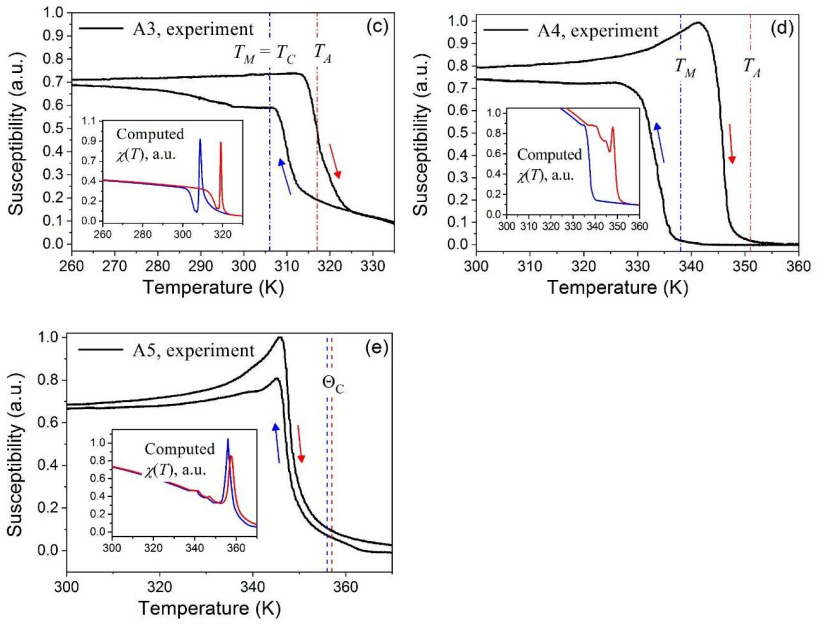
Ferromagnetic solids acquire nontrivial magnetic and caloric properties when the temperature of the structural phase transition approaches the Curie point. Deciphering magneto-structural transitions, i.e. determining their characteristic temperatures and elucidating the related properties, remains challenging. In the present paper, three types of transformational behaviour of Ni50Mn25-xCuxGa25 (x = 6.25, 6.5, 6.75, 7) and Ni50.5Mn18.5Cu6.5Ga24.5 alloys have been identified, arising from small variations in chemical composition: (i) structural martensitic transformation (MT) in the ferromagnetic phase; (ii) magneto-structural phase transition from paramagnetic austenite to ferromagnetic martensite; (iii) MT in paramagnetic phase. The temperature-dependent values of magnetization, M(T), and of magnetic susceptibility, $\chi(T)$, were measured for each alloy. A novel thermodynamic analysis was used to determine the Curie points and MT temperatures. The novelty lies in considering the interplay between structural and magnetic characteristics of the alloys through the impact of the structural transition on the spin-exchange parameter. The theoretical analysis of experimental data revealed that this impact results in a large difference ($\geq$ 50 K) between the Curie temperatures computed for the austenitic and martensitic states of each alloy. The characteristic temperatures, corresponding to the extrema of the dM(T)/dT and $\chi(T)$ functions, were calculated. The correlation of these temperatures with the Curie temperatures and the MT temperatures is not straightforward and depends strongly on the type of transformational behaviour (i) - (iii). The proposed approach provides a robust framework for extracting unmeasurable characteristic temperatures from standard magnetization data, applicable to ferromagnetic Heusler systems and other multiferroic ferromagnetic materials.
Editorial analysis
A structured set of objections, weighed in public.
Referee Report
Summary. The paper reports measurements of M(T) and χ(T) on Ni50Mn25-xCuxGa25 (x = 6.25, 6.5, 6.75, 7) and Ni50.5Mn18.5Cu6.5Ga24.5 Heusler alloys and classifies three distinct magneto-structural transformational regimes arising from small composition changes. A thermodynamic model is introduced that incorporates the effect of the martensitic transition on the spin-exchange parameter; this model is used to extract separate Curie temperatures for the austenitic and martensitic states, yielding a reported difference of at least 50 K. Characteristic temperatures are also obtained from extrema of dM/dT and χ(T) and their correlation with the transition type is discussed.
Significance. If the separation of austenite and martensite Curie temperatures can be shown to be robust and independent of fitting assumptions, the approach would supply a practical route to obtain otherwise inaccessible characteristic temperatures from routine bulk magnetization data. This would be useful for the design of Heusler alloys exhibiting coupled transitions and large caloric effects. The classification of three behavioral types as a function of composition is also of direct materials interest.
major comments (2)
- [thermodynamic analysis section] Thermodynamic analysis (the section introducing the model that accounts for the structural transition’s impact on the spin-exchange parameter): the manuscript states that the structural change produces a ≥50 K shift in Tc but does not supply the explicit free-energy expressions, the functional form chosen for the J shift, or the fitting protocol used to deconvolve the superimposed M(T) curves. Without these details it is impossible to determine whether the reported difference is an independent result or is largely fixed by the assumed functional form.
- [results section] Results and discussion of the extracted Curie temperatures: no cross-validation against local probes (e.g., NMR, neutron diffraction, or composition-tuned single-phase specimens) or against independent measurements on the same alloys is presented. Given that the measured magnetization is a superposition near the coupled transition, the magnitude of the claimed ≥50 K difference remains under-constrained without additional constraints or external checks.
minor comments (2)
- [abstract and introduction] The abstract and introduction refer to “the extrema of the dM(T)/dT and χ(T) functions” without specifying whether these are local maxima, minima, or inflection points; a brief clarification of the precise definition used would improve reproducibility.
- [figures and discussion] Figure captions and text occasionally interchange “Curie temperature” and “characteristic temperature” without explicit mapping; consistent terminology would reduce ambiguity when the correlation between the two is discussed.
Simulated Author's Rebuttal
We thank the referee for the careful and constructive review. The comments highlight important aspects of clarity and validation that we address point by point below. We will revise the manuscript to improve transparency while maintaining the focus on the thermodynamic approach applied to bulk data.
read point-by-point responses
-
Referee: [thermodynamic analysis section] Thermodynamic analysis (the section introducing the model that accounts for the structural transition’s impact on the spin-exchange parameter): the manuscript states that the structural change produces a ≥50 K shift in Tc but does not supply the explicit free-energy expressions, the functional form chosen for the J shift, or the fitting protocol used to deconvolve the superimposed M(T) curves. Without these details it is impossible to determine whether the reported difference is an independent result or is largely fixed by the assumed functional form.
Authors: We agree that the explicit details of the model were insufficiently elaborated. The thermodynamic framework is a Landau expansion coupling the structural order parameter to the magnetic exchange J, with J taking distinct values in the austenite and martensite phases. The shift in J is taken as a step change at the martensitic transition temperature, and the total magnetization is obtained by weighting the contributions from each phase according to the temperature-dependent phase fraction. Fitting is performed by least-squares minimization against the measured M(T) curves, with Tc^A and Tc^M as adjustable parameters. In the revised manuscript we will add the full free-energy expression, the precise functional form for the J shift, and a step-by-step description of the fitting protocol in a new appendix. We will also include a brief sensitivity test using an alternative (linear) coupling form to show that the ≥50 K difference remains required to reproduce the data. revision: yes
-
Referee: [results section] Results and discussion of the extracted Curie temperatures: no cross-validation against local probes (e.g., NMR, neutron diffraction, or composition-tuned single-phase specimens) or against independent measurements on the same alloys is presented. Given that the measured magnetization is a superposition near the coupled transition, the magnitude of the claimed ≥50 K difference remains under-constrained without additional constraints or external checks.
Authors: We concur that independent validation would strengthen the quantitative claim. The present study is restricted to standard bulk magnetization and susceptibility measurements; no local-probe or single-phase data were acquired. The model is constrained by the observed shapes of M(T) and χ(T) together with the independently measured structural transition temperatures. In the revision we will add an explicit paragraph discussing this limitation, noting that the large Tc difference is required to fit the distinct magnetic regimes on either side of the coupled transition and that the consistency across the four compositions provides internal support. We cannot, however, supply new experimental cross-validation within the scope of this work. revision: partial
- Cross-validation of the extracted Curie temperatures against local probes (NMR, neutron diffraction) or independent measurements on single-phase specimens, as such data were not collected in the present study.
Circularity Check
Tc(austenite) vs Tc(martensite) difference obtained by fitting thermodynamic model with assumed J jump to the same M(T)/χ(T) curves
specific steps
-
fitted input called prediction
[Abstract]
"The novelty lies in considering the interplay between structural and magnetic characteristics of the alloys through the impact of the structural transition on the spin-exchange parameter. The theoretical analysis of experimental data revealed that this impact results in a large difference (≥ 50 K) between the Curie temperatures computed for the austenitic and martensitic states of each alloy."
The model incorporates the structural transition's effect on the spin-exchange parameter as an adjustable feature; the reported ≥50 K Tc difference is then computed from the same M(T) and χ(T) data to which the model is fitted. The difference is therefore forced by the chosen functional form and parameter adjustment rather than emerging as an independent result.
full rationale
The paper's central result (≥50 K difference) is obtained by fitting a thermodynamic model that encodes the structural transition's effect on the spin-exchange parameter directly to the measured magnetization and susceptibility curves. The extracted difference is therefore a direct output of the fit parameters rather than an independent prediction or external verification. No cross-check against local probes or single-phase samples is described, so the magnitude is not shown to be robust to alternative functional forms.
Axiom & Free-Parameter Ledger
free parameters (1)
- spin-exchange parameter shift
axioms (1)
- domain assumption Magnetization and susceptibility extrema correspond to characteristic transition temperatures in a manner that depends on the relative ordering of magnetic and structural transitions.
Lean theorems connected to this paper
-
IndisputableMonolith/Cost/FunctionalEquation.leanwashburn_uniqueness_aczel contradicts?
contradictsCONTRADICTS: the theorem conflicts with this paper passage, or marks a claim that would need revision before publication.
J(T) = J_ex + ΔJ(T) with ΔJ(T) = j_0 [1 + tanh((T - T_tr)/ΔT_tr)] / 2; Gibbs free energy minimization yielding separate Curie temperatures T_C and Θ_C differing by ≥50 K (Eqs. 2,5,6 and Table 2).
-
IndisputableMonolith/Foundation/RealityFromDistinction.leanreality_from_one_distinction contradicts?
contradictsCONTRADICTS: the theorem conflicts with this paper passage, or marks a claim that would need revision before publication.
Thermodynamic model fitted to M(T) and χ(T) data with one adjustable parameter j_0/J_ex per alloy (Table 2).
What do these tags mean?
- matches
- The paper's claim is directly supported by a theorem in the formal canon.
- supports
- The theorem supports part of the paper's argument, but the paper may add assumptions or extra steps.
- extends
- The paper goes beyond the formal theorem; the theorem is a base layer rather than the whole result.
- uses
- The paper appears to rely on the theorem as machinery.
- contradicts
- The paper's claim conflicts with a theorem or certificate in the canon.
- unclear
- Pith found a possible connection, but the passage is too broad, indirect, or ambiguous to say the theorem truly supports the claim.
Reference graph
Works this paper leans on
-
[1]
Vopson, Fundamentals of multiferroic mater ials and their possible applications, Crit
M.M. Vopson, Fundamentals of multiferroic mater ials and their possible applications, Crit. Rev. Solid State Mater. Sci. 40 (2015) 223–250. https://doi.org/10.1080/10408436.2014.992584
-
[2]
L.H. Lewis, C.H. Marrows, S. Langridge, Coupled magnetic, structural, and electronic phase transitions in FeRh, J. Phys. D: Appl. Phys. 49 (2016) 323002. https://d oi.org/10.1088/0022- 3727/49/32/323002
-
[3]
Sánchez-Valdés, et al., The effect of cool ing rate on magnetothermal properties of Fe49Rh51, J
C.F. Sánchez-Valdés, et al., The effect of cool ing rate on magnetothermal properties of Fe49Rh51, J. Magn. Magn. Mater. 498 (2020) 166130. https://doi.org/10.1016/j.jmmm.2019.166130
-
[4]
F. Long, Y. Song, J. Chen, La(Fe,Si/Al)13-based materials with exceptional magnetic functionalities: A review, Microstructures 4 (2024) 2024011. http://dx.doi.org/10.20517/microstructures.2023.58
-
[5]
A. Vinod, D. Arvindha Babu, M. Wuppulluri, A sh ort review on the evolution of magnetocaloric La (Fe, Si)13 and its fabrication th rough melt spinning, ACS Omega 9 (2024) 11110 –11128. https://doi.org/10.1021/acsomega.3c08622
-
[6]
X.F. Miao, et al., Overview of magnetoelastic coupling in (Mn, Fe)₂(P, Si)-type magnetocaloric materials , Rare Met. 37 (2018) 723–733. https://doi.org/10.1007/s12598-018-1090-2
-
[7]
Zhang, et al., Magnetocaloric effect in the (Mn, Fe)₂(P, Si) system: From bulk to nano, Acta Mater
F. Zhang, et al., Magnetocaloric effect in the (Mn, Fe)₂(P, Si) system: From bulk to nano, Acta Mater. 224 (2022) 117532. https://doi.org/10.1016/j.actamat.2021.117532
-
[8]
Z. Wang, et al., Insights into reduction of hys teresis in (Mn, Fe) 2(P, Si) compounds by experimental approach and Landau theory, Materialia 37 (2024) 102195. https://doi.org/10.1016/j.mtla.2024.102195
-
[9]
A. Planes, L. Mañosa, M. Acet, Magnetocaloric effect and its relation to shape-mem ory properties in ferromagnetic Heusler alloys, J. Phys .: Condens. Matter 21 (2009) 233201. https://doi.org/10.1088/0953-8984/21/23/233201
-
[10]
L. Mañosa, A. Planes, Elastocaloric effect in shape-memory alloys, Shape Mem. Superelasticity 10 (2024) 89–98. https://doi.org/10.1007/s40830-024-00477-x
-
[11]
A. Gràcia-Condal, et al., Multicaloric effects in metamagnetic Heusler Ni-Mn-In under uniaxial stress and magnetic field, Appl. Phys. Rev . 7 (2020) 041401. https://doi.org/10.1063/5.0020755 23
-
[12]
H.L. Yan, X.M. Huang, C. Esling, Recent progre ss in crystallographic characterization, magnetoresponsive and elastocaloric effects of Ni-Mn-In-based Heusler alloys—a review, Front. Mater. 9 (2022) 812984. https://doi.org/10.3389/fmats.2022.812984
-
[13]
D. Pal, K. Mandal, O. Gutfleisch, Large negati ve magnetoresistance in nickel-rich Ni–Mn– Ga Heusler alloys , J. Appl. Phys. 107 (2010) 09A921. https://doi.org/10.1063/1.3350912
-
[14]
T. Zheng, et al., Large magnetocaloric and mag netoresistance effects during martensitic transformation in Heusler-type Ni44Co6Mn37In13 allo y . J. Magn. Magn. Mater. 563 (2022) 170034. https://doi.org/10.1016/j.jmmm.2022.170034
-
[15]
Ullakko, et al., Large magnetic-field-induc ed strains in Ni₂MnGa single crystals, Appl
K. Ullakko, et al., Large magnetic-field-induc ed strains in Ni₂MnGa single crystals, Appl. Phys. Lett. 69 (1996) 1966–1968. https://doi.org/10.1063/1.117637
-
[16]
S.J. Murray, et al., Large field induced strai n in single crystalline Ni–Mn–Ga ferromagnetic shape memory alloy, J. Appl. Phys. 87 (2000) 5774 . https://doi.org/10.1063/1.372518
-
[17]
Sozinov, et al., Giant magnetic-field-induced strain in NiMnGa seven-layered martensitic phase, Appl
A. Sozinov, et al., Giant magnetic-field-induced strain in NiMnGa seven-layered martensitic phase, Appl. Phys. Lett. 80 (2002) 1746–1748. https://doi.org/10.1063/1.1458075
-
[18]
Albertini, et al., Magnetoelastic effects and magnetic anisotropy in Ni₂MnGa polycrystals, J
F. Albertini, et al., Magnetoelastic effects and magnetic anisotropy in Ni₂MnGa polycrystals, J. Appl. Phys. 89 (2001) 5614–5617. https://doi.org/10.1063/1.1350630
-
[19]
Barandiarán, et al., Magnetostriction in the vicinity of structural transitions in Ni₂MnGa, Appl
J.M. Barandiarán, et al., Magnetostriction in the vicinity of structural transitions in Ni₂MnGa, Appl. Phys. Lett. 100 (2012) 262410. https://doi.org/10.1063/1.4732483
-
[20]
T. Sakon, Y. Adachi, T. Kanomata, Magneto-structural properties of Ni₂MnGa ferromagnetic shape memory alloy in magnetic fields, Metals 3 (20 13) 202–224. https://doi.org/10.3390/met3020202
-
[21]
Ullakko, et al., Magnetically controlled sh ape memory effect in Ni₂MnGa intermetallics , Scr
K. Ullakko, et al., Magnetically controlled sh ape memory effect in Ni₂MnGa intermetallics , Scr. Mater. 36 (1997) 1133–1138. https://doi.org/10.1016/S1359-6462(96)00483-6
-
[22]
Planes, et al., Caloric and multicaloric effects in shape memory alloys, Mater
A. Planes, et al., Caloric and multicaloric effects in shape memory alloys, Mater. Today: Proc. 2 (2015) S477–S484. https://doi.org/10.1016/j.matpr.2015.07.332
-
[23]
F. Albertini, et al., Magnetocaloric propertie s and magnetic anisotropy by tailoring phase transitions in NiMnGa alloys, Mater. Sci. Forum 583 (2008) 169–196. https://doi.org/10.4028/www.scientific.net/MSF.583.169
- [24]
-
[25]
M. Takhsha, et al., Magnetic Shape-Memory Heuslers Turn to Bio: Cytocompatibility of Ni– Mn–Ga Films and Biomedical Perspective, ACS Appl. B io Mater. 6 (2023) 5009–5017. https://doi.org/10.1021/acsabm.3c00691
-
[26]
M. Takhsha, et al., Self-regulating magnetic h yperthermia by magnetostructural phase transformation of magnetic-shape-memory Ni–Mn–Cu–Ga Heusler-type particles , Mater. Today Chem. 48 (2025) 103006. https://doi.org/10.1016/j.mtchem.2025.103006
-
[27]
A. Kosogor, et al., Strong influence of magnet ic field and non‑uniform stress on elastic modulus and transition temperatures of twinned Ni–Fe(Co)–Ga alloy, Sci. Rep. 14 (2024) 12199. https://doi.org/10.1038/s41598-024-62909-z
-
[28]
A. Biswas, et al., Unusual first-order magneti c phase transition and large magnetocaloric effect in Nd2In, Phys. Rev. Mater. 6 (2022) 114406. https://doi.org/10.1103/PhysRevMaterials.6.114406
-
[29]
V.A. L'vov, O. Salyuk, A. Kosogor, Thermodynam ic analysis of magnetocaloric properties of ferromagnet undergoing structural phase transition near Curie temperature, Sci. Rep. 15 (2025) 31002. https://doi.org/10.1038/s41598-025-15896-8
-
[30]
Chernenko, et al., Ferromagnetism of thermoelastic martensites: Theory and experiment, Phys
V.A. Chernenko, et al., Ferromagnetism of thermoelastic martensites: Theory and experiment, Phys. Rev. B 67 (2003) 064407. https://doi.org/10.1103/PhysRevB.67.064407
-
[31]
M. Kataoka, et al., Martensitic transition, fe rromagnetic transition, and their interplay in the shape memory alloys Ni2Mn1−xCuxGa, Phys. Rev. B 82 (2010) 214423. https://doi.org/10.1103/PhysRevB.82.214423
-
[32]
Endo, et al., Magnetic Phase Diagram of the Ferromagnetic Shape Memory Alloys Ni2MnGa1-xCux, Mater
K. Endo, et al., Magnetic Phase Diagram of the Ferromagnetic Shape Memory Alloys Ni2MnGa1-xCux, Mater. Sci. Forum 684 (2011) 165–176 . https://doi.org/10.4028/www.scientific.net/MSF.684.165
-
[33]
A. Kosogor, et al., Magnetocaloric Effect Caused by Paramagnetic Austenite–Ferromagnetic Martensite Phase Transformation. Metals 9 (2019) 11. https://doi.org/10.3390/met9010011
-
[34]
D. Dzekan, et al., Efficient and affordable thermomagnetic materials for harvesting low grade waste heat, APL Mater. 9 (2021) 011105. https://doi.org/10.1063/5.0033970
-
[35]
F. Cugini, et al., In-operando test of tunable Heusler alloys for thermomagnetic harvesting of low-grade waste heat, Acta Mater. 288 (2025) 120847 . https://doi.org/10.1016/j.actamat.2025.120847 25
-
[36]
Gueltig, et al., High frequency thermal ene rgy harvesting using magnetic shape memory films , Adv
M. Gueltig, et al., High frequency thermal ene rgy harvesting using magnetic shape memory films , Adv. Energy Mater. 4 (2014) 1400751. https://doi.org/10.1002/aenm.201400751
-
[37]
Gueltig, et al., Thermomagnetic actuation b y low hysteresis metamagnetic Ni-Co-Mn-In films, Mater
M. Gueltig, et al., Thermomagnetic actuation b y low hysteresis metamagnetic Ni-Co-Mn-In films, Mater. Today: Proc. 2 (2015) S883–S886. https://doi.org/10.1016/j.matpr.2015.07.423
-
[38]
M. Gueltig, et al., Thermal energy harvesting by high frequency actuation of magnetic shape memory alloy films, Transducers 2015, IEEE, 2015, p p. 718–721. https://doi.org/10.1109/TRANSDUCERS.2015.7181024
-
[39]
J. Joseph, et al., Upscaling of thermomagnetic generators based on Heusler alloy films, Joule 4 (2020) 2718–2732. https://doi.org/10.1016/j.joule.2020.10.019
-
[40]
Gueltig, et al., High‐Performance Thermomag netic Generators Based on Heusler Alloy Films, Adv
M. Gueltig, et al., High‐Performance Thermomag netic Generators Based on Heusler Alloy Films, Adv. Energy Mater. 7 (2017) 1601879. https://doi.org/10.1002/aenm.201601879
-
[41]
Joseph, et al., Resonant Self-Actuation Bas ed on Bistable Microswitching , Actuators 12 (2023) 245
J. Joseph, et al., Resonant Self-Actuation Bas ed on Bistable Microswitching , Actuators 12 (2023) 245. https://doi.org/10.3390/act12060245
-
[42]
V.A. L'vov, O. Salyuk, Thermodynamic model of quasi -first-order paramagnetic– ferromagnetic phase transition and giant magnetocaloric effect, Low Temp. Phys. 51 (2025) 300– 305 . https://doi.org/10.1063/10.0035811
- [43]
-
[44]
R. Tickle, R.D. James, Magnetic and magnetomec hanical properties of Ni2MnGa, J. Magn. Magn. Mater. 195 (1999) 627–638. https://doi.org/10.1016/S0304-8853(99)00292-9
-
[45]
Entel, et al., Modelling the phase diagram of magnetic shape memory Heusler alloys, J
P. Entel, et al., Modelling the phase diagram of magnetic shape memory Heusler alloys, J. Phys. D: Appl. Phys. 39 (2006) 865. https://doi.org/10.1088/0022-3727/39/5/S13
-
[46]
Kanomata, et al., Magnetic Moment of Cu-Modified Ni2MnGa, Metals 3 (2013) 114–122
T. Kanomata, et al., Magnetic Moment of Cu-Modified Ni2MnGa, Metals 3 (2013) 114–122. https://doi.org/10.3390/met3010114
-
[47]
D. R. Baigutlin, et al., Electronic structure beyond the generalized gradient approximation for Ni₂MnGa, Phys. Rev. B 102 (2020) 045127. https://doi.org/10.1103/PhysRevB.102.045127
-
[48]
J. Janovec, et al., Localization versus deloca lization of d-states within the Ni₂MnGa Heusler alloy, Sci. Rep. 12 (2022) 20577. https://doi.org/10.1038/s41598-022-23575-1
- [49]
-
[50]
P. J. Brown, et al., Direct observation of a b and Jahn–Teller effect in the martensitic phase transition of Ni₂MnGa, J. Phys.: Condens. Matter 11 (1999) 4715. https://doi.org/10.1088/0953- 8984/11/24/312
-
[51]
A. Planes, Controlling the martensitic transition in Heusler shape-memory materials, Physics 3 (2010) 36
work page 2010
-
[52]
A. Gonzalez-Comas, et al., Premartensitic and martensitic phase transitions in ferromagnetic Ni₂MnGa, Phys. Rev. B 60 (1999) 7085. https://doi.org/10.1103/PhysRevB.60.7085
-
[53]
Zheludev, et al., Precursor effects and pre martensitic transformation in Ni₂MnGa, Phys
A. Zheludev, et al., Precursor effects and pre martensitic transformation in Ni₂MnGa, Phys. Rev. B 54 (1996) 15045. https://doi.org/10.1103/PhysRevB.54.15045
-
[54]
G. Li, L. Xu, Z. Cao, A unified physical mecha nism for martensitic phase transition and ductility in Ni–Mn-based ferromagnetic shape memory alloys: the case of Cu-doped Ni₂MnGa, J. Mater. Chem. C 11 (2023) 6173–6182. https://doi.org/10.1039/D3TC00769C
-
[55]
S. Roy, et al., Delocalization and hybridizati on enhance the magnetocaloric effect in Cu- doped Ni2MnGa, Phys. Rev. B 79 (2009) 235127. https://doi.org/10.1103/PhysRevB.79.235127
-
[56]
D.E. Newbury, N.W. Ritchie, Performing element al microanalysis with high accuracy and high precision by scanning electron microscopy/sili con drift detector energy-dispersive X-ray spectrometry (SEM/SDD-EDS), J. Mater. Sci. 50 (2015 ) 493–518, https://doi.org/10.1007/s10853-014-8685-2
-
[57]
Wirth, et al., Structural and magnetic properties of Ni2MnGa, J
S. Wirth, et al., Structural and magnetic properties of Ni2MnGa, J. Magn. Magn. Mater. 167 (1997) L7–L11. https://doi.org/10.1016/S0304-8853(96)00745-7
-
[58]
T. Eto, et al., Martensitic and magnetic trans itions in Ni2+ xMnGa1 − x ferromagn etic shape memory alloys, J. Alloys Compd. 871 (2021) 159480. https://doi.org/10.1016/j.jallcom.2021.159480
-
[59]
V.D. Buchelnikov, et al., Influence of volume magnetostriction on the T–x phase diagram of shape memory Ni2+ xMn1 − xGa alloys, J. Magn. Magn. Mater. 290 (2005) 854 –856. https://doi.org/10.1016/j.jmmm.2004.11.393
-
[60]
A.A. Mendonça, et al., Experimentally correlating thermal hysteresis and phase compatibility in multifunctional Heusler alloys. Phys. Rev. Mater . 4 (2020) 114403. https://doi.org/10.1103/PhysRevMaterials.4.114403
-
[61]
J. Cui, et al., Combinatorial search of thermo elastic shape-memory alloys with extremely small hysteresis width, Nat. Mater. 5 (2006), 286–290 https://doi.org/10.1038/nmat1593
discussion (0)
Sign in with ORCID, Apple, or X to comment. Anyone can read and Pith papers without signing in.