Recognition: 1 theorem link
· Lean TheoremMulti-place shifted nonlocal reductions of a multi-component AKNS system
Pith reviewed 2026-05-12 01:46 UTC · model grok-4.3
The pith
Shifted nonlocal reductions on a multi-component AKNS system yield 23 new nonlocal nonlinear Schrödinger equations.
A machine-rendered reading of the paper's core claim, the machinery that carries it, and where it could break.
Core claim
By imposing 23 distinct shifted nonlocal reduction formulas on the multi-component AKNS system the authors obtain new integrable shifted nonlocal nonlinear Schrödinger equations. One-soliton solutions of the AKNS system reduce directly to solutions of these new equations, and the reduced solutions remain nonsingular when the parameters lie in certain intervals.
What carries the argument
Shifted nonlocal reduction formulas that relate components of the AKNS system at spatially or temporally shifted positions, thereby lowering the number of independent fields while introducing nonlocality.
If this is right
- The new equations are integrable and possess explicit one-soliton solutions obtained by reduction.
- Nonsingular soliton solutions exist for admissible parameter intervals.
- The same reduction technique generates both two-place and four-place nonlocal models from a single starting system.
- Singularity analysis restricts the physically viable parameter regimes for each equation.
Where Pith is reading between the lines
- The same shifted-reduction technique could be applied to other multi-component integrable systems to produce additional families of nonlocal equations.
- The nonsingular solitons may serve as test cases for numerical schemes in models of optical or fluid systems with delayed or shifted feedback.
- Four-place nonlocalities suggest possible extensions to interaction networks with multiple distinct delay points.
Load-bearing premise
The chosen shifted nonlocal reduction formulas produce consistent, well-defined equations that inherit integrability from the AKNS system and whose solutions are nonsingular for at least some parameter values.
What would settle it
A direct substitution showing that a reduced one-soliton solution fails to satisfy one of the new nonlocal equations for every choice of parameters, or an explicit check that the reduced system cannot be derived from the original AKNS Lax pair.
Figures






read the original abstract
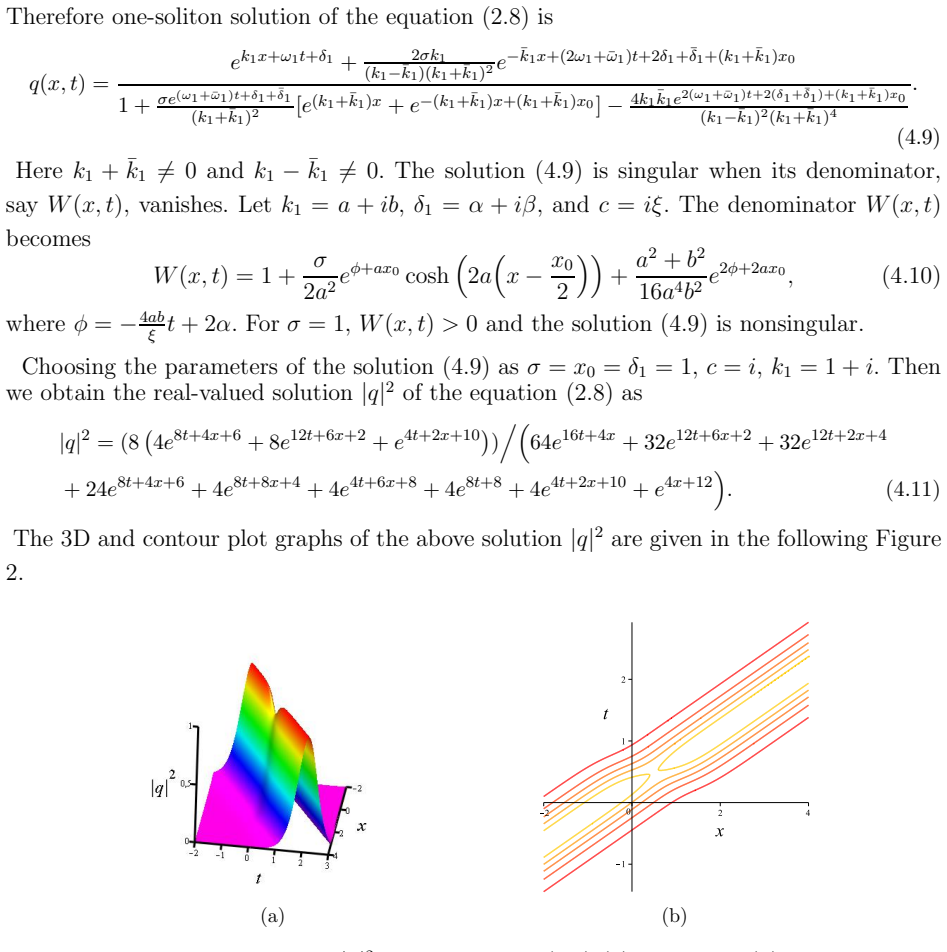
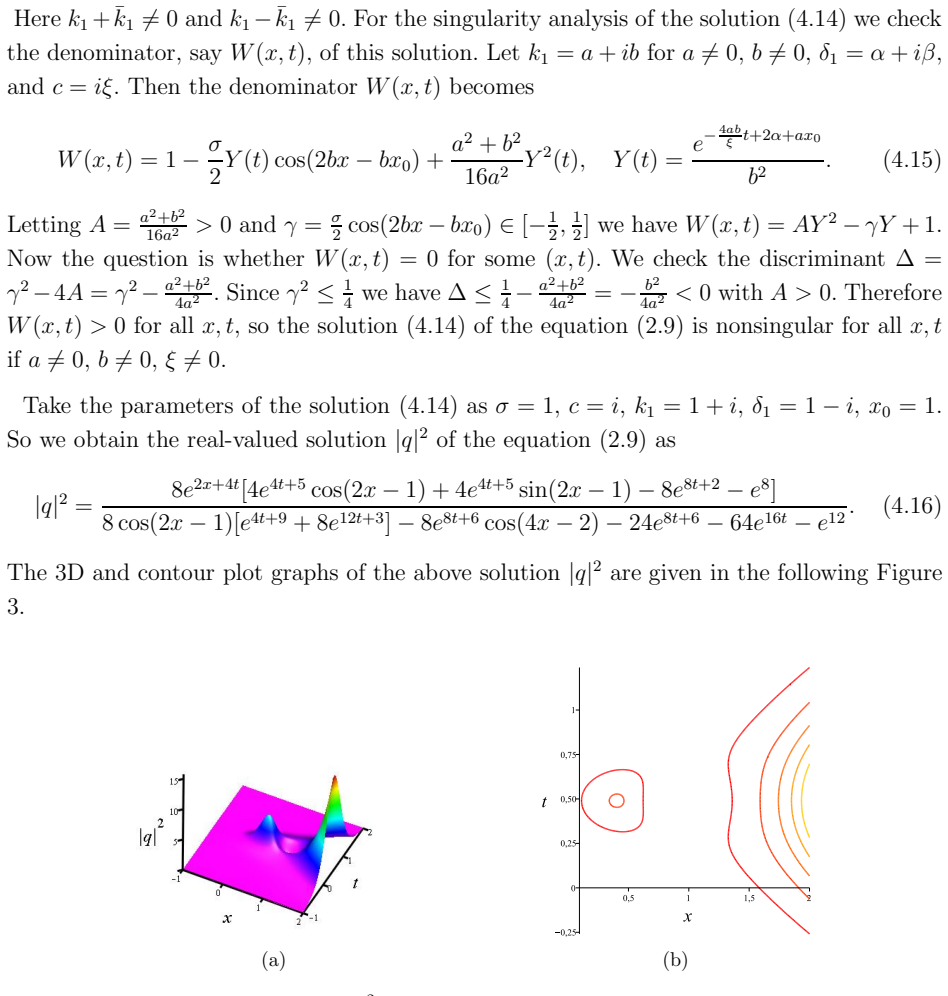
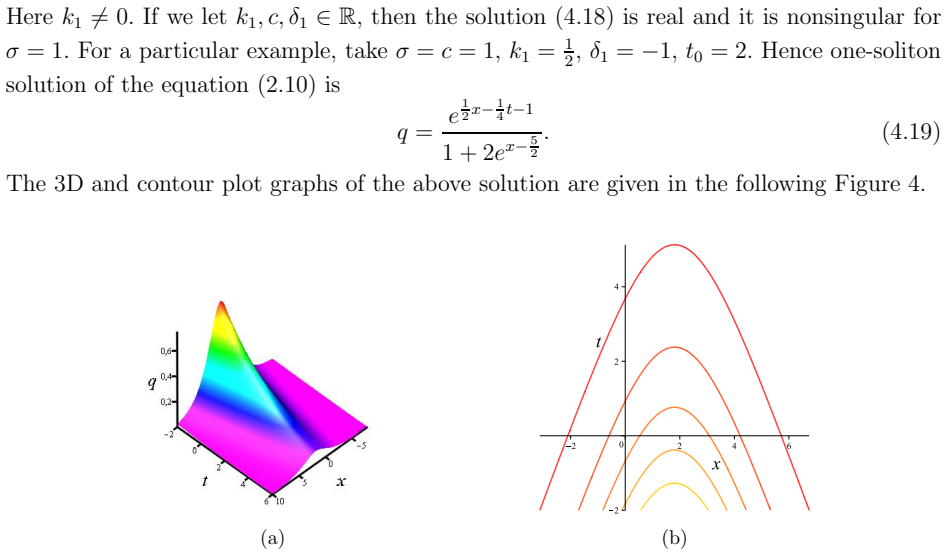
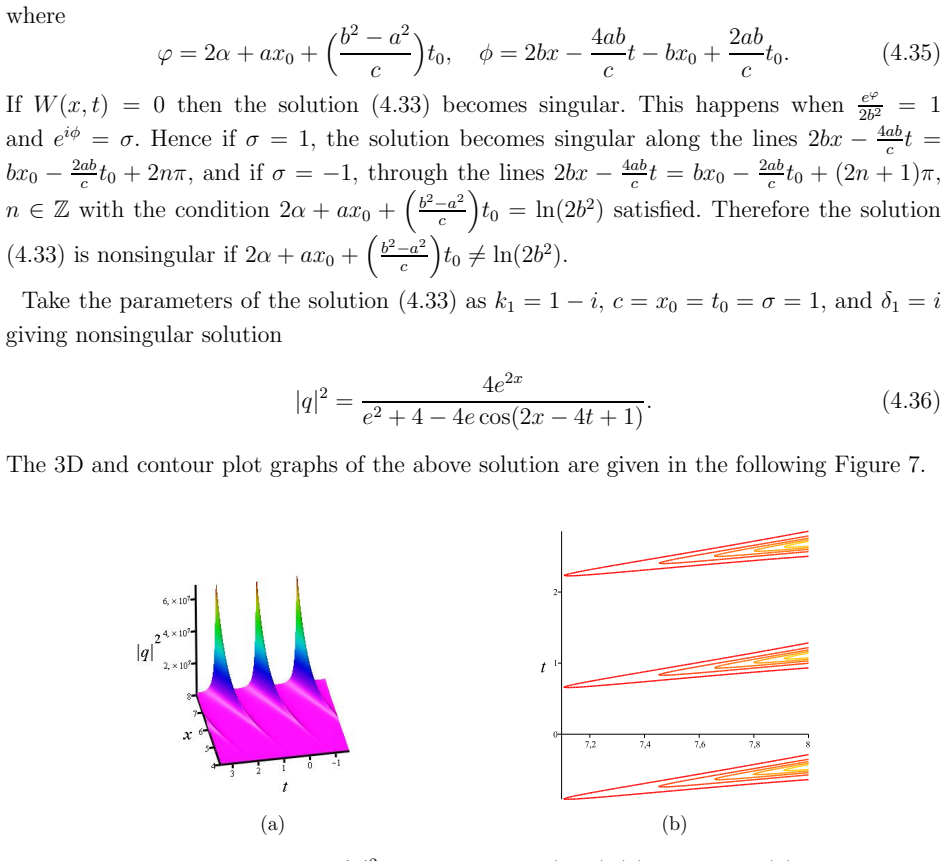
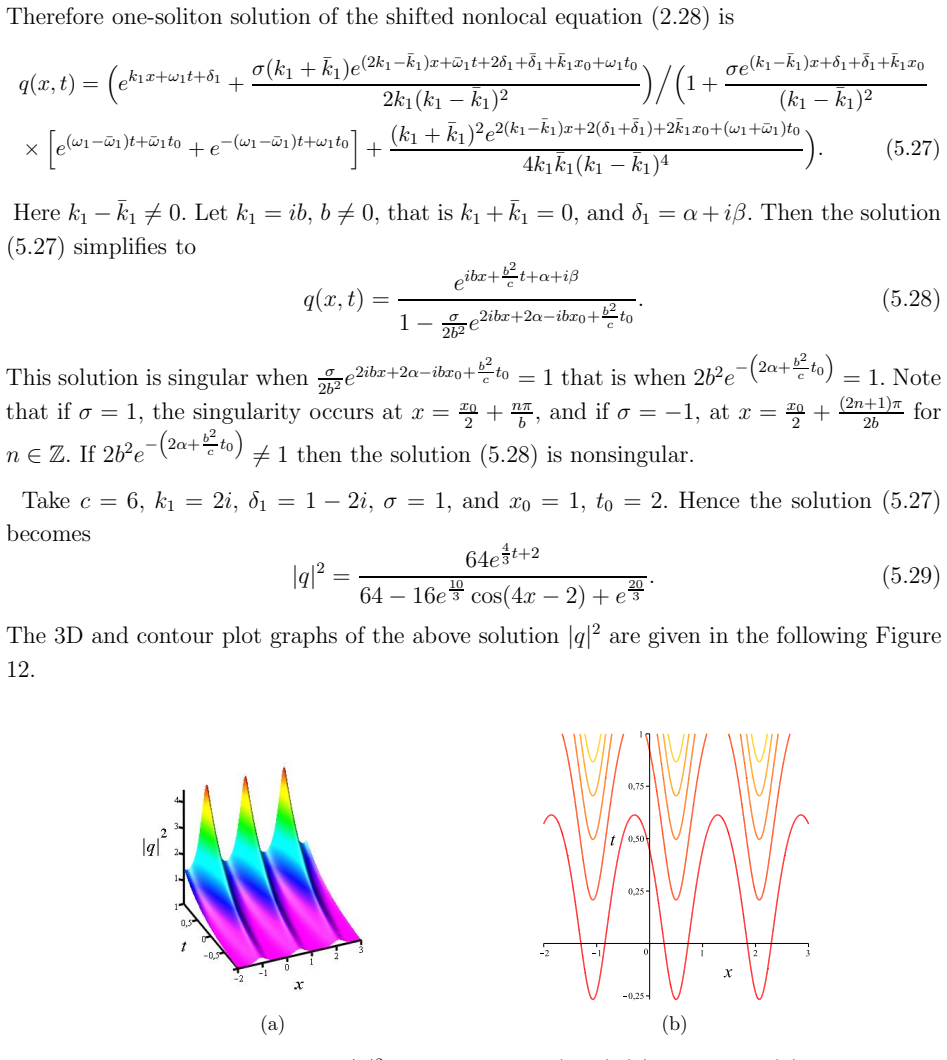
Starting from a multi-component AKNS system, we obtain new shifted nonlocal nonlinear Schr\"{o}dinger equations. We find 13 different shifted nonlocal nonlinear Schr\"{o}dinger equations with two-place nonlocalities and 10 shifted nonlocal nonlinear Schr\"{o}dinger equations with four-place nonlocalities. We first obtain one-soliton solutions of the multi-component AKNS system by the Hirota method. Applying the shifted nonlocal reduction formulas to this solution, we obtain one-soliton solutions for the shifted nonlocal nonlinear Schr\"{o}dinger equations. In cases yielding nontrivial solutions, we discuss the singularity structures of the solutions and show that the one-soliton solutions we obtain are nonsingular for certain values of the parameters. We plot representative nonsingular solutions obtained for admissible parameter values.
Editorial analysis
A structured set of objections, weighed in public.
Referee Report
Summary. The manuscript starts from a multi-component AKNS system and applies shifted nonlocal reduction formulas to derive new shifted nonlocal nonlinear Schrödinger equations. It enumerates 13 distinct two-place nonlocal NLS equations and 10 four-place ones, constructs one-soliton solutions of the parent system via the Hirota bilinear method, substitutes the reduction formulas to obtain solutions of the reduced equations, and analyzes singularity structures, identifying parameter values that yield nonsingular solutions with representative plots.
Significance. If the reductions and solution inheritance hold, the work adds a systematic catalog of multi-place shifted nonlocal integrable equations together with explicit one-soliton solutions and nonsingularity conditions. The direct inheritance of solutions from the unreduced system and the parameter-dependent singularity discussion provide concrete, usable examples that can support further analysis of nonlocal integrable systems.
minor comments (4)
- The abstract states the counts of 13 and 10 equations but does not indicate whether a table or explicit list of the reduction formulas and resulting PDEs appears in the main text; adding such a summary table would allow readers to verify the enumeration and distinctness of the cases.
- Section describing the Hirota bilinearization of the multi-component AKNS system should include the explicit bilinear equations and the form of the one-soliton ansatz before reduction, to make the substitution step fully traceable.
- The discussion of singularity structures would benefit from a brief statement of the precise condition on the parameters that guarantees nonsingularity, rather than only stating that such values exist.
- Figure captions should specify the numerical values of all free parameters used in each plotted solution so that the nonsingular cases can be reproduced.
Simulated Author's Rebuttal
We thank the referee for the careful reading and positive evaluation of our manuscript, including the recommendation for minor revision. No specific major comments were provided in the report, so we have no detailed point-by-point responses to address. We will incorporate any minor editorial or presentational improvements in the revised version.
Circularity Check
No significant circularity; direct constructive reductions
full rationale
The derivation applies explicit shifted nonlocal reduction formulas to the multi-component AKNS system and substitutes the resulting constraints into its Hirota-derived one-soliton solutions. The enumeration of 13 two-place and 10 four-place equations follows from exhaustive checking of consistent reductions that yield nontrivial, nonsingular solutions for admissible parameters. This is a standard constructive procedure: any solution of the parent system satisfying the reduction relations is automatically a solution of the reduced system. No parameter fitting, self-definition of terms, load-bearing self-citations, or renaming of known results occurs. The central claims remain independent of the paper's own inputs.
Axiom & Free-Parameter Ledger
axioms (1)
- domain assumption The multi-component AKNS system admits a Hirota bilinear representation and one-soliton solutions.
Lean theorems connected to this paper
-
IndisputableMonolith/Cost/FunctionalEquation.leanwashburn_uniqueness_aczel unclear?
unclearRelation between the paper passage and the cited Recognition theorem.
Starting from a multi-component AKNS system, we obtain new shifted nonlocal nonlinear Schrödinger equations... 13 different... two-place... 10... four-place
What do these tags mean?
- matches
- The paper's claim is directly supported by a theorem in the formal canon.
- supports
- The theorem supports part of the paper's argument, but the paper may add assumptions or extra steps.
- extends
- The paper goes beyond the formal theorem; the theorem is a base layer rather than the whole result.
- uses
- The paper appears to rely on the theorem as machinery.
- contradicts
- The paper's claim conflicts with a theorem or certificate in the canon.
- unclear
- Pith found a possible connection, but the passage is too broad, indirect, or ambiguous to say the theorem truly supports the claim.
Reference graph
Works this paper leans on
-
[1]
W. X. Ma, Application of the Riemann–Hilbert approach to the multic omponent AKNS integrable hierarchies, Nonlinear Anal.: Real World Appl. 47, 1–17, 2019
work page 2019
-
[2]
W. X. Ma and R. Zhou, Adjoint symmetry constraints leading to bin ary nonlinearization, J. Nonlinear Math. Phys. 9 (1), 106–126, 2002
work page 2002
-
[3]
H. X. Yang, D. L. Wang, and C. S. Li, The generalized multi-compon ent AKNS hierarchy and N-fold Darboux transformation, Modern Phys. Lett. B 20 (25), 1575–1589, 2006
work page 2006
-
[4]
S. Y. Lou, Multi-place physics and multi-place nonlocal systems, C ommun. Theor. Phys. 72, 057001, 2020. 26
work page 2020
-
[5]
M. J. Ablowitz and Z. H. Musslimani, Integrable nonlocal nonlinear S chr¨ odinger equation, Phys. Rev. Lett. 110, 064105, 2013
work page 2013
-
[6]
M. J. Ablowitz and Z. H. Musslimani, Inverse scattering transfor m for the integrable nonlocal nonlinear Schr¨ odinger equation, Nonlinearity 29, 915–946, 2016
work page 2016
-
[7]
M. J. Ablowitz and Z. H. Musslimani, Integrable nonlocal nonlinear e quations, Stud. Appl. Math. 139 (1), 7–59, 2016
work page 2016
-
[8]
M. J. Ablowitz and Z. H. Musslimani, Integrable space-time shifted nonlocal nonlinear equations, Phys. Lett. A 409, 127516, 2021
work page 2021
-
[9]
M. J. Ablowitz, Z. H. Musslimani, and N. J. Ossi, Inverse scatterin g transform for con- tinuous and discrete space-time shifted integrable equations, Stu d. Appl. Math. 153 (4), e12764, 2024
work page 2024
-
[10]
M. G¨ urses and A. Pekcan, Nonlocal nonlinear Schr¨ odinger eq uations and their soliton solutions, J. Math. Phys. 59, 051501, 2018
work page 2018
-
[11]
M. G¨ urses and A. Pekcan, Nonlocal nonlinear modified KdV equa tions and their soliton solutions, Commun. Nonlinear Sci. Numer. Simulat. 67, 427–448, 2019
work page 2019
-
[12]
M. G¨ urses and A. Pekcan, Nonlocal KdV equations, Phys. Let t. A 384 (35), 126894, 2020
work page 2020
-
[13]
Pekcan, Local and nonlocal (2+1)-dimensional Maccari sy stems and their soliton solutions, Phys
A. Pekcan, Local and nonlocal (2+1)-dimensional Maccari sy stems and their soliton solutions, Phys. Scr. 96 (3), 035217, 2021
work page 2021
-
[14]
M. G¨ urses and A. Pekcan, Soliton solutions of the shifted nonlo cal NLS and MKdV equations, Phys. Lett. A 422, 127793, 2022
work page 2022
-
[15]
M. G¨ urses and A. Pekcan, (2 + 1)-dimensional local and nonloc al reductions of the negative AKNS system: Soliton solutions, Commun. Nonlinear Sci. Num er. Simul. 71, 161–173, 2019
work page 2019
-
[16]
M. G¨ urses, A. Pekcan, and K. Zheltukhin, Discrete symmetries and nonlocal reductions, Phys. Lett. A 384, 120065, 2020
work page 2020
-
[17]
S. Baylı and A. Pekcan, Shifted nonlocal reductions of 5-comp onent Maccari system, Phys. Scr. 101, 015201, 2026
work page 2026
-
[18]
S. Y. Lou, Multi-place physics and multi-place nonlocal systems, Commun. Theoret. Phys. 72, 057001, 2020
work page 2020
-
[19]
S. Y. Lou and F. Huang, Alice-Bob physics: Coherent solutions o f nonlocal KdV systems, Sci. Rep. 7, 869, 2017. 27
work page 2017
-
[20]
S. Y. Lou, Alice-Bob systems, ˆP − ˆT − ˆC symmetry invariant and symmetry breaking soliton solutions, J. Math. Phys. 59, 083507, 2018
work page 2018
-
[21]
W. X. Ma, Soliton hierarchies and soliton solutions of type ( −λ⋆, −λ) reduced nonlocal nonlinear Schr¨ odinger equations of arbitrary even order, Partial Dif. Equ. Appl. Math. 7, 100515, 2023. 28
work page 2023
discussion (0)
Sign in with ORCID, Apple, or X to comment. Anyone can read and Pith papers without signing in.