Recognition: 2 theorem links
· Lean TheoremCyclicity of centers on center manifolds in a 3D chaotic system with a four-wing attractor
Pith reviewed 2026-05-12 01:55 UTC · model grok-4.3
The pith
Hopf points in a four-wing chaotic system produce centers on their center manifolds whose cyclicity raises the lower bound on small limit cycles.
A machine-rendered reading of the paper's core claim, the machinery that carries it, and where it could break.
Core claim
By restricting to the center manifold at the Hopf points and evaluating the sequence of Lyapunov quantities, the authors identify parameter values where the reduced two-dimensional system has a center of positive cyclicity; this proves that at least as many limit cycles bifurcate from those points as the cyclicity indicates, exceeding the earlier lower bound established for the same system.
What carries the argument
Reduction to the center manifold at a Hopf point followed by computation of focal values to resolve the center-focus problem and obtain the cyclicity of the resulting center.
Load-bearing premise
The focal values obtained on the center manifold completely determine the cyclicity, so that higher-order terms and global dynamics do not change the local count of bifurcating limit cycles.
What would settle it
Explicit computation of one more focal value that fails to vanish when the cyclicity prediction requires it, or a numerical branch continuation that locates fewer limit cycles than the claimed cyclicity near the Hopf point.
Figures

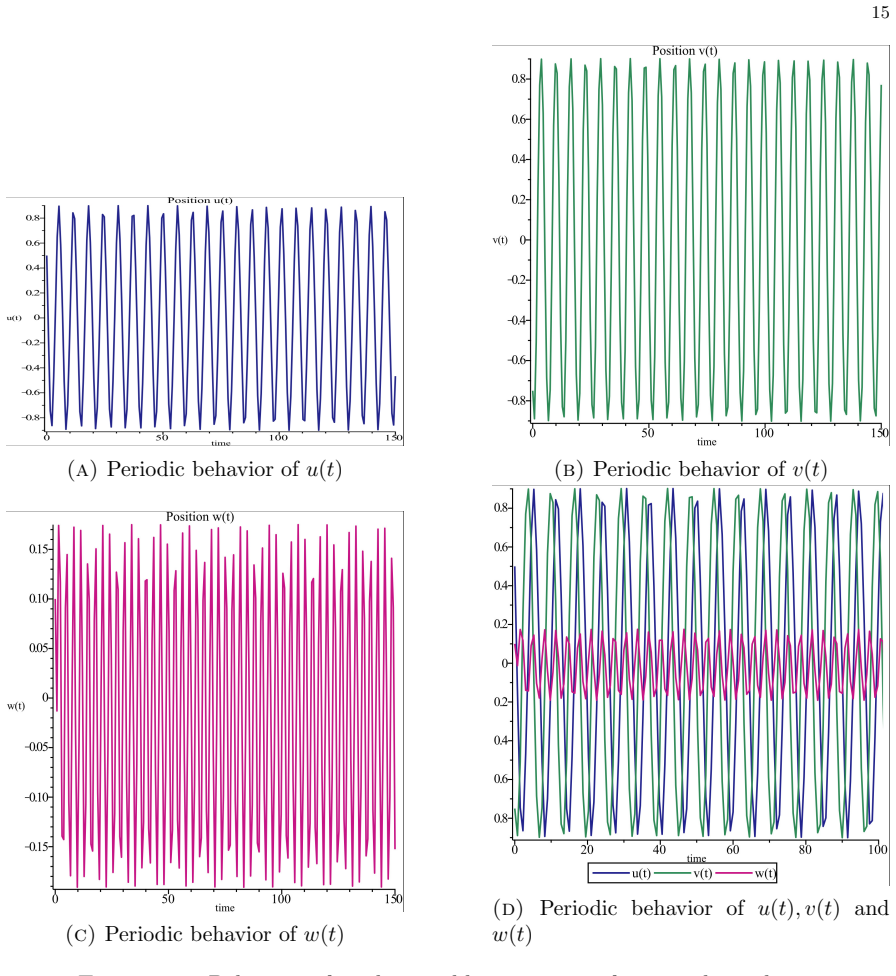
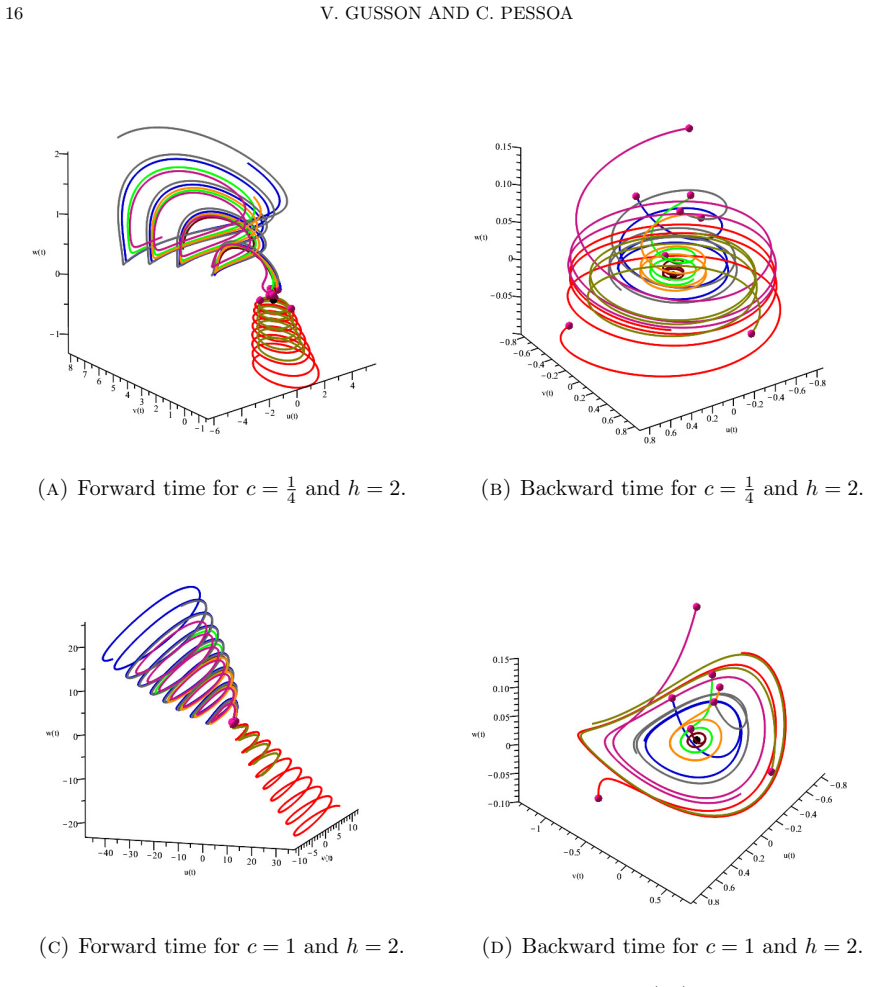


read the original abstract
In this work, we investigate the conditions that guarantee the existence of centers on the center manifold, arising from Hopf points, in the new three-dimensional quadratic chaotic system introduced by B. Khaled et al. in 2024 in the Int. J. Data Netw. Sci. For some of the Hopf points of the system, we solve the center-focus problem on the center manifold, analyzing both its isochronicity and cyclicity. Our results significantly improve the previously known lower bound on the number of limit cycles bifurcating from Hopf points in this system, as established by B. M. Mohammed in 2025 in the Int. J. Bifurc. Chaos Appl. Sci. Eng.
Editorial analysis
A structured set of objections, weighed in public.
Referee Report
Summary. The manuscript investigates the center-focus problem for Hopf points in the three-dimensional quadratic chaotic system with a four-wing attractor introduced by Khaled et al. (2024). After center-manifold reduction, the authors compute Lyapunov quantities (focal values) to identify parameter values at which multiple quantities vanish, thereby solving the center-focus problem for selected Hopf points, determining isochronicity conditions, and claiming an improved lower bound on the number of small-amplitude limit cycles that bifurcate from those points relative to the bound established by Mohammed (2025).
Significance. If the algebraic computations of the focal values and the parameter solutions are correct, the work would raise the known lower bound on cyclicity at Hopf points in this concrete system. Such an improvement is of interest within the study of local bifurcations in quadratic 3-D vector fields and could inform the global structure of the four-wing attractor. The approach follows standard center-manifold and normal-form techniques appropriate to the problem.
major comments (1)
- [Center-manifold reduction and focal-value computation sections] The improved lower bound on cyclicity rests on the explicit computation of the first several Lyapunov quantities on the center manifold and the identification of parameter values making the first k of them vanish while the (k+1)th is nonzero. The manuscript must supply these polynomial expressions (or at least the first non-vanishing quantity and the solution set) together with verification that the claimed vanishings hold identically; without them the central claim cannot be confirmed.
minor comments (1)
- [Abstract and §1] The abstract and introduction should state the precise numerical improvement in the lower bound (e.g., from 2 to 4) rather than the qualitative phrase 'significantly improve'.
Simulated Author's Rebuttal
We thank the referee for the careful reading of the manuscript and the constructive recommendation. We address the major comment below and will incorporate the requested material in a revised version.
read point-by-point responses
-
Referee: [Center-manifold reduction and focal-value computation sections] The improved lower bound on cyclicity rests on the explicit computation of the first several Lyapunov quantities on the center manifold and the identification of parameter values making the first k of them vanish while the (k+1)th is nonzero. The manuscript must supply these polynomial expressions (or at least the first non-vanishing quantity and the solution set) together with verification that the claimed vanishings hold identically; without them the central claim cannot be confirmed.
Authors: We agree that the explicit polynomial expressions for the Lyapunov quantities are required to allow independent verification of the vanishings and the resulting cyclicity bound. In the revised manuscript we will include the computed focal values (at least the first non-vanishing quantity together with the preceding ones) for the Hopf points under consideration, the explicit algebraic conditions on the parameters that make the initial quantities vanish identically, and a brief indication of the symbolic computation confirming that the next quantity remains nonzero. These additions will be placed in the center-manifold reduction and focal-value sections. revision: yes
Circularity Check
No circularity: standard focal-value computation on externally defined system
full rationale
The derivation applies the classical center-manifold reduction and successive computation of Lyapunov quantities (focal values) to the quadratic vector field introduced by Khaled et al. (2024). The claimed improvement consists in exhibiting explicit parameter values at which a larger number of these quantities vanish identically while the next does not; this is a concrete algebraic result, not a redefinition or renaming of the input data. No self-citation is load-bearing, no ansatz is smuggled, and the lower bound on cyclicity is not forced by construction from the paper's own assumptions. The work is therefore self-contained against external benchmarks.
Axiom & Free-Parameter Ledger
axioms (1)
- domain assumption The 2024 system possesses the stated Hopf points and the center manifold reduction is valid at those points.
Lean theorems connected to this paper
-
IndisputableMonolith/Foundation/RealityFromDistinction.leanreality_from_one_distinction unclearWe solve the center-focus problem on the center manifold... focus quantities L_k... rank of Jacobian matrix of focus quantities... at least three limit cycles... at least five limit cycles through quadratic perturbations
-
IndisputableMonolith/Cost/FunctionalEquation.leanwashburn_uniqueness_aczel unclearL1 = d(k² + 4c² - 1) + ... ; decomposition of radical of ideal ⟨L1,L2,L3⟩ into minimal primes I1..I9
Reference graph
Works this paper leans on
-
[1]
L. Q. Arakaki , Nilpotent centers on center manifolds, cyclicity of Hopf centers and the period function near a persistent polycycle , PhD thesis , Universidade Estadual Paulista (Unesp), Instituto de Biociências, Letras e Ciências Exatas (IBILCE), 2024
work page 2024
-
[2]
Aulbach , A classical approach to the analyticity problem of center manifolds , Z
B. Aulbach , A classical approach to the analyticity problem of center manifolds , Z. Angew. Math. Phys., 36 (1985), pp. 1--23
work page 1985
-
[3]
S. Boccaletti, J. Kurths, G. Osipov, D. L. Valladares, and C. S. Zhou , The synchronization of chaotic systems , Phys. Rep., 366 (2002), pp. 1--101
work page 2002
-
[4]
A. Buic a , I. A. Garc\'ia, and S. Maza , Multiple H opf bifurcation in R ^3 and inverse J acobi multipliers , J. Differential Equations, 256 (2014), pp. 310--325
work page 2014
-
[5]
S. Cang, A. Wu, Z. Wang, W. Xue, and Z. Chen , Birth of one-to-four-wing chaotic attractors in a class of simplest three-dimensional continuous memristive systems , Nonlinear Dynam., 83 (2016), pp. 1987--2001
work page 2016
-
[6]
G. Chen and T. Ueta , Yet another chaotic attractor , Internat. J. Bifur. Chaos Appl. Sci. Engrg., 9 (1999), pp. 1465--1466
work page 1999
-
[7]
C. Christopher , Estimating limit cycle bifurcations from centers , in Differential Equations with Symbolic Computation, D. Wang and Z. Zheng, eds., Basel, 2005, Birkh \"a user Basel, pp. 23--35
work page 2005
-
[8]
W. Decker, G.-M. Greuel, G. Pfister, and H. Sch\"onemann , Singular 4-4-0 --- A computer algebra system for polynomial computations . http://www.singular.uni-kl.de, 2024
work page 2024
- [9]
-
[10]
Q. Deng, C. Wang, and L. Yang , Four-wing hidden attractors with one stable equilibrium point , International Journal of Bifurcation and Chaos, 30 (2020), p. 2050086
work page 2020
-
[11]
V. F. Edneral, A. Mahdi, V. G. Romanovski, and D. S. Shafer , The center problem on a center manifold in R^3 , Nonlinear Anal., 75 (2012), pp. 2614--2622
work page 2012
-
[12]
M. J. Feigenbaum , Quantitative universality for a class of nonlinear transformations , J. Statist. Phys., 19 (1978), pp. 25--52
work page 1978
-
[13]
A. L. Fradkov, R. J. Evans, and B. R. Andrievsky , Control of chaos: methods and applications in mechanics , Philos. Trans. R. Soc. Lond. Ser. A Math. Phys. Eng. Sci., 364 (2006), pp. 2279--2307
work page 2006
-
[14]
I. A. Garc\'ia, S. Maza, and D. S. Shafer , Cyclicity of polynomial nondegenerate centers on center manifolds , J. Differential Equations, 265 (2018), pp. 5767--5808
work page 2018
-
[15]
L. F. Gouveia and L. Queiroz , Lower bounds for the cyclicity of centers of quadratic three-dimensional systems , J. Math. Anal. Appl., 530 (2024), pp. Paper No. 127664, 16
work page 2024
-
[16]
L. F. Gouveia and J. Torregrosa , Lower bounds for the local cyclicity of centers using high order developments and parallelization , Journal of Differential Equations, 271 (2021), pp. 447--479
work page 2021
-
[17]
L. F. S. Gouveia , Limit cycles of small amplitude in polynomial and piecewise polynomial planar vector fields , PhD thesis , Universitat Autònoma de Barcelona, Bellaterra, Barcelona, 2019
work page 2019
-
[18]
Han , Lyapunov constants and Hopf cyclicity of Li \'e nard systems , Ann
M. Han , Lyapunov constants and Hopf cyclicity of Li \'e nard systems , Ann. Differ. Equations, 15 (1999), pp. 113--126
work page 1999
-
[19]
H\'enon , A two-dimensional mapping with a strange attractor , Comm
M. H\'enon , A two-dimensional mapping with a strange attractor , Comm. Math. Phys., 50 (1976), pp. 69--77
work page 1976
-
[20]
Ilyashenko , Centennial history of H ilbert's 16th problem , Bull
Y. Ilyashenko , Centennial history of H ilbert's 16th problem , Bull. Amer. Math. Soc. (N.S.), 39 (2002), pp. 301--354
work page 2002
-
[21]
Kelley , The stable, center-stable, center, center-unstable, unstable manifolds , J
A. Kelley , The stable, center-stable, center, center-unstable, unstable manifolds , J. Differential Equations, 3 (1967), pp. 546--570
work page 1967
-
[22]
B. Khaled, R. Moghrabi, A. Sambas, S. Kacar, S. Uzun, B. A. Hassan, S. Ibrahim, S. Vaidyanathan, M. A. Mohamed, and J. Saputra , A novel four-wing chaotic system with multiple equilibriums: Dynamical analysis, multistability, circuit simulation and pseudo random number generator (prng) based on the voice encryption , International Journal of Data and Netw...
work page 2024
- [23]
-
[24]
J. Llibre and C. Pessoa , The H opf bifurcation in the S himizu- M orioka system , Nonlinear Dynam., 79 (2015), pp. 2197--2205
work page 2015
-
[25]
E. N. Lorenz , Deterministic nonperiodic flow , J. Atmospheric Sci., 20 (1963), pp. 130--141
work page 1963
-
[26]
J. L\"u and G. Chen , A new chaotic attractor coined , Internat. J. Bifur. Chaos Appl. Sci. Engrg., 12 (2002), pp. 659--661
work page 2002
- [27]
-
[28]
R. M. May , Simple mathematical models with very complicated dynamics , Springer New York, New York, NY, 2004, pp. 85--93
work page 2004
-
[29]
L. F. Mello and S. F. Coelho , Degenerate H opf bifurcations in the L \"u system , Phys. Lett. A, 373 (2009), pp. 1116--1120
work page 2009
-
[30]
B. M. Mohammed , Hopf bifurcation in a novel 3 D -chaotic system with a four-wing attractor , Internat. J. Bifur. Chaos Appl. Sci. Engrg., 35 (2025), pp. Paper No. 2530011, 16
work page 2025
-
[31]
V. I. Oseledec , A multiplicative ergodic theorem. C haracteristic L japunov, exponents of dynamical systems , Trudy Moskov. Mat. Ob s c., 19 (1968), pp. 179--210
work page 1968
-
[32]
E. Ott, C. Grebogi, and J. A. Yorke , Controlling chaos , Phys. Rev. Lett., 64 (1990), pp. 1196--1199
work page 1990
-
[33]
L. M. Pecora and T. L. Carroll , Synchronization in chaotic systems , Phys. Rev. Lett., 64 (1990), pp. 821--824
work page 1990
- [34]
-
[35]
A. Pikovsky and A. Politi , Lyapunov exponents , Cambridge University Press, Cambridge, 2016. A tool to explore complex dynamics
work page 2016
-
[36]
H. Poincar\'e , Sur une forme nouvelle des \'equations du probl\`eme des trois corps , Acta Math., 21 (1897), pp. 83--97
-
[37]
F. J. Romeiras, C. Grebogi, E. Ott, and W. P. Dayawansa , Controlling chaotic dynamical systems , vol. 58, 1992, pp. 165--192. Interpretation of time series from nonlinear systems (Warwick, 1991)
work page 1992
-
[38]
O. E. R\"ossler , Continuous chaos , in Synergetics ( P roc. I nternat. W orkshop, G armisch- P artenkirchen, 1977), Springer, Berlin-New York, 1977, pp. 184--197
work page 1977
-
[39]
D. Ruelle and F. Takens , On the nature of turbulence , Comm. Math. Phys., 20 (1971), pp. 167--192
work page 1971
-
[40]
I. S\'anchez-S\'anchez and J. Torregrosa , Hopf bifurcation in 3-dimensional polynomial vector fields , Commun. Nonlinear Sci. Numer. Simul., 105 (2022), pp. Paper No. 106068, 13
work page 2022
-
[41]
T. Shimizu and N. Morioka , On the bifurcation of a symmetric limit cycle to an asymmetric one in a simple model , Phys. Lett. A, 76 (1980), pp. 201--204
work page 1980
-
[42]
S. H. Strogatz , Nonlinear dynamics and chaos , Westview Press, Boulder, CO, second ed., 2015. With applications to physics, biology, chemistry, and engineering
work page 2015
-
[43]
Q. Wang, J. Li, and W. Huang , Existence of multiple limit cycles in C hen system , J. Appl. Anal. Comput., 2 (2012), pp. 441--447
work page 2012
-
[44]
A. Wolf, J. B. Swift, H. L. Swinney, and J. A. Vastano , Determining L yapunov exponents from a time series , Phys. D, 16 (1985), pp. 285--317
work page 1985
- [45]
discussion (0)
Sign in with ORCID, Apple, or X to comment. Anyone can read and Pith papers without signing in.