Recognition: 2 theorem links
· Lean TheoremScore-Based Generative Modeling through Anisotropic Stochastic Partial Differential Equations
Pith reviewed 2026-05-12 02:41 UTC · model grok-4.3
The pith
Direction-dependent diffusion preserves geometric cues longer so the reverse process can reconstruct higher-fidelity images.
A machine-rendered reading of the paper's core claim, the machinery that carries it, and where it could break.
Core claim
The authors define a class of anisotropic SPDEs whose drift term performs structured deterministic smoothing and whose diffusion term injects noise, both modulated by direction-dependent anisotropy coefficients. Because these coefficients can be chosen to degrade information at different rates along different axes, geometric structure survives the forward process for longer time scales. The backward score-based sampling process can therefore exploit the surviving cues to achieve higher reconstruction fidelity than is possible when all structure has been destroyed uniformly.
What carries the argument
anisotropic stochastic partial differential equations whose drift and diffusion terms are each scaled by direction-specific anisotropy coefficients that control selective information degradation
If this is right
- The backward generative process obtains residual geometric cues that raise reconstruction fidelity.
- Unconditional image generation yields higher pixel-space and latent-space quality metrics than standard SDE models.
- The same gains appear relative to flow-matching baselines.
- Conditional stroke-to-image synthesis also benefits from the retained structure.
Where Pith is reading between the lines
- The same selective-preservation principle could be applied to other structured data such as videos or point clouds where uniform destruction erases important relations too quickly.
- Anisotropy schedules might be learned jointly with the score network rather than chosen by hand to further reduce the number of steps needed for good samples.
- The framework suggests a broader design rule: forward processes should be engineered to destroy information at different rates along different dimensions rather than uniformly.
Load-bearing premise
Suitable anisotropy coefficients exist that keep useful geometric cues alive long enough for the reverse process to exploit them without stopping the forward process from reaching a tractable noise distribution.
What would settle it
An exhaustive search over anisotropy coefficient values in which every choice that reaches a valid noise distribution produces no improvement in image quality metrics over the isotropic baseline.
Figures



read the original abstract
Score-based generative modeling (SBGM) has achieved state-of-the-art performance in image generation, with the quality of generated images being highly dependent on the design of the forward (diffusion) process. Among these, models based on stochastic differential equations (SDEs) have proven particularly effective. While traditional methods aim to progressively destroy all image information to enable reconstruction from pure noise, we propose a class of anisotropic stochastic partial differential equations (SPDEs) that preserve the geometric structure of the data over longer time scales throughout the transformation. These SPDEs consist of a drift term that enforces deterministic destruction via structured smoothing, and a diffusion coefficient that enables random destruction through noise injection. Both components are governed by anisotropy coefficients, enabling controlled, direction-dependent information degradation. This framework provides the theoretical foundation for a novel anisotropic score-based generative model. By retaining geometric structure for longer time scales, the backward generative process can exploit residual geometric cues, leading to improved reconstruction fidelity. We empirically validate this improvement in a proof-of-concept implementation on unconditional image generation, showing that anisotropic diffusion can achieve superior image quality metrics. We demonstrate consistent improvements in both pixel and latent space experiments over the SDE-driven baseline as well as over the state-of-the-art Flow Matching approach. Finally, we demonstrate the effectiveness of the introduced anisotropy in a conditional stroke-to-image generation task.
Editorial analysis
A structured set of objections, weighed in public.
Referee Report
Summary. The paper proposes a class of anisotropic stochastic partial differential equations (SPDEs) for score-based generative modeling. The forward process uses direction-dependent anisotropy coefficients in both a structured smoothing drift term and a noise-injection diffusion term to degrade image information in a controlled, geometry-preserving manner over longer time scales. This is claimed to allow the reverse generative process to exploit residual geometric cues for improved reconstruction fidelity. The manuscript provides a theoretical foundation for the resulting anisotropic score-based model and reports empirical gains on unconditional image generation (in both pixel and latent space) and a conditional stroke-to-image task, outperforming standard SDE baselines and Flow Matching.
Significance. If the central theoretical claim holds, the work would extend SBGM by replacing isotropic diffusion with anisotropic operators that deliberately retain directional structure, potentially yielding higher-fidelity samples without additional architectural complexity. The empirical component, if substantiated with quantitative metrics, would constitute a practical demonstration that controlled anisotropy can improve generation quality over established methods.
major comments (2)
- [Abstract / Theoretical foundation] Abstract and theoretical foundation section: the claim that the forward anisotropic SPDE reaches a data-independent, tractable terminal distribution (required for standard score-matching training) is not supported by any derivation or asymptotic analysis. The abstract states that both drift and diffusion are governed by anisotropy coefficients enabling “controlled, direction-dependent information degradation,” yet no limit is shown establishing that the covariance operator converges to a known, data-independent measure (e.g., identity or fixed anisotropic Gaussian) as t → T. Without this, the learned score may not correspond to the actual reverse process starting from the terminal measure.
- [Empirical validation] Empirical validation paragraph: the abstract asserts “superior image quality metrics” and “consistent improvements” over SDE and Flow Matching baselines, but supplies no numerical values, error bars, dataset specifications, or metric definitions (e.g., FID, IS). This absence prevents verification of the magnitude or statistical reliability of the reported gains and undermines the claim that anisotropy yields measurable improvement.
minor comments (2)
- [Model definition] The precise functional form of the anisotropy coefficients and how they enter the drift and diffusion operators should be stated explicitly with equations, including any constraints ensuring well-posedness of the SPDE.
- [Anisotropy coefficients] The manuscript should clarify whether the anisotropy coefficients are fixed a priori or learned, and how this choice affects the data-independence of the terminal distribution.
Simulated Author's Rebuttal
We thank the referee for the constructive feedback on our manuscript. The comments identify two areas where additional clarity and detail would strengthen the presentation. We address each point below and commit to revisions that directly respond to the concerns raised.
read point-by-point responses
-
Referee: [Abstract / Theoretical foundation] Abstract and theoretical foundation section: the claim that the forward anisotropic SPDE reaches a data-independent, tractable terminal distribution (required for standard score-matching training) is not supported by any derivation or asymptotic analysis. The abstract states that both drift and diffusion are governed by anisotropy coefficients enabling “controlled, direction-dependent information degradation,” yet no limit is shown establishing that the covariance operator converges to a known, data-independent measure (e.g., identity or fixed anisotropic Gaussian) as t → T. Without this, the learned score may not correspond to the actual reverse process starting from the terminal measure.
Authors: We appreciate the referee's identification of this gap. While the manuscript develops the anisotropic SPDE framework and states that suitable anisotropy coefficients enable convergence to a tractable terminal distribution, we acknowledge that an explicit asymptotic analysis of the covariance operator as t → T was not included. This omission could indeed leave the correspondence between the learned score and the reverse process under-specified. In the revised version we will add a dedicated derivation in the theoretical foundation section, establishing that the forward process converges to a fixed, data-independent anisotropic Gaussian measure under the chosen coefficients. This will directly support the validity of the score-matching training procedure. revision: yes
-
Referee: [Empirical validation] Empirical validation paragraph: the abstract asserts “superior image quality metrics” and “consistent improvements” over SDE and Flow Matching baselines, but supplies no numerical values, error bars, dataset specifications, or metric definitions (e.g., FID, IS). This absence prevents verification of the magnitude or statistical reliability of the reported gains and undermines the claim that anisotropy yields measurable improvement.
Authors: We agree that the abstract would benefit from concrete quantitative support. The body of the manuscript already reports FID scores, Inception Scores, and other metrics with error bars on standard datasets (CIFAR-10 and ImageNet) for both pixel-space and latent-space unconditional generation, as well as the stroke-to-image conditional task, including direct comparisons to SDE baselines and Flow Matching. To address the referee's concern, we will revise the abstract to include representative numerical results (e.g., specific FID deltas) together with the metric definitions and dataset names. This change will make the claimed improvements immediately verifiable from the abstract. revision: yes
Circularity Check
No significant circularity detected in the derivation chain
full rationale
The paper defines a new class of anisotropic SPDEs by extending standard SDE-based score matching with direction-dependent drift and diffusion coefficients. The forward process is constructed to degrade information in a controlled geometric manner while the backward process recovers via the learned score function; neither the terminal distribution assumption nor the claimed fidelity improvement reduces by construction to a fitted parameter or self-referential definition within the presented equations. The framework is positioned as an independent extension of existing SBGM theory, with empirical validation on image tasks serving as external support rather than a tautological loop. No load-bearing step equates the result to its own inputs via self-citation or renaming.
Axiom & Free-Parameter Ledger
free parameters (1)
- anisotropy coefficients
axioms (1)
- domain assumption The backward process can exploit residual geometric cues for improved reconstruction when forward degradation is anisotropic.
invented entities (1)
-
anisotropic SPDEs
no independent evidence
Lean theorems connected to this paper
-
IndisputableMonolith/Cost/FunctionalEquation.leanwashburn_uniqueness_aczel unclearBoth components are governed by anisotropy coefficients, enabling controlled, direction-dependent information degradation... g_i(t,x):=α_i(t)/sqrt(1+|x/λ_i(t)|^2)
-
IndisputableMonolith/Foundation/ArithmeticFromLogic.leanembed_injective unclearAs t→T, a transition to isotropy is required since the backward generative process must start from fully destructed data
Reference graph
Works this paper leans on
-
[1]
doi:10.1016/0304-4149(82)90051-5 Mikołaj Bi´nkowski, Danica J
Reverse-time diffusion equation models.Stochastic Processes and their Applications12, 3 (1982), 313–326. doi:10.1016/0304-4149(82)90051-5 Mikołaj Bi´nkowski, Danica J. Sutherland, Michael Arbel, and Arthur Gretton
-
[2]
arXiv preprint arXiv:1801.01401 (2018)
Demystifying MMD GANs. arXiv:1801.01401 [stat.ML]https://arxiv.org/abs/1801.01401 Giuseppe Da Prato and Jerzy Zabczyk. 2014.Stochastic Equations in Infinite Dimensions(2 ed.). Cambridge University Press. H. Föllmer and A. Wakolbinger
-
[3]
doi:10.1016/0304-4149(86)90114-6 U
Time reversal of infinite-dimensional diffusions.Stochastic Processes and their Applications22, 1 (1986), 59–77. doi:10.1016/0304-4149(86)90114-6 U. G. Haussmann and E. Pardoux
-
[4]
Time Reversal of Diffusions.The Annals of Probability14, 4 (1986), 1188 –
work page 1986
-
[5]
doi:10.1214/aop/1176992362 Martin Heusel, Hubert Ramsauer, Thomas Unterthiner, Bernhard Nessler, and Sepp Hochreiter
-
[6]
Curran Associates, Inc. https://proceedings.neurips.cc/paper_files/paper/2017/file/ 8a1d694707eb0fefe65871369074926d-Paper.pdf Jonathan Ho, Ajay Jain, and Pieter Abbeel
work page 2017
-
[7]
Emiel Hoogeboom and Tim Salimans
Denoising diffusion probabilistic models.Advances in neural information processing systems33 (2020), 6840–6851. Emiel Hoogeboom and Tim Salimans
work page 2020
-
[8]
Blurring diffusion models.arXiv preprint arXiv:2209.05557(2022). 10 SBGMTHROUGHANISOTROPICSPDES-PREPRINT- MAY12, 2026 Rongjie Huang, Max WY Lam, Jun Wang, Dan Su, Dong Yu, Yi Ren, and Zhou Zhao
-
[9]
Martin Hutzenthaler and Arnulf Jentzen
Fastdiff: A fast conditional diffusion model for high-quality speech synthesis.arXiv preprint arXiv:2204.09934(2022). Martin Hutzenthaler and Arnulf Jentzen
-
[10]
Numerical approximations of stochastic differential equations with non- globally Lipschitz continuous coefficients.Memoirs of the American Mathematical Society236, 1112 (July 2015), 0–0. doi:10.1090/memo/1112 Amirhossein Kazerouni, Ehsan Khodapanah Aghdam, Moein Heidari, Reza Azad, Mohsen Fayyaz, Ilker Hacihaliloglu, and Dorit Merhof
-
[11]
Diffusion models in medical imaging: A comprehensive survey.Medical Image Analysis88 (2023), 102846. Diederik P Kingma
work page 2023
-
[12]
Adam: A method for stochastic optimization.arXiv preprint arXiv:1412.6980(2014). Peter E. Kloeden and Eckhard Platen. 1992.Numerical Solution of Stochastic Differential Equations(1 ed.). Springer Berlin, Heidelberg.https://doi.org/10.1007/978-3-662-12616-5 Zhifeng Kong, Wei Ping, Jiaji Huang, Kexin Zhao, and Bryan Catanzaro
work page internal anchor Pith review Pith/arXiv arXiv doi:10.1007/978-3-662-12616-5 2014
-
[13]
Diffwave: A versatile diffusion model for audio synthesis.arXiv preprint arXiv:2009.09761, 2020
Diffwave: A versatile diffusion model for audio synthesis.arXiv preprint arXiv:2009.09761(2020). Alex Krizhevsky, Geoffrey Hinton, et al
-
[14]
Learning multiple layers of features from tiny images. (2009). Jae Hyun Lim, Nikola B Kovachki, Ricardo Baptista, Christopher Beckham, Kamyar Azizzadenesheli, Jean Kossaifi, Vikram V oleti, Jiaming Song, Karsten Kreis, Jan Kautz, et al
work page 2009
-
[15]
Sungbin Lim, Eun Bi Yoon, Taehyun Byun, Taewon Kang, Seungwoo Kim, Kyungjae Lee, and Sungjoon Choi
Score-based diffusion models in function space.arXiv preprint arXiv:2302.07400(2023). Sungbin Lim, Eun Bi Yoon, Taehyun Byun, Taewon Kang, Seungwoo Kim, Kyungjae Lee, and Sungjoon Choi
-
[16]
Yaron Lipman, Ricky TQ Chen, Heli Ben-Hamu, Maximilian Nickel, and Matt Le
Score-based generative modeling through stochastic evolution equations in hilbert spaces.Advances in Neural Information Processing Systems36 (2024). Yaron Lipman, Ricky TQ Chen, Heli Ben-Hamu, Maximilian Nickel, and Matt Le
work page 2024
-
[17]
Flow Matching for Generative Modeling
Flow matching for generative modeling. arXiv preprint arXiv:2210.02747(2022). Ziwei Liu, Ping Luo, Xiaogang Wang, and Xiaoou Tang
work page internal anchor Pith review Pith/arXiv arXiv 2022
-
[18]
Deep Learning Face Attributes in the Wild.. InICCV. IEEE Computer Society, 3730–3738.http://dblp.uni-trier.de/db/conf/iccv/iccv2015.html#LiuLWT15 Gabriel J. Lord, Catherine E. Powell, and Tony Shardlow. 2014.An Introduction to Computational Stochastic PDEs. Cambridge University Press. Chenlin Meng, Yutong He, Yang Song, Jiaming Song, Jiajun Wu, Jun-Yan Zh...
work page 2014
-
[19]
SDEdit: Guided Image Synthesis and Editing with Stochastic Differential Equations
Sdedit: Guided image synthesis and editing with stochastic differential equations.arXiv preprint arXiv:2108.01073(2021). Annie Millet, David Nualart, and Marta Sanz
work page internal anchor Pith review arXiv 2021
-
[20]
Time reversal for infinite-dimensional diffusions.Probability Theory and Related Fields82, 3 (Aug. 1989), 315–347. doi:10.1007/BF00339991 Andrea Pascucci. 2011.PDE and Martingale Methods in Option Pricing. Springer. Pietro Perona and Jitendra Malik
-
[21]
Severi Rissanen, Markus Heinonen, and Arno Solin
Scale-space and edge detection using anisotropic diffusion.IEEE Transactions on pattern analysis and machine intelligence12, 7 (1990), 629–639. Severi Rissanen, Markus Heinonen, and Arno Solin
work page 1990
-
[22]
Exponential convergence of Langevin distributions and their discrete approximations.Bernoulli2, 4 (1996), 341 –
work page 1996
-
[23]
ImageNet Large Scale Visual Recognition Challenge. International Journal of Computer Vision (IJCV)115, 3 (2015), 211–252. doi:10.1007/s11263-015-0816-y Tim Salimans, Ian Goodfellow, Wojciech Zaremba, Vicki Cheung, Alec Radford, Xi Chen, and Xi Chen
-
[24]
Curran Associates, Inc. https://proceedings.neurips.cc/paper_files/ paper/2016/file/8a3363abe792db2d8761d6403605aeb7-Paper.pdf Arne Schneuing, Charles Harris, Yuanqi Du, Kieran Didi, Arian Jamasb, Ilia Igashov, Weitao Du, Carla Gomes, Tom L Blundell, Pietro Lio, et al
work page 2016
- [25]
-
[26]
11 SBGMTHROUGHANISOTROPICSPDES-PREPRINT- MAY12, 2026 Yang Song and Stefano Ermon
work page 2026
-
[27]
Yang Song, Liyue Shen, Lei Xing, and Stefano Ermon
Generative modeling by estimating gradients of the data distribution.Advances in neural information processing systems32 (2019). Yang Song, Liyue Shen, Lei Xing, and Stefano Ermon. 2021a. Solving inverse problems in medical imaging with score-based generative models.arXiv preprint arXiv:2111.08005(2021). Yang Song, Jascha Sohl-Dickstein, Diederik P. Kingm...
-
[28]
Exposing flaws of generative model evaluation metrics and their unfair treatment of diffusion models. arXiv:2306.04675 [cs.LG]https://arxiv.org/abs/2306.04675 Jente Vandersanden, Sascha Holl, Xingchang Huang, and Gurprit Singh
-
[29]
Edge-preserving noise for diffusion models
Edge-preserving noise for diffusion models. arXiv preprint arXiv:2410.01540(2024). Jente Vandersanden, Sascha Holl, Xingchang Huang, and Gurprit Singh
work page internal anchor Pith review Pith/arXiv arXiv 2024
-
[30]
Edge-preserving noise for diffusion models. Computer Graphics Forum(2026). doi:10.1111/cgf.70383 Vikram V oleti, Christopher Pal, and Adam Oberman
-
[31]
Score-based denoising diffusion with non-isotropic gaussian noise models.arXiv preprint arXiv:2210.12254(2022). Tomer Weiss, Eduardo Mayo Yanes, Sabyasachi Chakraborty, Luca Cosmo, Alex M Bronstein, and Renana Gershoni-Poranne
-
[32]
Zhen Xing, Qijun Feng, Haoran Chen, Qi Dai, Han Hu, Hang Xu, Zuxuan Wu, and Yu-Gang Jiang
Guided diffusion for inverse molecular design.Nature Computational Science3, 10 (2023), 873–882. Zhen Xing, Qijun Feng, Haoran Chen, Qi Dai, Han Hu, Hang Xu, Zuxuan Wu, and Yu-Gang Jiang
work page 2023
-
[33]
A survey on video diffusion models.Comput. Surveys57, 2 (2024), 1–42. Fisher Yu, Yinda Zhang, Shuran Song, Ari Seff, and Jianxiong Xiao
work page 2024
-
[34]
LSUN: Construction of a Large-scale Image Dataset using Deep Learning with Humans in the Loop
LSUN: Construction of a Large-scale Image Dataset using Deep Learning with Humans in the Loop.arXiv preprint arXiv:1506.03365(2015). Xi Yu, Xiang Gu, Haozhi Liu, and Jian Sun
work page internal anchor Pith review arXiv 2015
-
[35]
Linqi Zhou, Aaron Lou, Samar Khanna, and Stefano Ermon
Constructing non-isotropic gaussian diffusion model using isotropic gaussian diffusion model for image editing.Advances in Neural Information Processing Systems36 (2023), 76839–76851. Linqi Zhou, Aaron Lou, Samar Khanna, and Stefano Ermon
work page 2023
-
[36]
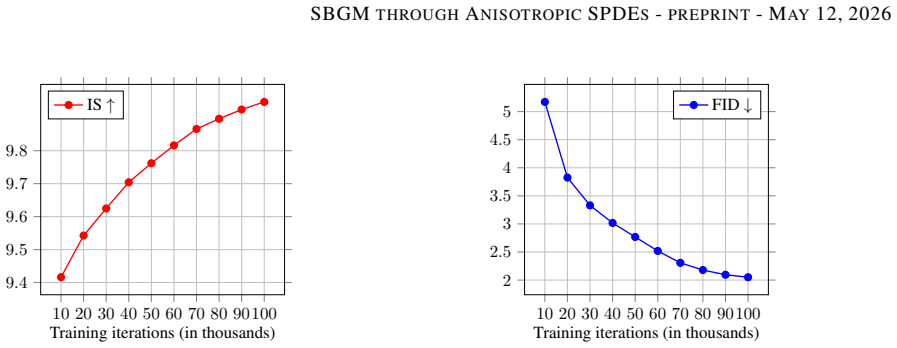
Denoising Diffusion Bridge Models. arXiv:2309.16948 [cs.CV]https://arxiv.org/abs/2309.16948 12 SBGMTHROUGHANISOTROPICSPDES-PREPRINT- MAY12, 2026 102030405060708090100 9.4 9.5 9.6 9.7 9.8 Training iterations (in thousands) IS↑ 102030405060708090100 2 2.5 3 3.5 4 4.5 5 Training iterations (in thousands) FID↓ Figure 4: Evaluation metrics on CIFAR10 between 1...
-
[37]
The diffusivity coefficientα 1 crucially controls the rate of the (an-)isotropic smoothing in the drift (4) of the SPDE (3). In the drift (4), a larger α1 results in stronger smoothing, leading to a faster elimination of high-frequency details (e.g., geometric structure, like edges and corners, and textures) in the image. Conversely, smaller values of α1 ...
work page 2026
-
[38]
The anisotropy coefficients λi control the directional sensitivity of both the drift and diffusion terms by modulating the degree of anisotropy in the transformation. The drift term (4) depends on g1(t,∇U t), which introduces directional weighting to the smoothing property of the drift. When λ1 is small, the smoothing from the drift term (4) is highly ani...
work page 2026
-
[39]
offer a flexible framework for generative modeling by constructing probability paths between distributions without requiring explicit SPDE formulations. In particular, they support structured perturbations via non-isotropic noise, as demonstrated in edge-aware extensions such as (Vandersanden et al., 2024). However, these perturbations remain spatially un...
work page 2024
-
[40]
address a fundamentally different task from ours. Rather than generating images unconditionally from noise, DDBM learn mappings between two given image distributions by modeling the bridge dynamics connecting them. While their method can, in principle, be applied to unconditional generation by choosing noise as the source distribution, their framework is ...
work page 2026
-
[41]
being the simplest approach. DiscussionWe emphasize that, in the practical application of our framework, it is the finite-dimensional SDE — obtained via the numerical scheme simulating our SPDE (3) described in Section I — that must be reversed in time, not the SPDE (3) itself. While — under a suitable set of assumptions — time-reversal of the SPDE (3) is...
work page 1986
-
[42]
+ g1 t, ui1+1, i 2−1 −u i1−1, i 2−1 0 +g 1 ui1+1, i 2−1 −u i1−1, i 2−1 ui −u i1, i 2−2∨0 (ui1, i 2−1 −u i), ifi∈∂ T Dwithi 1 >0 (30) 20 SBGMTHROUGHANISOTROPICSPDES-PREPRINT- MAY12, 2026 and ˜b(t, u)i := g1 t, ui −u i1−2∨0, i 2 0 +g 1(t,0) (ui1−1, i 2+...
work page 2026
-
[43]
+ g1 t, ui1+1, i 2+1 −u i1−1, i 2+1 ui1, i 2+2∧d 2−1 −u i +g 1 t, ui1+1, i 2+1 −u i1−1, i 2+1 0 (ui1, i 2+1 −u i), ifi∈∂ BDwithi 1 < d1 −1 (31) for(t, u)∈I×R D andi∈Dand the discretized diffusion coefficient being given by (˜σ(t, u)v)i := g2 t, ui1+1, i 2 −u i1−1,i2 ui1,i2+1 −u i1,i2−1 , ifi∈D ◦; g2 t, 0 ui1,i2+1 ...
work page 2015
discussion (0)
Sign in with ORCID, Apple, or X to comment. Anyone can read and Pith papers without signing in.