Recognition: 2 theorem links
· Lean TheoremSemiparametric Elliptical Mixture Clustering for High-Dimensional Data
Pith reviewed 2026-05-12 01:57 UTC · model grok-4.3
The pith
Semiparametric elliptical mixtures allow consistent clustering of high-dimensional heavy-tailed data without a fixed radial family.
A machine-rendered reading of the paper's core claim, the machinery that carries it, and where it could break.
Core claim
We propose a semiparametric elliptical mixture clustering framework with cluster-specific centers, an unknown common radial generator, and a common sparse precision-shape matrix, together with a data-driven rule for selecting the number of clusters. A generalized expectation-maximization algorithm is developed by combining transformed-radius estimation of the radial generator, radial-score center updates, and a Tyler-POET-GLASSO update for the common precision-shape matrix. We establish high-dimensional consistency for the estimated model components and the excess misclustering error.
What carries the argument
The semiparametric elliptical mixture model that separates cluster centers, shares an unknown radial generator, and imposes a single sparse precision-shape matrix across clusters.
If this is right
- The estimated centers, radial generator, and shared precision matrix converge in high dimensions under the model.
- Excess misclustering error vanishes with growing dimension and sample size when the elliptical-mixture assumption holds.
- The data-driven cluster-number selector works in the same high-dimensional regime.
- Performance remains competitive in heavy-tailed elliptical settings where parametric radial assumptions break down.
Where Pith is reading between the lines
- The shared radial generator and precision matrix may restrict use on data whose tail behavior or second-moment structure genuinely differs across clusters.
- The consistency results suggest the method could serve as a robust plug-in for downstream tasks such as high-dimensional discriminant analysis.
- Extensions that relax the common-radial assumption while retaining high-dimensional rates would be a natural next step.
- The Tyler-POET-GLASSO step inside the GEM loop may generalize to other robust scatter estimators in mixture settings.
Load-bearing premise
The data truly arise from an elliptical mixture whose clusters differ only in location while sharing the same unknown radial generator and the same sparse precision-shape matrix.
What would settle it
Generate data from the assumed elliptical mixture model with increasing dimension and sample size, then check whether the excess misclustering error fails to approach zero or the estimated centers and precision matrix diverge.
Figures
read the original abstract
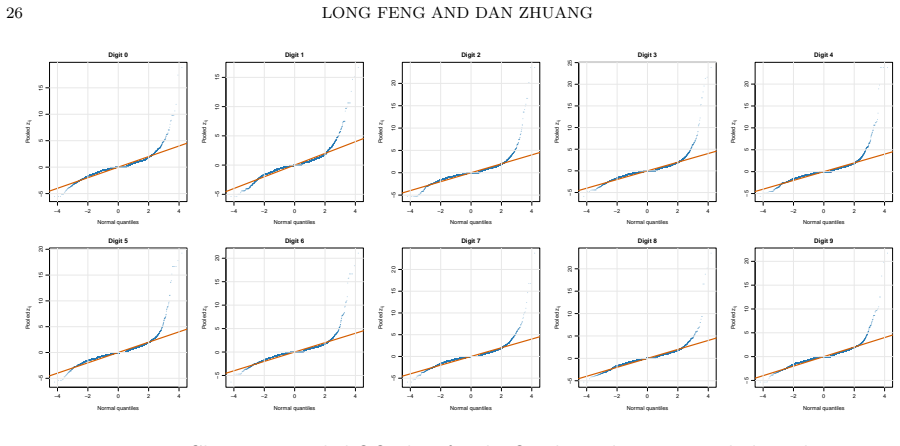
Clustering high-dimensional data is especially challenging when cluster distributions are heavy tailed and only approximately elliptical. Existing high-dimensional methods are largely built for Gaussian or other light-tailed models, whereas classical robust elliptical procedures are mostly low dimensional or rely on fully parametric radial families. We propose a semiparametric elliptical mixture clustering framework with cluster-specific centers, an unknown common radial generator, and a common sparse precision-shape matrix, together with a data-driven rule for selecting the number of clusters. A generalized expectation-maximization (GEM) algorithm is developed by combining transformed-radius estimation of the radial generator, radial-score center updates, and a Tyler-POET-GLASSO update for the common precision-shape matrix. The method avoids specifying a parametric radial family and remains computationally feasible in high dimensions. We establish high-dimensional consistency for the estimated model components and the excess misclustering error. Simulation studies and a handwritten-digit application demonstrate the competitive performance and robustness of the proposed method, particularly in heavy-tailed elliptical settings.
Editorial analysis
A structured set of objections, weighed in public.
Referee Report
Summary. The manuscript proposes a semiparametric elliptical mixture clustering framework for high-dimensional data, assuming cluster-specific centers, a common unknown radial generator, and a shared sparse precision-shape matrix. It develops a GEM algorithm that integrates transformed-radius estimation of the radial generator, radial-score updates for the centers, and a Tyler-POET-GLASSO step for the common shape matrix, together with a data-driven rule for selecting the number of clusters. High-dimensional consistency is established for the estimated model components and the excess misclustering error. Performance is illustrated through simulation studies and a handwritten-digit application, with emphasis on robustness in heavy-tailed elliptical settings.
Significance. If the consistency results hold, the work fills a notable gap by providing a flexible, non-parametric treatment of the radial component in high-dimensional elliptical mixtures while retaining computational tractability and sparsity regularization. The explicit focus on excess misclustering error and the combination of Tyler-type robust estimation with POET/GLASSO techniques constitute a clear advance over fully parametric or Gaussian-based high-dimensional clustering methods.
minor comments (3)
- [Abstract] Abstract: the phrase 'Tyler-POET-GLASSO' is introduced without expansion or reference; the first occurrence should include the full names or a pointer to the relevant section.
- [Simulation Studies] Simulation section: the reported misclustering rates lack accompanying standard errors or replication counts; adding these would allow readers to assess the stability of the performance comparisons.
- [Model and Method] Notation: the radial generator is denoted in several places without a consistent symbol across the model definition, estimation procedure, and theoretical statements; a single symbol and a brief reminder of its semiparametric nature would improve readability.
Simulated Author's Rebuttal
We thank the referee for the positive evaluation of our manuscript and the recommendation for minor revision. The report highlights the contributions of the semiparametric framework, the GEM algorithm, and the high-dimensional consistency results, which we appreciate. Since no specific major comments were raised, we have no individual points to address in this response. We will incorporate any minor improvements suggested during the revision process to further strengthen the presentation.
Circularity Check
No significant circularity detected in derivation or consistency claims
full rationale
The paper establishes high-dimensional consistency for GEM-based estimators of centers, radial generator, and sparse precision-shape matrix by combining standard convergence rates for Tyler's M-estimator, POET/GLASSO, and empirical-process bounds on the semiparametric radial-score updates. These supporting results are drawn from external literature and do not reduce by definition, self-citation chain, or fitted-input renaming to the target consistency statements. The model is fully specified with explicit assumptions (common radial generator, common sparse shape) that are not tautological with the claimed excess misclustering error bounds. No load-bearing step matches any enumerated circularity pattern.
Axiom & Free-Parameter Ledger
free parameters (1)
- tuning parameters for Tyler-POET-GLASSO and cluster selection rule
axioms (1)
- domain assumption Observations follow a mixture of elliptical distributions sharing a common radial generator and a common sparse precision-shape matrix.
Lean theorems connected to this paper
-
IndisputableMonolith/Cost/FunctionalEquation.leanwashburn_uniqueness_aczel unclearsemiparametric elliptical mixture clustering framework with cluster-specific centers, an unknown common radial generator, and a common sparse precision-shape matrix... Tyler-POET-GLASSO update
-
IndisputableMonolith/Foundation/RealityFromDistinction.leanreality_from_one_distinction unclearhigh-dimensional consistency for the estimated model components and the excess misclustering error
Reference graph
Works this paper leans on
-
[1]
and Chin, Suet-Feung and Turashvili, Gulisa and Rueda, Oscar M
Curtis, Christina and Shah, Sohrab P. and Chin, Suet-Feung and Turashvili, Gulisa and Rueda, Oscar M. and Dunning, Mark J. and Speed, Doug and Lynch, Andy G. and Samarajiwa, Shamith and Yuan, Yinyin and Gr. The genomic and transcriptomic architecture of 2,000 breast tumours reveals novel subgroups , journal =. 2012 , volume =. doi:10.1038/nature10983 , url =
-
[2]
Mwangi, Benson and Tian, Tian Siva and Soares, Jair C. , title =. Neuroinformatics , year =. doi:10.1007/s12021-013-9204-3 , url =
-
[3]
and Wang, Antai and Xuan, Jianhua and Liu, Minetta C
Clarke, Robert and Ressom, Habtom W. and Wang, Antai and Xuan, Jianhua and Liu, Minetta C. and Gehan, Edmund A. and Wang, Yue , title =. Nature Reviews Cancer , year =. doi:10.1038/nrc2294 , url =
-
[4]
Briefings in Functional Genomics , volume =
Menon, Vilas , title =. Briefings in Functional Genomics , volume =. 2018 , month =. doi:10.1093/bfgp/elx044 , url =
-
[5]
Tomohiro Ando and Jushan Bai , title =. Journal of the American Statistical Association , volume =. 2017 , publisher =. doi:10.1080/01621459.2016.1195743 , URL =
-
[6]
A similarity assessment technique for effective grouping of documents , journal =. 2015 , issn =. doi:https://doi.org/10.1016/j.ins.2015.03.038 , url =
-
[7]
Model-based clustering of high-dimensional data: a review , journal =. 2014 , issn =. doi:https://doi.org/10.1016/j.csda.2012.12.008 , url =
-
[8]
Michael Fop and Thomas Brendan Murphy , title =. Statistics Surveys , number =. 2018 , doi =
work page 2018
-
[9]
Gormley, Isobel Claire and Murphy, Thomas Brendan and Raftery, Adrian E. , title =. Annual Review of Statistics and Its Application , year =. doi:10.1146/annurev-statistics-033121-115326 , url =
-
[10]
Witten and Robert Tibshirani , title =
Daniela M. Witten and Robert Tibshirani , title =. Journal of the American Statistical Association , volume =. 2010 , publisher =. doi:10.1198/jasa.2010.tm09415 , note =
-
[11]
Electronic Journal of Statistics , year =
Sun, Wei and Wang, Junhui and Fang, Yixin , title =. Electronic Journal of Statistics , year =
-
[12]
Jakob Raymaekers and Ruben H. Zamar , title =. Journal of Machine Learning Research , year =
-
[13]
Robust and sparse K-means clustering for high-dimensional data , journal =
Brodinov. Robust and sparse K-means clustering for high-dimensional data , journal =. 2019 , volume =. doi:10.1007/s11634-019-00356-9 , url =
-
[14]
Journal of the American Statistical Association , volume =
Chan, Yao-ban and Hall, Peter , title =. Journal of the American Statistical Association , volume =. 2010 , publisher =. doi:10.1198/jasa.2010.tm09404 , URL =
-
[15]
Peter Hall and D. M. Titterington and Jing-Hao Xue , title =. Journal of the American Statistical Association , volume =. 2009 , publisher =. doi:10.1198/jasa.2009.tm08107 , URL =
-
[16]
Wild, Edward W. and Mangasarian, Olvi L. , title =. Proceedings of the SIAM International Conference on Data Mining, Workshop on Clustering High Dimensional Data and Its Applications , year =
-
[17]
Minimax theory for high-dimensional gaussian mixtures with sparse mean separation , url =
Azizyan, Martin and Singh, Aarti and Wasserman, Larry , booktitle =. Minimax theory for high-dimensional gaussian mixtures with sparse mean separation , url =
-
[18]
The Annals of Statistics , number =
Jiashun Jin and Wanjie Wang , title =. The Annals of Statistics , number =. 2016 , doi =
work page 2016
-
[19]
The Annals of Statistics , number =
Jiashun Jin and Zheng Tracy Ke and Wanjie Wang , title =. The Annals of Statistics , number =. 2017 , doi =
work page 2017
-
[20]
Azizyan, Martin and Singh, Aarti and Wasserman, Larry , booktitle =. 2015 , editor =
work page 2015
-
[21]
Journal of the American Statistical Association , volume =
Adrian E Raftery and Nema Dean , title =. Journal of the American Statistical Association , volume =. 2006 , publisher =. doi:10.1198/016214506000000113 , URL =
-
[22]
Journal of Machine Learning Research , year =
Pan, Wei and Shen, Xiaotong , title =. Journal of Machine Learning Research , year =
-
[23]
High-dimensional data clustering , journal =
Bouveyron, Charles and Girard, St. High-dimensional data clustering , journal =. 2007 , issn =. doi:https://doi.org/10.1016/j.csda.2007.02.009 , url =
-
[24]
Electronic Journal of Statistics , year =
Zhou, Hui and Pan, Wei and Shen, Xiaotong , title =. Electronic Journal of Statistics , year =. doi:10.1214/09-EJS487 , url =
-
[25]
Statistics and Computing , year =
Fop, Michael and Murphy, Thomas Brendan and Scrucca, Luca , title =. Statistics and Computing , year =. doi:10.1007/s11222-018-9838-y , url =
-
[26]
Advances in Neural Information Processing Systems 28 , pages =
Wang, Zhaoran and Gu, Quanquan and Ning, Yang and Liu, Han , title =. Advances in Neural Information Processing Systems 28 , pages =
-
[27]
Tony and Ma, Jing and Zhang, Linjun , title =
Cai, T. Tony and Ma, Jing and Zhang, Linjun , title =. The Annals of Statistics , year =
-
[28]
Baek, Jangsun and McLachlan, Geoffrey J. , title =. Bioinformatics , volume =. 2011 , month =. doi:10.1093/bioinformatics/btr112 , url =
-
[29]
Mixtures of skew-t factor analyzers , journal =. 2014 , issn =. doi:https://doi.org/10.1016/j.csda.2014.03.012 , url =
-
[30]
High-dimensional unsupervised classification via parsimonious contaminated mixtures , journal =. 2020 , issn =. doi:https://doi.org/10.1016/j.patcog.2019.107031 , url =
-
[31]
Fang, Kai-Tai and Kotz, Samuel and Ng, Kai Wang , title =. 1990 , series =
work page 1990
-
[32]
Peel, D. and McLachlan, G. J. , title =. Statistics and Computing , year =. doi:10.1023/A:1008981510081 , url =
-
[33]
Holzmann, Hajo and Munk, Axel and Gneiting, Tilmann , title =. Scandinavian Journal of Statistics , volume =. doi:https://doi.org/10.1111/j.1467-9469.2006.00505.x , url =
-
[34]
Andrews, Jeffrey L. and McNicholas, Paul D. , title =. Statistics and Computing , year =. doi:10.1007/s11222-011-9272-x , url =
-
[35]
Dang, Utkarsh J. and Browne, Ryan P. and McNicholas, Paul D. , title =. Biometrics , volume =. 2015 , month =. doi:10.1111/biom.12351 , url =
-
[36]
Teng, Jen-Chieh and Fan, Sheng-Hsin and Chiang, Chin-Tsang and Huang, Ming-Yueh and Lim, Alvin , title =. arXiv preprint arXiv:2604.07917 , year =
work page internal anchor Pith review Pith/arXiv arXiv
- [37]
-
[38]
Journal of the Royal Statistical Society Series B: Statistical Methodology , volume =
Fan, Jianqing and Liao, Yuan and Mincheva, Martina , title =. Journal of the Royal Statistical Society Series B: Statistical Methodology , volume =. 2013 , month =. doi:10.1111/rssb.12016 , url =
-
[39]
The Annals of Statistics , year =
Fan, Jianqing and Liu, Han and Wang, Weichen , title =. The Annals of Statistics , year =
-
[40]
arXiv preprint arXiv:2512.19325 , year =
Xu, Xinyue and Ma, Huifang and Wang, Hongfei and Feng, Long , title =. arXiv preprint arXiv:2512.19325 , year =
- [41]
-
[42]
Friedman, Jerome and Hastie, Trevor and Tibshirani, Robert , title =. Biostatistics , year =
-
[43]
Sign and rank covariance matrices , journal =. 2000 , note =. doi:https://doi.org/10.1016/S0378-3758(00)00199-3 , url =
-
[44]
Journal of the Royal Statistical Society: Series B (Statistical Methodology) , volume =
Tibshirani, Robert and Walther, Guenther and Hastie, Trevor , title =. Journal of the Royal Statistical Society: Series B (Statistical Methodology) , volume =. doi:https://doi.org/10.1111/1467-9868.00293 , url =
-
[45]
Journal of Computational and Graphical Statistics , volume =
Robert Tibshirani and Guenther Walther , title =. Journal of Computational and Graphical Statistics , volume =. 2005 , publisher =. doi:10.1198/106186005X59243 , URL =
-
[46]
Balakrishnan, Sivaraman and Wainwright, Martin J. and Yu, Bin , title =. The Annals of Statistics , year =
-
[47]
and Raskutti, Garvesh and Yu, Bin , title =
Ravikumar, Pradeep and Wainwright, Martin J. and Raskutti, Garvesh and Yu, Bin , title =. Electronic Journal of Statistics , year =
- [48]
- [49]
- [50]
-
[51]
A bennett concentration inequality and its application to suprema of empirical processes , journal =. 2002 , issn =. doi:https://doi.org/10.1016/S1631-073X(02)02292-6 , url =
-
[52]
The Annals of Statistics , year =
Chernozhukov, Victor and Chetverikov, Denis and Kato, Kengo , title =. The Annals of Statistics , year =
-
[53]
Concentration inequalities: a nonasymptotic theory of independence , publisher =
Boucheron, St. Concentration inequalities: a nonasymptotic theory of independence , publisher =. 2013 , doi =
work page 2013
discussion (0)
Sign in with ORCID, Apple, or X to comment. Anyone can read and Pith papers without signing in.