Recognition: no theorem link
A time dependent fractional order diffusion equation with constant diffusivity matrix
Pith reviewed 2026-05-12 03:04 UTC · model grok-4.3
The pith
A spectral spatial discretization combined with backward Euler time stepping approximates time-dependent fractional diffusion equations on nonhomogeneous domains with constant anisotropic diffusivity, supported by error analysis.
A machine-rendered reading of the paper's core claim, the machinery that carries it, and where it could break.
Core claim
The central claim is that the spectral approximation in space, which accommodates the nonhomogeneous domain through its basis choice, together with backward Euler in time, yields a convergent scheme for the time-dependent fractional diffusion problem with constant diffusivity matrix, with rigorous error estimates that are borne out in experiments demonstrating the domain's effects.
What carries the argument
The spectral approximation scheme for spatial discretization, which handles boundary behavior and different axial coefficients on the nonhomogeneous domain without extra interface conditions.
Load-bearing premise
The diffusivity matrix stays constant over the domain so that the chosen spectral basis can treat the nonhomogeneity directly.
What would settle it
Compute the scheme on a problem with a known exact solution and check whether the observed error rates match the bounds from the analysis; rates that deviate from the predicted order would falsify the error result.
Figures


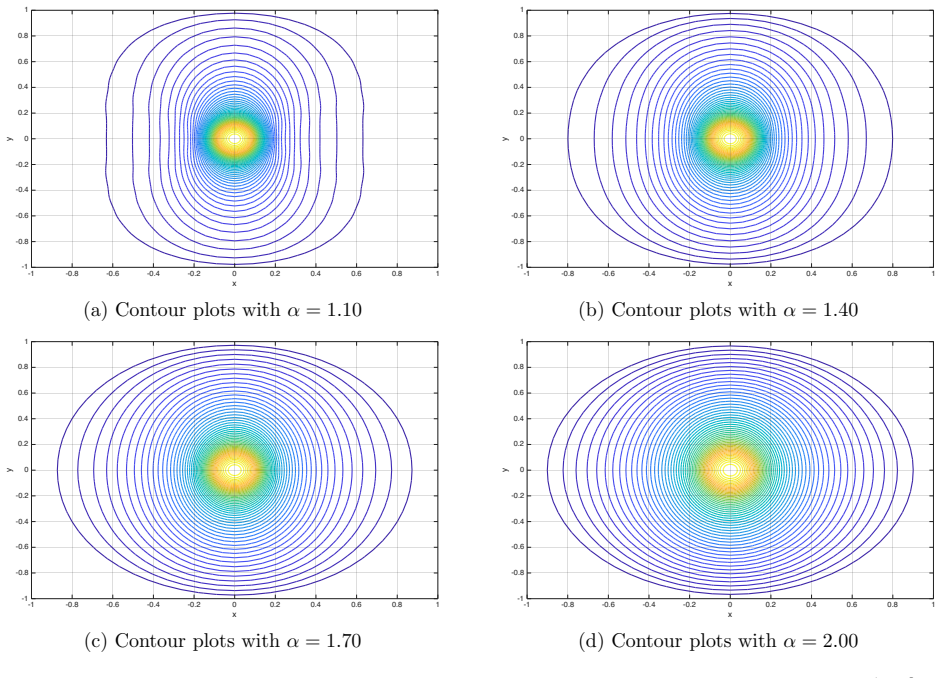


read the original abstract
Of primary interest in this paper is the numerical approximation of a time dependent fractional, in space, diffusion equation where the domain is assumed to be nonhomogeneous, having different axial diffusion coefficients. This work is motivated from the consideration of composite material which can exhibit different material properties along, and perpendicular to, internal planar structures. Careful attention is paid to accurately capture the boundary behavior of the solution. A spectral approximation scheme is used for the spatial discretization and a backward Euler approximation used for the temporal discretization. Following an error analysis for the approximation scheme, numerical experiments are given to demonstrate the effects of the nonhomogeneous domain and to support the theoretical analysis.
Editorial analysis
A structured set of objections, weighed in public.
Referee Report
Summary. The manuscript develops a numerical scheme for a time-dependent space-fractional diffusion equation on a nonhomogeneous domain with a constant but possibly anisotropic diffusivity matrix. Spatial discretization employs a spectral method with careful boundary treatment, time discretization uses backward Euler, an error analysis is performed for the fully discrete scheme, and numerical experiments illustrate the impact of nonhomogeneity while supporting the theoretical convergence rates.
Significance. If the error analysis is rigorous and the discretization correctly incorporates the nonhomogeneous features without violating interface conditions, the work would provide a practical tool for simulating fractional diffusion in composite materials. The emphasis on boundary behavior and the combination of spectral methods with fractional operators could be useful for applications in materials science. However, the significance is tempered by the need to confirm that the global spectral approach respects physical transmission conditions when axial coefficients differ.
major comments (3)
- [Abstract, §1, §4] Abstract and §1 (Introduction): The description of the domain as 'nonhomogeneous, having different axial diffusion coefficients' while the title asserts a 'constant diffusivity matrix' creates ambiguity. If nonhomogeneity is realized via piecewise-constant coefficients (as implied by the composite-material motivation), the global spectral basis cannot automatically enforce continuity of the normal flux across interfaces. The error analysis in §4 relies on solution regularity that may not hold without explicit interface treatment or domain decomposition.
- [§3] §3 (Spatial Discretization): The spectral approximation is formulated on the global domain without mention of modified basis functions or mortar-type conditions to handle jumps in the diffusivity matrix. This omission means the scheme may not satisfy the weak form of the transmission problem, undermining the claimed convergence rates when axial coefficients differ across subregions.
- [§4] §4 (Error Analysis): The a priori bounds assume sufficient regularity of the solution in the presence of the nonhomogeneous coefficients. No explicit statement is given on how the weak formulation or the fractional operator is adjusted at material interfaces; without this, the analysis does not cover the physically relevant case suggested by the abstract.
minor comments (3)
- [§2] Notation for the fractional order α and the diffusivity matrix D should be introduced with explicit definitions and ranges in §2 to avoid reader confusion.
- [§5] Figure captions in §5 would benefit from quantitative statements (e.g., observed convergence rates) rather than qualitative descriptions of 'effects of the nonhomogeneous domain'.
- [Abstract, §4] The abstract claims 'an error analysis was performed'; the manuscript should state the precise norms and assumptions under which the bounds hold, including any restrictions on the fractional order.
Simulated Author's Rebuttal
We thank the referee for the careful reading and constructive comments. The primary concern is an ambiguity in our description of the diffusivity matrix and domain. We will revise the manuscript to explicitly state that the diffusivity matrix is constant throughout the domain (though anisotropic with different axial coefficients) and that there are no material interfaces or piecewise variations. This ensures the global spectral method and error analysis apply directly without additional interface treatments. We address each major comment point by point below.
read point-by-point responses
-
Referee: [Abstract, §1, §4] Abstract and §1 (Introduction): The description of the domain as 'nonhomogeneous, having different axial diffusion coefficients' while the title asserts a 'constant diffusivity matrix' creates ambiguity. If nonhomogeneity is realized via piecewise-constant coefficients (as implied by the composite-material motivation), the global spectral basis cannot automatically enforce continuity of the normal flux across interfaces. The error analysis in §4 relies on solution regularity that may not hold without explicit interface treatment or domain decomposition.
Authors: We agree the wording is ambiguous and could be read as implying piecewise-constant coefficients with interfaces. In the manuscript the diffusivity matrix is in fact constant in space but anisotropic. The composite-material motivation is contextual; the specific model has uniform coefficients with no interfaces or subregions. We will revise the abstract and §1 to state explicitly that the matrix is spatially constant. This eliminates the need for interface conditions, and the solution regularity assumed in the error analysis holds. revision: yes
-
Referee: [§3] §3 (Spatial Discretization): The spectral approximation is formulated on the global domain without mention of modified basis functions or mortar-type conditions to handle jumps in the diffusivity matrix. This omission means the scheme may not satisfy the weak form of the transmission problem, undermining the claimed convergence rates when axial coefficients differ across subregions.
Authors: Because the diffusivity matrix is spatially constant there are no jumps and no transmission problem arises. The spectral discretization satisfies the standard weak form of the constant-coefficient fractional operator. We will add an explicit statement in §3 confirming spatial constancy of the matrix and that no special interface handling is required. revision: yes
-
Referee: [§4] §4 (Error Analysis): The a priori bounds assume sufficient regularity of the solution in the presence of the nonhomogeneous coefficients. No explicit statement is given on how the weak formulation or the fractional operator is adjusted at material interfaces; without this, the analysis does not cover the physically relevant case suggested by the abstract.
Authors: The coefficients are anisotropic but spatially constant, so the weak formulation and fractional operator require no interface adjustments. The regularity assumptions are valid for this uniform-coefficient setting. We will insert a clarifying remark in §4 stating that the matrix is constant in space and that the analysis therefore applies directly. revision: yes
Circularity Check
No circularity: standard discretization with independent error analysis
full rationale
The paper introduces a spectral spatial discretization combined with backward Euler time stepping for a time-dependent fractional diffusion equation on a nonhomogeneous domain with constant (possibly anisotropic) diffusivity. It performs an error analysis for the scheme and then presents numerical experiments. No step in the provided abstract or description reduces a claimed result to a fitted parameter, self-definition, or self-citation chain; the error bounds are derived from the approximation properties of the chosen basis and time integrator, which are independent of the final numerical outcomes. The derivation chain therefore remains self-contained against external benchmarks.
Axiom & Free-Parameter Ledger
axioms (1)
- domain assumption The time-dependent fractional diffusion equation admits a unique weak solution in appropriate Sobolev-type spaces for the given boundary conditions.
Reference graph
Works this paper leans on
-
[1]
G. Acosta and J.P. Borthagaray. A fractional Laplace equation: Regularity of solutions and finite element approximations.SIAM J. Numer. Anal., 55(2):472–495, 2017
work page 2017
-
[2]
M. Ainsworth and C. Glusa. Aspects of an adaptive finite element method for the fractional Laplacian: a priori and a posteriori error estimates, efficient implementation and multigrid solver.Comput. Methods Appl. Mech. Engrg., 327:4–35, 2017
work page 2017
- [3]
-
[4]
H. Antil, Z.W. Di, and R. Khatri. Bilevel optimization, deep learning and fractional Laplacian regularization with applications in tomography.Inverse Problems, 36(6):064001, 22, 2020
work page 2020
-
[5]
I. Babuˇ ska and B. Guo. Direct and inverse approximation theorems for thep-version of the finite element method in the framework of weighted Besov spaces. I. Approximability of functions in the weighted Besov spaces.SIAM J. Numer. Anal., 39(5):1512–1538, 2001/02
work page 2001
-
[6]
B. Baeumer and M.M. Meerschaert. Tempered stable L´ evy motion and transient super-diffusion. J. Comput. Appl. Math., 233(10):2438–2448, 2010
work page 2010
- [7]
- [8]
-
[9]
S.C. Brenner and L.R. Scott.The mathematical theory of finite element methods, volume 15 of Texts in Applied Mathematics. Springer, New York, third edition, 2008
work page 2008
-
[10]
A review of image denoising algorithms, with a new one
A. Buades, B. Coll, and J.M. Morel. Image denoising methods. A new nonlocal principle.SIAM Rev., 52(1):113–147, 2010. Reprint of “A review of image denoising algorithms, with a new one” [MR2162865]
work page 2010
-
[11]
A. Bueno-Orovio, D. Kay, V. Grau, B. Rodriguez, and K. Burrage. Fractional diffusion models of cardiac electrical propagation reveal structural heterogeneity effects on dispersion of repo- larization.J. Roy. Soc. Interface, 11(97):20140352, 2014
work page 2014
-
[12]
J. Burkardt, Y. Wu, and Y. Zhang. A unified meshfree pseudospectral method for solving both classical and fractional PDEs.SIAM J. Sci. Comput., 43(2):A1389–A1411, 2021
work page 2021
-
[13]
D. del Castillo-Negrete, B.A. Carreras, and V.E. Lynch. Fractional diffusion in plasma turbu- lence.Phys. Plasmas, 11(8):3854–3864, 2004
work page 2004
-
[14]
M. D’Elia and M. Gunzburger. The fractional Laplacian operator on bounded domains as a special case of the nonlocal diffusion operator.Comput. Math. Appl., 66(7):1245–1260, 2013
work page 2013
- [15]
- [16]
- [17]
-
[18]
B. Dyda, A. Kuznetsov, and M. Kwa´ snicki. Fractional Laplace operator and Meijer G-function. Constr. Approx., 45(3):427–448, 2017
work page 2017
-
[19]
B.P. Epps and B. Cushman-Roisin. Turbulence Modeling via the Fractional Laplacian. arxiv preprint arxiv: 1803.05286, 2018
-
[20]
A. Ern and J.-L. Guermond.Theory and practice of finite elements, volume 159 ofApplied Mathematical Sciences. Springer-Verlag, New York, 2004
work page 2004
-
[21]
A. Ern and J.-L. Guermond.Finite elements III – First-order and time-dependent PDEs, volume 74 ofTexts in Applied Mathematics. Springer, Cham, 2021
work page 2021
-
[22]
V.J. Ervin. Equivalence of the weighted fractional Sobolev space on a disk with characterization by the decay rate of Fourier-Jacobi coefficients andK-interpolation.J. Fourier Anal. Appl., 30(6):Paper No. 71, 27, 2024
work page 2024
-
[23]
V.J. Ervin. A variable diffusivity fractional Laplacian.J. Math. Anal. Appl., 547(1):Paper No. 129283, 23, 2025
work page 2025
-
[24]
G. Failla and M. Zingales. Advanced materials modelling via fractional calculus: challenges and perspectives.Philosophical Transactions of the Royal Society A: Mathematical, Physical and Engineering Sciences, 378(2172):20200050, 05 2020
work page 2020
-
[25]
G. Gilboa and S. Osher. Nonlocal operators with applications to image processing.Multiscale Model. Simul., 7(3):1005–1028, 2008
work page 2008
-
[26]
Z. Hao, Z. Cai, and Z. Zhang. Fractional-order dependent radial basis functions meshless methods for the integral fractional Laplacian.Comput. Math. Appl., 178:197–213, 2025
work page 2025
-
[27]
Z. Hao, H. Li, Z. Zhang, and Z. Zhang. Sharp error estimates of a spectral Galerkin method for a diffusion-reaction equation with integral fractional Laplacian on a disk.Math. Comp., 90(331):2107–2135, 2021
work page 2021
-
[28]
Z. Hao, Z. Zhang, and R. Du. Fractional centered difference scheme for high-dimensional integral fractional Laplacian.J. Comput. Phys., 424:Paper No. 109851, 17, 2021
work page 2021
-
[29]
Y. Huang and A. Oberman. Numerical methods for the fractional Laplacian: a finite difference– quadrature approach.SIAM J. Numer. Anal., 52(6):3056–3084, 2014
work page 2014
-
[30]
M. Javanainen, H. Hammaren, L. Monticelli, J.-H. Jeon, M.S. Miettinen, H. Martinez-Seara, R. Metzler, and I. Vattulainen. Anomalous and normal diffusion of proteins and lipids in crowded lipid membranes.Faraday Discuss., 161:397–417, 2013. 50
work page 2013
-
[31]
J. Klafter and I.M Sokolov. Anomalous diffusion spreads its wings.Phys. World, 18(8):29–32, 2005
work page 2005
-
[32]
M. Kwa´ snicki. Ten equivalent definitions of the fractional Laplace operator.Fract. Calc. Appl. Anal., 20(1):7–51, 2017
work page 2017
-
[33]
N. Laskin. Fractional quantum mechanics and Levy paths integrals.Phys. Lett. A, 268:298–305, 2000
work page 2000
-
[34]
R.B. Lehoucq and S.T. Rowe. A radial basis function Galerkin method for inhomogeneous nonlocal diffusion.Comput. Methods Appl. Mech. Engrg., 299:366–380, 2016
work page 2016
- [35]
-
[36]
N. Lindemulder and E. Lorist. Stein interpolation for the real interpolation method.Banach J. Math. Anal., 16(1):Paper No. 7, 18, 2022
work page 2022
-
[37]
V. Minden and L. Ying. A simple solver for the fractional Laplacian in multiple dimensions. SIAM J. Sci. Comput., 42(2):A878–A900, 2020
work page 2020
-
[38]
F. Qi and Q.-M. Luo. Bounds for the ratio of two gamma functions—from Wendel’s and related inequalities to logarithmically completely monotonic functions.Banach J. Math. Anal., 6(2):132–158, 2012
work page 2012
-
[39]
M.F. Shlesinger, B.J. West, and J. Klafter. L´ evy dynamics of enhanced diffusion: Application to turbulence.Phys. Rev. Lett., 58(11):1100–1103, 1987
work page 1987
-
[40]
X. Tian, Q. Du, and M. Gunzburger. Asymptotically compatible schemes for the approximation of fractional Laplacian and related nonlocal diffusion problems on bounded domains.Adv. Comput. Math., 42(6):1363–1380, 2016
work page 2016
-
[41]
H. Wang and K. Wang. AnO(Nlog 2 N) alternating-direction finite difference method for two-dimensional fractional diffusion equations.J. Comput. Phys., 230(21):7830–7839, 2011
work page 2011
- [42]
-
[43]
F. Zeng, F. Liu, C. Li, K. Burrage, I. Turner, and V. Anh. A Crank-Nicolson ADI spec- tral method for a two-dimensional Riesz space fractional nonlinear reaction-diffusion equation. SIAM J. Numer. Anal., 52(6):2599–2622, 2014
work page 2014
-
[44]
Y. Zhang, M.M. Meerschaert, and A. Packman. Linking fluvial bed sediment transport across scales.Geophys. Res. Lett., 39(20), 2012
work page 2012
-
[45]
X. Zheng, V.J. Ervin, and H. Wang. An anomalous fractional diffusion operator.Fract. Calc. Appl. Anal., 28(3):1198–1228, 2025
work page 2025
-
[46]
S. Zhou and Y. Zhang. A novel and simple spectral method for nonlocal PDEs with the fractional Laplacian.Comput. Math. Appl., 168:133–147, 2024. 51
work page 2024
discussion (0)
Sign in with ORCID, Apple, or X to comment. Anyone can read and Pith papers without signing in.