Recognition: 2 theorem links
· Lean TheoremJWST observations and a model for the extremely luminous obscured quasar W2246-0526 at z=4.6
Pith reviewed 2026-05-12 02:37 UTC · model grok-4.3
The pith
A statistically significant hot dust component interpreted as polar dust must be added to SED models of high-redshift obscured quasars because it substantially revises the derived AGN luminosity.
A machine-rendered reading of the paper's core claim, the machinery that carries it, and where it could break.
Core claim
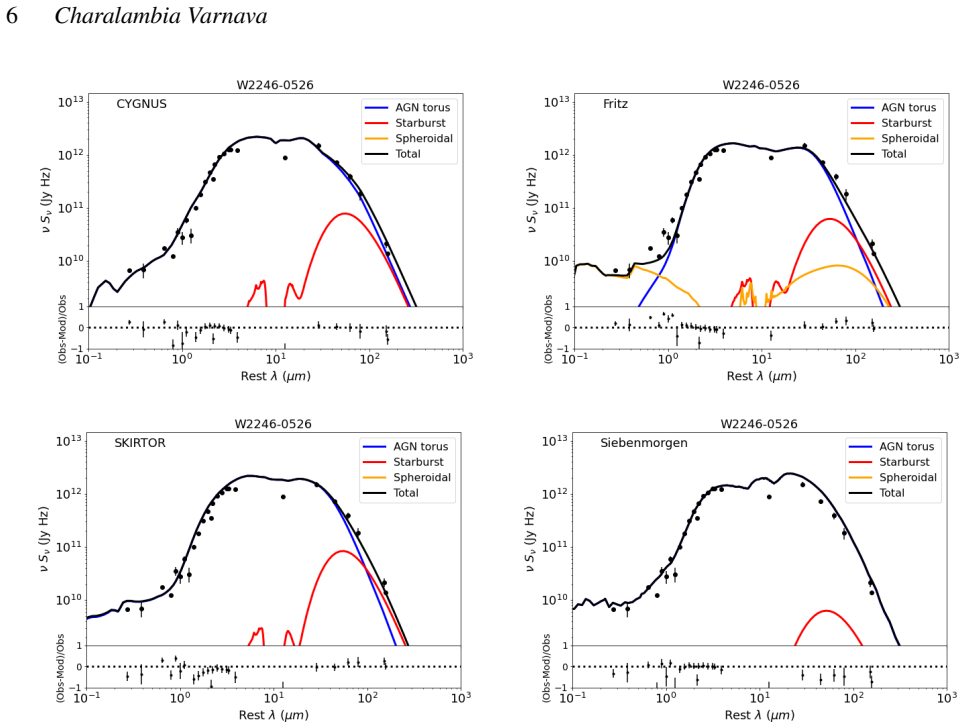
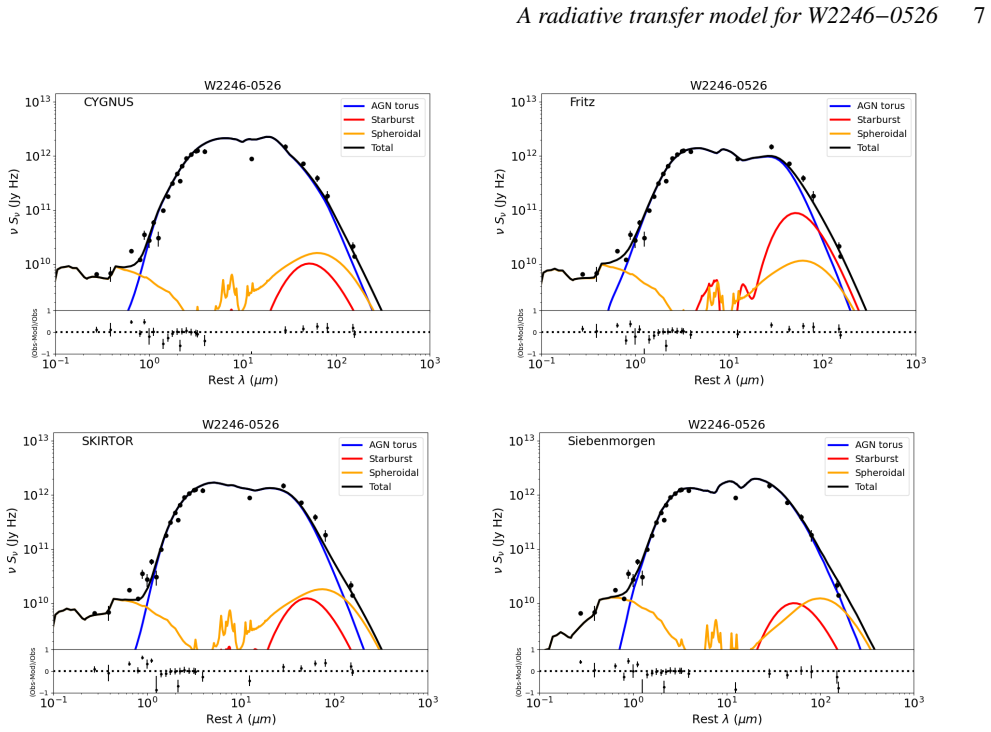
We present new JWST/MIRI-MRS data of the z=4.601 extremely luminous obscured quasar WISEA J224607.56-052634.9 (W2246-0526). Our fits of its spectral energy distribution (SED) with the SED fitting code SMART predict an active galactic nucleus (AGN) fraction in the range 72-81 per cent, an intrinsic AGN luminosity of 4.2-7.2 x 10^14 Lo, a polar dust luminosity of 1.6-1.7 x 10^14 Lo, a black hole mass of 1.3-2.3 x 10^10 Mo (assuming the quasar is accreting at the Eddington limit), a star formation rate (SFR) of 360-2900 Mo/yr and a stellar mass of 4.8-5 x 10^11 Mo. We find statistically significant evidence for the presence of a hot dust component, which we interpret as polar dust in thecontext
What carries the argument
The SMART radiative-transfer SED code that simultaneously fits two smooth and two two-phase torus geometries plus an extra hot polar-dust component to the observed mid-infrared spectrum and photometry.
If this is right
- The AGN supplies 72 to 81 percent of the total energy output.
- The intrinsic AGN luminosity reaches 4.2 to 7.2 times 10 to the 14 solar luminosities once polar dust is included.
- Black-hole mass estimates fall in the range 1.3 to 2.3 times 10 to the 10 solar masses under the Eddington assumption.
- Star-formation rates lie between 360 and 2900 solar masses per year while the stellar mass is already 5 times 10 to the 11 solar masses.
- Similar hot-dust components may connect this high-redshift source to some local AGN even though their total luminosities differ by orders of magnitude.
Where Pith is reading between the lines
- Accounting for polar dust could systematically lower the inferred Eddington ratios or require revised bolometric corrections for other z greater than 4 obscured AGN.
- If the polar dust geometry evolves with redshift, multi-epoch JWST spectra of additional targets could reveal whether the component is transient or stable.
- The already mature stellar mass at z=4.6 implies the host galaxy assembled most of its stars before the observed epoch, tightening constraints on early co-evolution models.
Load-bearing premise
The black-hole mass is calculated by assuming the quasar is radiating at the Eddington limit.
What would settle it
A new set of observations that reproduces the same mid-infrared spectrum with torus models alone and yields an equally good fit without any additional hot polar-dust component would remove the need to revise AGN luminosities for similar objects.
Figures


read the original abstract
We present new JWST/MIRI-MRS data of the z=4.601 extremely luminous obscured quasar WISEA J224607.56-052634.9 (W2246-0526). Our fits of its spectral energy distribution (SED) with the SED fitting code SMART (Spectral energy distributions Markov chain Analysis with Radiative Transfer models) predict an active galactic nucleus (AGN) fraction in the range 72-81 per cent, an intrinsic AGN luminosity of 4.2-7.2 x 10^14 Lo, a polar dust luminosity of 1.6-1.7 x 10^14 Lo, a black hole mass of 1.3-2.3 x 10^10 Mo (assuming the quasar is accreting at the Eddington limit), a star formation rate (SFR) of 360-2900 Mo/yr and a stellar mass of 4.8-5 x 10^11 Mo. The stellar and black hole masses of W2246-0526 are typical of a giant elliptical galaxy at z=0. We find statistically significant evidence for the presence of a hot dust component, which we interpret as polar dust in the context of a torus geometry, based on recent results obtained for nearby AGN. We explore two smooth and two two-phase models for the AGN torus, to put constraints on the AGN fraction of the galaxy, the black hole mass and its SFR. We show that the presence of polar dust affects the estimate of the AGN luminosity and we recommend to take into account this component in SED fits of other high-redshift obscured AGN/quasars. Despite the large difference in luminosity, we discuss possible links between the presence of this hot dust component in W2246-0526 and in some local AGN, suggesting that they may have a different origin.
Editorial analysis
A structured set of objections, weighed in public.
Referee Report
Summary. The manuscript presents new JWST/MIRI-MRS spectroscopy of the z=4.601 extremely luminous obscured quasar W2246-0526. Using the SMART SED fitting code with two smooth and two two-phase AGN torus models, the authors report an AGN fraction of 72–81%, intrinsic AGN luminosity 4.2–7.2 × 10^14 L⊙, polar dust luminosity 1.6–1.7 × 10^14 L⊙, black-hole mass 1.3–2.3 × 10^10 M⊙ (Eddington assumption), SFR 360–2900 M⊙ yr⁻¹, and stellar mass ~5 × 10^11 M⊙. They claim statistically significant evidence for a hot dust component interpreted as polar dust and conclude that this component must be included in SED fits of other high-redshift obscured AGN because it affects the derived AGN luminosity.
Significance. If the hot-dust component is robustly required by the data and materially changes the AGN luminosity, the result would be useful for refining SED models of high-z obscured quasars. The new MIRI-MRS spectrum and the systematic exploration of four torus geometries constitute clear strengths; the wide parameter ranges already signal degeneracies that the community will need to confront when applying similar models elsewhere.
major comments (2)
- [Results / SED fitting section] The central claim that the hot dust component is 'statistically significant' and affects the AGN luminosity estimate is not supported by any reported model-comparison statistics (Δχ², reduced-χ², AIC/BIC, or Bayesian evidence) between the four torus models run with and without the polar-dust luminosity term. Without these quantities it is impossible to judge whether the extra component is demanded by the MIRI-MRS data or merely permitted by it.
- [Results / SED fitting section] The reported AGN fraction (72–81 %) and AGN luminosity range already incorporate the polar-dust term; however, no explicit comparison is shown of the same torus models run without polar dust, so the quantitative impact on the AGN luminosity cannot be assessed from the text.
minor comments (3)
- [Methods] The fitting procedure, error treatment, and any data-exclusion rules applied to the MIRI-MRS spectrum are not described in sufficient detail to allow reproduction.
- [Discussion] The black-hole mass is derived solely under the Eddington-limit assumption; a brief sensitivity test or citation to typical accretion-rate distributions at z~4.6 would strengthen the result.
- [Results] The wide SFR range (360–2900 M⊙ yr⁻¹) indicates strong degeneracies; the text should state which parameters are held fixed versus varied in the SMART runs.
Simulated Author's Rebuttal
We thank the referee for their constructive and detailed review of our manuscript. The new MIRI-MRS data and systematic torus modeling are indeed strengths, and we appreciate the feedback on strengthening the statistical support for our claims. We have revised the manuscript to address both major comments by adding the requested model-comparison statistics and explicit comparisons of fits with and without polar dust.
read point-by-point responses
-
Referee: [Results / SED fitting section] The central claim that the hot dust component is 'statistically significant' and affects the AGN luminosity estimate is not supported by any reported model-comparison statistics (Δχ², reduced-χ², AIC/BIC, or Bayesian evidence) between the four torus models run with and without the polar-dust luminosity term. Without these quantities it is impossible to judge whether the extra component is demanded by the MIRI-MRS data or merely permitted by it.
Authors: We agree that the original submission did not report quantitative model-comparison statistics to support the statement of 'statistically significant evidence.' Although the improvement in fit quality was visually apparent across all four torus geometries when the polar-dust term was included, we did not provide Δχ², AIC, or BIC values. In the revised manuscript we have added a dedicated paragraph and accompanying table in the Results/SED-fitting section that reports these metrics for each torus model run with and without polar dust. The values confirm that the polar-dust component is statistically preferred (Δχ² > 15 and ΔAIC > 12 in every case), thereby substantiating our original claim without altering the scientific interpretation. revision: yes
-
Referee: [Results / SED fitting section] The reported AGN fraction (72–81 %) and AGN luminosity range already incorporate the polar-dust term; however, no explicit comparison is shown of the same torus models run without polar dust, so the quantitative impact on the AGN luminosity cannot be assessed from the text.
Authors: We concur that an explicit side-by-side comparison was absent. The revised manuscript now includes a new table that lists the best-fit AGN luminosity, AGN fraction, and polar-dust luminosity for each of the four torus models both with and without the polar-dust component. This comparison shows that inclusion of polar dust reduces the inferred intrinsic AGN luminosity by 18–27 % depending on geometry while leaving the AGN fraction largely unchanged (70–82 %). These numbers are now cited in the text to quantify the effect and to support our recommendation that polar dust be included in future high-redshift obscured-AGN SED fits. revision: yes
Circularity Check
No significant circularity; parameters are direct outputs of SED fits to independent JWST data
full rationale
The paper applies the pre-existing SMART radiative-transfer code (with smooth and two-phase torus models plus an added hot-dust term) to newly acquired JWST/MIRI-MRS photometry and spectroscopy of W2246-0526. All reported quantities—AGN fraction (72–81 %), intrinsic AGN luminosity, polar-dust luminosity, SFR, and stellar mass—are obtained as posterior outputs of the same Markov-chain fit to the observed SED; they are not re-derived from one another by algebraic identity. The black-hole mass range is explicitly conditioned on the external Eddington-limit assumption, which is stated rather than inferred from the fit. The assertion that the hot-dust component alters the AGN luminosity follows from the joint fit itself and is presented as a recommendation for future work, not as a first-principles prediction. No load-bearing step reduces to a self-citation, self-definition, or renaming of a fitted parameter as an independent result. The derivation chain therefore remains self-contained against the new observations.
Axiom & Free-Parameter Ledger
free parameters (3)
- AGN fraction
- Polar dust luminosity
- Black-hole mass
axioms (2)
- domain assumption The quasar is accreting at the Eddington limit when converting luminosity to black-hole mass.
- domain assumption The hot dust component can be interpreted as polar dust in a torus geometry.
invented entities (1)
-
Polar dust component
no independent evidence
Lean theorems connected to this paper
-
IndisputableMonolith/Cost/FunctionalEquation.leanwashburn_uniqueness_aczel unclearWe explore two smooth and two two-phase models for the AGN torus... statistically significant evidence for the presence of a hot dust component, which we interpret as polar dust
-
IndisputableMonolith/Foundation/RealityFromDistinction.leanreality_from_one_distinction unclearOur fits... predict an active galactic nucleus (AGN) fraction in the range 72-81 per cent, an intrinsic AGN luminosity of 4.2-7.2 x 10^14 Lo
Reference graph
Works this paper leans on
-
[1]
Alonso-Herrero A., Garc \' a-Burillo S., H \"o nig S. F. et al, 2021, , 652, A99
work page 2021
-
[2]
Asmus D., 2019, , 489, 2177
work page 2019
- [3]
- [4]
-
[5]
Boquien M., Burgarella D., Roehlly Y. et al., 2019, , 622, A103
work page 2019
- [6]
- [7]
- [8]
- [9]
-
[10]
Burtscher L., Meisenheimer K., Tristram K. R. W. et al., 2013, , 558, A149
work page 2013
-
[11]
Cameron M., Storey J. W. V., Rotaciuc V. et al., 1993, , 419, 136
work page 1993
- [12]
- [13]
-
[14]
D \' az-Santos T., Assef R. J., Blain A. W. et al., 2018, Science, 362, 1034
work page 2018
-
[15]
D \' az-Santos T., Assef R. J., Eisenhardt P. R. M. et al., 2021, , 654, A37
work page 2021
-
[16]
D \' az-Santos T., Lai T. S. Y., Finnerty L. et al., 2025, Astrophysics Source Code Library, record ascl:2501.001
work page 2025
-
[17]
& Rowan-Robinson M., 1995, , 273, 649
Efstathiou A. & Rowan-Robinson M., 1995, , 273, 649
work page 1995
-
[18]
H., Young S., 1995, , 277, 1134
Efstathiou A., Hough J. H., Young S., 1995, , 277, 1134
work page 1995
-
[19]
& Siebenmorgen R., 2000, , 313, 734
Efstathiou A., Rowan-Robinson M. & Siebenmorgen R., 2000, , 313, 734
work page 2000
-
[20]
& Rowan-Robinson M., 2003, , 343, 322
Efstathiou A. & Rowan-Robinson M., 2003, , 343, 322
work page 2003
-
[21]
Efstathiou A., 2006, , 371, L70
work page 2006
-
[22]
& Siebenmorgen R., 2009, , 502, 541
Efstathiou A. & Siebenmorgen R., 2009, , 502, 541
work page 2009
-
[23]
& Siebenmorgen R., 2013, , 436, 1873
Efstathiou A., Christopher N., Verma A. & Siebenmorgen R., 2013, , 436, 1873
work page 2013
-
[24]
Efstathiou A., Pearson C., Farrah D. et al., 2014, , 437, L16
work page 2014
-
[25]
Efstathiou A., Ma ek K., Burgarella D. et al., 2021, , 503, L11
work page 2021
-
[26]
Efstathiou A., Farrah D., Afonso J. et al., 2022, , 512, 5183
work page 2022
-
[27]
Eisenhardt P. R. M., Wu J., Tsai C.-W. et al., 2012, , 755, 173
work page 2012
- [28]
-
[29]
Farrah D., Lebouteiller V., Spoon H. W. W. et al., 2013, , 776, 38
work page 2013
- [30]
-
[31]
Farrah D., Efstathiou A., Afonso J. et al., 2022, , 513, 4770
work page 2022
-
[32]
Farrah D., Petty S., Croker K. S. et al., 2023, , 943, 133
work page 2023
-
[33]
Farrah D., Ejercito K., Efstathiou A. et al., 2026, , 997, 150
work page 2026
-
[34]
& Hatziminaoglou E., 2006, , 366, 767
Fritz J., Franceschini A. & Hatziminaoglou E., 2006, , 366, 767
work page 2006
- [35]
-
[36]
Garc \' a-Bernete I., Gonz \'a lez-Mart \' n O., Ramos Almeida C. et al. 2022, , 667, A140
work page 2022
-
[37]
Haidar H., Rosario D. J., Alonso-Herrero A. et al., 2024, , 532, 4645
work page 2024
-
[38]
H \"o nig S. F., Kishimoto M., Antonucci R. et al., 2012, , 755, 149
work page 2012
-
[39]
H \"o nig S. F., Kishimoto M., Tristram K. R. W. et al., 2013, , 771, 87
work page 2013
-
[40]
H \"o nig S. F. & Kishimoto M., 2017, , 838, L20
work page 2017
- [41]
-
[42]
Isbell J. W., Burtscher L., Asmus D. et al., 2021, , 910, 104
work page 2021
-
[43]
Isbell J. W., Meisenheimer K., Pott J. U. et al., 2022, , 663, A35
work page 2022
- [44]
-
[45]
Jaffe W., Meisenheimer K., R \"o ttgering H. J. A. et al., 2004, , 429, 47
work page 2004
-
[46]
Kass R. E. & Raftery A. E., 1995, J. Am. Stat. Assoc., 90, 773
work page 1995
-
[47]
Leftley J., Tristram K., H \"o nig S. et al. 2018, , 862, 17
work page 2018
-
[48]
L \'o pez-Gonzaga N., Jaffe W., Burtscher L. et al., 2014, , 565, A71
work page 2014
- [49]
-
[50]
L \'o pez-Gonzaga N., Burtscher L., Tristram K. R. W et al., 2016, , 591, A47
work page 2016
-
[51]
Lopez-Rodriguez E., Ramos Almeida C., Pereira-Santaella M. et al., 2025, , 994, 206
work page 2025
- [52]
-
[53]
Mart \' nez-Paredes M., Gonz \'a lez-Mart \' n O., HyeongHan K. et al., 2021, , 922, 157
work page 2021
-
[54]
Mattila S., P \'e rez-Torres M. \'A ., Efstathiou A. et al., 2018, Science, 361, 482
work page 2018
-
[55]
Noll S., Burgarella D., Giovannoli E. et al., 2009, , 507, 1793
work page 2009
-
[56]
Raban D., Jaffe W., R \"o ttgering H. et al., 2009, , 394, 1325
work page 2009
-
[57]
Reines A. E. & Volonteri M., 2015, , 813, 82
work page 2015
-
[58]
Reynolds T. M., Mattila S., Efstathiou A. et al., 2022, , 664, A158
work page 2022
-
[59]
& Efstathiou A., 2015, , 583, A120
Siebenmorgen R., Heymann F. & Efstathiou A., 2015, , 583, A120
work page 2015
- [60]
- [61]
- [62]
-
[63]
Stalevski M., Tristram K. R. W. & Asmus D., 2019, , 484, 3334
work page 2019
-
[64]
Tristram K. R. W., Raban D., Meisenheimer K. et al., 2009, , 502, 67
work page 2009
-
[65]
Tristram K. R. W., Burtscher L., Jaffe W. et al., 2014, , 563, A82
work page 2014
-
[66]
Tsai C.-W., Eisenhardt P. R. M., Wu J. et al., 2015, , 805, 90
work page 2015
-
[67]
Tsai C.-W., Eisenhardt P. R. M, Jun H. D. et al., 2018, , 868, 15
work page 2018
- [68]
-
[69]
& Efstathiou A., 2024b, Astrophysics Source Code Library, record ascl:2406.003
Varnava C. & Efstathiou A., 2024b, Astrophysics Source Code Library, record ascl:2406.003
-
[70]
& Farrah D., 2024, , 534, 2585
Varnava C., Efstathiou A. & Farrah D., 2024, , 534, 2585
work page 2024
-
[71]
& Rigopoulou D., 2025 , 538, 426
Varnava C., Efstathiou A., Farrah D. & Rigopoulou D., 2025 , 538, 426
work page 2025
- [72]
-
[73]
Wright E. L., Eisenhardt P. R. M., Mainzer A. K. et al., 2010, , 140, 1868
work page 2010
- [74]
- [75]
discussion (0)
Sign in with ORCID, Apple, or X to comment. Anyone can read and Pith papers without signing in.