Recognition: 2 theorem links
· Lean TheoremSemilinear Heat Inequalities with a Hardy-Type Potential in an Exterior Geodesic Domain on mathbb{S}^N
Pith reviewed 2026-05-12 02:20 UTC · model grok-4.3
The pith
A critical exponent separates existence from nonexistence for solutions of a semilinear heat inequality on the sphere with Hardy potential and weighted nonlinearity.
A machine-rendered reading of the paper's core claim, the machinery that carries it, and where it could break.
Core claim
In an exterior geodesic domain on the sphere S^N the semilinear heat inequality with the singular potential λ/sin²r and the weighted term (sin r)^α |u|^p admits, for α > −2 and 0 < λ ≤ λ* = ((N−2)/2)², a critical exponent p_crit(α,N,λ) such that the inequality possesses no weak solution for any nontrivial nonnegative source when p exceeds p_crit, yet admits classical solutions for suitable positive continuous sources when 1 < p < p_crit. Nonexistence is also shown at the critical value under extra assumptions, and total nonexistence for all p > 1 when α ≤ −2.
What carries the argument
Radial Hardy barriers constructed to match the antipodal singularity, used together with sharp integral estimates that employ power and logarithmic cutoffs near r = π.
If this is right
- No weak solutions exist above p_crit for any nontrivial nonnegative source.
- Classical solutions exist below p_crit for some positive continuous sources.
- Nonexistence extends to the critical exponent itself under additional assumptions on the source.
- When α ≤ −2 the inequality admits no weak solutions for any p > 1 regardless of the source.
Where Pith is reading between the lines
- The explicit dependence of p_crit on α, N and λ may be recoverable by optimizing the barrier constants.
- The same barrier technique could be tested on other compact manifolds with isolated singularities.
- The existence/nonexistence transition may influence long-time behavior of the associated parabolic equation.
Load-bearing premise
That radial barrier functions can be built to control the solution near the antipodal point and that the resulting integral estimates with power and logarithmic cutoffs remain sharp.
What would settle it
Constructing an explicit weak solution for a nontrivial nonnegative source when p lies strictly above the claimed p_crit would contradict the nonexistence statement.
Figures

read the original abstract
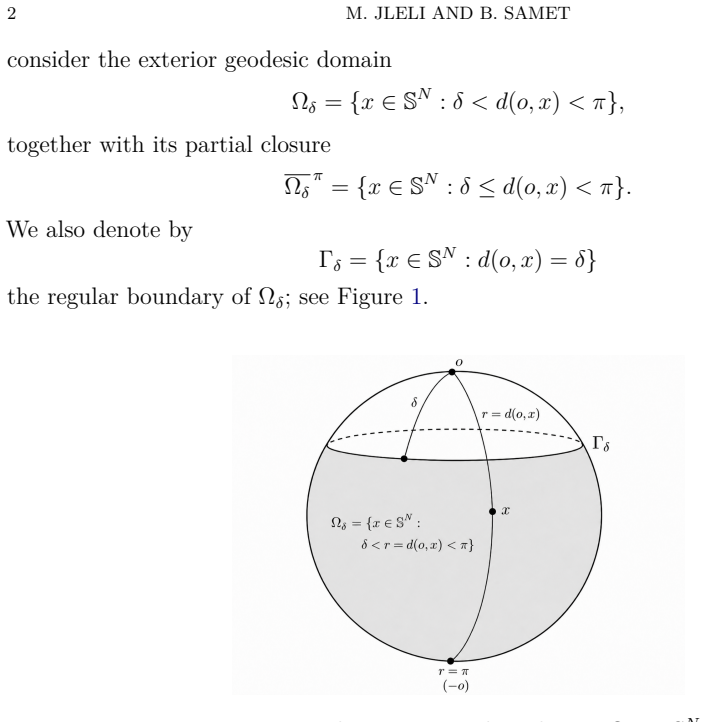
We study an inhomogeneous semilinear heat inequality on the unit sphere \(\mathbb S^N\), \(N\ge3\), in an exterior geodesic domain associated with a fixed pole. The equation involves the singular Hardy-type potential \(\lambda/\sin^2 r\), where \(r=d(o,x)\), and the weighted nonlinearity \((\sin r)^\alpha |u|^p\). For \(\alpha>-2\) and \(0<\lambda\le \lambda^*=((N-2)/2)^2\), we prove the existence of a critical exponent \(p_{\mathrm{crit}}=p_{\mathrm{crit}}(\alpha,N,\lambda)\) governing the existence and nonexistence of solutions. More precisely, we prove that no weak solution exists for any nontrivial nonnegative source in the range \(p>p_{\mathrm{crit}}\), whereas classical solutions exist for some positive continuous sources in the range \(1<p<p_{\mathrm{crit}}\). Under suitable additional assumptions, we also prove nonexistence at the critical exponent \(p=p_{\mathrm{crit}}\). If \(\alpha\le -2\), we show that nonexistence holds for all \(p>1\). The analysis is based on the construction of radial Hardy barriers adapted to the antipodal singularity and on sharp integral estimates involving power and logarithmic cutoffs near \(r=\pi\).
Editorial analysis
A structured set of objections, weighed in public.
Referee Report
Summary. The paper studies an inhomogeneous semilinear heat inequality on the unit sphere S^N (N≥3) in an exterior geodesic domain, featuring the singular Hardy potential λ/sin²r (with 0<λ≤λ*=((N-2)/2)²) and the weighted nonlinearity (sin r)^α |u|^p. For α>-2 it establishes a critical exponent p_crit=p_crit(α,N,λ) such that no weak solution exists for any nontrivial nonnegative source when p>p_crit, while classical solutions exist for some positive continuous sources when 1<p<p_crit; nonexistence at criticality holds under extra assumptions. For α≤-2 nonexistence holds for all p>1. The proofs rely on radial Hardy barriers adapted to the antipodal singularity together with sharp integral estimates using power and logarithmic cutoffs near r=π.
Significance. If the barrier constructions and integral estimates hold, the work supplies a sharp existence/nonexistence threshold for semilinear inequalities in a geometrically natural setting with singular potentials on the sphere. The explicit adaptation of Hardy-type barriers to the antipodal point and the weighted spherical geometry constitutes a technical contribution that could inform related problems on manifolds.
major comments (2)
- [Section on barrier construction (near the description of radial Hardy barriers adapted to the antipodal singularity)] The nonexistence claim for p>p_crit (and at criticality) rests on the radial Hardy barriers serving as admissible test functions or supersolutions in the weak formulation. The construction must be verified to satisfy the differential inequality involving the spherical Laplacian, the term λ/sin²r, and the weight (sin r)^α while remaining valid in the exterior domain approaching r=π; any failure to control the singularity or the cutoff integrals would invalidate the contradiction obtained for large p.
- [Section on integral estimates (near the power and logarithmic cutoff arguments)] The sharp integral estimates with power and logarithmic cutoffs near r=π are load-bearing for identifying the precise threshold p_crit(α,N,λ) and for forcing nonexistence when α≤-2. These estimates must be shown to produce the required contradiction when tested against a positive source; gaps in the constants or in the handling of the weight (sin r)^α would collapse the separation between the existence and nonexistence regimes.
minor comments (2)
- [Abstract] The abstract states the claims clearly but could briefly indicate the precise form of the semilinear heat inequality (e.g., whether it is u_t - Δu - λ/sin²r u ≥ (sin r)^α |u|^p or an integrated weak form).
- [Introduction / notation] Notation for the exterior geodesic domain and the distance r=d(o,x) should be fixed once at the beginning and used consistently; minor inconsistencies in the description of the domain boundaries would not affect the main argument.
Simulated Author's Rebuttal
We thank the referee for the careful reading of our manuscript and the constructive comments on the technical foundations of the existence/nonexistence results. We address the two major comments point by point below. The constructions and estimates are carried out in the paper as described in the abstract, but we agree that additional explicit verifications will strengthen the presentation.
read point-by-point responses
-
Referee: [Section on barrier construction (near the description of radial Hardy barriers adapted to the antipodal singularity)] The nonexistence claim for p>p_crit (and at criticality) rests on the radial Hardy barriers serving as admissible test functions or supersolutions in the weak formulation. The construction must be verified to satisfy the differential inequality involving the spherical Laplacian, the term λ/sin²r, and the weight (sin r)^α while remaining valid in the exterior domain approaching r=π; any failure to control the singularity or the cutoff integrals would invalidate the contradiction obtained for large p.
Authors: In Section 3 we construct the radial Hardy barriers adapted to the antipodal singularity and verify directly that they satisfy the required differential inequality for the spherical Laplacian plus the Hardy term λ/sin²r, while incorporating the weight (sin r)^α. The verification is performed in radial coordinates on the exterior geodesic domain, with the barriers chosen to remain admissible as test functions or supersolutions in the weak formulation. Singularities at r=π are controlled by the cutoffs, which are shown to preserve the necessary integrability. We will expand the verification into a self-contained lemma with all intermediate calculations displayed in the revised version. revision: partial
-
Referee: [Section on integral estimates (near the power and logarithmic cutoff arguments)] The sharp integral estimates with power and logarithmic cutoffs near r=π are load-bearing for identifying the precise threshold p_crit(α,N,λ) and for forcing nonexistence when α≤-2. These estimates must be shown to produce the required contradiction when tested against a positive source; gaps in the constants or in the handling of the weight (sin r)^α would collapse the separation between the existence and nonexistence regimes.
Authors: Section 4 derives the sharp integral estimates via power and logarithmic cutoffs near r=π. These estimates are inserted into the weak formulation tested against a positive continuous source, yielding the contradiction for p > p_crit and the separation of regimes. The weight (sin r)^α is retained throughout the integration, and the constants are tracked explicitly to obtain the precise value of p_crit(α,N,λ). For α ≤ -2 the same estimates produce divergence for every p > 1. We will add an appendix or expanded subsection displaying the full constant computations and the precise testing argument against the source term. revision: partial
Circularity Check
No circularity: critical exponent obtained via explicit barrier construction and integral estimates
full rationale
The paper introduces p_crit(α,N,λ) as the threshold value separating existence and nonexistence for the inhomogeneous semilinear heat inequality with Hardy potential and weighted nonlinearity. The claimed results are established by direct construction of radial Hardy barriers adapted to the antipodal singularity on the exterior geodesic domain, together with sharp integral estimates that employ power and logarithmic cutoffs near r=π. These steps are presented as independent analytic arguments that exploit the spherical geometry, the explicit form of the potential λ/sin²r, and the weight (sin r)^α; they do not reduce p_crit to a fitted parameter, a self-referential definition, or a load-bearing self-citation. The abstract and description contain no equations or statements in which the separation between regimes is forced by construction from the inputs themselves. Consequently the derivation chain remains self-contained against external benchmarks and receives the lowest circularity score.
Axiom & Free-Parameter Ledger
axioms (1)
- standard math Standard comparison principle and weak formulation for semilinear parabolic inequalities on Riemannian manifolds
Lean theorems connected to this paper
-
IndisputableMonolith/Cost/FunctionalEquation.leanwashburn_uniqueness_aczel unclearConstruction of a radial Hardy barrier in Ω_δ ... h(r) ≍ (π-r)^μ- ... logarithmic cutoff η_m(ln(R(π-r))/ln√R) ... p_crit = 1 + (α+2)/λ_N
-
IndisputableMonolith/Foundation/AlexanderDuality.leanalexander_duality_circle_linking unclearindicial equation μ(μ+N-2)+λ=0 ... μ± = -(N-2)/2 ± sqrt(((N-2)/2)^2 - λ)
Reference graph
Works this paper leans on
-
[1]
B. Abdellaoui, I. Peral, A. Primo, Influence of the Hardy potential in a semilinear heat equation, Proc. R. Soc. Edinb. A 139(5) (2009) 897–926
work page 2009
-
[2]
B. Abdellaoui, I. Peral, A. Primo, Optimal results for parabolic problems arising in some physical models with critical growth in the gradient respect to a Hardy potential, Adv. Math. 225(6) (2010) 2967–3021
work page 2010
-
[3]
B. Abdellaoui, I. Peral, A. Primo, A note on the Fujita exponent in fractional heat equation involving the Hardy potential, Math. Eng. 2(4) (2020) 639–656
work page 2020
-
[4]
B. Abdellaoui, G. Siclari, A. Primo, Fujita exponent for non-local parabolic equation involving the Hardy-Leray potential, J. Evol. Equ. 24(3) (2024) 55
work page 2024
-
[5]
A. H. Ardila, M. Hamano, M. Ikeda, Mass-energy threshold dynamics for the focusing NLS with a repulsive inverse-power potential, Evol. Equ. Control Theory 13(5) (2024) 1401–1422
work page 2024
-
[6]
P. Baras, J.A. Goldstein, The heat equation with a singular potential, Trans. Am. Math. Soc. 284(1) (1984) 121–139
work page 1984
- [7]
- [8]
-
[9]
Fujita, On the blowing up of solutions of the Cauchy problem forut = ∆u +u1+α, J
H. Fujita, On the blowing up of solutions of the Cauchy problem forut = ∆u +u1+α, J. Fac. Sci. Univ. Tokyo Sect. I 13 (1966) 109–124
work page 1966
-
[10]
J. Goldstein, Q.S. Zhang, On a degenerate heat equation with a singular potential, J. Funct. Anal. 186(2) (2001) 342–359
work page 2001
-
[11]
Q. Gu, Y. Sun, J. Xiao, F. Xu, Global positive solution to a semi-linear parabolic equation with potential on Riemannian manifold, Calc. Var. 59 (2020) 170. SEMILINEAR HEAT INEQUALITIES IN AN EXTERIOR GEODESIC DOMAIN ONS N 27
work page 2020
-
[12]
Grigor’yan, Heat Kernel and Analysis on Manifolds, AMS/IP Studies in Advanced Mathematics, vol
A. Grigor’yan, Heat Kernel and Analysis on Manifolds, AMS/IP Studies in Advanced Mathematics, vol. 47, American Mathematical Society, Providence, RI, 2009
work page 2009
-
[13]
A. Grigor’yan, Y. Sun, On nonnegative solutions of the inequality∆u +uσ≤0on Riemannian manifolds, Commun. Pure Appl. Math. 67(8) (2014) 1336–1352
work page 2014
-
[14]
A. Grigor’yan, Y. Sun, I. Verbitsky, Superlinear elliptic inequalities on manifolds, J. Func. Anal. 278(9) (2020) 108444
work page 2020
- [15]
-
[16]
Hayakawa, On the nonexistence of global solutions of some semilinear parabolic equations, Proc
K. Hayakawa, On the nonexistence of global solutions of some semilinear parabolic equations, Proc. Japan Acad. 49(7) (1973) 503–505
work page 1973
-
[17]
M. Jleli, M.A. Ragusa, B. Samet, Nonlinear Liouville-type theorems for generalized Baouendi-Grushin operator on Riemaniann manifolds, Adv. Differ. Equ. 28(1–2) (2023) 143–168
work page 2023
- [18]
- [19]
-
[20]
P. Mastrolia, D.D. Monticelli, F. Punzo, Nonexistence results for elliptic differential inequalities with a potential on Riemannian manifolds, Calc. Var. Partial Diff. Eq. 54(2) (2015) 1345–1372
work page 2015
-
[21]
P. Mastrolia, D.D. Monticelli, F. Punzo, Nonexistence of solutions to parabolic differential inequalities with a potential on Riemannian manifolds, Math. Ann. 367(3–4) (2017) 929–963
work page 2017
-
[22]
J. Vancostenoble, E. Zuazua, Null controllability for the heat equation with singular inverse-square potentials, J. Funct. Anal. 254(7) (2008) 1864–1902
work page 2008
-
[23]
Zhang, Blow-up results for non-linear parabolic equations on manifolds, Duke Math
Q.S. Zhang, Blow-up results for non-linear parabolic equations on manifolds, Duke Math. J. 97 (1999) 515–539
work page 1999
-
[24]
Zhang, A general blow-up result on nonlinear boundary-value problems on exterior domains, Proc
Q.S. Zhang, A general blow-up result on nonlinear boundary-value problems on exterior domains, Proc. Roy. Soc. Edinburgh Sect. A 131(2) (2001) 451–475. (M. Jleli) Department of Mathematics, College of Science, King Saud University, Riyadh 11451, Saudi Arabia Email address:jleli@ksu.edu.sa (B. Samet) Department of Mathematics, College of Science, King Saud...
work page 2001
discussion (0)
Sign in with ORCID, Apple, or X to comment. Anyone can read and Pith papers without signing in.