Recognition: 2 theorem links
· Lean TheoremA scalar interface reduction for nonlinear interface problems
Pith reviewed 2026-05-12 02:47 UTC · model grok-4.3
The pith
Decomposing solutions into continuous and unit-jump parts reduces nonlinear interface conditions to a single scalar equation.
A machine-rendered reading of the paper's core claim, the machinery that carries it, and where it could break.
Core claim
The central claim is that the nonlinear interface problem can be reformulated by expressing the solution as a sum of a continuous function satisfying linear interface conditions and a multiple of a unit-jump mode, thereby reducing the entire nonlinear jump condition to an equation in a single scalar coefficient associated with the jump mode. This scalar equation functions as a nonlinear Schur complement for the interface degree of freedom.
What carries the argument
The decomposition of the solution into a continuous component and a unit-jump response mode, which isolates the nonlinearity into a scalar variable.
If this is right
- The bulk linear problems are solved separately from the interface nonlinearity.
- The nonlinear interface condition is reduced to solving a scalar nonlinear equation.
- The procedure consists of linear solves combined with a low-dimensional nonlinear update.
- Second-order accuracy is obtained for interface quantities in both elliptic and parabolic cases.
Where Pith is reading between the lines
- If the decomposition holds, the method could simplify the treatment of similar nonlinear transmission problems in other discretization schemes.
- This reduction might enable more efficient iterative solvers by decoupling the linear bulk from the nonlinear scalar.
- Extensions to time-dependent nonlinearities in parabolic problems could follow if the unit-jump mode remains time-independent.
Load-bearing premise
The solution admits a decomposition into a continuous component and a unit-jump response mode that isolates all nonlinearity into one scalar, even for nonlinear jumps, with the resulting scalar equation being well-posed.
What would settle it
A test case with a specific nonlinear jump condition where the scalar nonlinear equation produces a value that, when used to reconstruct the solution, fails to satisfy the original interface jump condition beyond discretization error.
Figures
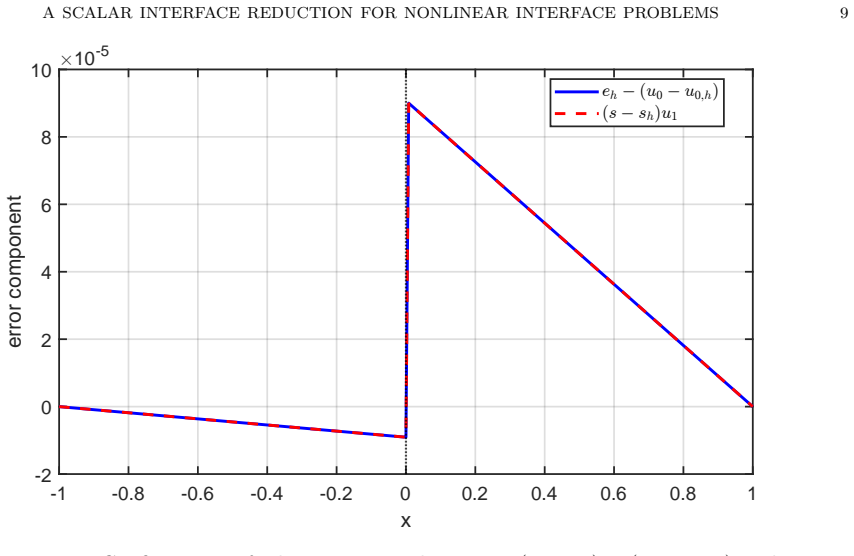

read the original abstract
We study finite element approximations of elliptic and parabolic interface problems with discontinuous coefficients and nonlinear jump conditions. We introduce a scalar interface reduction in which the solution is decomposed into a continuous component and a unit-jump response mode. This representation isolates the interface nonlinearity into a single scalar variable while the bulk problem remains linear. From this perspective, the nonlinear interface condition is reduced to a scalar nonlinear equation, which may be interpreted as a nonlinear Schur complement associated with the interface degree of freedom. The resulting formulation leads to a simple computational procedure consisting of linear solves combined with a low-dimensional nonlinear update. Numerical results for representative elliptic and parabolic problems confirm second-order accuracy for interface quantities and demonstrate the effectiveness of the proposed approach.
Editorial analysis
A structured set of objections, weighed in public.
Referee Report
Summary. The manuscript introduces a scalar interface reduction for finite element approximations of elliptic and parabolic interface problems with discontinuous coefficients and nonlinear jump conditions. The solution is decomposed as u = u_c + s * phi, where u_c is continuous across the interface and phi is a fixed unit-jump response mode satisfying [[phi]] = 1. This isolates all nonlinearity into the scalar s, reducing the interface condition to a scalar nonlinear equation interpreted as a nonlinear Schur complement. The bulk problems remain linear and are solved independently, with the overall procedure consisting of linear solves plus a low-dimensional nonlinear update. Numerical experiments on representative problems are reported to confirm second-order accuracy for interface quantities.
Significance. If rigorously justified, the reduction would offer a computationally attractive approach by preserving linearity in the bulk while confining nonlinearity to a scalar equation, potentially simplifying solvers for interface problems. The numerical results provide evidence of effectiveness and accuracy on the tested cases, and the interpretation as a nonlinear Schur complement is a useful conceptual framing. However, the significance is tempered by the need to establish applicability beyond special cases.
major comments (1)
- [Abstract and decomposition section] The proposed decomposition (abstract and the definition of the unit-jump response mode) enforces [[u]] = s to be spatially constant on the interface because phi is a single fixed mode with constant jump 1. For general local nonlinear jump conditions of the form [[∂_n u]] = g([[u]], u) evaluated pointwise along the interface, the true solution admits a spatially varying jump function. Neither the continuous component nor the single scalar multiple of phi can reproduce arbitrary tangential variation in the jump. The manuscript states the reduction applies to general elliptic/parabolic interface problems with nonlinear jump conditions without restricting to constant-jump or 1D cases; this assumption is load-bearing for the claim that nonlinearity is isolated into one scalar variable and for the nonlinear Schur complement interpretation.
minor comments (1)
- [Numerical results] The numerical section would benefit from explicit statements of the nonlinear functions g used in the test problems, the precise definition of interface error norms, and the range of mesh sizes employed to substantiate the second-order accuracy claim for interface quantities.
Simulated Author's Rebuttal
We thank the referee for the careful reading and constructive feedback. The comment correctly identifies a key modeling assumption in the decomposition, and we address it directly below by agreeing to revise the scope and claims.
read point-by-point responses
-
Referee: [Abstract and decomposition section] The proposed decomposition (abstract and the definition of the unit-jump response mode) enforces [[u]] = s to be spatially constant on the interface because phi is a single fixed mode with constant jump 1. For general local nonlinear jump conditions of the form [[∂_n u]] = g([[u]], u) evaluated pointwise along the interface, the true solution admits a spatially varying jump function. Neither the continuous component nor the single scalar multiple of phi can reproduce arbitrary tangential variation in the jump. The manuscript states the reduction applies to general elliptic/parabolic interface problems with nonlinear jump conditions without restricting to constant-jump or 1D cases; this assumption is load-bearing for the claim that nonlinearity is isolated into one scalar variable and for the nonlinear Schur complement interpretation.
Authors: We agree with the referee that the decomposition u = u_c + s ϕ with [[ϕ]] = 1 forces the jump [[u]] = s to be spatially constant. This restricts the method to nonlinear jump conditions whose solutions admit (or are well-approximated by) a constant jump, such as certain one-dimensional problems or specific forms of g that are independent of tangential position. The manuscript's statements of applicability to fully general pointwise nonlinear conditions are therefore too broad. We will revise the abstract, introduction, and decomposition section to explicitly limit the scope to problems with constant jumps, add a remark on the limitation for spatially varying jumps, and adjust the nonlinear Schur complement interpretation accordingly. These changes will be accompanied by a brief discussion of when the constant-jump assumption holds. revision: yes
Circularity Check
No circularity: decomposition is an explicit ansatz, not a redefinition or fitted prediction
full rationale
The paper introduces an explicit decomposition u = u_c + s * phi where phi is the fixed unit-jump mode with [[phi]] = 1. This choice directly produces a constant jump [[u]] = s and reduces the interface condition to a scalar equation for s by algebraic substitution. No step fits a parameter to data and then renames the output as a prediction, no self-citation supplies a uniqueness theorem that forces the form, and no prior result is invoked to smuggle the ansatz. The derivation is self-contained once the representation is chosen; any limitation on applicability to non-constant jumps is a question of modeling scope rather than circular reduction of the claimed equations to their inputs.
Axiom & Free-Parameter Ledger
axioms (2)
- standard math Standard finite element approximation theory applies to the decomposed linear bulk problems
- domain assumption The solution admits a decomposition into continuous component plus unit-jump response mode that isolates nonlinearity
invented entities (1)
-
unit-jump response mode
no independent evidence
Reference graph
Works this paper leans on
-
[1]
I. Babu s ka and J. M. Melenk , The partition of unity method , International journal for numerical methods in engineering, 40 (1997), pp. 727--758
work page 1997
-
[2]
S.-H. Chou, C. Khaemba, and A. Wachira , A finite difference method for an interface problem with a nonlinear jump condition , Int. J. Numer. Anal. Model., 22 (2025), pp. 801--823
work page 2025
-
[3]
T.-P. Fries and T. Belytschko , The extended/generalized finite element method: an overview of the method and its applications , International journal for numerical methods in engineering, 84 (2010), pp. 253--304
work page 2010
-
[4]
G. Hetzer and A. Meir , On an interface problem with a nonlinear jump condition, numerical approximation of solutions , Int. J. Numer. Anal. Model, 4 (2007), pp. 519--530
work page 2007
-
[5]
T. Y. Hou and X.-H. Wu , A multiscale finite element method for elliptic problems in composite materials and porous media , Journal of Computational Physics, 134 (1997), pp. 169--189
work page 1997
-
[6]
Y. Jeon and S.-Y. Yi , The immersed interface hybridized difference method for parabolic interface problems. , Numerical Mathematics: Theory, Methods & Applications, 15 (2022)
work page 2022
- [7]
-
[8]
R. J. LeVeque and Z. Li , The immersed interface method for elliptic equations with discontinuous coefficients and singular sources , SIAM Journal on Numerical Analysis, 31 (1994), pp. 1019--1044
work page 1994
- [9]
-
[10]
T. Lin, D. Sheen, and X. Zhang , A locking-free immersed finite element method for planar elasticity interface problems , Journal of Computational Physics, 276 (2014), pp. 205--222
work page 2014
discussion (0)
Sign in with ORCID, Apple, or X to comment. Anyone can read and Pith papers without signing in.