Recognition: no theorem link
An Experimental Method to Study Opinion Diffusion in Human-AI Hybrid Societies
Pith reviewed 2026-05-12 03:41 UTC · model grok-4.3
The pith
Hybrid human-AI networks reach lower polarization than human-only networks after repeated opinion updates on a grid.
A machine-rendered reading of the paper's core claim, the machinery that carries it, and where it could break.
Core claim
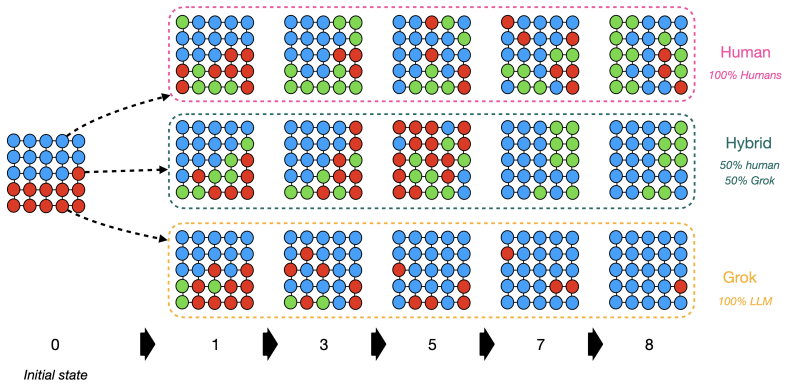
In 5x5 grid lattice networks, hybrid groups containing equal shares of humans and AI agents reach the lowest final polarization after eight iterative rounds of statement selection and revision, while human-only networks display higher polarization together with lower neighbor agreement.
What carries the argument
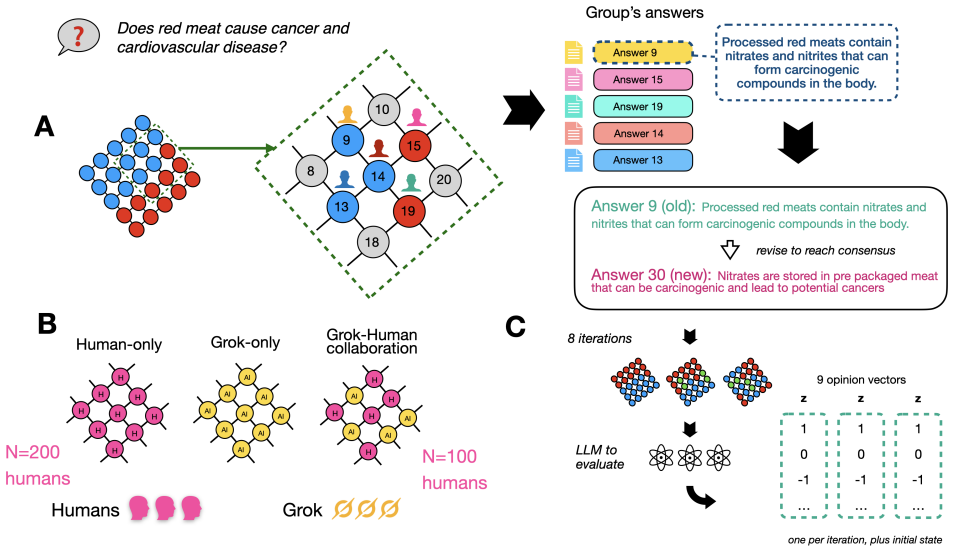
The 5x5 grid lattice network in which participants iteratively select and revise statements on a given polarizing topic, with AI agents implemented through large language model prompts.
If this is right
- Hybrid human-AI networks can produce lower final polarization than human-only networks under repeated opinion updates.
- Changes in how AI agents are prompted can shift the observed convergence patterns.
- Grid-based experimental networks isolate the effect of AI presence on human opinion dynamics.
Where Pith is reading between the lines
- The method could be extended to vary network size or run more rounds to test whether the polarization reduction persists.
- If the pattern holds, platforms might explore limited AI participation to reduce echo-chamber effects on specific topics.
- Results may still depend on the choice of polarizing topic and the exact prompt wording given to the AI.
Load-bearing premise
The small grid size, fixed number of rounds, and use of prompted AI agents sufficiently represent how opinions actually spread in larger human-AI societies.
What would settle it
A follow-up experiment on larger networks or with real deployed AI tools that finds hybrid groups do not end with lower polarization than human-only groups.
Figures


read the original abstract
As artificial intelligence increasingly mediates public discourse, it becomes important to understand how human-AI collectives shape opinion formation, deliberation, and democratic outcomes. We present a novel experimental method for studying opinion dynamics in hybrid human-AI social networks. Participants, human or AI, were embedded in $5\times5$ grid lattice networks and iteratively asked to select and revise statements on a given polarizing topic over eight rounds. We compared three conditions: human-only, AI-only, and hybrid networks with equal proportions of human and AI participants. Hybrid human-AI networks achieved the lowest final polarization while, in contrast, human-only networks exhibited higher polarization with lower neighbor agreement. We also ran additional experiments varying Large Language Model (LLM) prompt framing to explore whether instruction design might influence convergence patterns. Although these early findings are preliminary and cannot yet support broad generalizations, they highlight the potential value of experimental social networks for understanding opinion dynamics in human-AI hybrid societies.
Editorial analysis
A structured set of objections, weighed in public.
Referee Report
Summary. The manuscript presents a novel experimental method to study opinion diffusion in human-AI hybrid societies. Participants, either human or AI agents powered by LLMs, are placed in 5x5 grid lattice networks and iteratively select and revise statements on polarizing topics over eight rounds. The study compares three conditions: human-only, AI-only, and hybrid networks with equal proportions of humans and AIs. Key findings indicate that hybrid networks result in the lowest final polarization, whereas human-only networks show higher polarization and lower neighbor agreement. Additional experiments explore variations in LLM prompt framing.
Significance. If the reported differences in polarization hold under more rigorous conditions, this work could provide an important experimental framework for investigating how AI integration affects opinion formation and deliberation in social networks. It offers preliminary evidence that hybrid human-AI setups might mitigate polarization compared to purely human groups, which has implications for designing AI-mediated public discourse platforms. The method itself is a strength as an initial step toward controlled studies in this emerging area.
major comments (3)
- [Abstract] The abstract states that hybrid human-AI networks achieved the lowest final polarization while human-only networks exhibited higher polarization with lower neighbor agreement, but provides no sample sizes, exact definition of the polarization metric, statistical tests, controls for individual differences, or summaries of raw data, rendering the comparative claims unverifiable.
- [Experimental Design] The choice of a 5×5 grid lattice with only eight iterative rounds limits the emergence of global mixing or cascade effects characteristic of real opinion diffusion on larger platforms, since the network diameter is small (4–8 hops) and local neighbor influence dominates.
- [AI Agent Model] Since LLM agents are deterministic given fixed prompts, the observed convergence in hybrid and AI-only conditions may reflect prompt-induced averaging rather than the stochastic, identity-driven processes in human groups; the paper reports exploratory prompt variants but without per-run variance or sensitivity analyses.
minor comments (1)
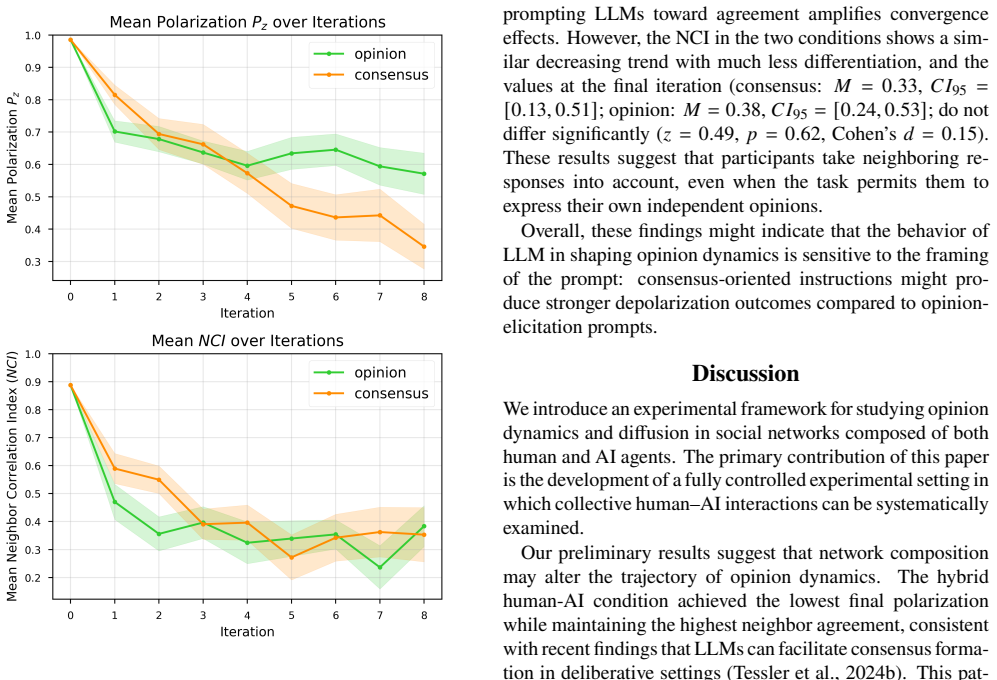
- The abstract mentions 'additional experiments varying Large Language Model (LLM) prompt framing' but does not specify the exact framings or their quantitative impacts.
Simulated Author's Rebuttal
We thank the referee for their thoughtful and constructive comments, which have helped us identify areas to strengthen the manuscript. We address each major comment below and describe the planned revisions.
read point-by-point responses
-
Referee: [Abstract] The abstract states that hybrid human-AI networks achieved the lowest final polarization while human-only networks exhibited higher polarization with lower neighbor agreement, but provides no sample sizes, exact definition of the polarization metric, statistical tests, controls for individual differences, or summaries of raw data, rendering the comparative claims unverifiable.
Authors: We agree that the abstract requires additional detail to support verifiability. In the revised version we will incorporate the sample sizes (number of networks and participants per condition), a concise definition of the polarization metric (network-level opinion variance), reference to the statistical tests performed (e.g., ANOVA with reported p-values), mention of baseline controls for individual opinion differences, and a brief note on raw-data consistency across runs. These additions will be made while remaining within abstract length constraints. revision: yes
-
Referee: [Experimental Design] The choice of a 5×5 grid lattice with only eight iterative rounds limits the emergence of global mixing or cascade effects characteristic of real opinion diffusion on larger platforms, since the network diameter is small (4–8 hops) and local neighbor influence dominates.
Authors: We acknowledge the limitation of the chosen scale. The 5×5 grid and eight-round design were selected to enable precise observation and coding of every local interaction in a controlled setting. We will add an explicit limitations paragraph in the Discussion section that notes the restricted network diameter and the consequent focus on local rather than global dynamics, and we will outline planned extensions to larger or alternative topologies for future work. The core experimental design itself will not be altered, as it fulfills the paper’s stated goal of providing an initial controlled method. revision: partial
-
Referee: [AI Agent Model] Since LLM agents are deterministic given fixed prompts, the observed convergence in hybrid and AI-only conditions may reflect prompt-induced averaging rather than the stochastic, identity-driven processes in human groups; the paper reports exploratory prompt variants but without per-run variance or sensitivity analyses.
Authors: We appreciate the distinction drawn between prompt-driven and stochastic processes. Although we used a non-zero temperature (0.8) during generation to introduce sampling variability, we agree that variance reporting and sensitivity checks are needed. The revision will add (i) per-run standard deviations for polarization and agreement metrics, (ii) a sensitivity analysis across temperature values and prompt-framing variants, and (iii) a short discussion clarifying how these controls help separate prompt effects from human-like stochasticity. These elements will appear in the Results and Methods sections. revision: yes
Circularity Check
No circularity: purely empirical experimental report
full rationale
The paper is an experimental report describing participant trials in 5x5 grids over eight rounds across human-only, AI-only, and hybrid conditions. No equations, derivations, model predictions, fitted parameters, or self-citations appear in the provided text. Results are presented as direct observations from the setup rather than reductions from prior claims or definitions. The analysis is therefore self-contained with no load-bearing steps that reduce to inputs by construction.
Axiom & Free-Parameter Ledger
axioms (1)
- domain assumption LLM agents given appropriate prompts can simulate human-like opinion revision and neighbor influence in a social network setting.
Reference graph
Works this paper leans on
-
[1]
Epidemic modeling with generative agents
Epidemic modeling with generative agents , author=. arXiv preprint arXiv:2307.04986 , year=
-
[2]
OpenRouter.ai: Unified API for AI Models , author=
-
[3]
arXiv preprint arXiv:2502.00879 , year=
Generating computational cognitive models using large language models , author=. arXiv preprint arXiv:2502.00879 , year=
-
[4]
Large Language Models for Scientific and Societal Advances , year=
Collective Social Behaviors in LLMs: An Analysis of LLMs Social Networks , author=. Large Language Models for Scientific and Societal Advances , year=
-
[5]
Humans create more novelty than ChatGPT when asked to retell a story , author=. Scientific Reports , volume=. 2024 , publisher=
work page 2024
-
[6]
Proceedings-british academy , volume=
Why culture is common, but cultural evolution is rare , author=. Proceedings-british academy , volume=. 1996 , organization=
work page 1996
-
[7]
arXiv preprint arXiv:2409.11112 , year=
Strategic Insights in Human and Large Language Model Tactics at Word Guessing Games , author=. arXiv preprint arXiv:2409.11112 , year=
-
[8]
arXiv preprint arXiv:2501.10476 , year=
Revisiting Rogers' Paradox in the Context of Human-AI Interaction , author=. arXiv preprint arXiv:2501.10476 , year=
-
[9]
Nature human behaviour , volume=
Building machines that learn and think with people , author=. Nature human behaviour , volume=. 2024 , publisher=
work page 2024
-
[10]
Gibbs Sampling with People , url =
Harrison, Peter and Marjieh, Raja and Adolfi, Federico and van Rijn, Pol and Anglada-Tort, Manuel and Tchernichovski, Ofer and Larrouy-Maestri, Pauline and Jacoby, Nori , booktitle =. Gibbs Sampling with People , url =
-
[11]
Nature Human Behaviour , volume=
A new sociology of humans and machines , author=. Nature Human Behaviour , volume=. 2024 , publisher=
work page 2024
-
[12]
AI can help humans find common ground in democratic deliberation , author =. Science , volume=. 2024 , publisher=
work page 2024
-
[13]
UMAP: Uniform Manifold Approximation and Projection for Dimension Reduction
Umap: Uniform manifold approximation and projection for dimension reduction , author=. arXiv preprint arXiv:1802.03426 , year=
work page internal anchor Pith review Pith/arXiv arXiv
-
[14]
Efficient Estimation of Word Representations in Vector Space
Efficient estimation of word representations in vector space , author=. arXiv preprint arXiv:1301.3781 , year=
work page internal anchor Pith review Pith/arXiv arXiv
-
[15]
Generative AI enhances individual creativity but reduces the collective diversity of novel content , author=. Science advances , volume=. 2024 , publisher=
work page 2024
-
[16]
Nature Human Behaviour , pages=
A large-scale comparison of divergent creativity in humans and large language models , author=. Nature Human Behaviour , pages=. 2025 , publisher=
work page 2025
-
[17]
Towards an AI co-scientist , author=. arXiv preprint arXiv:2502.18864 , year=
work page internal anchor Pith review Pith/arXiv arXiv
-
[18]
AI can spark creativity—if we ask it how, not what, to think , author=. Nature , volume=. 2026 , publisher=
work page 2026
-
[19]
Nature communications , volume=
Simple autonomous agents can enhance creative semantic discovery by human groups , author=. Nature communications , volume=. 2024 , publisher=
work page 2024
-
[20]
Trends in cognitive sciences , volume=
Exploration versus exploitation in space, mind, and society , author=. Trends in cognitive sciences , volume=. 2015 , publisher=
work page 2015
- [21]
-
[22]
arXiv preprint arXiv:2310.13018 , year=
Getting aligned on representational alignment , author=. arXiv preprint arXiv:2310.13018 , year=
-
[23]
Administrative science quarterly , volume=
The network structure of exploration and exploitation , author=. Administrative science quarterly , volume=. 2007 , publisher=
work page 2007
-
[24]
Journal of the Royal Society Interface , volume=
Individual exploration and selective social learning: balancing exploration--exploitation trade-offs in collective foraging , author=. Journal of the Royal Society Interface , volume=. 2022 , publisher=
work page 2022
-
[25]
Locally noisy autonomous agents improve global human coordination in network experiments , author=. Nature , volume=. 2017 , publisher=
work page 2017
-
[26]
Nature Computational Science , volume=
Using LLMs to advance the cognitive science of collectives , author=. Nature Computational Science , volume=. 2025 , publisher=
work page 2025
-
[27]
Nature Human Behaviour , volume=
Machine culture , author=. Nature Human Behaviour , volume=. 2023 , publisher=
work page 2023
-
[28]
Artificial intelligence tools expand scientists’ impact but contract science’s focus , author=. Nature , pages=. 2026 , publisher=
work page 2026
-
[29]
AI-generated poetry is indistinguishable from human-written poetry and is rated more favorably , author=. Scientific Reports , volume=. 2024 , publisher=
work page 2024
-
[30]
A foundation model to predict and capture human cognition , author=. Nature , pages=. 2025 , publisher=
work page 2025
-
[31]
PsyNet: An Online Framework for Behavioral Experiments , author =. 2020 , howpublished =
work page 2020
-
[32]
Behavior Research Methods , volume=
Empirica: a virtual lab for high-throughput macro-level experiments , author=. Behavior Research Methods , volume=. 2021 , publisher=
work page 2021
-
[33]
arXiv preprint arXiv:2406.04278 , year=
Characterizing similarities and divergences in conversational tones in humans and llms by sampling with people , author=. arXiv preprint arXiv:2406.04278 , year=
-
[34]
Findings of the Association for Computational Linguistics: EMNLP 2025 , pages=
Agent laboratory: Using llm agents as research assistants , author=. Findings of the Association for Computational Linguistics: EMNLP 2025 , pages=. 2025 , publisher=
work page 2025
-
[35]
Highly accurate protein structure prediction with AlphaFold , author=. nature , volume=. 2021 , publisher=
work page 2021
-
[36]
Autonomous chemical research with large language models , author=. Nature , volume=. 2023 , publisher=
work page 2023
-
[37]
Proceedings of the National Academy of Sciences , volume=
Bayesian modeling of human--AI complementarity , author=. Proceedings of the National Academy of Sciences , volume=. 2022 , publisher=
work page 2022
-
[38]
arXiv preprint arXiv:2502.12847 , year=
Characterizing the Interaction of Cultural Evolution Mechanisms in Experimental Social Networks , author=. arXiv preprint arXiv:2502.12847 , year=
-
[39]
Divergent creativity in humans and large language models , author=. Scientific Reports , volume=. 2026 , publisher=
work page 2026
-
[40]
Advances in neural information processing systems , volume=
Gibbs sampling with people , author=. Advances in neural information processing systems , volume=
-
[41]
Commonality and variation in mental representations of music revealed by a cross-cultural comparison of rhythm priors in 15 countries , volume =. Nat Hum Behav , author =. 2024 , pages =. doi:10.1038/s41562-023-01800-9 , abstract =
-
[42]
Cognitive Psychology , author =
Uncovering mental representations with. Cognitive Psychology , author =. 2010 , pages =. doi:10.1016/j.cogpsych.2009.07.001 , language =
-
[43]
Shiiku, Shota and Marjieh, Raja and Anglada-Tort, Manuel and Jacoby, Nori , month = may, year =. The. doi:10.48550/arXiv.2502.17962 , abstract =
-
[44]
URL https://www.science.org/doi/abs/10.1126/ science.adq2852
Science , author =. 2024 , pages =. doi:10.1126/science.adq2852 , abstract =
-
[45]
doi:10.48550/arXiv.2506.06366 , abstract =
Chen, Lin and Zhang, Yunke and Feng, Jie and Chai, Haoye and Zhang, Honglin and Fan, Bingbing and Ma, Yibo and Zhang, Shiyuan and Li, Nian and Liu, Tianhui and Sukiennik, Nicholas and Zhao, Keyu and Li, Yu and Liu, Ziyi and Xu, Fengli and Li, Yong , month = jun, year =. doi:10.48550/arXiv.2506.06366 , abstract =
-
[46]
A data-driven kinetic model for opinion dynamics with social network contacts , volume =. Eur. J. Appl. Math , author =. 2025 , pages =. doi:10.1017/S0956792524000068 , abstract =
-
[47]
Conflicting narratives and polarization on social media , url =
Pournaki, Armin , month = jul, year =. Conflicting narratives and polarization on social media , url =. doi:10.48550/arXiv.2507.15600 , abstract =
-
[48]
Examining. Proc. ACM Hum.-Comput. Interact. , author =. 2025 , pages =. doi:10.1145/3757591 , abstract =
-
[49]
Potter, Yujin and Lai, Shiyang and Kim, Junsol and Evans, James and Song, Dawn , month = nov, year =. Hidden. doi:10.48550/arXiv.2410.24190 , abstract =
-
[50]
Summerfield, Christopher and Argyle, Lisa and Bakker, Michiel and Collins, Teddy and Durmus, Esin and Eloundou, Tyna and Gabriel, Iason and Ganguli, Deep and Hackenburg, Kobi and Hadfield, Gillian and Hewitt, Luke and Huang, Saffron and Landemore, Helene and Marchal, Nahema and Ovadya, Aviv and Procaccia, Ariel and Risse, Mathias and Schneier, Bruce and S...
-
[51]
Argyle, Lisa P. and Busby, Ethan C. and Gubler, Joshua R. and Hepner, Bryce and Lyman, Alex and Wingate, David , month = apr, year =. Arti-"fickle". doi:10.48550/arXiv.2504.03822 , abstract =
-
[52]
Hybrid collective intelligence in a human–. AI & Soc , author =. 2021 , pages =. doi:10.1007/s00146-020-01005-y , language =
-
[53]
Mnemonic convergence in social networks:. Proc. Natl. Acad. Sci. U.S.A. , author =. 2016 , pages =. doi:10.1073/pnas.1525569113 , abstract =
-
[54]
Donkers, Tim and Ziegler, Jürgen , month = jun, year =. Human-. doi:10.48550/arXiv.2502.01340 , abstract =
-
[55]
Artificial intelligence in the battle against disinformation and misinformation: a systematic review of challenges and approaches , volume =. Knowl Inf Syst , author =. 2025 , pages =. doi:10.1007/s10115-024-02337-7 , language =
-
[56]
Wang, Chenxi and Liu, Zongfang and Yang, Dequan and Chen, Xiuying , year =. Decoding. doi:10.48550/ARXIV.2409.19338 , abstract =
-
[57]
Human Behavior and Emerging Technologies , author =
The. Human Behavior and Emerging Technologies , author =. 2023 , pages =. doi:10.1155/2023/9094933 , abstract =
-
[58]
Opinion cascades and the unpredictability of partisan polarization , volume =. Sci. Adv. , author =. 2019 , pages =. doi:10.1126/sciadv.aax0754 , abstract =
-
[59]
Network structure shapes consensus dynamics through individual decisions , volume =. Proc. Natl. Acad. Sci. U.S.A. , author =. 2026 , pages =. doi:10.1073/pnas.2520483123 , abstract =
-
[60]
Why more social interactions lead to more polarization in societies , volume =. Proc. Natl. Acad. Sci. U.S.A. , author =. 2025 , pages =. doi:10.1073/pnas.2517530122 , abstract =
-
[61]
Chitra, Uthsav and Musco, Christopher , month = jan, year =. Analyzing the. Proceedings of the 13th. doi:10.1145/3336191.3371825 , language =
-
[62]
Quantifying. Trans. Soc. Comput. , author =. 2018 , pages =. doi:10.1145/3140565 , abstract =
-
[63]
A. ICWSM , author =. 2021 , pages =. doi:10.1609/icwsm.v7i1.14421 , abstract =
-
[64]
The. ICWSM , author =. 2022 , pages =. doi:10.1609/icwsm.v16i1.19275 , abstract =
-
[65]
Data Min Knowl Disc , author =
Measuring and moderating opinion polarization in social networks , volume =. Data Min Knowl Disc , author =. 2017 , pages =. doi:10.1007/s10618-017-0527-9 , language =
-
[66]
Cinus, Federico and Miyauchi, Atsushi and Kuroki, Yuko and Bonchi, Francesco , month = jan, year =. Minimizing. doi:10.48550/arXiv.2501.16076 , abstract =
-
[67]
Journal of mathematical sociology , volume=
Social influence and opinions , author=. Journal of mathematical sociology , volume=. 1990 , publisher=
work page 1990
-
[68]
Advances in Complex Systems , volume=
Mixing beliefs among interacting agents , author=. Advances in Complex Systems , volume=. 2000 , publisher=
work page 2000
-
[69]
Dynamic Games and Applications , volume=
Opinion dynamics and learning in social networks , author=. Dynamic Games and Applications , volume=. 2011 , publisher=
work page 2011
-
[70]
The Journal of Mathematical Sociology , volume=
Disambiguation of social polarization concepts and measures , author=. The Journal of Mathematical Sociology , volume=. 2016 , publisher=
work page 2016
-
[71]
arXiv preprint arxiv:2602.21236 , year =
Migliarini, Matteo and Ercevik, Berat and Olowe, Oluwagbemike and Fatima, Saira and Zhao, Sarah and Le, Minh Anh and Sharma, Vasu and Panda, Ashwinee , title =. arXiv preprint arxiv:2602.21236 , year =
-
[72]
arXiv preprint arXiv:2602.11286 , year =
Mei, Katelyn Xiaoying and Wolfe, Robert and Weber, Nicholas and Saveski, Martin , title =. arXiv preprint arXiv:2602.11286 , year =
- [73]
discussion (0)
Sign in with ORCID, Apple, or X to comment. Anyone can read and Pith papers without signing in.