Recognition: 2 theorem links
· Lean TheoremRaman suppression in nanophotonics enabled by multimode spectral filtering
Pith reviewed 2026-05-12 02:01 UTC · model grok-4.3
The pith
Multimode coupling and selective filtering suppress stimulated Raman scattering while preserving Kerr nonlinearity in nanophotonic devices.
A machine-rendered reading of the paper's core claim, the machinery that carries it, and where it could break.
Core claim
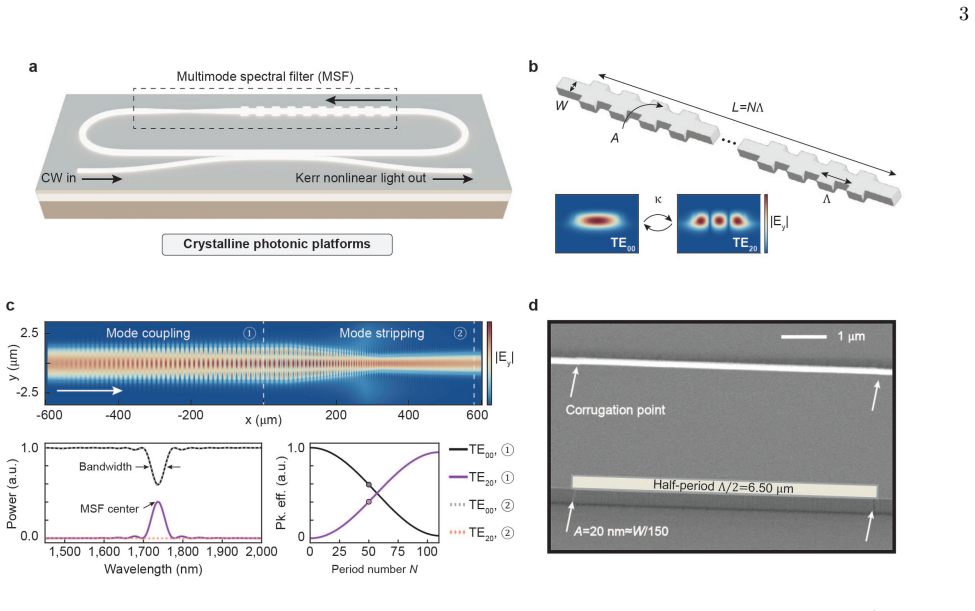
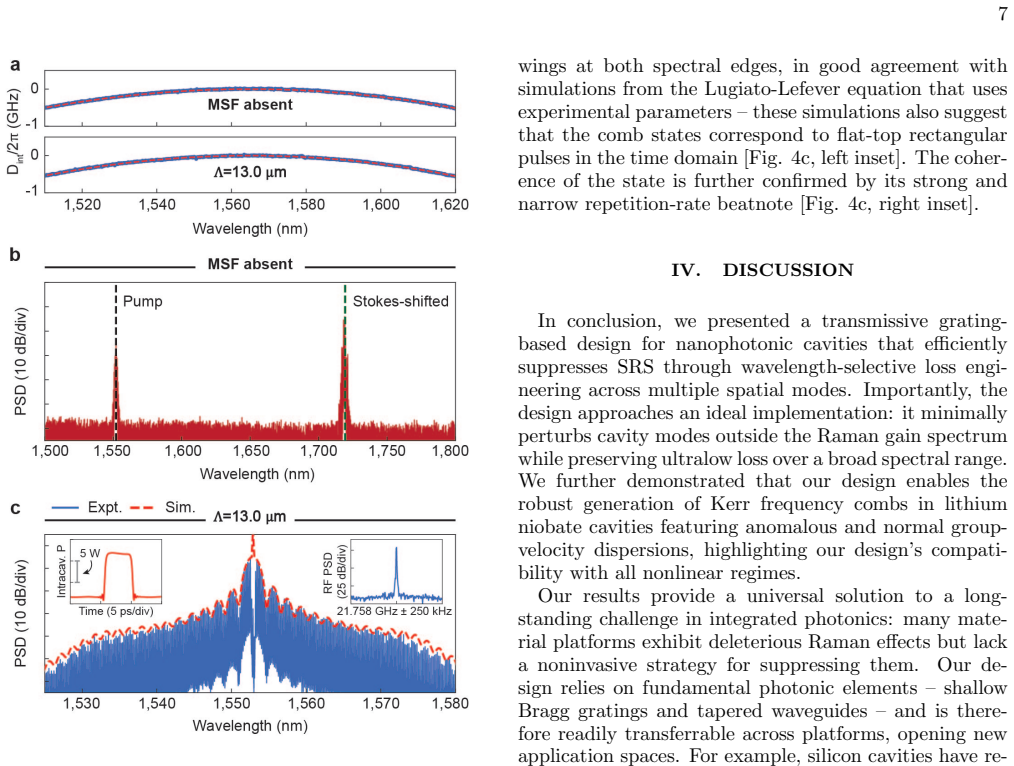
By combining nanometrically-corrugated Bragg gratings and tapered waveguides, the authors achieve co-directional multimode coupling and mode-selective filtering that suppresses stimulated Raman scattering across broad spectra. In lithium niobate nanophotonic devices this preserves the Kerr nonlinearity and allows reliable formation of two distinct coherent optical frequency combs.
What carries the argument
Multimode spectral filtering via co-directional coupling and mode-selective loss implemented with nanometrically-corrugated Bragg gratings and tapered waveguides.
If this is right
- Robust generation of Kerr nonlinear states such as coherent optical frequency combs becomes possible in Raman-active nanophotonic materials.
- The method applies directly to classical and quantum light generation on platforms like silicon and diamond photonics.
- Highly-structured, wavelength-specific losses can now be engineered in nanophotonic waveguides and cavities.
- New design options open for ultrafast and nonlinear integrated photonics devices.
Where Pith is reading between the lines
- The same filtering principle could be adapted to reduce Raman-induced noise in quantum light sources such as single-photon or entangled-state generators.
- Extending the bandwidth tailoring might allow selective suppression of other competing nonlinear processes while enhancing desired ones.
- Direct fabrication and testing in silicon or diamond waveguides would provide a clear test of the claimed material generality.
Load-bearing premise
That multimode coupling and mode-selective filtering can be engineered across ultrabroad bandwidths to suppress SRS without disrupting the Kerr nonlinearity or overall device performance.
What would settle it
Observing persistent SRS signatures in the output spectra of the fabricated lithium niobate devices that prevent formation of the expected Kerr frequency combs would falsify the suppression claim.
Figures


read the original abstract
Miniaturized photonic cavities generating nonlinear optical states of light are central to telecommunications and metrology applications. The emergence of such states is primarily underpinned by the ubiquitous Kerr nonlinearity that is present in all media. However, stimulated Raman scattering (SRS), an additional process inherent to many materials, has been shown to critically hinder the states' formation, imposing fundamental constraints on the choice of photonic platforms. Here, we introduce a novel strategy for the suppression of SRS in nanophotonic devices, adaptable to diverse Raman spectral responses. This is achieved by controlling the coupling and loss among multiple transverse spatial modes of the system, tailored across ultrabroad spectral bandwidths. Specifically, we combine nanometrically-corrugated Bragg gratings and tapered waveguides that, together enable co-directional multimode coupling and mode-selective filtering. We use lithium niobate as an exemplary Raman-active material to realize the concept, and we demonstrate the robust generation of two distinct Kerr nonlinear states (corresponding to coherent optical frequency combs) using the fabricated devices. The simplicity and generality of the concept suggest wide applicability to classical and quantum light generation on many technologically-relevant platforms nominally plagued by SRS (e.g., silicon and diamond photonics). More broadly, our multimode spectral shaping and filtering concept opens a path forward for highly-structured, wavelength-specific losses in nanophotonic waveguides and cavities, with potential applications in ultrafast and nonlinear integrated photonics.
Editorial analysis
A structured set of objections, weighed in public.
Referee Report
Summary. The paper introduces a strategy for suppressing stimulated Raman scattering (SRS) in nanophotonic devices via multimode spectral filtering, achieved through nanometrically-corrugated Bragg gratings combined with tapered waveguides to enable co-directional multimode coupling and mode-selective loss over broad bandwidths. Using lithium niobate as the platform, the authors report the generation of two distinct Kerr nonlinear states corresponding to coherent optical frequency combs. They emphasize the approach's simplicity and potential for wide use in other SRS-limited materials such as silicon and diamond for classical and quantum applications.
Significance. If the experimental claims are substantiated, the work could meaningfully expand viable material platforms for integrated nonlinear photonics by addressing SRS constraints that currently limit device choices. The multimode filtering concept for structured losses may also apply more broadly to ultrafast and nonlinear integrated optics. The experimental demonstration in LiNbO3 provides a concrete starting point, though its robustness requires detailed validation.
major comments (2)
- [Abstract] Abstract: The manuscript asserts an 'experimental demonstration' of robust Kerr comb generation in lithium niobate, yet provides no data, spectra, error bars, power thresholds, or verification protocols (e.g., comparison of SRS thresholds with/without the gratings). This absence prevents assessment of whether the multimode filtering actually suppresses SRS while preserving Kerr nonlinearity and cavity Q.
- [Abstract] Abstract and implied methods: The central claim requires that the engineered co-directional coupling and mode-selective loss remain effective and selective over ultrabroad bandwidths (>1000 nm) needed for comb formation. No analysis or measurement of wavelength-dependent phase-matching, coupling coefficients, or mode overlaps is referenced, leaving open the possibility that dispersion allows SRS gain windows to persist outside designed stop-bands.
minor comments (1)
- [Abstract] The abstract would benefit from quantitative metrics (e.g., achieved SRS suppression factor or spectral range of effective filtering) to make the 'robust' claim more concrete.
Simulated Author's Rebuttal
We thank the referee for their thorough review and valuable feedback on our work. We address each of the major comments below and have made revisions to improve the clarity and completeness of the manuscript.
read point-by-point responses
-
Referee: [Abstract] Abstract: The manuscript asserts an 'experimental demonstration' of robust Kerr comb generation in lithium niobate, yet provides no data, spectra, error bars, power thresholds, or verification protocols (e.g., comparison of SRS thresholds with/without the gratings). This absence prevents assessment of whether the multimode filtering actually suppresses SRS while preserving Kerr nonlinearity and cavity Q.
Authors: The experimental demonstration is detailed in the main body of the manuscript, particularly in the 'Experimental Results' section and associated figures (e.g., Figures 2-4), which include spectra of the Kerr combs, SRS threshold comparisons with and without the gratings, power levels, and Q-factor measurements. Error bars are provided for key data points, and the verification methods are described in the Methods. To make this more accessible from the abstract, we have revised the abstract to include a brief reference to the supporting experimental figures. revision: partial
-
Referee: [Abstract] Abstract and implied methods: The central claim requires that the engineered co-directional coupling and mode-selective loss remain effective and selective over ultrabroad bandwidths (>1000 nm) needed for comb formation. No analysis or measurement of wavelength-dependent phase-matching, coupling coefficients, or mode overlaps is referenced, leaving open the possibility that dispersion allows SRS gain windows to persist outside designed stop-bands.
Authors: We have performed and included in the manuscript (see 'Device Design' and 'Simulations' sections) detailed calculations of the wavelength-dependent coupling coefficients, mode overlaps, and phase-matching conditions for the co-directional multimode coupling. These show that the filtering remains effective across the broad bandwidth required for comb generation, with SRS gain windows suppressed. However, to further substantiate this and address potential concerns about dispersion effects, we will expand the discussion with additional plots of the coupling strength versus wavelength in the revised version. revision: yes
Circularity Check
No circularity: experimental demonstration of multimode SRS suppression
full rationale
The paper presents an experimental strategy for SRS suppression via nanometrically-corrugated Bragg gratings and tapered waveguides enabling multimode coupling and mode-selective filtering. Central claims rest on device fabrication in lithium niobate and direct observation of two distinct Kerr nonlinear states (coherent frequency combs), with no load-bearing mathematical derivations, fitted parameters renamed as predictions, or self-citation chains that reduce the result to its inputs by construction. The concept is introduced as novel and general, but its validity is asserted through physical realization and measurement rather than tautological equations or ansatzes smuggled via prior self-work. This matches the reader's score of 1.0 and leaves the skeptic's bandwidth concern as an empirical question, not a circularity issue.
Axiom & Free-Parameter Ledger
axioms (2)
- domain assumption Kerr nonlinearity is present in all media and underpins nonlinear optical states
- domain assumption Stimulated Raman scattering critically hinders nonlinear state formation in many materials
Lean theorems connected to this paper
-
IndisputableMonolith/Cost/FunctionalEquation.leanwashburn_uniqueness_aczel unclearwe combine nanometrically-corrugated Bragg gratings and tapered waveguides that, together enable co-directional multimode coupling and mode-selective filtering... Λ=λ0/∆neff(λ0)... η(λ) ... Qi(λ)=c/λ⋅fFSR⋅(1−(1−α0)⋅(1−η))
Reference graph
Works this paper leans on
-
[1]
photonics host native quantum defects, and their interaction with monolithic nonlinear light sources may be studied in SRS-suppressed resonators. Lithium nio- bate [81] and tantalate [53] cavities that feature strong electro-optic or second-order nonlinear-optical properties require robust Raman suppression, and our work may fi- nally unlock high-power re...
- [2]
- [3]
-
[4]
S. Namiki and Y. Emori, IEEE Journal of Selected Topics in Quantum Electronics7, 3 (2001)
work page 2001
-
[5]
M. N. Islam, IEEE Journal of Selected Topics in Quan- tum Electronics8, 548 (2002)
work page 2002
-
[6]
H. Rong, R. Jones, A. Liu, O. Cohen, D. Hak, A. Fang, and M. Paniccia, Nature433, 725 (2005)
work page 2005
-
[7]
J. M. Dudley, G. Genty, and S. Coen, Reviews of Modern Physics78, 1135 (2006)
work page 2006
-
[8]
Z. Li, Y. Xu, S. Shamailov, X. Wen, W. Wang, X. Wei, Z. Yang, S. Coen, S. G. Murdoch, and M. Erkintalo, Na- ture Photonics18, 46 (2024)
work page 2024
-
[9]
A. M. Vengsarkar, P. J. Lemaire, J. B. Judkins, V. Bha- tia, T. Erdogan, and J. E. Sipe, Journal of Lightwave Technology14, 58 (2002)
work page 2002
- [10]
-
[11]
R.-J. Essiambre, G. Kramer, P. J. Winzer, G. J. Foschini, and B. Goebel, Journal of Lightwave Technology28, 662 (2010)
work page 2010
-
[12]
P. Marin-Palomo, J. N. Kemal, M. Karpov, A. Kordts, J. Pfeifle, M. H. Pfeiffer, P. Trocha, S. Wolf, V. Brasch, M. H. Anderson,et al., Nature546, 274 (2017)
work page 2017
-
[13]
A. A. Jørgensen, D. Kong, M. Henriksen, F. Klejs, Z. Ye, `O. Helgason, H. Hansen, H. Hu, M. Yankov, S. Forch- hammer,et al., Nature Photonics16, 798 (2022)
work page 2022
-
[14]
K. Y. Yang, C. Shirpurkar, A. D. White, J. Zang, L. Chang, F. Ashtiani, M. A. Guidry, D. M. Lukin, S. V. Pericherla, J. Yang,et al., Nature Communications13, 7862 (2022)
work page 2022
- [15]
-
[16]
B. Corcoran, A. Mitchell, R. Morandotti, L. K. Ox- enløwe, and D. J. Moss, Nature Photonics19, 451 (2025)
work page 2025
-
[17]
Z. L. Newman, V. Maurice, T. Drake, J. R. Stone, T. C. Briles, D. T. Spencer, C. Fredrick, Q. Li, D. Westly, B. R. Ilic,et al., Optica6, 680 (2019)
work page 2019
- [18]
-
[19]
M.-G. Suh, X. Yi, Y.-H. Lai, S. Leifer, I. S. Grudinin, G. Vasisht, E. C. Martin, M. P. Fitzgerald, G. Dopp- mann, J. Wang,et al., Nature photonics13, 25 (2019)
work page 2019
-
[20]
I. Kudelin, W. Groman, Q.-X. Ji, J. Guo, M. L. Kelleher, D. Lee, T. Nakamura, C. A. McLemore, P. Shirmoham- madi, S. Hanifi,et al., Nature627, 534 (2024)
work page 2024
-
[21]
S. Sun, B. Wang, K. Liu, M. W. Harrington, F. Tabatabaei, R. Liu, J. Wang, S. Hanifi, J. S. Morgan, 9 M. Jahanbozorgi,et al., Nature627, 540 (2024)
work page 2024
-
[22]
Y. Zhao, J. K. Jang, G. J. Beals, K. J. McNulty, X. Ji, Y. Okawachi, M. Lipson, and A. L. Gaeta, Nature627, 546 (2024)
work page 2024
- [23]
-
[24]
X. Jin, Z. Xie, X. Zhang, H. Hou, B. Wu, F. Zhang, X. Zhang, L. Chang, Q. Gong, and Q.-F. Yang, Nature Photonics19, 630 (2025)
work page 2025
- [25]
-
[26]
J. Riemensberger, A. Lukashchuk, M. Karpov, W. Weng, E. Lucas, J. Liu, and T. J. Kippenberg, Nature581, 164 (2020)
work page 2020
-
[27]
R. Chen, H. Shu, B. Shen, L. Chang, W. Xie, W. Liao, Z. Tao, J. E. Bowers, and X. Wang, Nature Photonics 17, 306 (2023)
work page 2023
-
[28]
J. Chen, W. Li, Z. Kang, Z. Lin, S. Zhao, D. Lian, J. He, D. Huang, D. Dai, and Y. Shi, Nature Communications 16, 1056 (2025)
work page 2025
- [29]
-
[30]
S.-J. Tang, M. Zhang, J. Sun, J.-W. Meng, X. Xiong, Q. Gong, D. Jin, Q.-F. Yang, and Y.-F. Xiao, Nature Photonics17, 951 (2023)
work page 2023
-
[31]
P. Del’Haye, A. Schliesser, O. Arcizet, T. Wilken, R. Holzwarth, and T. J. Kippenberg, Nature450, 1214 (2007)
work page 2007
-
[32]
N. L. B. Sayson, T. Bi, V. Ng, H. Pham, L. S. Trainor, H. G. Schwefel, S. Coen, M. Erkintalo, and S. G. Mur- doch, Nature Photonics13, 701 (2019)
work page 2019
-
[33]
X. Lu, G. Moille, A. Rao, D. A. Westly, and K. Srini- vasan, Optica7, 1417 (2020)
work page 2020
-
[34]
J. A. Black, G. Brodnik, H. Liu, S.-P. Yu, D. R. Carlson, J. Zang, T. C. Briles, and S. B. Papp, Optica9, 1183 (2022)
work page 2022
-
[35]
Z. Yang, M. Jahanbozorgi, D. Jeong, S. Sun, O. Pfis- ter, H. Lee, and X. Yi, Nature Communications12, 4781 (2021)
work page 2021
-
[36]
Y. Shen, P.-Y. Hsieh, S. K. Sridhar, S. Feldman, Y.-C. Chang, T. A. Smith, and A. Dutt, Optica12, 302 (2025)
work page 2025
-
[37]
A. E. Ulanov, B. Ruhnke, T. Wildi, and T. Herr, Nature Communications (2025)
work page 2025
-
[38]
B. Hausmann, I. Bulu, V. Venkataraman, P. Deotare, and M. Lonˇ car, Nature Photonics8, 369 (2014)
work page 2014
-
[39]
A. G. Griffith, R. K. Lau, J. Cardenas, Y. Okawachi, A. Mohanty, R. Fain, Y. H. D. Lee, M. Yu, C. T. Phare, C. B. Poitras,et al., Nature Communications6, 6299 (2015)
work page 2015
-
[40]
M. Pu, L. Ottaviano, E. Semenova, and K. Yvind, Optica 3, 823 (2016)
work page 2016
-
[41]
Y. Xuan, Y. Liu, L. T. Varghese, A. J. Metcalf, X. Xue, P.-H. Wang, K. Han, J. A. Jaramillo-Villegas, A. Al No- man, C. Wang,et al., Optica3, 1171 (2016)
work page 2016
-
[42]
Q. Li, T. C. Briles, D. A. Westly, T. E. Drake, J. R. Stone, B. R. Ilic, S. A. Diddams, S. B. Papp, and K. Srinivasan, Optica4, 193 (2017)
work page 2017
-
[43]
D. J. Wilson, K. Schneider, S. H¨ onl, M. Anderson, Y. Baumgartner, L. Czornomaz, T. J. Kippenberg, and P. Seidler, Nature Photonics14, 57 (2020)
work page 2020
- [44]
-
[45]
D. M. Lukin, C. Dory, M. A. Guidry, K. Y. Yang, S. D. Mishra, R. Trivedi, M. Radulaski, S. Sun, D. Vercruysse, G. H. Ahn,et al., Nature Photonics14, 330 (2020)
work page 2020
-
[46]
J. Liu, E. Lucas, A. S. Raja, J. He, J. Riemensberger, R. N. Wang, M. Karpov, H. Guo, R. Bouchand, and T. J. Kippenberg, Nature Photonics14, 486 (2020)
work page 2020
-
[47]
H. Jung, S.-P. Yu, D. R. Carlson, T. E. Drake, T. C. Briles, and S. B. Papp, Optica8, 811 (2021)
work page 2021
-
[48]
X. Liu, Z. Gong, A. W. Bruch, J. B. Surya, J. Lu, and H. X. Tang, Nature Communications12, 5428 (2021)
work page 2021
-
[49]
H. Weng, J. Liu, A. A. Afridi, J. Li, J. Dai, X. Ma, Y. Zhang, Q. Lu, J. F. Donegan, and W. Guo, Photonics Research9, 1351 (2021)
work page 2021
-
[50]
P.-Y. Wang, S. Wan, R. Ma, W. Li, F. Bo, G.-C. Guo, and C.-H. Dong, Optics Letters49, 1729 (2024)
work page 2024
-
[51]
Y. Song, Y. Hu, X. Zhu, K. Yang, and M. Lonˇ car, Light: Science & Applications13, 225 (2024)
work page 2024
-
[52]
R. W. Boyd,Nonlinear optics(Elsevier, 2020)
work page 2020
-
[53]
C. Wang, M. Zhang, X. Chen, M. Bertrand, A. Shams- Ansari, S. Chandrasekhar, P. Winzer, and M. Lonˇ car, Nature562, 101 (2018)
work page 2018
-
[54]
C. Wang, Z. Li, J. Riemensberger, G. Lihachev, M. Chu- raev, W. Kao, X. Ji, J. Zhang, T. Blesin, A. Davydova, et al., Nature629, 784 (2024)
work page 2024
-
[55]
Y. Okawachi, M. Yu, V. Venkataraman, P. M. Latawiec, A. G. Griffith, M. Lipson, M. Lonˇ car, and A. L. Gaeta, Optics Letters42, 2786 (2017)
work page 2017
-
[56]
Y. He, R. Lopez-Rios, U. A. Javid, J. Ling, M. Li, S. Xue, K. Vahala, and Q. Lin, Nature Communications14, 3467 (2023)
work page 2023
-
[57]
Z. Gong, M. Li, X. Liu, Y. Xu, J. Lu, A. Bruch, J. B. Surya, C. Zou, and H. X. Tang, Physical Review Letters 125, 183901 (2020)
work page 2020
-
[58]
X. Lv, B. Nie, C. Yang, R. Ma, Z. Wang, Y. Liu, X. Jin, K. Zhu, Z. Chen, D. Qian,et al., Nature Communications 16, 2389 (2025)
work page 2025
-
[59]
Y. Song, X. Zhu, X. Zuo, G. Huang, and M. Lonˇ car, Optica12, 693 (2025)
work page 2025
-
[60]
B. Nie, X. Lv, C. Yang, R. Ma, K. Zhu, Z. Wang, Y. Liu, Z. Xie, X. Jin, G. Zhang,et al., eLight5, 15 (2025)
work page 2025
-
[61]
Y. Song, Z. Li, X. Zhu, N. Lippok, M. Erkintalo, and M. Lonˇ car, Science Advances12, eaeb5758 (2026)
work page 2026
-
[62]
M. Yu, Y. Okawachi, R. Cheng, C. Wang, M. Zhang, A. L. Gaeta, and M. Lonˇ car, Light: Science & Applica- tions9, 9 (2020)
work page 2020
-
[63]
F. Leo, S. Coen, P. Kockaert, S.-P. Gorza, P. Emplit, and M. Haelterman, Nature Photonics4, 471 (2010)
work page 2010
-
[64]
Y. K. Chembo and C. R. Menyuk, Physical Review A 87, 053852 (2013)
work page 2013
-
[65]
T. Herr, V. Brasch, J. D. Jost, C. Y. Wang, N. M. Kon- dratiev, M. L. Gorodetsky, and T. J. Kippenberg, Nature Photonics8, 145 (2014)
work page 2014
-
[66]
T. J. Kippenberg, A. L. Gaeta, M. Lipson, and M. L. Gorodetsky, Science361, eaan8083 (2018)
work page 2018
- [67]
-
[68]
X. Xue, Y. Xuan, Y. Liu, P.-H. Wang, S. Chen, J. Wang, D. E. Leaird, M. Qi, and A. M. Weiner, Nature Photonics 9, 594 (2015)
work page 2015
-
[69]
V. Lobanov, G. Lihachev, T. Kippenberg, and M. Gorodetsky, Optics Express23, 7713 (2015). 10
work page 2015
-
[70]
´O. B. Helgason, F. R. Arteaga-Sierra, Z. Ye, K. Twayana, P. A. Andrekson, M. Karlsson, and J. Schr¨ oder, Nature Photonics15, 305 (2021)
work page 2021
- [71]
- [72]
-
[73]
X. Lu, A. McClung, and K. Srinivasan, Nature Photonics 16, 66 (2022)
work page 2022
- [74]
-
[75]
E. Lucas, S.-P. Yu, T. C. Briles, D. R. Carlson, and S. B. Papp, Nature Photonics17, 943 (2023)
work page 2023
-
[76]
A. E. Ulanov, T. Wildi, N. G. Pavlov, J. D. Jost, M. Kar- pov, and T. Herr, Nature Photonics18, 294 (2024)
work page 2024
-
[77]
B. Chen, Y. Zhou, Y. Liu, C. Ye, Q. Cao, P. Huang, C. Kim, Y. Zheng, L. K. Oxenløwe, K. Yvind,et al., Nature Photonics18, 625 (2024)
work page 2024
-
[78]
Y. Liu, C. Lao, M. Wang, Y. Cheng, Y. Wang, S. Fu, C. Gao, J. Wang, B.-B. Li, Q. Gong,et al., Nature Pho- tonics18, 632 (2024)
work page 2024
- [79]
- [80]
discussion (0)
Sign in with ORCID, Apple, or X to comment. Anyone can read and Pith papers without signing in.