Recognition: 2 theorem links
· Lean TheoremNearly-Tight Bounds for Vertical Decomposition in Three and Four Dimensions
Pith reviewed 2026-05-12 04:35 UTC · model grok-4.3
The pith
Vertical decompositions of the complement of semi-algebraic unions in R^3 and of trivariate minimization diagrams have nearly tight complexity bounds.
A machine-rendered reading of the paper's core claim, the machinery that carries it, and where it could break.
Core claim
We obtain sharp bounds on the complexity of the vertical decomposition of the complement of the union of a set of semi-algebraic regions of constant complexity in R^3, and of the minimization diagram of a set of trivariate functions. These results lead to efficient algorithms for a variety of problems involving vertical decompositions, including algorithms for constructing the decompositions themselves and for constructing (1/r)-cuttings of substructures of arrangements. They also lead to a data structure for answering point-enclosure queries amid semi-algebraic sets in R^3 and R^4.
What carries the argument
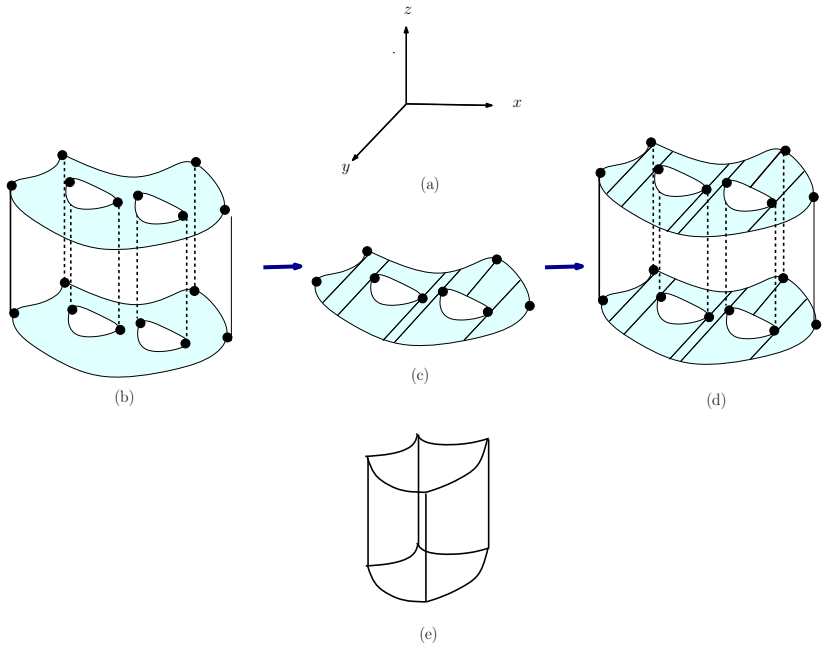
Vertical decomposition, which partitions each cell of an arrangement of semi-algebraic sets into a collection of constant-complexity subcells by drawing vertical walls from each edge.
If this is right
- Algorithms for constructing the vertical decompositions of the union complement and minimization diagrams become more efficient.
- Construction of (1/r)-cuttings for the same substructures of arrangements improves in both time and size.
- Data structures supporting point-enclosure queries amid semi-algebraic sets in three and four dimensions can be built with better preprocessing and query time.
Where Pith is reading between the lines
- The same analysis may yield improved running times for 3D motion-planning problems whose free space is defined by semi-algebraic obstacles.
- The technique could be adapted to obtain nearly-tight bounds for vertical decompositions of other low-dimensional substructures such as lower envelopes or Voronoi diagrams.
Load-bearing premise
The semi-algebraic regions and functions have constant descriptive complexity, so that the vertical decomposition can be bounded by a purely combinatorial argument without extra superlinear factors coming from algebraic degrees or degeneracies.
What would settle it
An explicit family of constant-complexity semi-algebraic regions in R^3 whose vertical decomposition of the union complement has size asymptotically larger than the stated nearly-tight bound.
Figures




read the original abstract
Vertical decomposition is a widely used general technique for decomposing the cells of arrangements of semi-algebraic sets in ${{\mathbb R}}^d$ into constant-complexity subcells. In this paper, we settle in the affirmative a few long-standing open problems involving the vertical decomposition of substructures of arrangements for $d = 3, 4$. For example, we obtain sharp bounds on the complexity of the vertical decomposition of the complement of the union of a set of semi-algebraic regions of constant complexity in ${{\mathbb R}}^3$, and of the minimization diagram of a set of trivariate functions. These results lead to efficient algorithms for a variety of problems involving vertical decompositions, including algorithms for constructing the decompositions themselves and for constructing $(1/r)$-cuttings of substructures of arrangements. They also lead to a data structure for answering point-enclosure queries amid semi-algebraic sets in ${{\mathbb R}}^3$ and ${{\mathbb R}}^4$.
Editorial analysis
A structured set of objections, weighed in public.
Referee Report
Summary. The paper claims to settle several long-standing open problems by deriving nearly-tight upper bounds on the complexity of the vertical decomposition of the complement of the union of a set of semi-algebraic regions of constant complexity in R^3, and of the minimization diagram of a set of trivariate functions. These results are used to obtain efficient algorithms for constructing the decompositions, (1/r)-cuttings, and a data structure for point-enclosure queries in R^3 and R^4.
Significance. If the bounds hold as claimed, this work significantly advances the understanding of arrangement complexities in low dimensions. The combinatorial analysis via random sampling and cuttings, with constants depending only on the fixed descriptive complexity, is a key strength, providing clean derivations without additional factors from algebraic degrees or degeneracies. This has direct implications for practical algorithms in computational geometry.
minor comments (2)
- [Introduction] The distinction between 'sharp bounds' in the abstract and 'Nearly-Tight Bounds' in the title should be clarified to avoid confusion.
- [Algorithmic applications] Explicit time complexities for the new algorithms should be stated more prominently to highlight the improvements.
Simulated Author's Rebuttal
We thank the referee for the positive assessment of our work and the recommendation for minor revision. The referee's summary accurately captures the main results on nearly-tight complexity bounds for vertical decompositions in 3D and 4D semi-algebraic arrangements, along with the algorithmic applications.
Circularity Check
No significant circularity in the derivation chain
full rationale
The paper derives nearly-tight bounds on vertical decomposition complexity for semi-algebraic regions in R^3 and minimization diagrams of trivariate functions via standard combinatorial arguments on arrangements, employing random sampling and cuttings whose constants depend solely on the fixed descriptive complexity. No steps reduce by construction to fitted inputs, self-definitions, or load-bearing self-citations; the analysis proceeds independently from arrangement complexity bounds without renaming known results or smuggling ansatzes.
Axiom & Free-Parameter Ledger
Lean theorems connected to this paper
-
IndisputableMonolith/Foundation/AlexanderDuality.leanalexander_duality_circle_linking echoes?
echoesECHOES: this paper passage has the same mathematical shape or conceptual pattern as the Recognition theorem, but is not a direct formal dependency.
We obtain sharp bounds on the complexity of the vertical decomposition of the complement of the union of a set of semi-algebraic regions of constant complexity in R³, and of the minimization diagram of a set of trivariate functions.
-
IndisputableMonolith/Foundation/AbsoluteFloorClosure.leanreality_from_one_distinction unclear?
unclearRelation between the paper passage and the cited Recognition theorem.
Vertical decomposition partitions a cell of A(S) by recursing on the dimension... each of which consists of at most 2d facets
What do these tags mean?
- matches
- The paper's claim is directly supported by a theorem in the formal canon.
- supports
- The theorem supports part of the paper's argument, but the paper may add assumptions or extra steps.
- extends
- The paper goes beyond the formal theorem; the theorem is a base layer rather than the whole result.
- uses
- The paper appears to rely on the theorem as machinery.
- contradicts
- The paper's claim conflicts with a theorem or certificate in the canon.
- unclear
- Pith found a possible connection, but the passage is too broad, indirect, or ambiguous to say the theorem truly supports the claim.
Reference graph
Works this paper leans on
-
[1]
P . K. Agarwal, Simplex range searching and its variants: A review, inJourney through Discrete Mathematics: A Tribute to Jiˇ r´ ı Matouˇ sek, M. Loebl, J. Ne ˇsetˇril, and R. Thomas (editors), Springer Verlag, Berlin-Heidelberg, 2017, pp. 1–30
work page 2017
-
[2]
P . K. Agarwal, B. Aronov, E. Ezra, M. J. Katz, and M. Sharir, Intersection queries for flat semi-algebraic objects in three dimensions and related problems. ACM Trans. Algorithms 21 (2025), 25:1–25:59
work page 2025
-
[3]
P . K. Agarwal, B. Aronov, E. Ezra, and J. Zahl, An efficient algorithm for generalized polynomial partitioning and its applications, SIAM J. Comput. 50 (2021), 760–787
work page 2021
-
[4]
P . K. Agarwal, B. Aronov, and M. Sharir, Computing envelopes in four dimensions with applications, SIAM J. Comput. 26(6) (1997), 1714–1732
work page 1997
-
[5]
P . K. Agarwal, A. Efrat, and M. Sharir, Vertical decomposition of shallow levels in 3-dimensional arrangements and its applications, SIAM J. Comput. 29(3) (1999), 912–953. 40
work page 1999
- [6]
-
[7]
P . K. Agarwal and J. Matouˇsek, On range searching with semialgebraic sets, Discrete Comput. Geom. 11 (1994), 393–418
work page 1994
-
[8]
P . K. Agarwal, J. Matouˇsek, O. Schwarzkopf, Computing many faces in arrangements of lines and segments, SIAM J. Comput. 27(2) (1998), 491–505
work page 1998
-
[9]
P . K. Agarwal, J. Matouˇsek, and M. Sharir, On range searching with semialgebraic sets II, SIAM J. Comput. 42 (2013), 2039–2062
work page 2013
-
[10]
P . K. Agarwal, J. Pach, and M. Sharir, State of the union (of geometric objects): A review, in Computational Geometry: Twenty Years Later(J. Goodman, J.Pach, and R. Pollack, eds.), American Mathematical Society, Providence, 2008, pp. 9–48
work page 2008
-
[11]
P . K. Agarwal, O. Schwarzkopf, and M. Sharir, The overlay of lower envelopes and its applications, Discrete Comput. Geom. 15 (1996), 1–13
work page 1996
-
[12]
P . K. Agarwal and M. Sharir, Efficient randomized algorithms for some geometric optimization problems, Discrete Comput. Geom. 16 (1996), 317–337
work page 1996
-
[13]
P . K. Agarwal and M. Sharir, Arrangements of surfaces in higher dimensions, in Handbook of Computational Geometry (eds. J.R. Sack and J. Urrutia), pp. 49–119, North- Holland, Amsterdam, 2000
work page 2000
-
[14]
P . K. Agarwal and M. Sharir, Pipes, cigars, and kreplach: The union of Minkowski sums in three dimensions, Discrete Comput. Geom. 24 (2000), 645–685
work page 2000
-
[15]
P . K. Agarwal, M. Sharir and A. Steiger, Decomposing the complement of the union of cubes in three dimensions, Discrete Comput. Geom. 72 (2024), 407–450
work page 2024
- [16]
-
[17]
B. Aronov and M. Sharir, Triangles in space or building (and analyzing) castles in the air, Combinatorica 10(2) (1990), 137–173
work page 1990
-
[18]
S. Basu, R. Pollack, and M.-F. Roy,Algorithms in Real Algebraic Geometry, 2nd Edition, Springer Verlag, Berlin, 2006
work page 2006
-
[19]
M. de Berg, K. Dobrindt, and O. Schwarzkopf, On lazy randomized incremental construction, Discrete Comput. Geom. 14 (1995), 261–286
work page 1995
-
[20]
M. de Berg, L. J. Guibas and D. Halperin, Vertical decomposition for triangles in 3-space, Discrete Comput. Geom. 15 (1996), 35–61
work page 1996
-
[21]
M. de Berg and O. Schwarzkopf, Cuttings and applications, Int. J. Comput. Geom. Appl. 5 (1995), 343–355. 41
work page 1995
-
[22]
T. M. Chan, Random sampling, halfspace range reporting, and construction of (≤ k)- levels in three dimensions, SIAM J. Comput. 30 (2000), 561–575
work page 2000
-
[23]
B. Chazelle, H. Edelsbrunner, L. Guibas and M. Sharir, A singly exponential stratifi- cation scheme for real semi-algebraic varieties and its applications, Theoret. Comput. Sci. 84 (1991), 77–105. Also in Proc. 16th Int. Colloq. on Automata, Languages and Programming, 1989, pp. 179–193
work page 1991
-
[24]
B. Chazelle and J. Friedman, A deterministic view of random sampling and its use in geometry, Combinatorica 10 (1990), 229–249
work page 1990
-
[25]
B. Chazelle and J. Incerpi, Triangulation and shape-complexity,ACM Trans. Graphics 3 (1984), 135–152
work page 1984
-
[26]
K. L. Clarkson, New applications of random sampling in computational geometry, Discrete Comput. Geom., 2 (1987), 195–222
work page 1987
-
[27]
K. L. Clarkson, H. Edelsbrunner, L. J. Guibas, M. Sharir, and E. Welzl, Combinatorial complexity bounds for arrangement of curves and spheres, Discrete Comput. Geom. 5 (1990), 99–160
work page 1990
-
[28]
K. L. Clarkson and P . W. Shor, Application of random sampling in computational geometry, II. Discrete Comput. Geom. 4 (1989), 387–421
work page 1989
-
[29]
G. E. Collins, Quantifier elimination for the elementary theory of real closed fields by cylindrical algebraic decomposition, Proc. 2nd GI Conf. Automata Theory and Formal Languages, volume 33. Springer LNCS, 1975
work page 1975
-
[30]
Ezra, On the union of cylinders in three dimensions, Discrete Comput
E. Ezra, On the union of cylinders in three dimensions, Discrete Comput. Geom. 45(1) (2011), 45–64
work page 2011
-
[31]
E. Ezra and M. Sharir, On the union of fat tetrahedra in three dimensions, J. ACM 57(1) (2009), 2:1–2:23
work page 2009
-
[32]
L. Guth. Polynomial partitioning for a set of varieties, Math. Proc. Camb. Phil. Soc., 159 (2015), 459–469
work page 2015
-
[33]
L. Guth and N. H. Katz, On the Erd˝os distinct distances problem in the plane, Annals Math. 181 (2015), 155–190
work page 2015
-
[34]
D. Halperin and M. Sharir, A near-quadratic algorithm for planning the motion of a polygon in a polygonal environment, Discrete Comput. Geom. 16(2) (1996), 121–134
work page 1996
-
[35]
D. Haussler and E. Welzl, Epsilon-nets and simplex range queries, Discrete Comput. Geom., 2 (1987), 127–151
work page 1987
-
[36]
Koltun, Almost tight upper bounds for vertical decompositions in four dimensions, J
V . Koltun, Almost tight upper bounds for vertical decompositions in four dimensions, J. ACM 51(5) (2004), 699–730
work page 2004
-
[37]
Matou ˇsek, Efficient partition trees, Discrete Comput
J. Matou ˇsek, Efficient partition trees, Discrete Comput. Geom. 8 (1992), 315–334. 42
work page 1992
-
[38]
Matou ˇsek, Reporting points in halfspaces, Comput
J. Matou ˇsek, Reporting points in halfspaces, Comput. Geom. Theory Appl. 2 (1992), 169–186
work page 1992
-
[39]
J. Matouˇsek and Z. Pat´akov´a, Multilevel polynomial partitioning and simplified range searching, Discrete Comput. Geom. 54 (2015), 22–41
work page 2015
-
[40]
J. T. Schwartz and M. Sharir, On the Piano Movers’ problem: II. General techniques for computing topological properties of real algebraic manifolds, Advances in Appl. Math., 4 (1983), 298–351
work page 1983
-
[41]
O. Schwarzkopf and M. Sharir, Vertical decomposition of a single cell in a three- dimensional arrangement of surfaces, Discrete Comput. Geom., 18(3) (1997), 269–288
work page 1997
-
[42]
M. Sharir and P . K. Agarwal,Davenport-Schinzel Sequences and Their Geometric Applica- tions, Cambridge University Press, Cambridge-New York-Melbourne, 1995
work page 1995
-
[43]
B. Tagansky, A new technique for analyzing substructures in arrangements of piecewise linear surfaces, Discrete Comput. Geom. 16(4) (1996), 455–479. 43
work page 1996
discussion (0)
Sign in with ORCID, Apple, or X to comment. Anyone can read and Pith papers without signing in.