Recognition: no theorem link
Resolution Estimation of a Digital Holographic Microscope Using Neural Network Analysis of Reconstructed Images
Pith reviewed 2026-05-12 03:50 UTC · model grok-4.3
The pith
A neural network estimates digital holographic microscope resolution by predicting source spectral bandwidth from reconstructed images.
A machine-rendered reading of the paper's core claim, the machinery that carries it, and where it could break.
Core claim
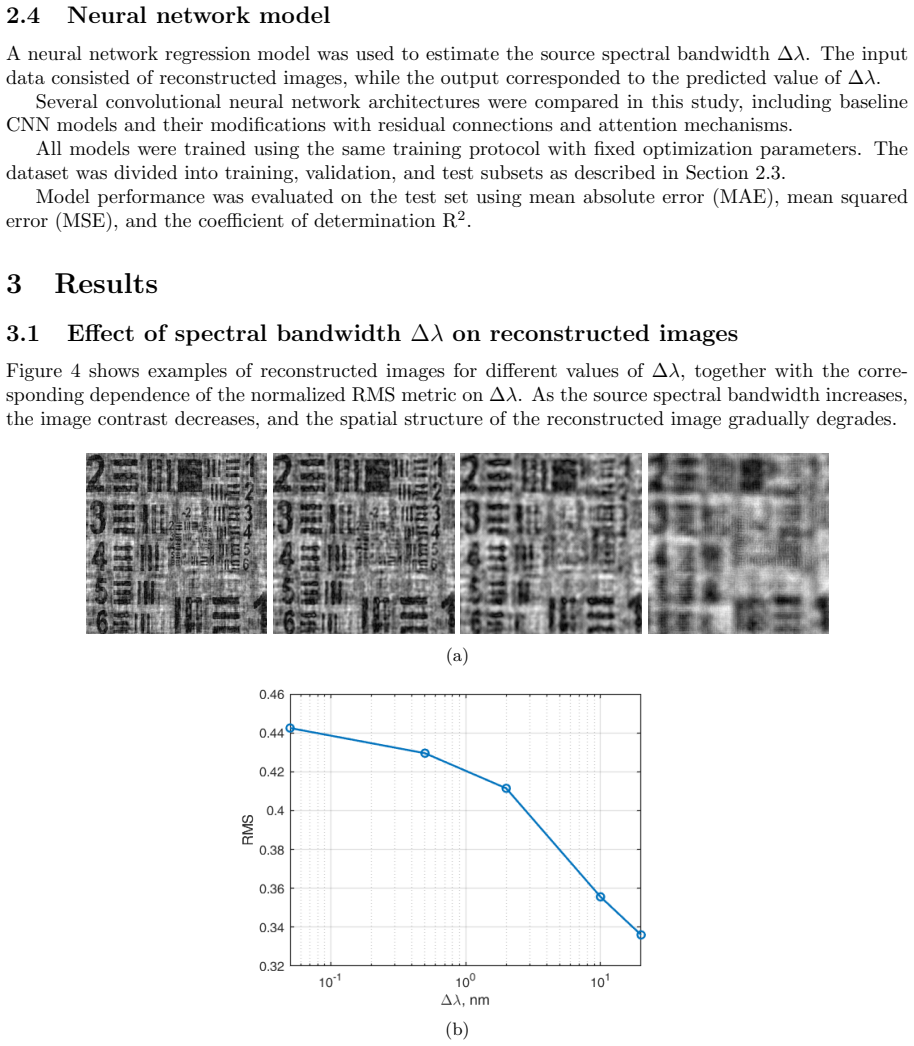
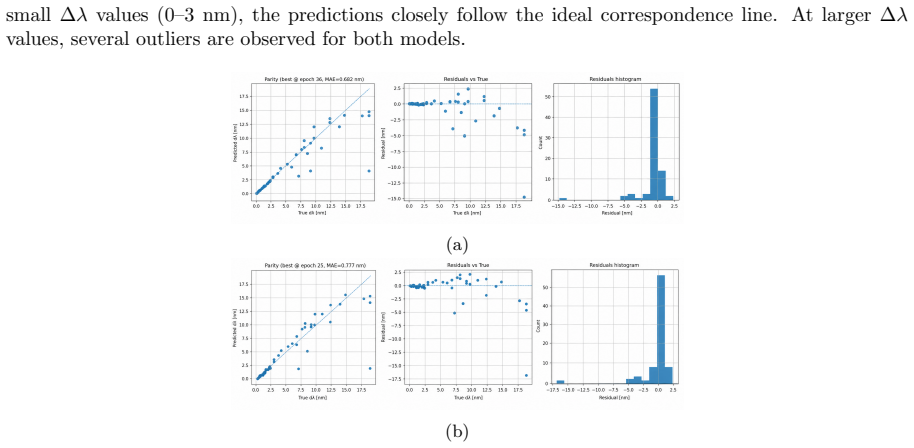
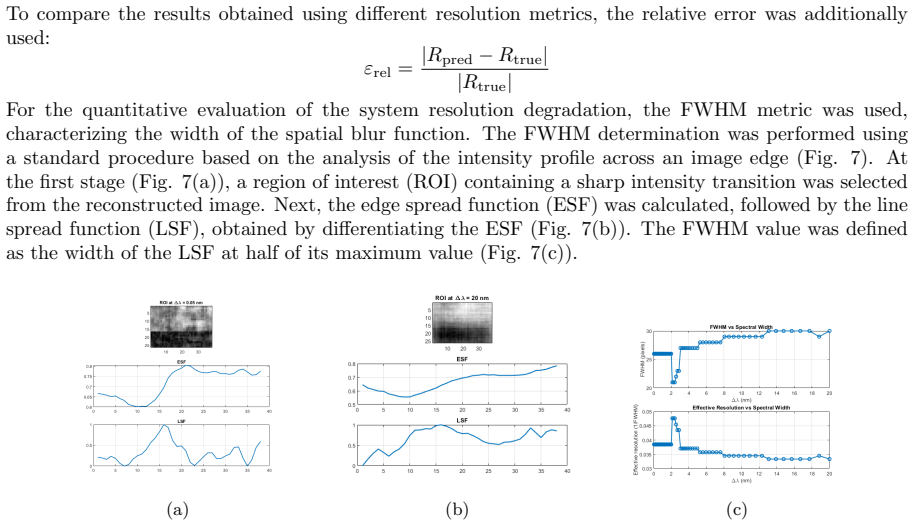
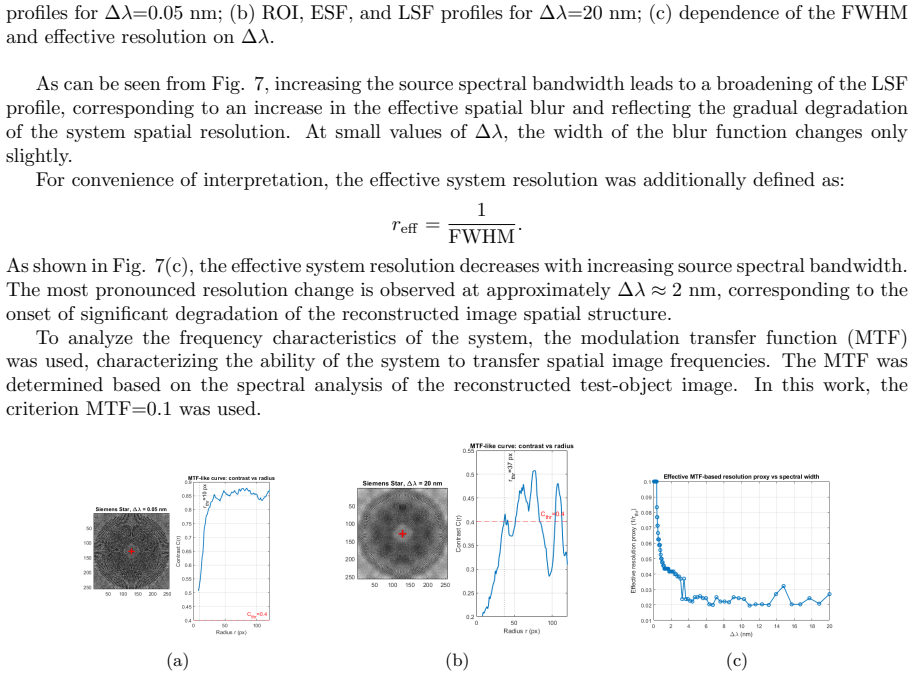
The central discovery is that a neural network trained on a dataset of reconstructed holographic images with varying source bandwidths from 0.05 to 20 nm can predict that bandwidth with high precision, and these predictions are consistent with standard resolution metrics including FWHM, MTF, and USAF criterion. The model is also sensitive to the type of degradation, capturing interferometric distortions selectively.
What carries the argument
A neural network regressor that takes reconstructed holographic images as input and outputs the estimated source spectral bandwidth Δλ as a measure of resolution degradation.
If this is right
- The predictions match results from full width at half maximum analysis.
- They align with modulation transfer function evaluations.
- They correspond to USAF resolution target criteria.
- The network captures interferometric distortions in the images.
- It responds selectively based on the physical mechanism of degradation, enabling application without full explicit modeling of all factors.
Where Pith is reading between the lines
- This method might extend to estimating resolution in real experimental setups where other noise sources are present.
- It could enable automated, real-time resolution monitoring during holographic imaging sessions.
- The selectivity to degradation type suggests potential for diagnosing specific optical issues in the system.
Load-bearing premise
The assumption that predicting the controlled simulation parameter of source bandwidth from images is equivalent to estimating the actual optical resolution in physical holographic microscopes.
What would settle it
If the neural network predictions do not match measured resolution when tested on real physical holographic microscope data with additional unaccounted degradations.
Figures



read the original abstract
This paper presents a method for estimating the resolution of a digital holographic microscope using neural network analysis of reconstructed images. The spectral bandwidth of the source ($\Delta \lambda$) is used as a controlled image degradation parameter. Numerical simulations were performed within inline Gabor holography. A dataset of reconstructed images was generated for several test objects over a $\Delta \lambda$ range from 0.05 to 20 nm. The model predicts $\Delta \lambda$ from reconstructed images with high precision. The predictions are consistent with standard resolution metrics, including FWHM, MTF, and the USAF resolution criterion. The generalization analysis shows that the model is sensitive to the type of degradation. It captures interferometric distortions and responds selectively to the underlying physical mechanism. The proposed approach enables resolution estimation without explicit modeling of all degradation factors and can be applied to compact holographic systems.
Editorial analysis
A structured set of objections, weighed in public.
Referee Report
Summary. The manuscript proposes a neural network method to estimate resolution in digital holographic microscopy by regressing the source spectral bandwidth Δλ from reconstructed images in inline Gabor holography simulations. A dataset is generated for test objects with Δλ varied from 0.05 to 20 nm. The NN is reported to predict Δλ with high precision, with predictions consistent with standard metrics (FWHM, MTF, USAF resolution criterion). Generalization tests indicate the model is sensitive to degradation type and captures interferometric distortions selectively. The approach is presented as enabling resolution estimation in compact systems without explicit modeling of all degradation factors.
Significance. If the NN-based predictions can be shown to generalize to experimental data with multiple real-world degradations, the method could offer a practical data-driven alternative for resolution assessment where analytical models are incomplete. The reported consistency with established metrics and selective response to physical mechanisms within simulations represent a potential strength for bypassing full degradation modeling.
major comments (2)
- [Abstract] Abstract: The assertion that the model 'predicts Δλ from reconstructed images with high precision' and that 'predictions are consistent with standard resolution metrics' is presented without quantitative error metrics (e.g., MAE or R²), training/validation details, or ablation studies, which are required to substantiate the central performance claim.
- [Generalization analysis] Generalization analysis: The reported sensitivity to degradation type is demonstrated only by varying Δλ within the same controlled simulation framework (all other parameters fixed); this does not test robustness to composite real-world effects such as speckle, aberrations, or sensor noise, undermining the claim that the approach enables resolution estimation in physical systems without explicit modeling of all factors.
Simulated Author's Rebuttal
We appreciate the referee's thorough review and valuable feedback on our manuscript. Below, we address each major comment in detail and outline the revisions we plan to make.
read point-by-point responses
-
Referee: [Abstract] Abstract: The assertion that the model 'predicts Δλ from reconstructed images with high precision' and that 'predictions are consistent with standard resolution metrics' is presented without quantitative error metrics (e.g., MAE or R²), training/validation details, or ablation studies, which are required to substantiate the central performance claim.
Authors: We agree that the abstract should include quantitative metrics to substantiate the central claims. The manuscript body reports the relevant performance metrics (MAE, R²), training/validation splits, and network architecture details, but these were not highlighted in the abstract. In the revised version, we will update the abstract to incorporate these quantitative error metrics along with a brief summary of the training and validation procedures. Ablation studies were not performed, as the work focused on demonstrating the regression task and consistency with physical metrics rather than exhaustive architecture comparisons; we will add a clarifying note on this scope in the revised manuscript if appropriate. revision: yes
-
Referee: [Generalization analysis] Generalization analysis: The reported sensitivity to degradation type is demonstrated only by varying Δλ within the same controlled simulation framework (all other parameters fixed); this does not test robustness to composite real-world effects such as speckle, aberrations, or sensor noise, undermining the claim that the approach enables resolution estimation in physical systems without explicit modeling of all factors.
Authors: We acknowledge that the generalization tests vary only Δλ while holding other simulation parameters fixed, isolating the effect of source bandwidth. This setup demonstrates the model's selective sensitivity to interferometric distortions arising from that mechanism. The manuscript does not claim robustness to arbitrary composite real-world degradations; the stated advantage is that the NN learns to estimate resolution directly from images without needing an explicit analytical model of every degradation source within the controlled simulation. To address the concern, we will revise the abstract, introduction, and conclusions to clarify the simulation-based scope of the study and explicitly note that extension to experimental data involving additional effects (speckle, aberrations, sensor noise) is required for physical systems and remains future work. revision: partial
Circularity Check
NN regression on controlled simulation parameter Δλ reduces to label recovery by construction
specific steps
-
fitted input called prediction
[Abstract]
"Numerical simulations were performed within inline Gabor holography. A dataset of reconstructed images was generated for several test objects over a Δλ range from 0.05 to 20 nm. The model predicts Δλ from reconstructed images with high precision. The predictions are consistent with standard resolution metrics, including FWHM, MTF, and the USAF resolution criterion."
Images are synthesized by varying the exact scalar Δλ that is later used as the regression target. The network therefore learns a mapping from image features back to the known generation parameter; any 'prediction' of Δλ on held-out simulation images is label recovery, not an independent resolution measurement. Consistency with FWHM/MTF is demonstrated only inside this closed simulation loop.
full rationale
The paper generates reconstructed images via inline Gabor simulations where Δλ is the sole controlled degradation input (0.05–20 nm range, all other parameters fixed). It then trains a neural network to regress that exact Δλ value from the images and presents the output as a resolution estimate that is 'consistent with' FWHM, MTF, and USAF metrics. Because the training labels are the simulation inputs themselves, the reported high-precision 'predictions' and their correlation with standard metrics are statistically forced within the training distribution; they do not constitute an independent derivation of optical resolution. Generalization analysis remains inside the same single-parameter simulation framework, providing no external benchmark that would break the construction.
Axiom & Free-Parameter Ledger
axioms (2)
- domain assumption Inline Gabor holography reconstruction accurately captures the effects of source spectral bandwidth on image quality
- ad hoc to paper Neural network predictions of Δλ correspond to physical resolution without needing explicit models of all other degradation sources
Reference graph
Works this paper leans on
-
[1]
D. Gabor, “A new microscope principle,” Nature 161. 1948. pp. 777–778
work page 1948
-
[2]
Technique for investigating the spa- tial structure of thin films at a nanolevel,
N.V. Egorov, A.G. Karpov, L.I. Antonova, et al. “Technique for investigating the spa- tial structure of thin films at a nanolevel,” J. Surf. Investig. 5, 992–995 (2011); DOI: https://doi.org/10.1134/S1027451011100089
-
[3]
Point Source for Ions and Electrons,
H.-W. Fink, “Point Source for Ions and Electrons,” Physica Scripta. Vol. 38. 1988. pp. 260-263
work page 1988
-
[4]
Theoretical and Experimental Evaluation of the Electrical Parameters of a Holographic Microscope,
N.V. Egorov, L.I. Antonova, A.G. Karpov et al. “Theoretical and Experimental Evaluation of the Electrical Parameters of a Holographic Microscope,” J. Surf. Investig. 14, 1061–1065 (2020); DOI: https://doi.org/10.1134/S1027451020050250
-
[5]
A. G. Fedorov, V. V. Trofimov and L. K. Fedorova, “Three-dimensional visualization of thin film structures obtained by lensless low-energy electron microscope,” AIP Conference Proceedings 2328, 030005 (2021); https://doi.org/10.1063/5.0042214. 10
-
[6]
Tatiana Latychevskaia and Hans-Werner Fink, ”Practical algorithms for simulation and reconstruction of digital in-line holograms,” Appl. Opt. 54, 2424-2434 (2015); DOI: https://doi.org/10.1364/AO.54.002424
-
[7]
Two-step propagation for the numeri- cal reconstruction of holographic image,
A.G. Fedorov, V.V. Trofimov, A. G. Karpov, “Two-step propagation for the numeri- cal reconstruction of holographic image,” AIP Conf. Proc. 2528 (1):020043. (2022); DOI: https://doi.org/10.1063/5.0106270
-
[8]
J. K. Wallace, M. Bedrossian, S. Rider, et al. “Architecture and Field Operation of a Portable Digital Holographic Microscope for In Situ Measurements of Bacterial Motility,” The Planetary Science Journal. 6. 112; DOI: 10.3847/PSJ/adceec
-
[9]
Prototype of a Digital Holographic Microscope for Study- ing Marine Plankton,
A. P. Khurchak, A. I. Khurchak, “Prototype of a Digital Holographic Microscope for Study- ing Marine Plankton,” Devices and Methods of Measurements. 2025; 16(3):185-190; DOI: https://doi.org/10.21122/2220-9506-2025-16-3-185-190
-
[10]
Maria J. Lopera-Acosta, Heidi Ottevaere, Carlos Trujillo, and Yunfeng Nie, ”Portable dig- ital lensless holographic microscope for fieldwork applications using a conventional smart- phone sensor and a customized freeform lens,” Opt. Continuum 3, 1753-1764 (2024); DOI: https://doi.org/10.1364/OPTCON.529685
-
[11]
A.G. Fedorov, et al. ”Development of a digital holographic microscope model for the investigate of structures in the optical range,” Vestnik of NEFU. 2024, Vol. 21, No. 2. Pp. 77–83; DOI: 10.25587/2222-5404-2024-21-2-77-83
-
[12]
P-TDHM: Open-source portable telecentric digital holographic microscope
Jin L, Yu Z, Au A, Serles P, Wang N, Lant JT, Filleter T, Yip CM. P-TDHM: Open-source portable telecentric digital holographic microscope. HardwareX. 2024 Jan 26;17:e00508; DOI: 10.1016/j.ohx.2024.e00508
-
[13]
P. Sahoo, A. F. Gonzalez, C. Garman, C. Meadlin, S. Schiller, A. Dharmasiri, M. Har- low, B. Vaidya, A. Verhoef, and A. V. Sokolov, ”Aerosol Detection and Characterization using Digital Inline Holography,” in Optica Imaging Congress 2025 (3D, DH, COSI, IS, pcAOP,RadIT), Technical Digest Series (Optica Publishing Group, 2025), paper DTh1C.4; DOI: https://d...
-
[14]
Daniel R. Guildenbecher, Kathryn N. Gabet Hoffmeister, W. Marley Kunzler, Daniel R. Richardson, and Sean P. Kearney, ”Phase conjugate digital inline holography (PCDIH),” Opt. Lett. 43, 803-806 (2018); DOI: https://doi.org/10.1364/OL.43.000803
-
[15]
Pacheco C, McKay GN, Oommen A, Durr NJ, Vidal R, Haeffele BD. Adaptive sparse reconstruc- tion for lensless digital holography via PSF estimation and phase retrieval. Opt Express. 2022 Sep 12;30(19):33433-33448; DOI: 10.1364/OE.458360
-
[16]
Studying the electrophysical pa- rameters of a holographic microscope,
N.V. Egorov, V.V. Trofimov, S.R. Antonov, et al. “Studying the electrophysical pa- rameters of a holographic microscope,” J. Surf. Investig. 8, 745–747 (2014); DOI: https://doi.org/10.1134/S1027451014040259
-
[17]
Principles and Practice of Electron Holography,
Shindo Daisuke, Akase Zentaro, “Principles and Practice of Electron Holography,” Springer Nature Singapore; DOI: 10.1007/978-981-97-3537-2
-
[18]
Investigation of gas-electron interactions with electron holography,
Jes Ærøe Hyllested, Marco Beleggia, “Investigation of gas-electron interactions with electron holography,” Ultramicroscopy, Volume 221, 2021, 113178; DOI: https://doi.org/10.1016/j.ultramic.2020.113178
-
[19]
Applications of artificial intelligence and digital holog- raphy in biomedical microscopy,
U. D. Anayet, S. Mandeep, A. Assif, et al. “Applications of artificial intelligence and digital holog- raphy in biomedical microscopy,” International Journal of System Assurance Engineering and Man- agement (2025); DOI: 10.1007/s13198-025-03070-2
-
[20]
Chen, D., Wang, L., Luo, X., Xie, H., Chen, X. (2022). Resolution and Contrast Enhancement for Lensless Digital Holographic Microscopy and Its Application in Biomedicine. Photonics, 9(5), 358; DOI: https://doi.org/10.3390/photonics9050358/
-
[21]
Red blood cell recognition and posture estimation in microfluidic chip based on lensless imagin,
Li J, Dai L, Yu N, Wu Y., “Red blood cell recognition and posture estimation in microfluidic chip based on lensless imagin,” Biomicrofluidics. 2021 May 28;15(3):034109; DOI: 10.1063/5.0050381. 11
-
[22]
3D-printable portable open-source platform for low-cost lens-less holographic cellular imaging,
S. Amann, M.V. Witzleben, S. Breuer, “3D-printable portable open-source platform for low-cost lens-less holographic cellular imaging,” Sci Rep 9, 11260 (2019); DOI: https://doi.org/10.1038/s41598-019-47689-1
-
[23]
Stereo In-Line Holographic Digital Microscope,
T. Zimmerman, N. Antipac, D. Elnatan, et al. “Stereo In-Line Holographic Digital Microscope,” (2019); DOI: 10.1101/790535
-
[24]
A.G. Fedorov, V.V. Trofimov, A.G. Karpov, “Numerical methods and algorithms for reconstruction of holographic images with an flexibility choice of physical size of the object and observation area,” Vestnik of Saint Petersburg University. Applied Mathematics. Computer Science. Control Processes, 2022, vol. 18, iss. 1, pp. 99–110
work page 2022
-
[25]
Introduction to fourier optics,
J. Goodman, “Introduction to fourier optics,” (Roberts Co., 2005) pp. 84–89, 3rd ed
work page 2005
-
[26]
Resolution Analysis in a Lens-Free On-Chip Digital Holographic Microscope,
Zh. Jialin, S. Jiasong, Ch. Qian, Zuo Chao, “Resolution Analysis in a Lens-Free On-Chip Digital Holographic Microscope,” IEEE Transactions on Computational Imaging. (2020). PP. 1-1; DOI: 10.1109/TCI.2020.2964247. 12
discussion (0)
Sign in with ORCID, Apple, or X to comment. Anyone can read and Pith papers without signing in.