Recognition: 2 theorem links
· Lean TheoremBound-State Spectra of a Lifshitz-Type Dirac Equation in (2+1) Dimensions
Pith reviewed 2026-05-12 03:11 UTC · model grok-4.3
The pith
A Lifshitz-modified Dirac equation yields bound-state energy shifts that scale linearly with parameter b for hard-wall confinement and as the square root of b for harmonic traps.
A machine-rendered reading of the paper's core claim, the machinery that carries it, and where it could break.
Core claim
The spectra of the Lifshitz-type Dirac equation exhibit characteristic scaling laws governed by the Lifshitz parameter b, including E minus M proportional to b over R zero squared for hard-wall confinement, E minus M proportional to the square root of two b times omega for harmonic trapping, and E minus M approximately alpha times the natural log of the square root of b in the semiclassical regime of logarithmic confinement.
What carries the argument
The modified Dirac Hamiltonian that includes the Lifshitz spatial derivative term with dynamical exponent z equals 2, controlled by the coefficient b, which supplies the quadratic momentum correction while preserving the overall Dirac structure.
Load-bearing premise
The Lifshitz spatial derivative term with dynamical exponent z equals 2 accurately captures the low-energy physics of the target materials without introducing extra interactions that would alter the bound-state structure.
What would settle it
Measure the ground-state energy shift as a function of the effective Lifshitz parameter b in a hard-wall confined sample of a material with quadratic dispersion and check whether the shift scales linearly with b over the square of the confinement radius.
Figures
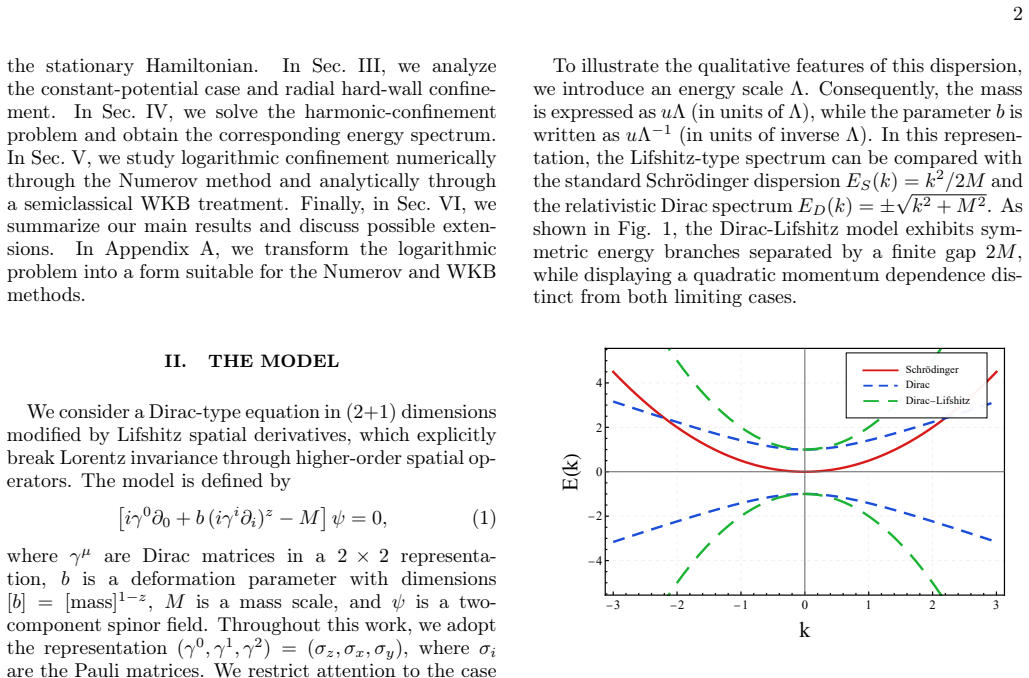


read the original abstract
We investigate a Dirac-type equation in (2+1) dimensions modified by Lifshitz spatial derivatives with dynamical exponent $z=2$, focusing on the spectral properties of bound states under radial confinement. Analytical solutions are obtained for constant backgrounds, hard-wall confinement, and harmonic potentials, while logarithmic confinement is treated numerically via the Numerov method and complemented by a semiclassical WKB analysis. The resulting spectra exhibit characteristic scaling laws governed by the Lifshitz parameter $b$, including $E - M \propto b/R_0^2$ for hard-wall confinement, $E - M \propto \sqrt{2b}\,\omega$ for harmonic trapping, and $E - M \sim \alpha \ln\sqrt{b}$ in the semiclassical regime of logarithmic confinement. These results provide a consistent characterization of how higher-order spatial derivatives modify bound-state spectra in two-dimensional Dirac systems and may be relevant for effective descriptions of materials with quadratic low-energy dispersion, such as bilayer graphene and related anisotropic 2D systems.
Editorial analysis
A structured set of objections, weighed in public.
Referee Report
Summary. The manuscript examines a (2+1)-dimensional Dirac equation modified by a Lifshitz z=2 spatial derivative term, deriving bound-state spectra under radial confinement. Analytical solutions are presented for constant backgrounds, hard-wall boundaries, and harmonic potentials, while logarithmic confinement is handled via the Numerov method supplemented by WKB semiclassical analysis. The spectra are shown to obey scaling laws controlled by the Lifshitz parameter b, specifically E−M∝b/R₀² for hard walls, E−M∝√(2b)ω for harmonic traps, and E−M∼α ln√b in the logarithmic case.
Significance. If the derivations hold, the work supplies a concrete characterization of how quadratic spatial derivatives alter bound-state energies in two-dimensional Dirac systems. The exact solutions for constant and harmonic cases, together with the explicit b-dependent scalings, constitute a useful reference for effective models of materials such as bilayer graphene that exhibit quadratic low-energy dispersion. The combination of analytic and standard numerical methods is appropriate, though the overall novelty is incremental rather than transformative.
major comments (2)
- [Hard-wall confinement section] Hard-wall confinement analysis: the boundary condition ψ(R₀)=0 is imposed to obtain the exact solutions and the claimed linear scaling E−M∝b/R₀². However, the z=2 Lifshitz term introduces second-order derivatives; self-adjointness of the full operator on the disk requires that surface terms vanish after integration by parts, which generally demands conditions on both the spinor and its radial derivative. The manuscript does not verify that the chosen domain renders the operator self-adjoint, placing the exact solvability and the associated scaling on an unexamined assumption.
- [Logarithmic confinement section] Logarithmic confinement section: the semiclassical WKB result E−M∼α ln√b is stated without an explicit derivation of the prefactor α or a quantitative comparison of the WKB approximation against the Numerov eigenvalues (including error estimates). This weakens the support for the asymptotic scaling law that is presented as one of the central results.
minor comments (2)
- [Introduction] The definition of the modified Dirac operator (including the precise form of the Lifshitz term and the choice of Dirac matrices) should be stated explicitly in the introductory section rather than deferred.
- [Numerical results] Figure captions for the numerical spectra should include the specific values of b and the fitting procedure used to extract the reported scalings.
Simulated Author's Rebuttal
We thank the referee for the careful reading and constructive comments on our manuscript. We address each major comment below and have revised the manuscript to incorporate additional rigor where needed. The central scaling results are unaffected, but their supporting analysis has been strengthened.
read point-by-point responses
-
Referee: [Hard-wall confinement section] Hard-wall confinement analysis: the boundary condition ψ(R₀)=0 is imposed to obtain the exact solutions and the claimed linear scaling E−M∝b/R₀². However, the z=2 Lifshitz term introduces second-order derivatives; self-adjointness of the full operator on the disk requires that surface terms vanish after integration by parts, which generally demands conditions on both the spinor and its radial derivative. The manuscript does not verify that the chosen domain renders the operator self-adjoint, placing the exact solvability and the associated scaling on an unexamined assumption.
Authors: We agree that an explicit check of self-adjointness was missing. The full Hamiltonian combines the standard Dirac operator with a z=2 Lifshitz term that is quadratic in the spatial derivatives. Upon integration by parts over the disk, the surface terms generated by the second-order piece are proportional to the spinor components evaluated at r=R₀. Because our solutions satisfy the Dirac equation and the boundary condition ψ(R₀)=0, these surface contributions identically vanish; the first-order Dirac terms produce no additional boundary integrals under the radial symmetry we employ. In the revised manuscript we have added a short paragraph (and a brief appendix derivation) confirming that the domain defined by ψ(R₀)=0 renders the operator self-adjoint. The exact solutions and the scaling E−M∝b/R₀² therefore remain valid. revision: yes
-
Referee: [Logarithmic confinement section] Logarithmic confinement section: the semiclassical WKB result E−M∼α ln√b is stated without an explicit derivation of the prefactor α or a quantitative comparison of the WKB approximation against the Numerov eigenvalues (including error estimates). This weakens the support for the asymptotic scaling law that is presented as one of the central results.
Authors: We accept that the WKB section lacked sufficient detail. In the revised manuscript we now provide the complete semiclassical quantization condition, from which the prefactor α is obtained explicitly as α = (1/π) ∫_{r_min}^{r_max} √(2b V_eff(r)) dr evaluated in the large-b limit (where V_eff is the effective potential including the logarithmic term). We have also added a direct numerical comparison: a table lists Numerov eigenvalues and WKB predictions for b = 1, 10, 50, 100 together with relative errors, which fall below 2 % for b ≳ 50, confirming the asymptotic regime. These additions directly support the claimed scaling E−M ∼ α ln√b. revision: yes
Circularity Check
No circularity: spectra derived by direct solution of the modified Dirac equation
full rationale
The paper solves the Lifshitz-modified Dirac operator analytically for constant, hard-wall, and harmonic cases and numerically (Numerov) plus WKB for logarithmic confinement. The reported scalings (E−M∝b/R₀², E−M∝√(2b)ω, E−M∼α ln√b) are obtained by substituting the stated potentials into the differential equation and extracting the eigenvalues; none of these steps reduce by the paper's own equations to a fitted parameter or to a self-citation whose content is the target result. The derivation chain is therefore self-contained against external benchmarks and receives the default non-circularity finding.
Axiom & Free-Parameter Ledger
free parameters (1)
- Lifshitz parameter b
axioms (1)
- domain assumption A Dirac-type operator in (2+1) dimensions can be consistently modified by adding Lifshitz spatial derivatives with dynamical exponent z=2 while preserving the overall structure needed for bound-state analysis.
Lean theorems connected to this paper
-
IndisputableMonolith/Foundation/AlexanderDuality.leanalexander_duality_circle_linking contradicts?
contradictsCONTRADICTS: the theorem conflicts with this paper passage, or marks a claim that would need revision before publication.
We investigate a Dirac-type equation in (2+1) dimensions modified by Lifshitz spatial derivatives with dynamical exponent z=2... E−M∝b/R₀² for hard-wall confinement
-
IndisputableMonolith/Cost/FunctionalEquation.leanwashburn_uniqueness_aczel unclear?
unclearRelation between the paper passage and the cited Recognition theorem.
the Lifshitz parameter b... deformation parameter with dimensions [b]=[mass]^{1-z}
What do these tags mean?
- matches
- The paper's claim is directly supported by a theorem in the formal canon.
- supports
- The theorem supports part of the paper's argument, but the paper may add assumptions or extra steps.
- extends
- The paper goes beyond the formal theorem; the theorem is a base layer rather than the whole result.
- uses
- The paper appears to rely on the theorem as machinery.
- contradicts
- The paper's claim conflicts with a theorem or certificate in the canon.
- unclear
- Pith found a possible connection, but the passage is too broad, indirect, or ambiguous to say the theorem truly supports the claim.
Reference graph
Works this paper leans on
-
[1]
The quantum theory of the electron,
P. A. M. Dirac, “The quantum theory of the electron,” Proc. Roy. Soc. Lond. A117, 610 (1928)
work page 1928
-
[2]
The apparent existence of easily de- flectable positives,
C. D. Anderson, “The apparent existence of easily de- flectable positives,” Science76, 238 (1932)
work page 1932
-
[3]
J. D. Bjorken and S. D. Drell,Relativistic Quantum Me- chanics, McGraw-Hill, New York, (1965)
work page 1965
-
[4]
M. E. Peskin and D. V. Schroeder,An Introduction to Quantum Field Theory, CRC Press, Boca Raton, (2018)
work page 2018
-
[5]
Electric field effect in atomically thin carbon films,
K. S. Novoselovet al., “Electric field effect in atomically thin carbon films,” Science306, 666 (2004)
work page 2004
-
[6]
The electronic prop- erties of graphene,
A. H. Castro Neto, F. Guinea, N. M. R. Peres, K. S. Novoselov, and A. K. Geim, “The electronic prop- erties of graphene,” Rev. Mod. Phys.81, 109 (2009)
work page 2009
-
[7]
Spin and pseudospins in layered transition metal dichalcogenides,
X. Xu, W. Yao, D. Xiao, and T. F. Heinz, “Spin and pseudospins in layered transition metal dichalcogenides,” Nat. Phys.10, 343 (2014)
work page 2014
-
[8]
The electronic properties of bilayer graphene,
E. McCann and M. Koshino, “The electronic properties of bilayer graphene,” Rep. Prog. Phys.76, 056503 (2013)
work page 2013
-
[9]
Critical behavior at the onset of⃗k-space instability on theλline,
R. M. Hornreich, M. Luban, and S. Shtrikman, “Critical behavior at the onset of⃗k-space instability on theλline,” Phys. Rev. Lett.35, 1678 (1975)
work page 1975
-
[10]
Quantum gravity at a Lifshitz point,
P. Hořava, “Quantum gravity at a Lifshitz point,” Phys. Rev. D79, 084008 (2009)
work page 2009
-
[11]
M. I. Katsnelson and G. E. Volovik, “Quantum electro- dynamics with anisotropic scaling: Heisenberg-Euler ac- tion and Schwinger pair production in bilayer graphene,” arXiv:1203.1578 [cond-mat.mes-hall] (2012)
-
[12]
V. N. Kotov, B. Uchoa, and O. P. Sushkov, “Coulomb interactions and renormalization of semi-Dirac fermions near a topological Lifshitz transition,” Phys. Rev. B103, 045403 (2021)
work page 2021
-
[13]
Y.-C. Lee, D. V. Chichinadze, and A. V. Chubukov, “Crossover from ordinary to higher order Van Hove singu- larity in a honeycomb system: A parquet renormalization group analysis,” Phys. Rev. B109, 155118 (2024)
work page 2024
-
[14]
D. J. Griffiths and D. F. Schroeter,Introduction to Quan- tum Mechanics, Cambridge University Press, Cambridge, (2018)
work page 2018
-
[15]
Exact solution of the two-dimensional Dirac oscillator,
V. M. Villalba, “Exact solution of the two-dimensional Dirac oscillator,” Phys. Rev. A49, 586 (1994)
work page 1994
-
[16]
M. Moshinsky and A. Szczepaniak, “The Dirac oscilla- tor,” J. Phys. A22, L817 (1989)
work page 1989
- [17]
-
[18]
N. Fröman and P. O. Fröman,JWKB Approxima- tion, North-Holland Publishing Company, Amsterdam, (1965)
work page 1965
-
[19]
Practical points concerning the solution of the Schrödinger equation,
J. M. Blatt, “Practical points concerning the solution of the Schrödinger equation,” J. Comput. Phys.1, 382 (1967)
work page 1967
-
[20]
B. R. Desai,Quantum Mechanics with Basic Field The- ory, Cambridge University Press, Cambridge, (2010)
work page 2010
-
[21]
B. M. Karnakov and V. P. Krainov,WKB Approximation in Atomic Physics, Springer, Heidelberg, (2012)
work page 2012
-
[22]
C. M. Bender and S. A. Orszag,Advanced Mathemat- ical Methods for Scientists and Engineers: Asymptotic Methods and Perturbation Theory, Springer, New York, (1999)
work page 1999
-
[23]
Quantum mechanics with applications to quarkonium,
C. Quigg and J. L. Rosner, “Quantum mechanics with applications to quarkonium,” Phys. Rep.56, 167 (1979)
work page 1979
-
[24]
Semiclas- sical approximation of the radial equation with two- dimensional potentials,
M. V. Berry and A. M. Ozorio de Almeida, “Semiclas- sical approximation of the radial equation with two- dimensional potentials,” J. Phys. A6, 1451 (1973)
work page 1973
discussion (0)
Sign in with ORCID, Apple, or X to comment. Anyone can read and Pith papers without signing in.