Recognition: 2 theorem links
· Lean TheoremAgentic AI for Particle-Based Simulation: Automating SPH Workflows for Debris Flow Modeling
Pith reviewed 2026-05-12 04:28 UTC · model grok-4.3
The pith
Agentic AI automates end-to-end SPH workflows for debris flow modeling with multimodal inputs.
A machine-rendered reading of the paper's core claim, the machinery that carries it, and where it could break.
Core claim
We present the first agentic AI workflow for meshless simulation in computational mechanics, demonstrated on debris flow modeling using Smoothed Particle Hydrodynamics (SPH) with the software DualSPHysics. By integrating tool orchestration, multimodal inputs (text and sketches), and human-in-the-loop interaction, the framework enables end-to-end simulation workflows for a class of problems that are inherently less structured and more challenging to automate. Results show that multimodal inputs enhance user experience and reduce failure modes over text-only descriptions. Human-in-the-loop is critical for resolving ambiguities and handling SPH-specific configurations. Post-processing shows a
What carries the argument
Agentic AI framework that uses LLM tool orchestration with multimodal text-and-sketch inputs plus human-in-the-loop feedback to automate DualSPHysics SPH simulations for debris flows.
Load-bearing premise
Multimodal inputs and human-in-the-loop interaction can sufficiently resolve ambiguities and handle the unstructured aspects of particle-based SPH problems to produce reliable workflows.
What would settle it
A test where the AI agent processes multiple debris flow cases from sketches and text inputs with no human corrections, then compares the resulting simulation outputs and parameters against those prepared by expert users for accuracy and completeness.
Figures

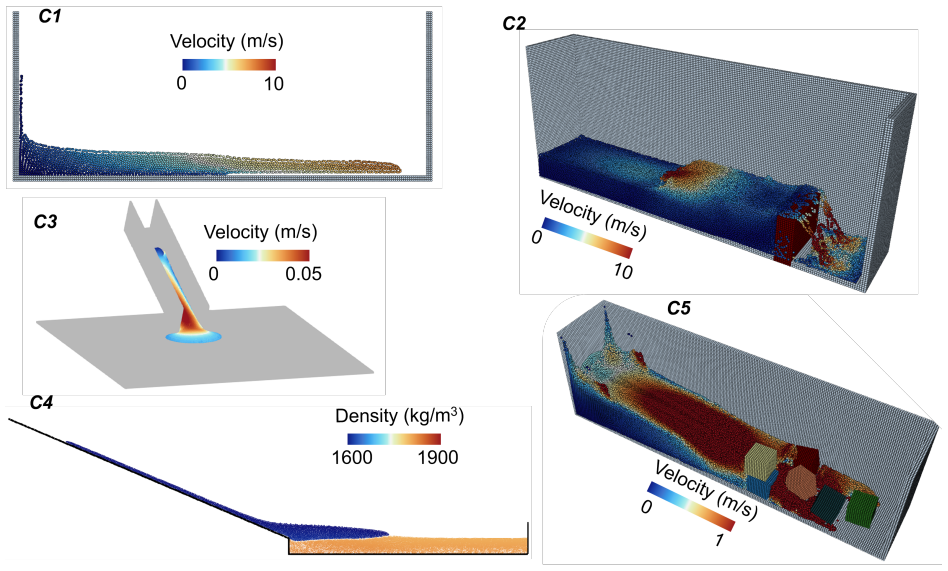
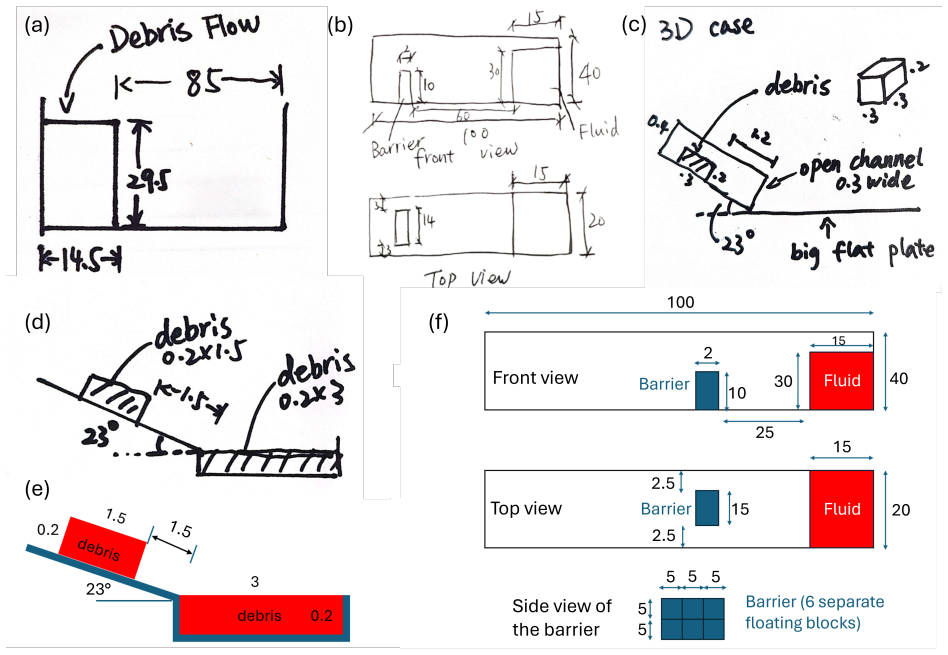


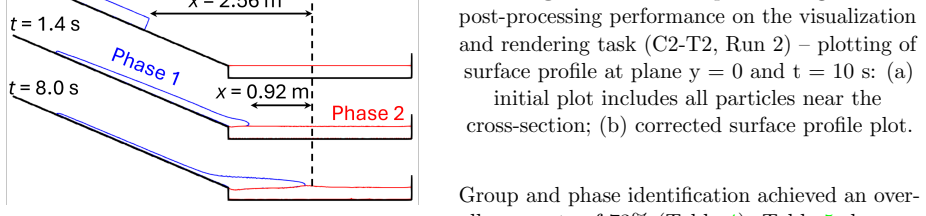

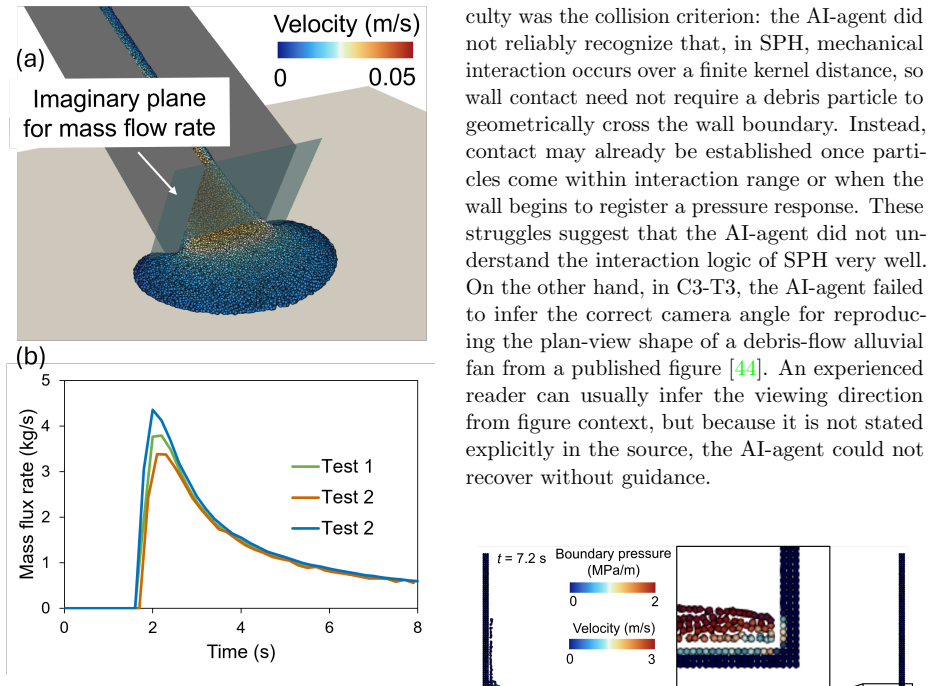
read the original abstract
Physics-based simulation underpins engineering analysis but remains difficult to deploy in practice due to complex setup, parameterization, and interpretation. While Large Language Model-based agentic systems have shown promise in automating engineering computing workflows, they have primarily targeted structured, mesh-based problems. We present the first agentic AI workflow for meshless simulation in computational mechanics, demonstrated on debris flow modeling using Smoothed Particle Hydrodynamics (SPH) with the software DualSPHysics. By integrating tool orchestration, multimodal inputs (text and sketches), and human-in-the-loop interaction, the framework enables end-to-end simulation workflows for a class of problems that are inherently less structured and more challenging to automate. Results show that multimodal inputs not only enhance user experience but also reduces failure modes over text-only descriptions. Human-in-the-loop is critical for resolving ambiguities and handling SPH-specific configurations. We further introduce a cognitive-task-based evaluation of post-processing, showing strong performance in visualization and data extraction, with remaining gaps in higher-level SPH-specific physical reasoning that are amenable to improvement through domain-aware modeling. These results establish the viability of agentic AI for particle-based simulation and underscore its potential to transform the accessibility and efficiency of computational mechanics workflows.
Editorial analysis
A structured set of objections, weighed in public.
Referee Report
Summary. The paper claims to introduce the first agentic AI workflow for meshless simulation in computational mechanics, demonstrated on debris flow modeling using Smoothed Particle Hydrodynamics (SPH) with DualSPHysics. It integrates tool orchestration, multimodal inputs (text and sketches), and human-in-the-loop interaction to enable end-to-end workflows for inherently unstructured particle-based problems. The abstract reports that multimodal inputs reduce failure modes relative to text-only descriptions, that human-in-the-loop is critical for resolving ambiguities and SPH-specific configurations, and that a cognitive-task-based evaluation shows strong post-processing performance in visualization and data extraction with gaps in higher-level physical reasoning.
Significance. If the framework can be shown to deliver reliable automation with measurable reductions in setup effort and failure rates, the work would address a genuine gap in applying agentic systems to meshless methods, which are more challenging than structured mesh-based problems. The cognitive-task evaluation approach for post-processing is a constructive contribution that could be extended to other simulation domains. However, the explicit dependence on human intervention for core SPH configuration tasks limits the scope of the claimed automation and reduces the potential impact relative to fully autonomous systems.
major comments (2)
- [Abstract] Abstract: The central claim that the framework 'enables end-to-end simulation workflows' for 'inherently less structured and more challenging' problems is directly qualified by the statement that 'Human-in-the-loop is critical for resolving ambiguities and handling SPH-specific configurations.' This indicates that the agent cannot autonomously manage key technical aspects of meshless simulation (e.g., DualSPHysics parameter choices for stability), so the demonstration may establish assisted rather than automated workflows. The manuscript should explicitly delineate which workflow steps are fully autonomous versus those requiring human input.
- [Abstract] Abstract: The abstract reports positive outcomes for multimodal inputs and post-processing but supplies no quantitative metrics, failure rates, error bars, or detailed comparisons (e.g., success rates for text-only vs. multimodal cases or task-completion times). Without such data, the assertions that multimodal inputs 'reduce failure modes' and that post-processing shows 'strong performance' cannot be evaluated, weakening support for the viability claim.
minor comments (1)
- The manuscript would benefit from a dedicated limitations section that discusses the current gaps in higher-level SPH-specific physical reasoning and the conditions under which human intervention remains necessary.
Simulated Author's Rebuttal
We thank the referee for their constructive comments, which highlight opportunities to clarify the degree of automation and to strengthen the evidentiary basis of our claims. We address each major comment point by point below and indicate the revisions we will implement.
read point-by-point responses
-
Referee: [Abstract] Abstract: The central claim that the framework 'enables end-to-end simulation workflows' for 'inherently less structured and more challenging' problems is directly qualified by the statement that 'Human-in-the-loop is critical for resolving ambiguities and handling SPH-specific configurations.' This indicates that the agent cannot autonomously manage key technical aspects of meshless simulation (e.g., DualSPHysics parameter choices for stability), so the demonstration may establish assisted rather than automated workflows. The manuscript should explicitly delineate which workflow steps are fully autonomous versus those requiring human input.
Authors: We agree that a precise delineation of autonomous versus human-assisted steps will improve clarity. While the agent autonomously manages input interpretation, tool selection, geometry setup from sketches, simulation execution, and visualization, human input is required for SPH-specific stability parameter tuning and ambiguity resolution in complex debris-flow cases. In the revised manuscript we will add a table in Section 3 (Methodology) that explicitly categorizes every workflow stage by autonomy level. This will qualify the 'end-to-end' claim as a practical, human-in-the-loop automation without overstating full autonomy. revision: yes
-
Referee: [Abstract] Abstract: The abstract reports positive outcomes for multimodal inputs and post-processing but supplies no quantitative metrics, failure rates, error bars, or detailed comparisons (e.g., success rates for text-only vs. multimodal cases or task-completion times). Without such data, the assertions that multimodal inputs 'reduce failure modes' and that post-processing shows 'strong performance' cannot be evaluated, weakening support for the viability claim.
Authors: We concur that the abstract would benefit from quantitative support. The full manuscript contains experimental results with comparative success rates, failure-mode reductions, and cognitive-task performance scores. We will revise the abstract to include concise quantitative statements (e.g., observed failure-rate reduction and post-processing accuracy metrics) drawn from the results section, together with any available statistical comparisons. This will allow readers to evaluate the reported outcomes directly. revision: yes
Circularity Check
No significant circularity: system demonstration without derivations or self-referential predictions
full rationale
The paper is a system description and empirical demonstration study of an agentic AI workflow for SPH simulations. It contains no mathematical derivations, equations, fitted parameters, predictions, or uniqueness theorems that could reduce to their own inputs by construction. Claims rest on workflow integration (tool orchestration, multimodal inputs, human-in-the-loop) and observed performance in a demonstration, which are independent of any circular reduction. No self-citation load-bearing steps, ansatz smuggling, or renaming of known results appear in the text. The reader's assessment of score 1.0 aligns with the absence of any load-bearing circular patterns.
Axiom & Free-Parameter Ledger
Lean theorems connected to this paper
-
IndisputableMonolith/Foundation/RealityFromDistinction.leanreality_from_one_distinction unclear?
unclearRelation between the paper passage and the cited Recognition theorem.
We present the first agentic AI workflow for meshless simulation... integrating tool orchestration, multimodal inputs (text and sketches), and human-in-the-loop interaction
-
IndisputableMonolith/Cost/FunctionalEquation.leanwashburn_uniqueness_aczel unclear?
unclearRelation between the paper passage and the cited Recognition theorem.
Human-in-the-loop is critical for resolving ambiguities and handling SPH-specific configurations
What do these tags mean?
- matches
- The paper's claim is directly supported by a theorem in the formal canon.
- supports
- The theorem supports part of the paper's argument, but the paper may add assumptions or extra steps.
- extends
- The paper goes beyond the formal theorem; the theorem is a base layer rather than the whole result.
- uses
- The paper appears to rely on the theorem as machinery.
- contradicts
- The paper's claim conflicts with a theorem or certificate in the canon.
- unclear
- Pith found a possible connection, but the passage is too broad, indirect, or ambiguous to say the theorem truly supports the claim.
Reference graph
Works this paper leans on
-
[1]
Thomas JR Hughes.The finite element method: linear static and dynamic finite ele- ment analysis. Courier Corporation, 2003
work page 2003
-
[2]
Joel H Ferziger, Milovan Peri´ c, and Robert L Street.Computational methods for fluid dy- namics, volume 3. Springer, 2002
work page 2002
-
[3]
Computational granular dynamics: models and algorithms
Thorsten P¨ oschel and Thomas Schwager. Computational granular dynamics: models and algorithms. Springer, 2005
work page 2005
-
[4]
Cambridge university press, 2010
William L Oberkampf and Christopher J Roy.Verification and validation in scien- tific computing. Cambridge university press, 2010
work page 2010
-
[5]
Ehsan Haghighat, Maziar Raissi, Adrian Moure, Hector Gomez, and Ruben Juanes. A physics-informed deep learning frame- work for inversion and surrogate model- ing in solid mechanics.Computer Meth- ods in Applied Mechanics and Engineering, 379:113741, 2021
work page 2021
-
[6]
Data- driven surrogate modeling of multiphase flows using machine learning techniques
Himakar Ganti and Prashant Khare. Data- driven surrogate modeling of multiphase flows using machine learning techniques. Computers & Fluids, 211:104626, 2020
work page 2020
-
[7]
Nils Wandel, Michael Weinmann, and Rein- hard Klein. Teaching the incompressible navier–stokes equations to fast neural surro- gate models in three dimensions.Physics of Fluids, 33(4), 2021
work page 2021
-
[8]
Yongjin Choi and Krishna Kumar. Graph neural network-based surrogate model for granular flows.Computers and Geotechnics, 166:106015, 2024
work page 2024
-
[9]
Machine learning aided modeling of granular mate- rials: A review: M
Mengqi Wang, Krishna Kumar, YT Feng, Tongming Qu, and Min Wang. Machine learning aided modeling of granular mate- rials: A review: M. wang et al.Archives of Computational Methods in Engineering, 32(4):1997–2034, 2025
work page 1997
-
[10]
Mehdi Nourbakhsh, Javier Irizarry, and John Haymaker. Generalizable surrogate model features to approximate stress in 3d trusses.Engineering Applications of Artifi- cial Intelligence, 71:15–27, 2018
work page 2018
-
[11]
Benet Eiximeno, Marcial Sanchis-Agudo, Ar- nau Mir´ o, Ivette Rodriguez, Ricardo Vin- uesa, and Oriol Lehmkuhl. On deep-learning- based closures for algebraic surrogate models of turbulent flows.Journal of Fluid Mechan- ics, 1020:A36, 2025
work page 2025
-
[12]
Jiachen Guo, Chanwook Park, Dong Qian, Thomas J.R. Hughes, and Wing Kam Liu. Large language model-empowered next-generation computer-aided engineering. Computer Methods in Applied Mechanics and Engineering, 450:118591, 2026. 21
work page 2026
-
[13]
Physics simulation capabilities of llms.Phys- ica Scripta, 99(11):116003, 2024
Mohamad Ali-Dib and Kristen Menou. Physics simulation capabilities of llms.Phys- ica Scripta, 99(11):116003, 2024
work page 2024
-
[14]
Alessio Alexiadis and Bahman Ghiassi. From text to tech: Shaping the future of physics- based simulations with ai-driven generative models.Results in Engineering, 21:101721, 2024
work page 2024
-
[15]
Jingsen Feng, Ran Xu, and Xu Chu. Open- FOAMGPT 2.0: End-to-end, trustworthy automation for computational fluid dynam- ics.International Journal of Heat and Fluid Flow, 120:110399, 2026
work page 2026
-
[16]
Honeycomb: A flexible llm-based agent system for materials science
Huan Zhang, Yu Song, Ziyu Hou, Santiago Miret, and Bang Liu. Honeycomb: A flexible llm-based agent system for materials science. InFindings of the Association for Compu- tational Linguistics: EMNLP 2024, pages 3369–3382, 2024
work page 2024
-
[17]
Darui Lu, Jordan M Malof, and Willie J Padilla. An agentic framework for au- tonomous metamaterial modeling and in- verse design.ACS Photonics, 12(11):6071– 6080, 2025
work page 2025
-
[18]
Quintina Campbell, Sam Cox, Jorge Med- ina, Brittany Watterson, and Andrew D White. Mdcrow: Automating molecular dy- namics workflows with large language mod- els.Machine Learning: Science and Tech- nology, 7(2):025037, 2026
work page 2026
-
[19]
Ox- ford University Press, 2012
Damien Violeau.Fluid mechanics and the SPH method: theory and applications. Ox- ford University Press, 2012
work page 2012
-
[20]
Ha H Bui and Giang D Nguyen. Smoothed particle hydrodynamics (sph) and its appli- cations in geomechanics.ALERT Doctoral School 2020 Point based numerical methods in geomechanics, page 3, 2020
work page 2020
-
[21]
Paul W Cleary, Simon M Harrison, Matt D Sinnott, Gerald G Pereira, Mahesh Prakash, Raymond CZ Cohen, Murray Rudman, and Nick Stokes. Application of sph to single and multiphase geophysical, biophysical and in- dustrial fluid flows.International Journal of Computational Fluid Dynamics, 35(1-2):22– 78, 2021
work page 2021
-
[22]
Yumeng Zhao, Wencheng Jin, Jordan Klinger, David C Dayton, and Sheng Dai. Sph modeling of biomass granular flow: The- oretical implementation and experimental validation.Powder Technology, 426:118625, 2023
work page 2023
-
[23]
Sph modeling of biomass granular flow: Engi- neering application in hoppers and augers
Yumeng Zhao, Wencheng Jin, Abdallah Ikbarieh, Jordan L Klinger, Nepu Saha, David C Dayton, and Sheng Dai. Sph modeling of biomass granular flow: Engi- neering application in hoppers and augers. ACS Sustainable Chemistry & Engineering, 12(10):4213–4223, 2024
work page 2024
-
[24]
Yi Zhan, Iv´ an Mart´ ınez-Est´ evez, Min Luo, Alejandro J.C. Crespo, and Abbas Khayyer. Coupling smoothed particle hydrodynamics with multi-agent deep reinforcement learning for cooperative control of point absorbers. arXiv preprint arXiv:2601.06485, 2026
-
[25]
Wenkang Wang, Ran Xu, Jingsen Feng, Qingfu Zhang, Sandeep Pandey, and Xu Chu. A status quo investigation of large-language models for cost-effective CFD automation with OpenFOAMGPT.Theoretical and Ap- plied Mechanics Letters, 15(6):100623, 2025
work page 2025
-
[26]
Bo Ni and Markus J Buehler. MechAgents: Large language model multi-agent collabora- tions can solve mechanics problems, generate new data, and integrate knowledge.Extreme Mechanics Letters, 67:102131, 2024
work page 2024
-
[27]
Zhaoyue Xu, Long Wang, Chunyu Wang, Yixin Chen, Qingyong Luo, Hua-Dong Yao, Shizhao Wang, and Guowei He. Cfdagent: A language-guided, zero-shot multi-agent sys- tem for complex flow simulation.Physics of Fluids, 37(11), 2025
work page 2025
-
[28]
Nayantara Mudur, Hao Cui, Subhashini Venugopalan, Paul Raccuglia, Michael P Brenner, and Peter Norgaard. FEABench: 22 Evaluating language models on multi- physics reasoning ability.arXiv preprint arXiv:2504.06260, 2025
-
[29]
Jose M Dom´ ınguez, Georgios Fourtakas, Cor- rado Altomare, Ricardo B Canelas, Angelo Tafuni, Orlando Garc´ ıa-Feal, Ivan Mart´ ınez- Est´ evez, Athanasios Mokos, Renato Vacon- dio, Alejandro JC Crespo, et al. Dual- sphysics: from fluid dynamics to multi- physics problems.Computational Particle Mechanics, 9(5):867–895, 2022
work page 2022
-
[30]
arXiv preprint arXiv:2407.21320 , year =
Yuxuan Chen, Xu Zhu, Hua Zhou, and Zhuyin Ren. MetaOpenFOAM: an LLM- based multi-agent framework for CFD.arXiv preprint arXiv:2407.21320, 2024
-
[31]
arXiv preprint arXiv:2502.00498 , year =
Yuxuan Chen, Xu Zhu, Hua Zhou, and Zhuyin Ren. MetaOpenFOAM 2.0: Large language model driven chain of thought for automating CFD simulation and post- processing.arXiv preprint arXiv:2502.00498, 2025
-
[32]
Sandeep Pandey, Ran Xu, Wenkang Wang, and Xu Chu. OpenFOAMGPT: A retrieval- augmented large language model agent for OpenFOAM-based computational fluid dy- namics.Physics of Fluids, 37(3):035120, 2025
work page 2025
-
[33]
Foam-agent: Towards au- tomated intelligent CFD workflows.arXiv preprint arXiv:2505.04997, 2025
Ling Yue, Nithin Somasekharan, Yadi Cao, and Shaowu Pan. Foam-agent: Towards au- tomated intelligent CFD workflows.arXiv preprint arXiv:2505.04997, 2025
-
[34]
E Fan, Weizong Wang, and Tianhan Zhang. ChatCFD: an end-to-end CFD agent with domain-specific structured thinking.arXiv preprint arXiv:2506.02019, 2025
-
[35]
Zhehao Dong, Zhen Lu, and Yue Yang. Fine- tuning a large language model for automat- ing computational fluid dynamics simula- tions.Theoretical and Applied Mechanics Letters, 15(3):100594, 2025
work page 2025
-
[36]
Chuan Tian and Yilei Zhang. Optimiz- ing collaboration of LLM-based agents for finite element analysis.arXiv preprint arXiv:2408.13406, 2024
-
[37]
Tao Zhang, Zhenhai Liu, Yong Xin, and Yongjun Jiao. MooseAgent: A LLM based multi-agent framework for automat- ing moose simulation.arXiv preprint arXiv:2504.08621, 2025
-
[38]
Taegu Kim, Tae Sup Yun, and Hyoung Suk Suh. Can chatgpt implement finite element models for geotechnical engineering applica- tions?International Journal for Numerical and Analytical Methods in Geomechanics, 49(6):1747–1766, 2025
work page 2025
-
[39]
Alejandro JC Crespo, Jos´ e M Dom´ ınguez, Benedict D Rogers, Moncho G´ omez-Gesteira, Sam Longshaw, RJFB Canelas, Renato Va- condio, Anxo Barreiro, and Orlando Garc´ ıa- Feal. Dualsphysics: Open-source parallel cfd solver based on smoothed particle hydrody- namics (sph).Computer Physics Communi- cations, 187:204–216, 2015
work page 2015
-
[40]
Wei Wang, Guangqi Chen, Zheng Han, Suhua Zhou, Hong Zhang, and Peideng Jing. 3d numerical simulation of debris-flow mo- tion using sph method incorporating non- newtonian fluid behavior.Natural Hazards, 81(3):1981–1998, 2016
work page 1981
-
[41]
Georgios Fourtakas and BD Rogers. Mod- elling multi-phase liquid-sediment scour and resuspension induced by rapid flows using smoothed particle hydrodynamics (sph) ac- celerated with a graphics processing unit (gpu).Advances in water resources, 92:186– 199, 2016
work page 2016
-
[42]
Building effective agents, 2024
Anthropic. Building effective agents, 2024. Accessed: 2026-04-02
work page 2024
-
[43]
Microsoft Agent Framework Workflows, 2025
Microsoft. Microsoft Agent Framework Workflows, 2025. Accessed:2026-04-02
work page 2025
-
[44]
Nikhil Kumar Pandey, Neelima Satyam, and Benjamin Basumatary. Integrating experi- mental and numerical approaches to simu- late viscous debris flows using an hbp-sph 23 framework.Scientific Reports, 15(1):16627, 2025
work page 2025
-
[45]
Boundary conditions gener- ated by dynamic particles in sph methods
AJC Crespo, M G´ omez-Gesteira, and RA Dalrymple. Boundary conditions gener- ated by dynamic particles in sph methods. comput mater contin 5: 173–184, 2007. 24 A Appendix A.1 Post-processing prompt examples We present post-processing dialogue examples that covers all 5 cognitive task types. In the dialogue below, we include comments shown in the pink dial...
work page 2007
discussion (0)
Sign in with ORCID, Apple, or X to comment. Anyone can read and Pith papers without signing in.