Recognition: no theorem link
Microscopic resonant-shell mechanism for slow Liouvillian sectors in an open correlated lattice
Pith reviewed 2026-05-12 04:14 UTC · model grok-4.3
The pith
Local doublon-bond resonance creates a fixed shell that selects slow Liouvillian sectors in open lattices via reservoir engineering.
A machine-rendered reading of the paper's core claim, the machinery that carries it, and where it could break.
Core claim
The central claim is that slow Liouvillian sectors in open correlated lattices are microscopically selected by a resonant shell mechanism. Starting from the local interacting resonance between an on-site doublon and branch-resolved bond, a composite shell orbital is defined whose doublon component sets reservoir visibility and whose mixed character sets mobility. This leads to a branch-selective dimerized channel upon projection, and in different density regimes produces an exponentially slow edge-memory pole via Zeno return, a near-zero standing-wave doublet at criticality, or density-dressed defects as slow variables with diffusive gap, all derived in one Schur-projection framework. The me
What carries the argument
The composite shell orbital arising from the local resonance between an on-site doublon and a branch-resolved nearest-neighbor bond, which controls reservoir visibility and shell mobility.
If this is right
- The reservoir-engineered fast block selects the observable slow sector while the microscopic parent shell remains fixed.
- In the dilute regime a boundary doublon-loss channel yields an exponentially slow edge-memory pole through a Zeno-type return.
- At the shell-critical point the edge pole is replaced by a near-zero standing-wave doublet with algebraic coherent spacing.
- At finite shell filling a number-conserving phase-locking jump removes a bright mismatch sector leaving defects as asymptotic slow variables and producing a diffusive finite-size gap.
Where Pith is reading between the lines
- Engineering the reservoir's fast block could selectively activate desired slow modes in quantum simulators without redesigning the underlying lattice interactions.
- The fixed parent shell implies that slow-sector selection remains stable against moderate changes in reservoir details provided the fast block is properly tuned.
- Analogous local resonance constructions may apply to other open many-body platforms to predict and isolate their long-time slow dynamics.
Load-bearing premise
The local interacting resonance between an on-site doublon and a branch-resolved nearest-neighbor bond is the dominant process that defines the composite shell orbital controlling reservoir visibility and mobility.
What would settle it
Observation of the transition from an exponentially slow edge-memory pole to a near-zero standing-wave doublet with algebraic spacing when tuning through the shell-critical point in a lattice with controlled boundary loss.
Figures



read the original abstract
We develop a microscopic theory for how slow Liouvillian sectors are selected in an open correlated lattice. The starting point is not a postulated non-Hermitian band, but a local interacting resonance between an on-site doublon and a branch-resolved nearest-neighbor bond. This resonance defines a composite shell orbital whose doublon weight controls reservoir visibility and whose mixed doublon-bond character controls shell mobility. Projecting the microscopic hopping onto the selected shell yields a branch-selective dimerized channel. In the dilute regime, a boundary doublon-loss channel yields an exponentially slow edge-memory pole through a Zeno-type return. At the shell-critical point, the edge pole is replaced by a near-zero standing-wave doublet with an algebraic coherent spacing. At finite shell filling, the same local shell becomes density dressed. A number-conserving phase-locking jump removes a bright mismatch sector, leaving defects as the asymptotic slow variables and producing a diffusive finite-size gap. We derive the local shell, the projected branch topology, the edge-memory law, the shell-critical doublet, the density-dressed shell Hamiltonian, and the defect generator within one Schur-projection framework. The resulting mechanism identifies the reservoir-engineered fast block as the selector of the observable slow sector, while the microscopic parent shell remains fixed.
Editorial analysis
A structured set of objections, weighed in public.
Referee Report
Summary. The manuscript develops a microscopic theory for the selection of slow Liouvillian sectors in open correlated lattices. It begins with a local interacting resonance between an on-site doublon and a branch-resolved nearest-neighbor bond that defines a composite shell orbital. A single Schur-projection framework is then used to derive the branch-selective dimerized channel, an exponentially slow edge-memory pole via Zeno-type return in the dilute regime, a near-zero standing-wave doublet at the shell-critical point, a density-dressed shell Hamiltonian at finite filling, and a defect generator after phase-locking removal of the bright mismatch sector. The central claim is that the reservoir-engineered fast block selects the observable slow sector while the microscopic parent shell remains fixed.
Significance. If the derivations hold, the work supplies a bottom-up, self-contained mechanism for slow dynamics in dissipative correlated systems that starts from local resonance rather than a postulated non-Hermitian band. The unification of the local shell, projected topology, edge-memory law, critical doublet, density dressing, and defect generator inside one projection scheme is a clear strength. The explicit identification of the fast block as selector of the slow sector, with the parent shell held fixed, offers a concrete route to reservoir engineering that could be tested in quantum simulators.
minor comments (3)
- The notation for the composite shell orbital and its doublon weight should be introduced with an explicit definition (e.g., as a linear combination of doublon and bond operators) before the projection step to avoid ambiguity in later sections.
- The manuscript would benefit from a short paragraph comparing the Schur-projection approach to standard Lindblad perturbation or adiabatic elimination techniques, including a reference to prior applications in open lattices.
- Figure captions for any plots of the edge-memory pole or shell-critical doublet should state the system size, filling, and parameter values used, as these control the algebraic spacing and diffusive gap claims.
Simulated Author's Rebuttal
We thank the referee for the positive assessment of our work and the recommendation of minor revision. The report highlights the strengths of the microscopic shell mechanism and its unification within the Schur-projection framework. No specific major comments were raised in the provided report, so we have no individual points requiring detailed rebuttal or clarification at this stage. We will address any minor editorial or presentational suggestions in the revised version.
Circularity Check
No significant circularity; derivation self-contained from local resonance
full rationale
The paper begins with an explicit local interacting resonance between an on-site doublon and a branch-resolved nearest-neighbor bond, which directly defines the composite shell orbital. All subsequent objects—the branch-selective dimerized channel, edge-memory pole via Zeno return, shell-critical doublet, density-dressed Hamiltonian, and defect generator—are obtained by projecting the microscopic hopping onto this shell inside a single Schur-projection framework. No parameter is fitted to data and then relabeled as a prediction, no load-bearing uniqueness theorem is imported via self-citation, and no ansatz is smuggled through prior work. The central claim that the reservoir-engineered fast block selects the observable slow sector while the parent shell remains fixed follows directly from the projection construction without reducing to its own inputs by definition.
Axiom & Free-Parameter Ledger
invented entities (1)
-
composite shell orbital
no independent evidence
Reference graph
Works this paper leans on
-
[1]
Let m1 denote an auxiliary molecular or excited level at the boundary and letb q denote bath modes
Boundary doublon-selective loss from a lossy auxiliary channel A natural route to boundary doublon loss is to cou- ple the boundary doublon to a lossy auxiliary level. Let m1 denote an auxiliary molecular or excited level at the boundary and letb q denote bath modes. Consider H(d) SB = X q gqb† qm1 + H.c., H(d) conv =λ d(m† 1c1↓c1↑ + H.c.). (57) If the au...
-
[2]
(def)L 10 20 30 40!lock=tsh 1 1.02 1.04 1.06
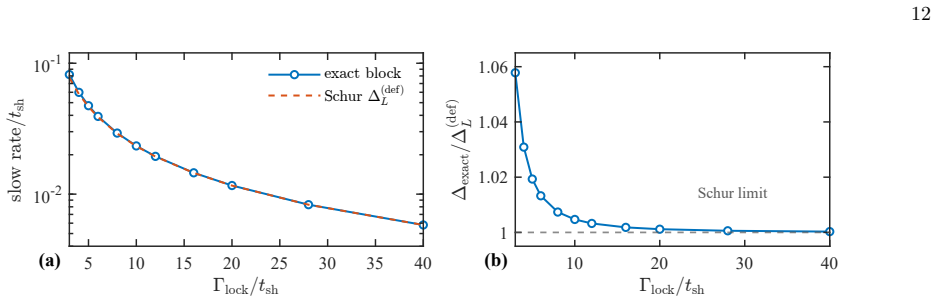
Number-conserving phase locking from a lossy conversion channel The phase-locking jump is more structured because it is number conserving inside the shell. We define bj = (pj +e iQpj+1)/ √ 2 anda j = (pj −e iQpj+1)/ √ 2 as the locked and mismatch shell combinations. The sim- plest microscopic route is then a lossy conversion from the mismatch shell combin...
- [3]
-
[4]
F. Verstraete, M. M. Wolf, and J. I. Cirac, Quantum computation and quantum-state engineering driven by dissipation, Nature Physics5, 633 (2009)
work page 2009
- [5]
-
[6]
A. J. Daley, Quantum trajectories and open many-body quantum systems, Advances in Physics63, 77 (2014)
work page 2014
-
[7]
J. C. Budich, P. Zoller, and S. Diehl, Dissipative prepa- ration of chern insulators, Physical Review A91, 042117 (2015)
work page 2015
- [8]
-
[9]
K. Macieszczak, M. Gut ¸˘ a, I. Lesanovsky, and J. P. Garra- han, Towards a theory of metastability in open quantum dynamics, Physical Review Letters116, 240404 (2016)
work page 2016
-
[10]
T. Mori and T. Shirai, Resolving a discrepancy be- tween liouvillian gap and exact relaxation time in open quantum systems, Physical Review Letters125, 230604 (2020)
work page 2020
-
[11]
P. A. Nosov, D. A. Abanin, and A. C. Potter, Hierarchy of relaxation times in open many-body systems, Physical Review B107, 174312 (2023)
work page 2023
- [12]
-
[13]
N. Lang and H. P. B¨ uchler, Topological states in a mi- croscopic model of interacting fermions, Physical Review B92, 041118(R) (2015)
work page 2015
-
[14]
M. Goldstein, Dissipation-induced topological insulators: A no-go theorem and a recipe, SciPost Physics7, 067 (2019)
work page 2019
-
[15]
A. Beck and M. Goldstein, Disorder in dissipation- induced topological states: Evidence for a different type of localization transition, Physical Review B103, L241401 (2021)
work page 2021
-
[16]
Z. Liu, E. J. Bergholtz, and J. C. Budich, Dissipative preparation of fractional chern insulators, Physical Re- view Research3, 043119 (2021)
work page 2021
-
[17]
S. Talkington and M. Claassen, Dissipation-induced flat bands, Physical Review B106, L161109 (2022)
work page 2022
- [18]
-
[19]
F. Yang, P. Molignini, and E. J. Bergholtz, Dissipative boundary state preparation, Physical Review Research 5, 043229 (2023)
work page 2023
-
[20]
F. Tonielli, J. C. Budich, A. Altland, and S. Diehl, Topo- logical field theory far from equilibrium, Physical Review Letters124, 240404 (2020)
work page 2020
-
[21]
H. Z. Shen, W. Wang, and X. X. Yi, Hall conductance and topological invariant for open systems, Scientific Re- ports4, 6455 (2014)
work page 2014
-
[22]
M. S. Rudner and L. S. Levitov, Topological transition in a non-hermitian quantum walk, Physical Review Letters 102, 065703 (2009)
work page 2009
-
[23]
T. E. Lee, Anomalous edge state in a non-hermitian lat- tice, Physical Review Letters116, 133903 (2016)
work page 2016
-
[24]
Z. Gong, Y. Ashida, K. Kawabata, K. Takasan, S. Hi- gashikawa, and M. Ueda, Topological phases of non- hermitian systems, Physical Review X8, 031079 (2018)
work page 2018
- [25]
-
[26]
F. K. Kunst, E. Edvardsson, J. C. Budich, and E. J. Bergholtz, Biorthogonal bulk-boundary correspondence in non-hermitian systems, Physical Review Letters121, 026808 (2018)
work page 2018
- [27]
-
[28]
G. Lindblad, On the generators of quantum dynamical semigroups, Communications in Mathematical Physics 48, 119 (1976)
work page 1976
-
[29]
N. Hatano and D. R. Nelson, Localization transitions in non-hermitian quantum mechanics, Physical Review Let- ters77, 570 (1996)
work page 1996
discussion (0)
Sign in with ORCID, Apple, or X to comment. Anyone can read and Pith papers without signing in.